Careers360 Logo
ask-icon
share

    JEE Main Exam 2026 - Session 2 City Slip, Date, Admit Card, Result, Cutoff, Toppers, Answer Key, Question Paper

    author
    Maniprabha SinghUpdated on Mar 10, 2026 11:28 AM

    About JEE Main 2026

    JEE Main 2026:  The National Testing Agency will release the JEE Main 2026 session 2 city intimation slip in the third week of March 2026. Candidates can access the JEE Main city intimation slip 2026 link on the official website, jeemain.nta.nic.in. To download the city intimation slip, candidates will need their application number and password. The authority will issue the JEE Main 2026 session 2 admit card in the last week of March 2026. The JEE Main session 2 2026 exam will be held from April 2 to 9, 2026. Candidates must check the JEE Main exam syllabus for the JEE session 2 preparation. The JEE Main 2026 toppers List for session 1 has been released along with the result. This year, the number of JEE Main exam centres has increased. NTA JEE Mains 2026 examination is an online entrance test to get admission in B.E./B.Tech/B.Arch/B.Plan courses. Below are the important highlights of the JEE Main 2026 examination. The National Testing Agency has uploaded the detailed JEE Main 2026 information bulletin online.

    JEE Main 2026 Exam: Key Points 

    SectionsDetails

    No. of sessions/attempts

    2

    Languages

    English, Hindi, Urdu, and 11 other regional languages

    JEE Main exam pattern for B.Tech

    • Section A: 20 (MCQs) for each subject
    • Section B: 5 (numerical questions) for each subject

    JEE Mains paper pattern for B. Arch / B Planning

    • Part-I: Mathematics- 20 MCQs + 5 (numerical questions)
    • Part-II: Aptitude Test-    50
    • Part-III: Planning-Based Objective Type MCQs -   25

    Tie Resolving Methodology for B.Tech

    For candidates obtaining equal NTA scores, the JEE Main 2026 tie-breaker policy is given below

    • NTA score in Mathematics
    • NTA score in Physics
    • NTA score in Chemistry

    Candidates having a lesser number of negative responses in the paper

    NTA JEE Main 2026 Forms

    • Candidates have to apply separately for both sessions in the JEE Main 2026 application form. 
    • Candidates can choose different exam centres for different sessions while filling out the JEE Main Application Form 2026

    Application fee refund

    In case a candidate does not want to appear in the session for which the fee has already been paid, it will be refunded

    JEE Main exam total marks300 - Paper 1
    400 - Paper 2

    JEE Main Exam timing

    • 9 am – 12 pm
    • 3 pm – 6 pm

    NTA JEE Main 2026 official website

    jeemain.nta.nic.in

    JEE Main exam centres 

    323 cities (including 15 cities abroa )

    What is the JEE Mains exam for?

    The full form of the JEE Main is the Joint Entrance Exam Main (JEE Main). The exam is a national-level entrance test conducted as a computer-based test for admission to B.E/B.Tech/B.Planning/B.Arch courses. The authorities conduct the JEE Main exam for 2 papers. Paper 1 is conducted for B.E./B. Tech course admission at NITs, IIITs, and GFTIs, while paper 2 is conducted for admission to B.Arch and B.Planning courses at various institutes accepting JEE Main exam scores for admission. The top 2,50,000 rank holders listed in the rank list of the JEE Main 2026 exam will be eligible to appear for the JEE Advanced exam.

    Browse Top Engineering Colleges Accepting JEE Main Score - Location Wise

    NTA JEE Main Help Line

    Address: Block C-20 1A/8, Sector- 62, IITK Outreach Centre, Gautam Buddh Nagar, Noida-201309, Uttar Pradesh (India)

    • Contact Number: +91-11-40759000/0120 6895200
    • E-Mail- jeemain@nta.nic.in
    • Website: jeemain.nta.nic.in 

    How many students took the JEE Main 2026 exam?

    National Testing Agency has released the JEE Main 2026 statistics on the official website. Candidates can check the JEE Main statistics to know how many students appeared for the JEE Main exam.

    How many students appeared for JEE Mains - Past Year Analysis 

    Year Students RegisteredStudents Appeared
    2026January - 13,55,293January - 13,04,653
    2025January - 13,11,544
    April - 10,61,840
    January -1311544
    April - 12,58,136

    20241231874
    B.E/B.Tech - 1221615
    B.Arch /B.Plan - 74002
    B.E/B.Tech - 1170036
    B.Arch / B.Plan - 55493

    2023

    January - 860064

    April - 931334

    January - 823967

    April - 883367

    2022

    June - 872970

    July - 622034

    June - 769604

    July - 540242

    2021

    February - 652628

    March - 619641

    July - 709611

    August - 767700

    February - 621033

    March - 556248

    July - 543553

    August - 481419

    2020

    8,58,000


    2019

    January - 9,29,198

    April - 9,35,755

    January - 8,74,469


    April - 8,81,096

    2018

    10,43,739


    2017

    1186454

    Online - 165635

    Offline - 956716

    2016

    12,07,257

    Online - 10,22,808

    Offline - 1,72,058

    2015

    13,04,646

    Online - 11,05,135

    Offline - 1,87,782

    2014

    13,56,805

    Online - 11,72,538

    Offline - 1,72,369

    2013

    12,60,219

    11,89,777

    2012

    11,45,353

    10,70,276

    2011

    11,14,880

    10,53,833

    2010

    11,18,147

    10,65,100

    2009

    10,10,061

    9,62,119

    Read More
    JEE Main Exam 2026 - Session 2 City Slip, Date, Admit Card, Result, Cutoff, Toppers, Answer Key, Question Paper
    JEE Main Exam 2026 - Session 2 City Slip, Date, Admit Card, Result, Cutoff, Toppers, Answer Key, Question Paper

    JEE Main 2026 Highlights

    Full Exam Name
    Joint Entrance Examination (Main)
    Short Exam Name
    JEE Main
    Conducting Body
    National Testing Agency
    Frequency Of Conduct
    Twice a year
    Exam Level
    National Level Exam
    Languages
    Assamese +12 more
    Mode Of Application
    online
    Application Fee
    Online : 1000
    Mode Of Exam
    online
    Mode Of Counselling
    online
    Participating Colleges
    1774
    Exam Duration
    3 Hours

    JEE Main Paper 1

    JEE Main Paper 2

    JEE Main Important Dates

    JEE Main Joint Entrance Examination (Main) (session 2026)

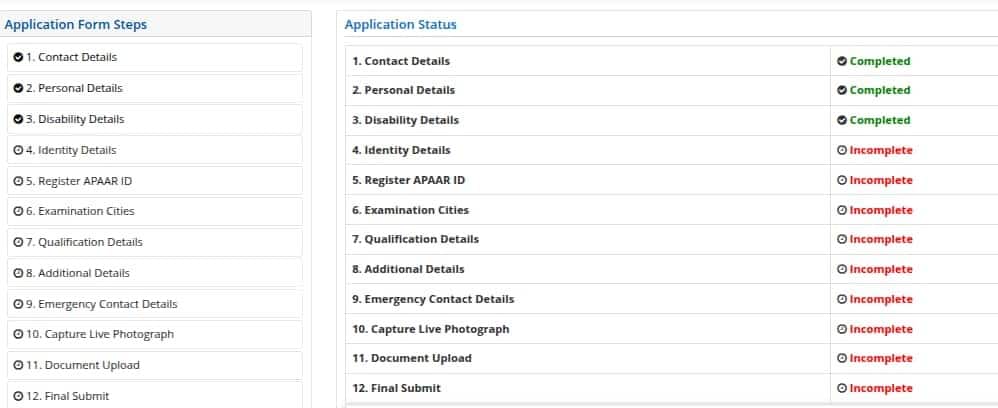
    NTA conducted the JEE Main 2026 form correction on February 27 & 28, 2026. The JEE Main 2026 application form for session 2 was concluded on February 25, 2026. Eligible candidates were able to fill the JEE Main exam registration form at jeemain.nta.nic.in. The authority had revised the JEE Main registration steps. As per the latest registration process, applicants had to fill out three new sections added for APAAR ID, disability details, and live photo capture for JEE Main registration 2026. Find below the steps for JEE Main registration. 

    Steps involved in filling the JEE Main exam form 2026 

    • JEE Mains Registration 2026.
    • Fill out the JEE Main exam form.
    • Uploading a photograph, signature, and other required certificates. The authority has introduced three new sections in the JEE Main application form, namely, Disability details, Identity details and Live photo capture.
    • Pay the JEE Mains 2026 registration fee.
    • Print the JEE Main Exam Confirmation Page.

    How to fill the JEE Main Application Form 2026?

    Below are the steps to fill out the JEE Main 2026 application form.

    Step 1- JEE Mains 2026 Registration

    It is the first step in filling out the JEE Mains application form. Read the steps below to fill out the JEE Main 2026 application form:

    • Click on the jeemain.nta.nic.in 2026, the registration link

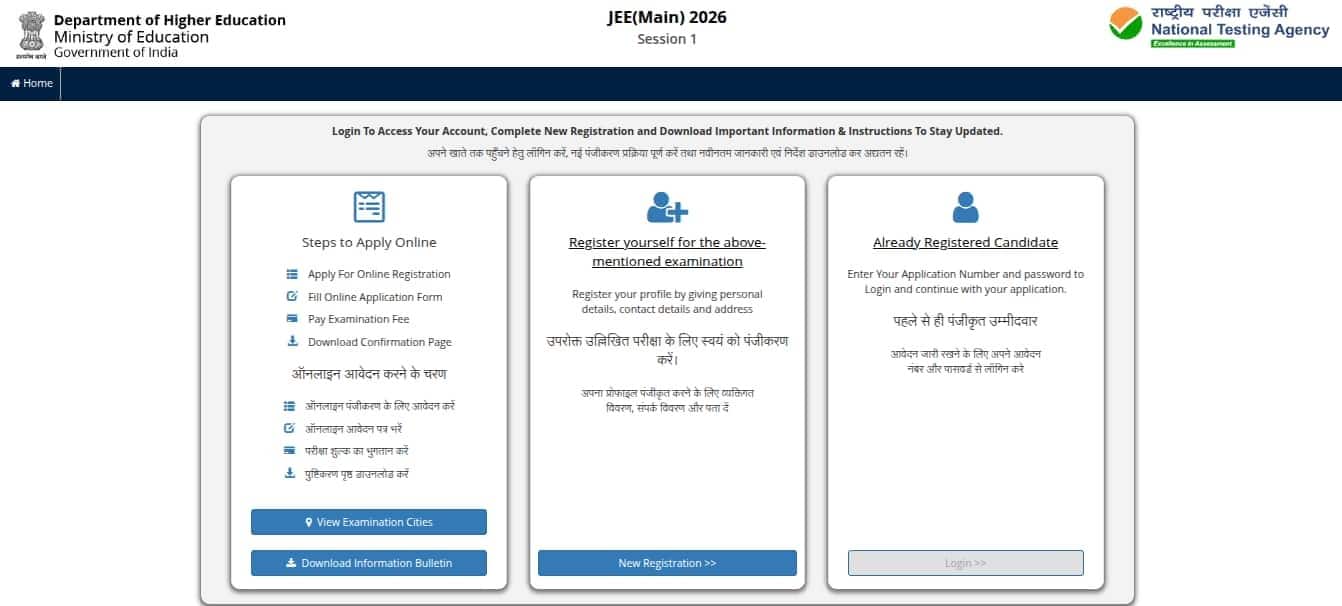
    • Click on the JEE Main 2026 session 1 registration link

    Jee_mains_registration_link

    • The JEE login page will appear

    • There are three simple steps to apply online: registration, filling out the online application form, and submitting the document.

    • Click on the ‘New Registration’ button, provided in the middle section.

    • Instructions and Procedure for online submission of the application form page will be displayed.

    • Go through the complete instructions carefully and then select the declaration

    • Click on the “click here to proceed” button

    JEE Main_Password_instruction

    • The JEE Main 2026 registration form will appear.

    • Provide personal details, present and permanent address

    • Choose a password, and enter the security pin

    • Finally, click on the submit button

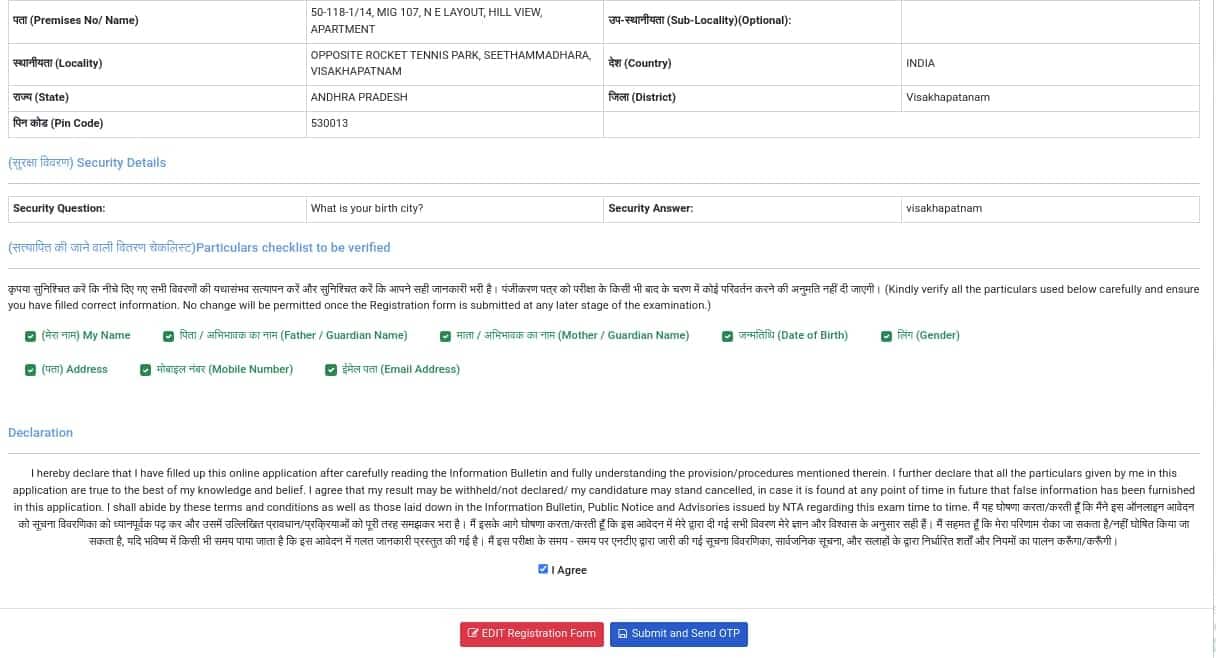
    • A preview of the JEE 2026 registration form will appear

    JEE_Main_form

    • Candidates have to verify the checklist and confirm the declaration

    • Hereafter, click on the submit and send OTP button

    • Verify the registered mobile number and email ID

    Step 2- Filling of NTA JEE Main Application Form 2026

    After the completion of JEE Main 2026 registration, students can continue filling out the detailed application form. For login, candidates have to use the registration number and password they have received at their email address/mobile number.

    At this stage of the JEE Main application form, candidates have to provide information related to the country of residence, state of residence, category, the medium of education in classes 11 and 12, information on the diabetic condition, and language choice for the JEE Main question paper. Students also have to enter details about the paper for which they are appearing, Paper 1 or Paper 2 or both, and a choice of four JEE Main 2026 exam centres. At last, students will have to enter details about the marks in classes 10 and 12. Students who will be appearing in their class 12 exam in 2026 have to enter only class 10 details. After providing all the details, click on the submit button to proceed to the Live Photo Capture Section.

    Jee mains registration

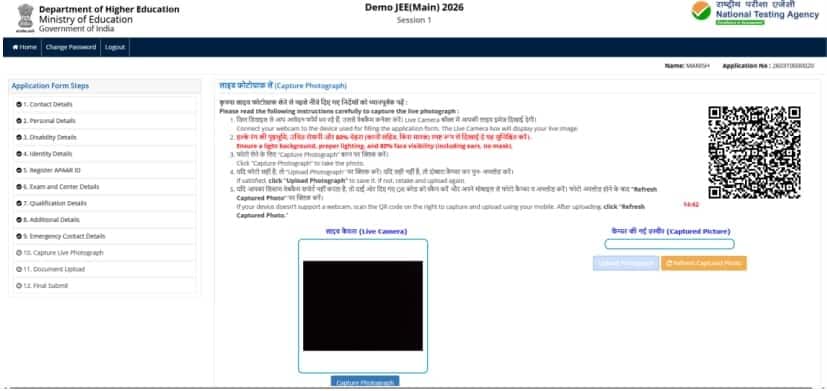
    Step 3- Capturing a live photograph for JEE Mains registration

    Candiates need to click a live photo after filling all the previous sections. This is a mandatory section, in which aspirants can use an in-built camera or an external device like a mobile phone to click their real-time picture.

    jee main application form


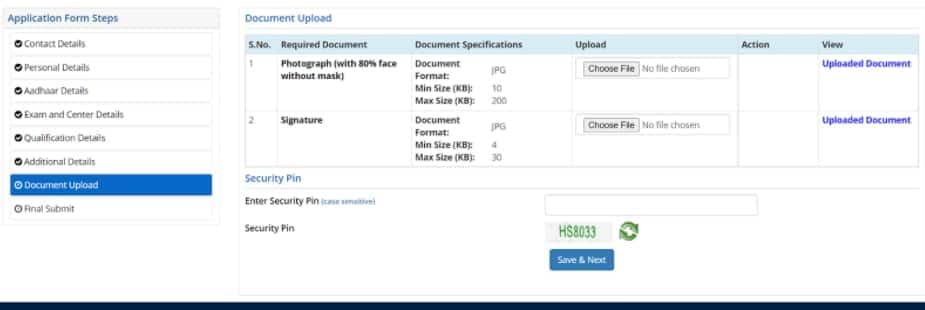
    Step 4-Uploading Scanned Images in JEE Main Application Form 2026

    Candidates have to upload the scanned image of their passport-size coloured photograph and signature in the JEE Main 2026 application form. The size and file format of images should be strictly adhered to as per the NTA JEE Main photo and signature guidelines.

    JEE_Main_documents_to_upload

    Step 5- JEE 2026 Fee Payment

    After completing the registration form, filling out the form, and uploading images, applicants will be redirected to the payment page. The payable fee will be displayed as per the gender and category of candidates. NTA JEE Mains 2026 registration fee has to be paid online through credit/debit card or net banking. Students will be required to enter details of the payment mode to complete the payment. A message of successful payment of JEE Main application form 2026 fees will be sent to their mobile numbers. 

    NTA JEE Mains 2026 Registration Fees (For Indian Exam Centres)

    Category

    BE./BTech or BArch or B.Planning

    BE./BTech & BArch or BE./BTech & BPlanning or BE./BTech, BArch & BPlanning or BArch & BPlanning

    General

    For Males- Rs 1000

    For Females- Rs 800

    For Males- Rs 2000

    For Females-Rs 1600

    EWS/OBC-NCL

    For Males- Rs 900

    For Females- Rs 800

    For Males- Rs 2000
    For Females-Rs 1600

    SC/ST/PWD/Transgender

    For All- Rs 500

    For All- Rs 1000

    NTA JEE Mains Registration Fees 2026 (For Abroad Exam Centres)

    Category

    B.E./B.Tech or B.Arch or B.Planning

    B.E./BTech & BArch or BE./BTech & BPlanning or BE./B.Tech, BArch & B. Planning or BArch & BPlanning

    General

    For Males- Rs 5000

    For Females- Rs 4000

    For Males- Rs 10000 For Females- Rs 8000

    EWS/OBC-NCL

    For Males - Rs. 4500 For Females- Rs. 4000

    For All- Rs 5000

    SC/ST/PWD/Transgender

    M / F- Rs 2500 Trasgender - Rs. 3000

    For All- Rs 5000

    JEE Main 2026: NTA Addresses Aadhaar Name Mismatch for JEE Mains Applications

    If candidates encounter a name-mismatch message during Aadhaar authentication, they will be provided an option to correct the error. Such a provision was provided in the previous year as well.

    JEE Main Correction Window 2026

    The National Testing Agency conducted session 2 JEE Main 2026 application form correction from February 27 to 28, 2026, on the official website. The JEE Main form correction was available online. Students who entered any incorrect information in their application form or candidates with defects in uploaded images can make edits till the last date. Applicants require their log-in to access the JEE application form 2026 correction facility. Candidates need to pay an additional fee for modifying the details, while some details will be allowed for modification without any cost. Information that can be modified is as follows

    • Personal Details: Spelling mistakes in name, parent's name, etc can be corrected.

    • Academic Details: School details, year of passing, and qualifying exam can be corrected in this section.

    • Change of Paper: The choice of paper from Paper 1 to Paper 2 as well as from Paper 2 to Paper 1. If candidates have applied for one paper and wish to apply for both papers they can do so on payment of the balance fee.

    • Exam Centres: Candidates will not be able to change their choice of exam centres.

    • Language of Examination: The language can be changed from English to Hindi/Gujarati and vice versa.

    • Name, State of Eligibility, and Date of Birth can also be corrected by candidates

    • Category: Candidates can also change their category. If the candidates change their category from general to reserved, then fees will not be refunded. If candidates change their category from reserved to general, they will have to pay the balance fee.

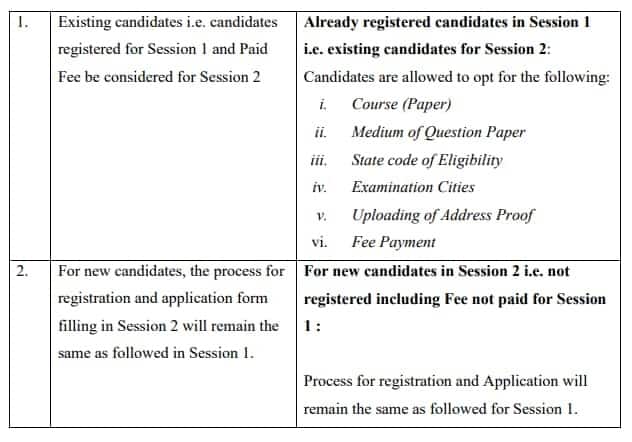
    JEE Main 2026 Application Form: Details required during session 1 NTA JEE Main registration 2026

    jee-main-application-form

    What to do after filling the JEE Main Application Form 2026?

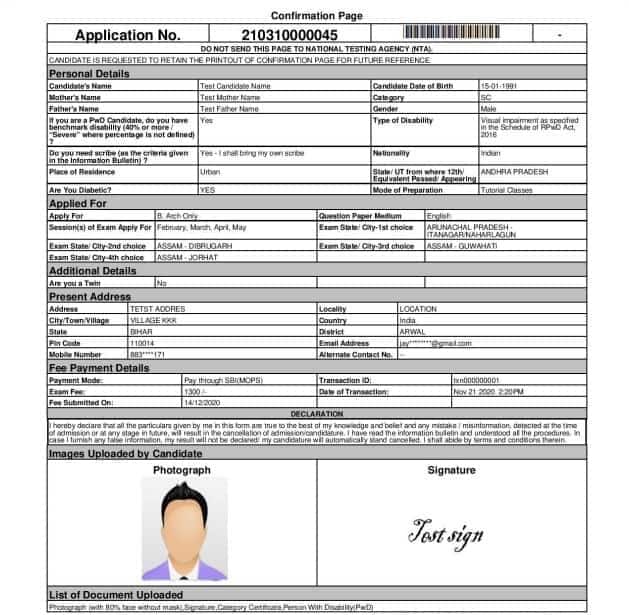
    After submitting the registration form for JEE Main 2026, candidates have to download a copy of the application form for future use. Candidates will not be able to change their allotted JEE Main 2026 exam centre. Candidates whose application form for JEE Main 2026 is submitted correctly can download the admit card at the official website- jeemain.nta.nic.in.

    JEE_Main_Confirmation_Page

    How to retrieve the NTA JEE Main 2026 application number?

    To retrieve the NTA JEE Main 2026 application number, candidates must click on the option for the same on the login window. They must enter the following details

    • Application Form    
    • Candidate Name
    • Father Name
    • Mother Name
    • Date of Birth
    • Security Pin (Case Sensitive)

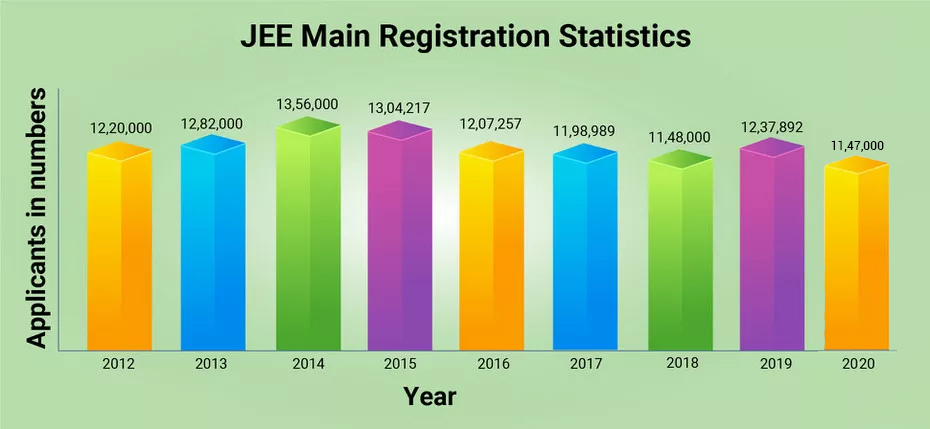
    JEE Main Statistics of previous years

    JEE_Main_registration_stats


    JEE Main 2026 College Predictor

    Discover your college admission chances with the JEE Main 2026 College Predictor. Explore NITs, IIITs, CFTIs and other institutes based on your percentile, rank, and details.

    Try Now

    National Testing Agency has released the JEE Main 2026 exam eligibility along with the official notification. Candidates who qualify the class 10+2 exam from a recognized board can apply for the JEE Mains 2026 exam. Moreover, it is informed that JEE Main eligibility marks in 12th are not required for appearing in JEE Mains exam 2026. The 75% mark is required while taking admission to the participating institutes. For SC / ST candidates, the qualifying marks should be 65%.

    NTA JEE Main 2026 eligibility criteria consist of age limit, compulsory academic details, mandatory subject in class 12, minimum percentage, and more. Candidates appearing in class 12 with results awaiting are also eligible to apply. Besides, candidates must be among the top 2,50,000 in NTA JEE Main Paper-1 to be eligible for JEE Advanced 2026.
    Also check: Eligibility for JEE Advanced

    JEE Main Eligibility Criteria 2026

    Particulars Details

    Age limit to appear for JEE Main 2026

    No age limit prescribed

    Qualifying Examination

    Candidates must have cleared class 12 or equivalent exams in 2024, 2025 or appearing in 2026 are also eligible. 

    Required subject in class 12 

    A minimum of 5 subjects, with Mathematics, Physics and Chemistry as mandatory subjects. Along with a language, one vocational subject shall have been studied.

    Minimum percentage required in class 12 

    Candidates should have secured at least 75% in the class 12 for admission. For BArch admissions, at least 50% marks should have been secured.

    Maximum attempts 

    A candidate can attempt JEE Main two times a year for three years consecutively. Hence, a candidate can appear for the JEE Main exam in 6 attempts.

    NTA JEE Mains Eligibility 2026 Paper-wise 

    CourseRequired Criteria

    B.E/B.Tech.

    Passed 10+2 exam with Physics and Mathematics as compulsory subjects along with one of the Chemistry/Biotechnology/Biology/Technical Vocational subjects.

    Candidates must have a required percentage of 75% marks in board exams. For SC/ST, the required percentage is 65%.

    B.Arch

    Passed 10+2 exam with Mathematics, Physics, Chemistry or 10+3 Diploma with Maths.

    Candidates must have a required percentage of 50% marks.

    B.Planning

    Passed 10+2 exam with Mathematics

    NTA JEE Main 2026 Reservation Criteria

    CategoryReservation

    Other Backward Classes (OBC) if they belong to Non-Creamy Layer (NCL)

    27%

    Scheduled Castes (SC)

    15%

    Scheduled Tribes (ST)

    7.5%

    Persons with Disability (PwD) with 40% or more disability

    3% horizontal

    Female Category (supernumerary) only in NITs

    8 to 14 %

    EWS (Supernumerary)

    10%

    Note: Reservation for the NITs, IIITs, and GFTIs will be as per the central list and not as per the state of eligibility.

    Background wave

    Documents Required at Exam JEE Main 2026

    Joint Entrance Examination (Main) 2026

    JEE Main admit card
    A valid photo ID (passport, college/school ID card, driving license)
    One passport size photograph
    PwD category candidates will have to carry a copy of the PwD certificate in the prescribed format.

    JEE Main 2026 Exam Centers

    StateCity
    Andaman and Nicobar Islands
    Port Blair
    Andhra Pradesh
    Chittoor
    Eluru
    Guntur
    Kurnool
    Kakinada
    Nellore
    Rajahmundry
    Tirupati
    Vijayawada
    Visakhapatnam
    Vizianagaram
    Ongole
    Srikakulam
    Proddatur
    Kadapa
    Anantapur
    Bhimavaram
    Narasaraopet
    Surampalem
    Machilipatnam
    Tadepalligudem
    Assam
    Dibrugarh
    Guwahati
    Jorhat
    Silchar
    Tezpur
    Bihar
    Bhagalpur
    Gaya
    Muzaffarpur
    Patna
    Purnea
    Darbhanga
    Arrah
    Aurangabad
    Samastipur
    Rohtas
    Bihar Sharif
    Chhattisgarh
    Bilaspur
    Raipur
    Bhilai Nagar
    Ambikapur
    Jagdalpur
    Durg
    Delhi
    Delhi
    New Delhi
    Goa
    Panaji
    Mapusa
    Gujarat
    Ahmedabad
    Anand
    Jamnagar
    Rajkot
    Surat
    Vadodara
    Valsad
    Himatnagar
    Gandhinagar
    Mehsana
    Vapi
    Junagadh
    Bhuj
    Haryana
    Ambala
    Faridabad
    Hisar
    Gurugram
    Himachal Pradesh
    Shimla
    Hamirpur
    Mandi
    Una
    Kullu
    Bilaspur
    Kangra
    Jammu and Kashmir
    Jammu
    Srinagar
    Samba
    Pulwama
    Jharkhand
    Dhanbad
    Jamshedpur
    Ranchi
    Hazaribagh
    Bokaro
    Ramgarh
    Karnataka
    Ballari
    Hassan
    Udupi
    Bangalore
    Gulbarga
    Hubballi
    Mangaluru
    Mysore
    Shivamogga
    Davanagere
    Belagavi
    Chikkamagaluru
    Tumakuru
    Dharwad
    Kerala
    Alappuzha
    Ernakulam
    Kannur
    Kollam
    Kottayam
    Kozhikode
    Malappuram
    Palakkad
    Thiruvananthapuram
    Thrissur
    Idukki
    Kasaragod
    Pathanamthitta
    Chengannur
    Muvattupuzha
    Wayanad
    Payyanur
    Madhya Pradesh
    Bhopal
    Gwalior
    Indore
    Jabalpur
    Sagar
    Satna
    Ujjain
    Balaghat
    Khandwa
    Maharashtra
    Ahmednagar
    Akola
    Aurangabad
    Jalgaon
    Kolhapur
    Mumbai
    Nagpur
    Nanded
    Nashik
    Pune
    Solapur
    Thane
    Chandrapur
    Dhule
    Latur
    Ratnagiri
    Sangli
    Satara
    Wardha
    Beed
    Bhandara
    Buldhana
    Yavatmal
    Parbhani
    Gadchiroli
    Jalna
    Navi Mumbai
    Manipur
    Imphal
    Meghalaya
    Shillong
    Tura
    Mizoram
    Aizawl
    Nagaland
    Dimapur
    Kohima
    Odisha
    Balasore
    Berhampur
    Bhubaneswar
    Cuttack
    Rourkela
    Sambalpur
    Dhenkanal
    Angul
    Bhadrak
    Mayurbhanj
    Baripada
    Jajpur
    Kendrapara
    Kendujhar
    Puri
    Jagatsinghpur
    Jeypore
    Balangir
    Rayagada
    Bargarh
    Ganjam
    Puducherry
    Puducherry
    Punjab
    Amritsar
    Jalandhar
    Ludhiana
    Patiala
    Pathankot
    Bathinda
    Fatehgarh Sahib
    Phagwara
    Rajasthan
    Ajmer
    Alwar
    Bikaner
    Jaipur
    Jodhpur
    Kota
    Sikar
    Udaipur
    Sri Ganganagar
    Dausa
    Hanumangarh
    Bharatpur
    Bhilwara
    Sikkim
    Gangtok
    Tamil Nadu
    Chennai
    Coimbatore
    Kanyakumari
    Madurai
    Namakkal
    Salem
    Tiruchirappalli
    Tirunelveli
    Cuddalore
    Thanjavur
    Thoothukudi
    Vellore
    Virudhunagar
    Nagercoil
    Kanchipuram
    Viluppuram
    Krishnagiri
    Tiruppur
    Dharmapuri
    Dindigul
    Erode
    Karur
    Nagapattinam
    Pudukottai
    Ramanathapuram
    Sivaganga
    Tiruvannamalai
    Telangana
    Hyderabad
    Karimnagar
    Khammam
    Mahabubnagar
    Nalgonda
    Nizamabad
    Suryapet
    Siddipet
    Kothagudem
    Jagtial
    Warangal
    Tripura
    Agartala
    Uttar Pradesh
    Agra
    Aligarh
    Allahabad
    Bareilly
    Ghaziabad
    Gorakhpur
    Greater Noida
    Noida
    Jhansi
    Kanpur
    Lucknow
    Meerut
    Mathura
    Moradabad
    Muzaffarnagar
    Varanasi
    Ayodhya
    Sitapur
    Ambedkar Nagar
    Azamgarh
    Ballia
    Bulandshahr
    Chandauli
    Firozabad
    Ghazipur
    Mau
    Raebareli
    Saharanpur
    Pratapgarh
    Uttarakhand
    Dehradun
    Roorkee
    Almora
    Pauri Garhwal
    Haldwani
    West Bengal
    Asansol
    Durgapur
    Hooghly
    Howrah
    Kalyani
    Kolkata
    Siliguri
    Burdwan
    Bankura
    Suri
    Paschim Medinipur
    Purba Medinipur
    Murshidabad
    Baharampur
    Lakshadweep
    Kavaratti
    Ladakh
    Leh
    Kargil
    Dadra and Nagar Haveli
    Silvassa
    Chandigarh
    Chandigarh
    Sahibzada Ajit Singh Nagar
    Arunachal Pradesh
    Naharlagun
    Daman and Diu
    Diu
    Amity University-Noida B.Tech Admissions 2026

    Among top 100 Universities Globally in the Times Higher Education (THE) Interdisciplinary Science Rankings 2026

    UPES B.Tech Admissions 2026

    Last Date to Apply: 26th March | Ranked #43 among Engineering colleges in India by NIRF | Highest Package 1.3 CR , 100% Placements

    Paper 1

    NTA will release the JEE Main 2026 exam pattern on the official website. The authority has removed the option of selecting 5 out of 10 questions in paper 1, in 2025. The JEE Main paper pattern 2026 states that there will be 5 compulsory numerical questions in section B of paper 1. Aspirants appearing for JEE Main Paper 1 must be conversant with the exam pattern. Students can know what to expect in the exam in terms of types of questions, marking scheme, language, mode, and more. Candidates can check the exam pattern of JEE Main 2026 Paper 1 below.

    JEE Main Exam Pattern 2026: Paper 1 (B.E/B.Tech)

    Particulars

    Details

    Exam Mode

    Computer-based examination

    Test Duration

    Three hours

    Language of Examination

    English, Hindi, Assamese, Bengali, Gujarati, Kannada, Marathi, Malayalam, Odia, Punjabi, Tamil, Telugu, and Urdu.

    Type of Questions

    • Multiple choice questions (MCQs)

    • Questions with numerical values as answers

    No. of Sections

    Three are three sections:

    • Mathematics

    • Physics

    • Chemistry

    JEE Mains Total questions

    Mathematics: 25 (20+5) 5 Questions with answers as a numerical value. All 5 questions are compulsory.


    Physics: 25 (20+5) 5 Questions with answers as a numerical value. All 5 questions are compulsory.


    Chemistry: 25 (20+5) 5 Questions with answers as a numerical value. All 5 questions are compulsory.


    Total: 75 Questions (25 questions each)

    JEE Mains total marks

    300 Marks (100 marks for each section)

    JEE Main Marking Scheme

    MCQs: Four marks will be awarded for each correct answer and there will be a negative marking of one mark on each wrong answer.

    Questions with numerical value answers: Candidates will be given four marks for each correct answer and there will be a negative marking of 1 mark for each wrong answer.

    Paper 2

    NTA has announced significant JEE Main exam pattern changes for the year 2025. The authority has discontinued optional questions in Section B, which were previously introduced during the COVID-19 pandemic. Candidates will now be required to answer all 5 questions in this section, eliminating the choice of selecting questions. B.Arch or B.Plan aspirants appearing for JEE Main Paper 2 must be conversant with the exam pattern. 

    With the help of JEE Main exam pattern 2025 for paper 2 , candidates can know details on types of questions, marking scheme, language, mode, and more. Paper 2 of JEE Main is separate for B.Arch and B.Plan applicants. While both have aptitude and mathematics in common, B.Arch students must take up the drawing test while the B.Plan applicants must answer JEE Main 2025 questions on planning.  Candidates can check the exam pattern of JEE Main 2025 below.

    JEE Main Exam Pattern (Paper 2) - B.Arch

    Exam modeComputer-based
    Exam duration3 hours
    Languages/ MediumCandidates can answer JEE main 2024 questions in 13 languages. The details and guidelines for languages are the same as for Paper 1.
    Duration3 hours
    JEE main 2024 Number of shiftsTwo shifts per day:
    (9:00 am to 12:00 pm and 3:00 pm to 6:00 pm)
    Type of Questions in JEE Main 2024For Maths and Aptitude -Multiple choice questions (MCQs) and Numerical Questions (NQs)
    Drawing - questions requiring drawing
    JEE Main Question Paper detailsSubject No of Questions Marks
    Part 1 - Mathematics 20 MCQs + 5 Numerical (all 5 are compulsory)100
    Part 2 - Aptitude50 MCQs200
    Part 3 - Drawing2100
    Total77400
    Marking Scheme for MCQs Mathematics-Part I
    Aptitude Test-Part II
    Correct Answer  Four marks (+4) 
    Incorrect Answer/Multiple AnswerMinus one mark (-1). No negative marks for NQs
    Unanswered  No mark (0)
    Drawing Test – Part IIITwo questions to be evaluated out of 100 marks
    Difficulty levels of questionsMaths and Aptitude - Class 11 and Class 12  standard

    JEE Main Exam Pattern (Paper 2B) - B.Plan

    Parameters

    Particulars

    Exam Mode

    Computer-based test (CBT)

    Exam Duration 

    3 hours (3.00 pm to 6.00 pm)

    Subjects

    Mathematics, General Aptitude, and Planning

    Total number and type of questions

    Maths - 20 MCQ questions and 5 numerical questions (all 5 questions are compulsory)

    Aptitude - 50 MCQs 

    Planning - 25 questions.

    Total Questions - 100

    Marking Scheme

    4 marks for a correct answer

    -1 for an incorrect answer. No negative marks for numerical questions

    Maximum Marks

    400


    Recommended Exams

    Other Engineering Exams

    Birla Institute of Technology and Science Admission Test
    Institute of Eminence (IOE) by Govt. of India | Merit Based Scholarships | Ranked #11 by NIRF | Last Date to Apply: 16th Mar'26
    Jain Entrance Test
    98% Placement Record | Highest CTC 81.25 LPA | NAAC A++ Accredited | Ranked #62 in India by NIRF Ranking 2025 | JEE & JET Scores Accepted
    Manav Rachna National Aptitude Test
    NAAC A++ Grade | Recognized as Category-1 Deemed to be University by UGC | 41,000 + Alumni Imprints Globally

    JEE Main 2026 Syllabus

    JEE Main Paper 1 Syllabus

    Mathematics: Unit 01


    Sets, relations, and functions
    • Sets and their representation; union, intersection and complement of sets and their algebraic properties; power set; relations, type of relations, equivalence relations, functions; one-one, into and onto functions, the composition of functions

    Mathematics: Unit 02


    Complex numbers and quadratic equations
    • Complex numbers as ordered pairs of reals, representation of complex numbers in the form a + ib and their representation in a plane, Argand diagram, algebra of complex numbers, modulus and argument (or amplitude) of a complex number
    • Quadratic equations in real and complex number systems and their solutions; relations between roots and coefficients, nature of roots, the formation of quadratic equations with given roots

    Mathematics: Unit 03


    Matrices and determinants
    • Matrices, algebra of matrices, type of matrices, determinants and matrices of order two and three, evaluation of determinants, area of triangles using determinants; adjoint and inverse of a square matrix
    • Test of consistency and solution of simultaneous linear equations in two or three variables using matrices

    Mathematics: Unit 04


    Permutations and combinations
    • The fundamental principle of counting, permutations and combinations; meaning of p(n, r) and c(n, r)
    • Simple applications

    Mathematics: Unit 05


    Binomial theorem and its simple applications
    • Binomial theorem for a positive integral index, general term and middle term and simple applications

    Mathematics: Unit 06


    Sequence and series
    • Arithmetic and geometric progressions, insertion of arithmetic, geometric means between two given numbers, relation between A.M and G.M.

    Mathematics: Unit 07


    Limit, continuity, and differentiability
    • Real-valued functions, algebra of functions; polynomial, rational, trigonometric, logarithmic and exponential functions; inverse functions. graphs of simple functions
    • Limits, continuity and differentiability
    • Differentiation of the sum, difference, product and quotient of two functions
    • Differentiation of trigonometric, inverse trigonometric, logarithmic, exponential, composite and implicit functions; derivatives of order upto two, applications of derivatives: Rate of change of quantities, monotonic-increasing and decreasing functions
    • Applications of derivatives: Maxima and minima of functions of one variable

    Mathematics: Unit 08


    Integral calculus
    • Integral as an antiderivative, fundamental integrals involving algebraic, trigonometric, exponential and logarithmic functions
    • Integration by substitution, by parts and by partial fractions
    • Integration using trigonometric identities
    • Evaluation of simple integrals of the type: ∫dx/ x² + a², ∫dx/ √x² ± a², ∫dx/ √a² - x², ∫dx/ √a² - x², ∫dx/ ax² + bx + c, ∫dx/√ax² ± bx + c, ∫(px + q) dx/ ax² + bx + c, ∫(px + q) dx/ √ax² + bx + c, ∫√a² + x² dx, ∫√x² - a² dx
    • The fundamental theorem of calculus, properties of definite integrals. evaluation of definite integrals, determining areas of the regions bounded by simple curves by simple curves in standard forms

    Mathematics: Unit 09


    Differential equations
    • Ordinary differential equations, their order and degree, the solution of differential equation by the method of separation of variables, solution of a homogeneous and linear differential equation of the type: dy/ dx + p(x)y = q(x)

    Mathematics: Unit 10


    Coordinate geometry
    • Cartesian system of rectangular coordinates in a plane, distance formula, sections formula, locus and its equation, the slope of a line, parallel and perpendicular lines, intercepts of a line on the coordinate axis.
    • Straight line: Various forms of equations of a line, intersection of lines, angles between two lines, conditions for concurrence of three lines, the distance of a point form a line, coordinate of the centroid, orthocentre and circumcentre of a triangle
    • Circle, conic sections: A standard form of equations of a circle, the general form of the equation of a circle, its radius and centre, equation of a circle when the endpoints of a diameter are given
    • Circle, conic sections: Points of intersection of a line and a circle with the centre at the origin and sections of conics, equations of conic sections (parabola, ellipse and hyperbola) in standard forms

    Mathematics: Unit 11


    Three dimensional geometry
    • Coordinates of a point in space, the distance between two points, section formula, direction ratios and direction cosines and the angle between two intersecting lines
    • Equation of a line; skew lines, the shortest distance between them and its equation

    Mathematics: Unit 12


    Vector algebra
    • Vectors and scalars, the addition of vectors, components of a vector in two dimensions and three-dimensional spaces, scalar and vector products

    Mathematics: Unit 13


    Statistics and probability
    • Measures of dispersion; calculation of mean, median, mode of grouped and ungrouped data, calculation of standard deviation, variance and mean deviation for grouped and ungrouped data
    • Probability: Probability of an event, addition and multiplication theorems of probability, Bayes theorem, probability distribution of a random variable

    Mathematics: Unit 14


    Trigonometry
    • Trigonometric identities and trigonometric functions, inverse trigonometric functions their properties

    Physics: Unit 01


    Physics and measurement
    • Units of measurements, system of units, SI units, fundamental and derived units, least count, significant figures, errors in measurements
    • Dimensions of physics quantities, dimensional analysis and its applications

    Physics: Unit 02


    Kinematics
    • The frame of reference, motion in a straight line, speed and velocity, uniform and non-uniform motion, average speed and instantaneous velocity, uniformly accelerated motion, velocity-time, position-time graph, relations for uniformly accelerated motion
    • Relative velocity
    • Motion in a plane, projectile motion, uniform circular motion

    Physics: Unit 03


    Laws of motion
    • Force and inertia, Newton’s first law of motion, momentum, Newton’s second law of motion, impulse, Newton’s third law of motion
    • Law of conservation of linear momentum and its applications, equilibrium of concurrent forces
    • Static and kinetic friction, laws of friction, rolling friction
    • Dynamics of uniform circular motion, centripetal force and its applications: Vehicle on a level circular road, vehicle on a banked road

    Physics: Unit 04


    Work, energy, and power
    • Work done by a constant force and a variable force, kinetic and potential energies, work-energy theorem, power
    • Thee potential energy of a spring, conservation of mechanical energy, conservative and non- conservative forces, motion in a vertical circle
    • Elastic and inelastic collisions in one and two dimensions

    Physics: Unit 05


    Rotational motion
    • Centre of mass of a two-particle system, centre of mass of a rigid body
    • Basic concepts of rotational motion, moment of a force, torque, angular momentum, conservation of angular momentum and its applications
    • The moment of inertia, the radius of gyration, values of moments of inertia for simple geometrical objects, parallel and perpendicular axes theorems and their applications
    • Equilibrium of rigid bodies, rigid body rotation and equations of rotational motion, comparison of linear and rotational motions

    Physics: Unit 06


    Gravitation
    • The universal law of gravitation
    • Acceleration due to gravity and its variation with altitude and depth
    • Kepler’s law of planetary motion. gravitational potential energy, gravitational potential
    • Escape velocity, motion of a satellite, orbital velocity, time period and energy of satellite

    Physics: Unit 07


    Properties of solids and liquids
    • Elastic behaviour, stress-strain relationship, Hooke's Law, Young's modulus, bulk modulus and modulus of rigidity
    • Pressure due to a fluid column, Pascal's law and its applications, effect of gravity on fluid pressure, viscosity, Stoke’s law, terminal velocity, streamline and turbulent flow, critical velocity, Bernoulli's principle and its applications
    • Surface energy and surface tension, angle of contact, excess of pressure across a curved surface, application of surface tension: Drops, bubbles and capillary rise
    • Heat, temperature, thermal expansion, specific heat capacity, calorimetry, change of state, latent heat
    • Heat transfer: Conduction, convection and radiation

    Physics: Unit 08


    Thermodynamics
    • Thermal equilibrium and the concept of temperature, zeroth law of thermodynamics, heat, work and internal energy
    • The first law of thermodynamics, isothermal and adiabatic processes
    • The second law of thermodynamics: Reversible and irreversible processes

    Physics: Unit 09


    Kinetic theory of gases
    • Equation of state of a perfect gas, work done on compressing a gas, kinetic theory of gases: Assumptions, the concept of pressure, kinetic interpretation of temperature, RMS speed of gas molecules, degrees of freedom
    • Law of equipartition of energy and applications to specific heat capacities of gases, mean free path, Avogadro's number

    Physics: Unit 10


    Oscillations and waves
    • Oscillations and periodic motion: Time period, frequency, displacement as a function of time, periodic functions. Simple harmonic motion (S.H.M.) and its equation, phase, oscillations of a spring: Restoring force and force constant, energy in S.H.M.
    • Oscillations and periodic motion: Oscillations of a spring-kinetic and potential energies, simple pendulum: Derivation of expression for its time period.
    • Wave motion, longitudinal and transverse waves, speed of the travelling wave, displacement relation for a progressive wave, principle of superposition of waves, reflection of waves, standing waves in strings and organ pipes
    • Fundamental mode and harmonics, beats

    Physics: Unit 11


    Electrostatics
    • Electric charges: Conservation of charge, Coulomb's law forces between two point charges, forces between multiple charges, superposition principle and continuous charge distribution
    • Electric field: Electric field due to a point charge, electric field lines, electric dipole, electric field due to a dipole, torque on a dipole in a uniform electric field.
    • Electric flux, Gauss's law and its applications to find field due to infinitely long uniformly charged straight wire, uniformly charged infinite plane sheet and uniformly charged thin spherical shell
    • Electric potential and its calculation for a point charge, electric dipole and system of charges, potential difference, equipotential surfaces, electrical potential energy of a system of two point charges and of electric dipole in an electrostatic field
    • Conductors and insulators, dielectrics and electric polarization, capacitors and capacitance, the combination of capacitors in series and parallel and capacitance of a parallel plate capacitor with and without dielectric medium between the plates
    • Energy stored in a capacitor

    Physics: Unit 12


    Current electricity
    • Electric current: Drift velocity, mobility and their relation with electric current, Ohm's law, electrical resistance, I-V characteristics of Ohmic and non-ohmic conductors, electrical energy and power, electrical resistivity and conductivity
    • Electric current: Series and parallel combinations of resistors, temperature dependence of resistance
    • Internal resistance, potential difference and EMF of a cell, a combination of cells in series and parallel
    • Kirchhoff’s laws and their applications, Wheatstone bridge, metre bridge

    Physics: Unit 13


    Magnetic effects of current and magnetism
    • Biot-Savart law and its application to the current carrying circular loop, Ampere's law and its applications to infinitely long current carrying straight wire and solenoid
    • Force on a moving charge in uniform magnetic and electric fields, force on a current-carrying conductor in a uniform magnetic field, the force between two parallel currents carrying conductors-definition of ampere
    • Torque experienced by a current loop in a uniform magnetic field: Moving coil galvanometer, its sensitivity and conversion to ammeter and voltmeter
    • Current loop as a magnetic dipole and its magnetic dipole moment, bar magnet as an equivalent solenoid, magnetic field lines, magnetic field due to a magnetic dipole (bar magnet) along its axis and perpendicular to its axis
    • Torque on a magnetic dipole in a uniform magnetic field, para-, dia- and ferromagnetic substances with examples, the effect of temperature on magnetic properties

    Physics: Unit 14


    Electromagnetic induction and alternating currents
    • Electromagnetic induction: Faraday's law, induced EMF and current, Lenz’s law, eddy currents, self and mutual inductance
    • Alternating currents, peak and RMS value of alternating current/ voltage, reactance and impedance, LCR series circuit, resonance, power in AC circuits, wattless current, AC generator and transformer

    Physics: Unit 15


    Electromagnetic waves
    • Displacement current, electromagnetic waves and their characteristics, transverse nature of electromagnetic waves, electromagnetic spectrum (radio waves, microwaves, infrared, visible, ultraviolet, X-rays, gamma rays)
    • Applications of electromagnetic waves

    Physics: Unit 16


    Optics
    • Reflection of light, spherical mirrors, mirror formula
    • Refraction of light at plane and spherical surfaces, thin lens formula and lens maker formula, total internal reflection and its applications, magnification, power of a lens, combination of thin lenses in contact, refraction of light through a prism
    • Microscope and astronomical telescope (reflecting and refracting ) and their magnifying powers
    • Wave optics: Wavefront and Huygens‘ principle, laws of reflection and refraction using Huygens principle
    • Interference: Young's double-slit experiment and expression for fringe width, coherent sources and sustained interference of light. Diffraction due to a single slit, width of central maximum
    • Polarization: Plane-polarized light, Brewster's law, uses of plane-polarized light and polaroid

    Physics: Unit 17


    Dual nature of matter and radiation
    • Dual nature of radiation, photoelectric effect, Hertz and Lenard's observations, Einstein's photoelectric equation, particle nature of light
    • Matter waves: Wave nature of particle, De-Broglie relation

    Physics: Unit 18


    Atoms and nuclei
    • Alpha-particle scattering experiment, Rutherford's model of atom, Bohr model, energy levels, hydrogen spectrum
    • Composition and size of nucleus, atomic masses, mass-energy relation, mass defect, binding energy per nucleon and its variation with mass number, nuclear fission and fusion

    Physics: Unit 19


    Electronic devices
    • Semiconductors, semiconductor diode: I-V characteristics in forward and reverse bias, diode as a rectifier; I-V characteristics of LED, the photodiode, solar cell, Zener diode, Zener diode as a voltage regulator
    • Logic gates (or, and, not, nand and nor)

    Physics: Unit 20


    Experimental skills
    • Familiarity with the basic approach and observations of the experiments and activities: (1) Vernier calipers its use to measure the internal and external diameter and depth of a vessel
    • Familiarity with the basic approach and observations of the experiments and activities: (2) Screw gauge-its use to determine the thickness/ diameter of thin sheet/ wire
    • Familiarity with the basic approach and observations of the experiments and activities: (3) Simple pendulum-dissipation of energy by plotting a graph between the square of amplitude and time
    • Familiarity with the basic approach and observations of the experiments and activities: (4) Metre scale-the mass of a given object by the principle of moments. (5) Young's modulus of elasticity of the material of a metallic wire
    • Familiarity with the basic approach and observations of the experiments and activities: (6) Surface tension of water by capillary rise and effect of detergents
    • Familiarity with the basic approach and observations of the experiments and activities: (7) Coefficient of viscosity of a given viscous liquid by measuring the terminal velocity of a given spherical body
    • Familiarity with the basic approach and observations of the experiments and activities: (8) Speed of sound in air at room temperature using a resonance tube. (9) Specific heat capacity of a given - (i) solid and (ii) liquid by method of mixtures
    • Familiarity with the basic approach and observations of the experiments and activities: (10) The resistivity of the material of a given wire using a metre bridge. (11) The resistance of a given wire using Ohm's law
    • Familiarity with the basic approach and observations of the experiments and activities: (12) Resistance and figure of merit of a galvanometer by half deflection method
    • Familiarity with the basic approach and observations of the experiments and activities: (13) The focal length of-(i) convex mirror, (ii) concave mirror, and (iii) convex lens, using the parallax method
    • Familiarity with the basic approach and observations of the experiments and activities: (14) The plot of the angle of deviation vs angle of incidence for a triangular prism. (15) The refractive index of a glass slab using a travelling microscope
    • Familiarity with the basic approach and observations of the experiments and activities: (16) Characteristic curves of a P-N junction diode in forward and reverse bias. (17) Characteristic curves of a zener diode and finding reverse breakdown voltage
    • Familiarity with the basic approach and observations of the experiments and activities: (18) Identification of diode. LED, resistor. A capacitor from a mixed collection of such items

    Chemistry: Unit 01


    Some basic concept in chemistry
    • Matter and its nature, Dalton's atomic theory, concept of atom, molecule, element and compound, Laws of chemical combination, atomic and molecular masses, mole concept, molar mass, percentage composition, empirical and molecular formulae
    • Chemical equations and stoichiometry

    Chemistry: Unit 02


    Atomic structure
    • Nature of electromagnetic radiation, photoelectric effect, spectrum of the hydrogen atom, Bohr model of a hydrogen atom-its postulates, derivation of the relations for the energy of the electron and radii of the different orbits
    • Limitations of Bohr's model, dual nature of matter, De Broglie's relationship, Heisenberg uncertainty principle, elementary ideas of quantum mechanics, the quantum mechanical model of the atom and its important features
    • Concept of atomic orbitals as one-electron wave functions, variation of Ψ and Ψ² with r for 1s and 2s orbitals, various quantum numbers (principal, angular momentum and magnetic quantum numbers) and their significance
    • Shapes of s, p and d - orbitals, electron spin and spin quantum number, rules for filling electrons in orbitals-Aufbau principle, Pauli's exclusion principle and Hund's rule
    • Electronic configuration of elements and extra stability of half-filled and completely filled orbitals

    Chemistry: Unit 03


    Chemical bonding and molecular structure
    • Kossel-Lewis approach to chemical bond formation, the concept of ionic and covalent bonds
    • Ionic bonding: Formation of ionic bonds, factors affecting the formation of ionic bonds; calculation of lattice enthalpy
    • Covalent bonding: Concept of electronegativity, Fajan’s rule, dipole moment, valence shell electron pair repulsion (VSEPR) theory and shapes of simple molecules
    • Quantum mechanical approach to covalent bonding: Valence bond theory-its important features, the concept of hybridization involving s, p and d orbitals, resonance
    • Molecular orbital theory-its important features, LCAOs, types of molecular orbitals (bonding, antibonding), sigma and pi-bonds, molecular orbital electronic configurations of homonuclear diatomic molecules
    • The concept of bond order, bond length and bond energy
    • Elementary idea of metallic bonding, hydrogen bonding and its applications

    Chemistry: Unit 04


    Chemical thermodynamics
    • Fundamentals of thermodynamics: System and surroundings, extensive and intensive properties, state functions, entropy, types of processes
    • The first law of thermodynamics: Concept of work, heat, internal energy and enthalpy, heat capacity, molar heat capacity, Hess’s law of constant heat summation, Enthalpies of bond dissociation, combustion, formation, atomization, sublimation
    • The first law of thermodynamics: Phase transition, hydration, ionization and solution
    • The second law of thermodynamics: Spontaneity of processes, ΔS of the universe and ΔG of the system as criteria for spontaneity. ΔG° (standard Gibbs energy change) and equilibrium constant

    Chemistry: Unit 05


    Solutions
    • Different methods for expressing the concentration of solution-molality, molarity, mole fraction, percentage (by volume and mass both), the vapour pressure of solutions and Raoult's law-Ideal and nonideal solutions
    • Vapour pressure-composition, plots for ideal and non- ideal solutions, colligative properties of dilute solutions-a relative lowering of vapour pressure, depression of freezing point, the elevation of boiling point and osmotic pressure
    • Determination of molecular mass using colligative properties, abnormal value of molar mass, Van’t Hoff factor and its significance

    Chemistry: Unit 06


    Equilibrium
    • Meaning of equilibrium is the concept of dynamic equilibrium
    • Equilibria involving physical processes: Solid-liquid, liquid-gas, gas-gas and solid-gas equilibria, Henry's law. General characteristics of equilibrium involving physical processes
    • Equilibrium involving chemical processes: Law of chemical equilibrium, equilibrium constants (Kp and Kc) and their significance, the significance of ΔG and ΔG° in chemical equilibrium, factors affecting equilibrium concentration, pressure, temperature
    • Equilibrium involving chemical processes: The effect of catalyst, Le Chatelier’s principle
    • Ionic equilibrium: Weak and strong electrolytes, ionization of electrolytes, various concepts of acids and bases (Arrhenius, Bronsted-Lowry and Lewis) and their ionization, acid-base equilibria (including multi stage ionization) and ionization constants
    • Ionic equilibrium: Ionization of water, pH scale, common ion effect, hydrolysis of salts and pH of their solutions, the solubility of sparingly soluble salts, solubility product and buffer solutions

    Chemistry: Unit 07


    Redox reactions and electrochemistry
    • Electronic concepts of oxidation and reduction, redox reactions, oxidation number, rules for assigning oxidation number and balancing of redox reactions
    • Electrolytic and metallic conduction, conductance in electrolytic solutions, molar conductivities and their variation with concentration, Kohlrausch’s law and its applications
    • Electrochemical cells-electrolytic and galvanic cells, different types of electrodes, electrode potentials including standard electrode potential, half-cell and cell reactions, EMF of a galvanic cell and its measurement
    • Nernst equation and its applications, relationship between cell potential and Gibbs' energy change, dry cell and lead accumulator, fuel cells

    Chemistry: Unit 08


    Chemical kinetics
    • Rate of a chemical reaction, factors affecting the rate of reactions: Concentration, temperature, pressure and catalyst, elementary and complex reactions, order and molecularity of reactions, rate law, rate constant and its units
    • Differential and integral forms of zero and first-order reactions, their characteristics and half-lives, the effect of temperature on the rate of reactions, Arrhenius theory, activation energy and its calculation
    • Collision theory of bi-molecular gaseous reactions (no derivation)

    Chemistry: Unit 09


    Classification of elements and periodicity in properties
    • Modern periodic law and present form of the periodic table, s, p, d, and f block elements, periodic trends in properties of elements atomic and ionic radii, ionization enthalpy, electron gain enthalpy, valence, oxidation states and chemical reactivity

    Chemistry: Unit 10


    P- block elements
    • Group-13 to group-18 elements: General Introduction-electronic configuration and general trends in physical and chemical properties of elements across the periods and down the groups, unique behaviour of the first element in each group

    Chemistry: Unit 11


    D- and f- block elements
    • Transition elements: General introduction, electronic configuration, occurrence and characteristics, general trends in properties of the first-row transition elements-physical properties, ionization enthalpy, oxidation states, atomic radii, colour
    • Transition elements: Catalytic behaviour, magnetic properties, complex formation, interstitial compounds, alloy formation, preparation, properties and uses of K2Cr2O7 and KMnO4
    • Inner transition elements: (i) Lanthanoids-electronic configuration, oxidation states and lanthanoid contraction. (ii) Actinoids-electronic configuration and oxidation states

    Chemistry: Unit 12


    Coordination compounds
    • Introduction to coordination compounds
    • Werner's theory, ligands, coordination number, denticity, chelation, IUPAC nomenclature of mononuclear coordination compounds, isomerism, bonding: Valence bond approach and basic ideas of crystal field theory, colour and magnetic properties
    • Importance of coordination compounds (in qualitative analysis, extraction of metals and in biological systems)

    Chemistry: Unit 13


    Purification and characterisation of organic compounds
    • Purification: Crystallization, sublimation, distillation, differential extraction and chromatography-principles and their applications
    • Qualitative analysis: Detection of nitrogen, sulphur, phosphorus and halogens. Quantitative analysis (basic principles only)-estimation of carbon, hydrogen, nitrogen, halogens, sulphur and phosphorus
    • Calculations of empirical formula and molecular formulae, numerical problems in organic quantitative analysis

    Chemistry: Unit 14


    Some basic principles of organic chemistry
    • Tetravalency of carbon, shapes of simple molecules-hybridization (s and p): Classification of organic compounds based on functional groups and those containing halogens, oxygen, nitrogen and sulphur
    • Homologous series: Isomerism-structural and stereoisomerism
    • Nomenclature (trivial and IUPAC): Covalent bond fission-homolytic and heterolytic, free radicals, carbocations and carbanions, stability of carbocations and free radicals, electrophiles and nucleophiles
    • Electronic displacement in a covalent bond: Inductive effect, electromeric effect, resonance and hyperconjugation
    • Common types of organic reactions: Substitution, addition, elimination and rearrangement

    Chemistry: Unit 15


    Hydrocarbons
    • Classification, isomerism, IUPAC nomenclature, general methods of preparation, properties and reactions
    • Alkanes: Conformations-Sawhorse and newman projections (of ethane), mechanism of halogenation of alkanes
    • Alkenes: Geometrical isomerism, mechanism of electrophilic addition, addition of hydrogen, halogens, water, hydrogen halides (Markownikoff's and peroxide effect), Ozonolysis and polymerization
    • Alkynes: Acidic character, addition of hydrogen, halogens, water and hydrogen halides, polymerization
    • Aromatic hydrocarbons: Nomenclature, benzene - structure and aromaticity, mechanism of electrophilic substitution, halogenation, nitration.
    • Friedel-Crafts alkylation and acylation, directive influence of the functional group in mono-substituted benzene

    Chemistry: Unit 16


    Organic compounds containing halogens
    • General methods of preparation, properties and reactions, nature of C-X bond, mechanisms of substitution reactions
    • Uses, environmental effects of chloroform, iodoform, freons and DDT

    Chemistry: Unit 17


    Organic compounds containing oxygen
    • General Methods of Preparation, Properties, Reactions and Uses
    • Alcohols, phenols and ethers: (i) Alcohols-identification of primary, secondary and tertiary alcohols, mechanism of dehydration. (ii) Phenols: Acidic nature, electrophilic substitution reactions, halogenation, nitration and sulphonation
    • Alcohols, phenols and ethers: (ii) Phenol-Reimer-Tiemann reaction. (iii) Ethers: Structure
    • Aldehyde and ketones: Nature of carbonyl group, nucleophilic addition to >C=O group, relative reactivities of aldehydes and ketones, important reactions such as-nucleophilic addition reactions (addition of HCN, NH3 and its derivatives)
    • Aldehyde and ketones: Grignard reagent, oxidation, reduction (Wolf Kishner and Clemmensen), the acidity of α-hydrogen. Aldol condensation, Cannizzaro reaction, haloform reaction, chemical tests to distinguish between aldehydes and ketones
    • Carboxylic acids: Acidic strength and factors affecting it

    Chemistry: Unit 18


    Organic compounds containing nitrogen
    • General Methods of Preparation, Properties, Reactions and Uses
    • Amines: Nomenclature, classification, structure, basic character and identification of primary, secondary and tertiary amines and their basic character
    • Diazonium salts: importance in synthetic organic chemistry

    Chemistry: Unit 19


    Biomolecules
    • General introduction and importance of biomolecules
    • Carbohydrates: Classification, aldoses and ketoses, monosaccharides (glucose and fructose) and constituent monosaccharides of oligosaccharides (sucrose, lactose and maltose)
    • Proteins: Elementary idea of α-amino acids, peptide bond, polypeptides, proteins: primary, secondary, tertiary and quaternary structure (qualitative idea only), denaturation of proteins, enzymes
    • Vitamins: Classification and functions
    • Nucleic acids: Chemical constitution of DNA and RNA, biological functions of nucleic acids
    • Hormones (general introduction)

    Chemistry: Unit 20


    Principles related to practical chemistry
    • Detection of extra elements (nitrogen, sulphur, halogens) in organic compounds, detection of the following functional groups, hydroxyl (alcoholic and phenolic), carbonyl (aldehyde and ketones) carboxyl and amino groups in organic compounds
    • The chemistry involved in the preparation of the following: (i) Inorganic compounds, Mohr’s salt, potash alum. (ii) Organic compounds: Acetanilide, p-nitro acetanilide, aniline yellow, iodoform
    • The chemistry involved in the titrimetric exercises-acids, bases and the use of indicators, oxalic-acid vs KMnO4, Mohr’s salt vs KMnO4
    • Chemical principles involved in the qualitative salt analysis: (i) Cations-Pb 2+, Cu 2+, Al3+ , Fe 3+ , Zn 2+ , Ni2+ , Ca 2+ , Ba 2+ , Mg 2+ , NH4+. (ii) Anions- CO3 2− , S 2-, SO4 2− , NO3 -, NO2 -, Cl -, Br -, I - (insoluble salts excluded)
    • Chemical principles involved in the following experiments: (i) Enthalpy of solution of CuSO4 2. (ii) Enthalpy of neutralization of strong acid and strong base. (iii) Preparation of lyophilic and lyophobic sols
    • Chemical principles involved in the following experiments: (iv) Kinetic study of the reaction of iodide ions with hydrogen peroxide at room temperature
    JEE Main Paper 2 Syllabus

    Paper 2A (B.Arch.)-Mathematics: Unit 01


    Sets, relations, and functions
    • Sets and their representation; union, intersection and complement of sets and their algebraic properties; power set; relations, type of relations, equivalence relations, functions; one-one, into and onto functions, the composition of functions

    Paper 2A (B.Arch.)-Mathematics: Unit 02


    Complex numbers and quadratic equations
    • Complex numbers as ordered pairs of reals, representation of complex numbers in the form a + ib and their representation in a plane, Argand diagram, algebra of complex numbers, modulus and argument (or amplitude) of a complex number
    • Quadratic equations in real and complex number systems and their solutions; relations between roots and coefficients, nature of roots, the formation of quadratic equations with given roots

    Paper 2A (B.Arch.)-Mathematics: Unit 03


    Matrices and determinants
    • Matrices, algebra of matrices, type of matrices, determinants and matrices of order two and three, evaluation of determinants, area of triangles using determinants; adjoint and inverse of a square matrix
    • Test of consistency and solution of simultaneous linear equations in two or three variables using matrices

    Paper 2A (B.Arch.)-Mathematics: Unit 04


    Permutations and combinations
    • The fundamental principle of counting, permutations and combinations; meaning of p(n, r) and c(n, r)
    • Simple applications

    Paper 2A (B.Arch.)-Mathematics: Unit 05


    Binomial theorem and its simple applications
    • Binomial theorem for a positive integral index, general term and middle term and simple applications

    Paper 2A (B.Arch.)-Mathematics: Unit 06


    Sequence and series
    • Arithmetic and geometric progressions, insertion of arithmetic, geometric means between two given numbers, relation between A.M and G.M.

    Paper 2A (B.Arch.)-Mathematics: Unit 07


    Limit, continuity, and differentiability
    • Real-valued functions, algebra of functions; polynomial, rational, trigonometric, logarithmic and exponential functions; inverse functions. graphs of simple functions
    • Limits, continuity and differentiability
    • Differentiation of the sum, difference, product and quotient of two functions
    • Differentiation of trigonometric, inverse trigonometric, logarithmic, exponential, composite and implicit functions; derivatives of order upto two, applications of derivatives: Rate of change of quantities, monotonic-increasing and decreasing functions
    • Applications of derivatives: Maxima and minima of functions of one variable

    Paper 2A (B.Arch.)-Mathematics: Unit 08


    Integral calculus
    • Integral as an antiderivative, fundamental integrals involving algebraic, trigonometric, exponential and logarithmic functions
    • Integration by substitution, by parts and by partial fractions
    • Integration using trigonometric identities
    • Evaluation of simple integrals of the type: ∫dx/ x² + a², ∫dx/ √x² ± a², ∫dx/ √a² - x², ∫dx/ √a² - x², ∫dx/ ax² + bx + c, ∫dx/√ax² ± bx + c, ∫(px + q) dx/ ax² + bx + c, ∫(px + q) dx/ √ax² + bx + c, ∫√a² + x² dx, ∫√x² - a² dx
    • The fundamental theorem of calculus, properties of definite integrals. evaluation of definite integrals, determining areas of the regions bounded by simple curves by simple curves in standard forms

    Paper 2A (B.Arch.)-Mathematics: Unit 09


    Differential equations
    • Ordinary differential equations, their order and degree, the solution of differential equation by the method of separation of variables, solution of a homogeneous and linear differential equation of the type: dy/ dx + p(x)y = q(x)

    Paper 2A (B.Arch.)-Mathematics: Unit 10


    Coordinate geometry
    • Cartesian system of rectangular coordinates in a plane, distance formula, sections formula, locus and its equation, the slope of a line, parallel and perpendicular lines, intercepts of a line on the coordinate axis.
    • Straight line: Various forms of equations of a line, intersection of lines, angles between two lines, conditions for concurrence of three lines, the distance of a point form a line, coordinate of the centroid, orthocentre and circumcentre of a triangle
    • Circle, conic sections: A standard form of equations of a circle, the general form of the equation of a circle, its radius and centre, equation of a circle when the endpoints of a diameter are given
    • Circle, conic sections: Points of intersection of a line and a circle with the centre at the origin and sections of conics, equations of conic sections (parabola, ellipse and hyperbola) in standard forms

    Paper 2A (B.Arch.)-Mathematics: Unit 11


    Three dimensional geometry
    • Coordinates of a point in space, the distance between two points, section formula, direction ratios and direction cosines and the angle between two intersecting lines
    • Equation of a line; skew lines, the shortest distance between them and its equation

    Paper 2A (B.Arch.)-Mathematics: Unit 12


    Vector algebra
    • Vectors and scalars, the addition of vectors, components of a vector in two dimensions and three-dimensional spaces, scalar and vector products

    Paper 2A (B.Arch.)-Mathematics: Unit 13


    Statistics and probability
    • Measures of dispersion; calculation of mean, median, mode of grouped and ungrouped data, calculation of standard deviation, variance and mean deviation for grouped and ungrouped data
    • Probability: Probability of an event, addition and multiplication theorems of probability, Bayes theorem, probability distribution of a random variable

    Paper 2A (B.Arch.)-Mathematics: Unit 14


    Trigonometry
    • Trigonometric identities and trigonometric functions, inverse trigonometric functions their properties

    Paper 2A (B.Arch.)-Aptitude test: Unit 01


    Awareness of persons: Buildings, materials
    • Objects, texture related to architecture and build-environment, visualizing three-dimensional objects from two-dimensional drawings
    • Visualizing
    • Different sides of three-dimensional objects
    • Analytical reasoning mental ability (visual, numerical and verbal)

    Paper 2A (B.Arch.)-Aptitude test: Unit 02


    Three dimensional-perception
    • Understanding and appreciation of scale and proportions of objects, building forms and elements, colour texture harmony and contrast design and drawing of geometrical or abstract shapes and patterns in pencil
    • Transformation of forms both 2D and 3D union, subtraction rotation, development of surfaces and volumes, generation of plans, elevations and 3D views of objects, creating two-dimensional and three-dimensional compositions using given shapes and forms

    Paper 2A (B.Arch.)-Drawing test: Unit 01


    Sketching of scenes and activities from memory of urbanscape
    • Public space, market, festivals, street scenes, monuments, recreational spaces, etc.

    Paper 2A (B.Arch.)-Drawing test: Unit 02


    Landscape
    • Riverfronts, jungle, gardens, trees, plants, etc. and rural life

    Paper 2B (B.Planning.)-Mathematics: Unit 01


    Sets, relations, and functions
    • Sets and their representation; union, intersection and complement of sets and their algebraic properties; power set; relations, type of relations, equivalence relations, functions; one-one, into and onto functions, the composition of functions

    Paper 2B (B.Planning.)-Mathematics: Unit 02


    Complex numbers and quadratic equations
    • Complex numbers as ordered pairs of reals, representation of complex numbers in the form a + ib and their representation in a plane, Argand diagram, algebra of complex numbers, modulus and argument (or amplitude) of a complex number
    • Quadratic equations in real and complex number systems and their solutions; relations between roots and coefficients, nature of roots, the formation of quadratic equations with given roots

    Paper 2B (B.Planning.)-Mathematics: Unit 03


    Matrices and determinants
    • Matrices, algebra of matrices, type of matrices, determinants and matrices of order two and three, evaluation of determinants, area of triangles using determinants; adjoint and inverse of a square matrix
    • Test of consistency and solution of simultaneous linear equations in two or three variables using matrices

    Paper 2B (B.Planning.)-Mathematics: Unit 04


    Permutations and combinations
    • The fundamental principle of counting, permutations and combinations; meaning of p(n, r) and c(n, r)
    • Simple applications

    Paper 2B (B.Planning.)-Mathematics: Unit 05


    Binomial theorem and its simple applications
    • Binomial theorem for a positive integral index, general term and middle term and simple applications

    Paper 2B (B.Planning.)-Mathematics: Unit 06


    Sequence and series
    • Arithmetic and geometric progressions, insertion of arithmetic, geometric means between two given numbers, relation between A.M and G.M.

    Paper 2B (B.Planning.)-Mathematics: Unit 07


    Limit, continuity, and differentiability
    • Real-valued functions, algebra of functions; polynomial, rational, trigonometric, logarithmic and exponential functions; inverse functions. graphs of simple functions
    • Limits, continuity and differentiability
    • Differentiation of the sum, difference, product and quotient of two functions
    • Differentiation of trigonometric, inverse trigonometric, logarithmic, exponential, composite and implicit functions; derivatives of order upto two, applications of derivatives: Rate of change of quantities, monotonic-increasing and decreasing functions
    • Applications of derivatives: Maxima and minima of functions of one variable

    Paper 2B (B.Planning.)-Mathematics: Unit 08


    Integral calculus
    • Integral as an antiderivative, fundamental integrals involving algebraic, trigonometric, exponential and logarithmic functions
    • Integration by substitution, by parts and by partial fractions
    • Integration using trigonometric identities
    • Evaluation of simple integrals of the type: ∫dx/ x² + a², ∫dx/ √x² ± a², ∫dx/ √a² - x², ∫dx/ √a² - x², ∫dx/ ax² + bx + c, ∫dx/√ax² ± bx + c, ∫(px + q) dx/ ax² + bx + c, ∫(px + q) dx/ √ax² + bx + c, ∫√a² + x² dx, ∫√x² - a² dx
    • The fundamental theorem of calculus, properties of definite integrals. evaluation of definite integrals, determining areas of the regions bounded by simple curves by simple curves in standard forms

    Paper 2B (B.Planning.)-Mathematics: Unit 09


    Differential equations
    • Ordinary differential equations, their order and degree, the solution of differential equation by the method of separation of variables, solution of a homogeneous and linear differential equation of the type: dy/ dx + p(x)y = q(x)

    Paper 2B (B.Planning.)-Mathematics: Unit 10


    Coordinate geometry
    • Cartesian system of rectangular coordinates in a plane, distance formula, sections formula, locus and its equation, the slope of a line, parallel and perpendicular lines, intercepts of a line on the coordinate axis.
    • Straight line: Various forms of equations of a line, intersection of lines, angles between two lines, conditions for concurrence of three lines, the distance of a point form a line, coordinate of the centroid, orthocentre and circumcentre of a triangle
    • Circle, conic sections: A standard form of equations of a circle, the general form of the equation of a circle, its radius and centre, equation of a circle when the endpoints of a diameter are given
    • Circle, conic sections: Points of intersection of a line and a circle with the centre at the origin and sections of conics, equations of conic sections (parabola, ellipse and hyperbola) in standard forms

    Paper 2B (B.Planning.)-Mathematics: Unit 11


    Three dimensional geometry
    • Coordinates of a point in space, the distance between two points, section formula, direction ratios and direction cosines and the angle between two intersecting lines
    • Equation of a line; skew lines, the shortest distance between them and its equation

    Paper 2B (B.Planning.)-Mathematics: Unit 12


    Vector algebra
    • Vectors and scalars, the addition of vectors, components of a vector in two dimensions and three-dimensional spaces, scalar and vector products

    Paper 2B (B.Planning.)-Mathematics: Unit 13


    Statistics and probability
    • Measures of dispersion; calculation of mean, median, mode of grouped and ungrouped data, calculation of standard deviation, variance and mean deviation for grouped and ungrouped data
    • Probability: Probability of an event, addition and multiplication theorems of probability, Bayes theorem, probability distribution of a random variable

    Paper 2B (B.Planning.)-Mathematics: Unit 14


    Trigonometry
    • Trigonometric identities and trigonometric functions, inverse trigonometric functions their properties

    Paper 2B (B.Planning.)-Aptitude test: Unit 01


    Awareness of persons: Buildings, materials
    • Objects, texture related to architecture and build-environment, visualizing three-dimensional objects from two-dimensional drawings
    • Visualizing
    • Different sides of three-dimensional objects
    • Analytical reasoning mental ability (visual, numerical and verbal)

    Paper 2B (B.Planning.)-Aptitude test: Unit 02


    Three dimensional-perception
    • Understanding and appreciation of scale and proportions of objects, building forms and elements, colour texture harmony and contrast design and drawing of geometrical or abstract shapes and patterns in pencil
    • Transformation of forms both 2D and 3D union, subtraction rotation, development of surfaces and volumes, generation of plans, elevations and 3D views of objects, creating two-dimensional and three-dimensional compositions using given shapes and forms

    Paper 2B (B.Planning.)-Planning: Unit 01


    General awareness
    • General knowledge questions and knowledge about prominent cities, development issues, government programs etc.

    Paper 2B (B.Planning.)-Planning: Unit 02


    Social sciences
    • The idea of nationalism, nationalism in India, pre-modern world, 19th-century global economy, colonialism and colonial cities, industrialization, resources and development, types of resources, agriculture, water, mineral resources, industries
    • National economy; human settlements
    • Power-sharing, federalism, political parties, democracy, the constitution of India
    • Economic development-economic sectors, globalization, the concept of development, poverty; population structure, social exclusion and inequality, urbanization, rural development, colonial cities

    Paper 2B (B.Planning.)-Planning: Unit 03


    Thinking skills
    • Comprehension (unseen passage); map reading skills, scale, distance, direction, area etc.; critical reasoning; understanding of charts, graphs and tables; basic concepts of statistics and quantitative reasoning

    Practice is the key to improving what one has studied. This is possible with constant practice with the help of past question papers, mock tests, and such for NTA JEE Main 2026. NTA will activate the JEE Main 2026 mock tests link on the official website. Candidates can download the same or practice online. Aspirants could even register and book JEE Main mock tests and go to the nearest Test Practice Centres (TPCs) for practice. Practising the JEE Main mock will help the candidates to get familiar with the online exam and improve their time management skills. Moreover, candidates will also know how to use the JEE Main virtual calculator.

    To practice on the JEE Main Mock Test on the NTA website

    National Test Abhyas App: NTA released its National Test Abhyas in English and Hindi for JEE Main 2026 aspirants. Candidates can download the app and simply practice for IIT JEE Main exam 2026 at their convenience with daily tests uploaded for their benefit. NTA will release sample numerical questions of the JEE Mains exam 2026. Candidates can use these to understand the type of questions that may be asked in the actual IIT NTA JEE exam.

    JEE Main Question Papers of Past Years:  It is important to check all previous year's JEE Main question papers to gauge the important topics, understand what the exam will be like, improve time management skills as well as increase the speed of answering on the JEE Main exam day.

    Aspirants preparing for the JEE Mains exam are advised to follow proper JEE Main 2026 preparation tips to ace the exam with good marks. A good knowledge of JEE Main preparation tips 2026 will help candidates secure marks above the qualifying and admission cutoff. Since the JEE Main exam 2026 is one of the largest entrance exams in the country, its preparation level has to be the best. Every year approximately 10 lakh candidates appear for the JEE Main entrance exam willing to get admission to top IITs, NITs and IIITs of the country. Hence, provided below are the tips and tricks to crack the Joint Entrance Examination with flying colours:

    JEE Main Preparation Tips 2026

    • Knowing JEE Main exam pattern and syllabus- The first step towards JEE Main preparation is to know the syllabus and exam pattern. With the help of the NTA JEE Main 2026 syllabus and exam pattern, candidates will be able to know what topics to study and the structure of the question paper.

    • Creating a study timetable- It is always advisable to create a study timetable. Since the JEE Main exam has a lot of syllabi from classes 11 and 12, candidates are required to create a timetable providing time for each subject. Candidates have to focus more on their weaker areas during their preparation. 

    • Study material- To get admission to top NITs or IITs of India, or to qualify for JEE Advanced, candidates have to make sure they understand the fundamentals of the topics asked in JEE Main exam 2026. For that, referring to JEE Mains best books is essential. Moreover, candidates can also refer to the previous year JEE Main question paper, and mock test to enhance their preparation.

    • Attempt JEE Mains Mock Test - The mock test of JEE Main helps to boost confidence as well as provide knowledge of the type of questions asked in the exam. Candidates who solve the mock tests of JEE Mains have a high chance of getting good marks in the entrance exam. 

    • Revision notes- During studying, candidates should make sure they create short notes/revision notes. With the help of the JEE Main revision plan, candidates will be able to revise the important points quickly. 

    Related links:

    Best books for JEE Main 2026

    Candidates are advised to clear the fundamentals of JEE Main topics from NCERT. However, as per the experts, to crack the JEE Main exam, merely completing NCERT is not sufficient. Hence, candidates can refer to the following best study material for the JEE Main 2026 exam.

    Best Books for JEE Main Chemistry 2026

    Best BooksAuthor
    Modern Approach to Chemical CalculationsR.C. Mukherjee
    Organic ChemistryO P Tandon
    Concept of Physical ChemistryP Bahadur
    Concise Inorganic ChemistryJ D Lee
    Physical ChemistryP.W. Atkins
    Organic ChemistryMorrison & Boyd

    Best Books for JEE Main Maths 2026

    Maths BooksAuthor
    Objective MathematicsR D Sharma
    Plane TrigonometryS L Loney
    The Elements Of Coordinate GeometryS L Loney
    Algebra by Dr. S K GoyalArihant Publications
    Play with GraphsAmit M Agarwal (Arihant Publications)
    Differential CalculusAmit M Agarwal (Arihant Publications)
    Integral CalculusAmit M Agarwal (Arihant Publications)
    Complete mathematicsJEE Main TMH

    Best Books for JEE Main Physics 2026

    Physics books Author
    Concepts of physics (Vol. 1 and 2)H.C Verma
    Fundamentals of PhysicsHalliday, Resnick & Walker
    Understanding PhysicsD C Pandey (Arihant Publications)
    Problems in General PhysicsI.E Irodov
    Understanding physicsFreedman and Young
    Problems in physicsSS Krotov
    Problems and solutions of physicsShashi Bhushan Tiwari

    JEE Main 2026 Preparation Tips by Experts and Toppers

    Some of the preparation tips for JEE Main 2026 suggested by experts and toppers are

    • Use the JEE Main 2026 syllabus and study all topics thoroughly
    • Understand and know the NTA JEE Main exam pattern well
    • Prepare a JEE Main study plan and adhere to it well
    • Check and refer to important books and topics recommended by experts and toppers
    • Prepare short notes while studying to use as a reference at the last minute
    • Practice well by solving the previous year's sample papers
    • Revise and analyze after each test
    • Attempt the NTA JEE Main mock test to feel the actual exam environment
    • Check out JEE Main Topper Tips to know their strategies. One may work for you
    • Look at the exam analysis from past exam sessions to know the weightage of topics and such.
    • Revise regularly to avoid missing or forgetting any topic
    • Go for small breaks to avoid monotony and tiredness
    • Stay positive and be confident; avoid comparisons with others
    • Keep healthy and fit

    Last-minute tips to crack JEE Main 2026

    The National Testing Agency will announce the JEE Main 2026 session 2 admit card release date on the official website, jeemain.nta.nic.in. To download the JEE Main 2026 admit card, candidates have to provide their application number and password. JEE admit card 2026 will comprise the candidates' details, exam date, exam centre venue, important guidelines, and self-declaration form. Candidates must verify the details mentioned in the NTA JEE 2026 admit card. The authority issued the admit card for JEE Main 2026 session 1 for Jan 21, 22, 23, 24, 28 & 29, 2026

    How to Download the JEE Main Exam Admit Card 2026?

    Below are the steps to download the JEE Main hall ticket 2026.

    • Visit the JEE Main exam 2026 official website, jeemain.nta.nic.in
    • Click on the JEE Main admit card download link
    • On the candidate login page, enter the application number and date of birth and click on the submit button.
    • The hall ticket for JEE Mains 2026 exam will be displayed on the screen.
    • Preview the details and take a printout of the NTA JEE Main admit card 2026 for future use.

    Details Mentioned on the JEE Mains Admit Card 2026

    The following details will be mentioned in the admit card of JEE Main 2026: 

    • Name of Candidate
    • Father's Name
    • Date of Birth
    • Gender
    • Category
    • State of Eligibility
    • JEE Main Roll Number
    • Paper for which appearing
    • JEE Main Application Number
    • JEE Main Exam 2026 Centre Name and Address
    • Photograph and Signature of Candidate
    • Parent's signature
    • JEE Main Exam Date and Time (Shift)

     Things to carry to JEE Main 2026 Exam Centres

    • IIT JEE Admit Card along with Self Declaration (Undertaking) downloaded from the NTA website (a clear printout on A4 size paper) duly filled in.
    • A simple transparent Ball Point Pen
    • A valid photo ID proof
    • A passport-size photograph (same as in the application form)
    • PwD certificate if applicable
    • Personal hand sanitiser (50 ml)

    NTA JEE Main Admit Card Image

    JEE_Main_admit_card_provisional

    IIT JEE Admit Card 2026: Unable to download the admit card?

    Candidates who are unable to download their admit card must call the JEE Main helpline numbers from 10 am to 5 pm at 0120 6895200 OR send an email to jeemain-nta@nic.in giving their NTA JEE Mains 2026 application number and the confirmation page.

    JEE Main Admit Card 2026 - Exam Day Guidelines

    Candidates have to read and adhere to the following JEE Mains 2026 exam day guidelines during the exam: 
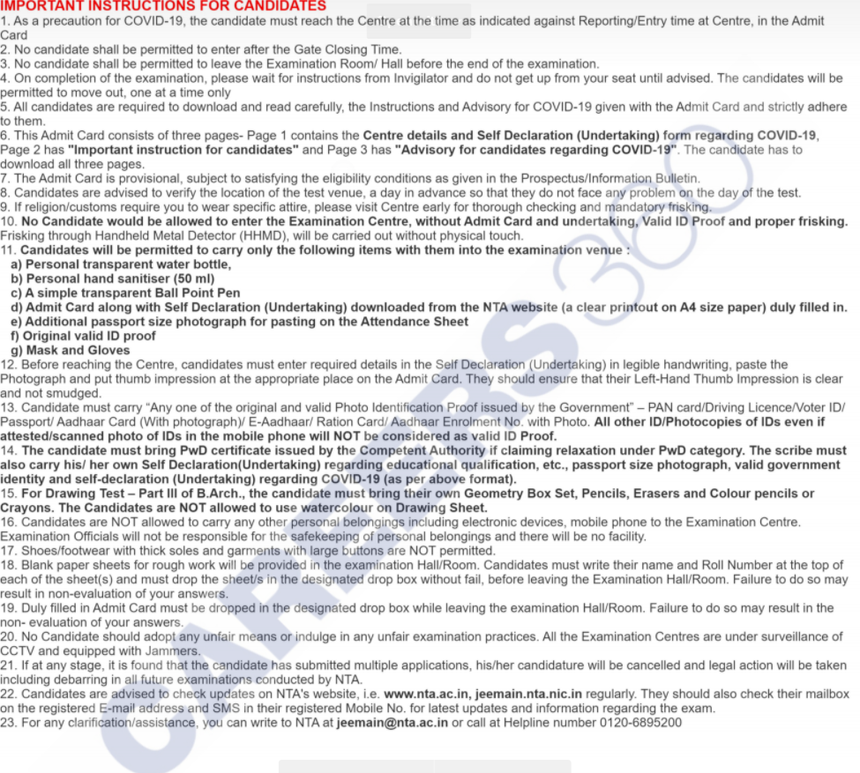
    • Candidates have to carry the NTA JEE Mains admit card along with a valid ID proof to appear for the entrance exam. 
    • No candidate will be allowed to enter or leave the JEE Main exam centre before and after the gate closing time. 
    • Candidates have to make sure they follow the JEE Main dress code 2026 to appear for the exam. They are advised to wear light and simple clothes at the exam centre. 
    • The authorities will provide the scribble paper to each candidate at the centre. Hence, candidates need not take any paper with them to the centre. 
    • Candidates with PwD reservation have to carry a PwD certificate issued by the competent authority. 
    • The authorities also suggested that candidates must carry their transparent water bottle along with the face mask and hand sanitiser in lieu of the ongoing COVID-19 pandemic. 

    JEE-Main-COVID-GuidelinesJEE-Main-covid-19-guidelines'

    Candidates will be able to check the student reactions on JEE Main 2026 after the conclusion of the exam. Careers360 team will cover all JEE Main 2026 sessions and all the student reactions, reviews, and responses will be updated here. In the meantime, candidates can check the previous year JEE Main student's reactions. 

    Previous Year's JEE Main Student's Reactions

    JEE Main 2024 April 5 - Students Reactions

    Shift 1 students reactions -

    • Maths moderate, Physics and Chemistry easy
    • The exam was tough compared to the January session
    • The physics question was based on Modern physics, kinetic energy (2-3 ques.), gravitation, work done, semiconductor
    • Chemistry - Organic (NCERT-based questions), biomolecules, electrochemistry,
    • Maths - vector, 3d, calculus, integration, differential equations,

    JEE Main 2024 April 4 - Students Reactions

    Shift 2 students reactions - 

    • JEE Main 2024 April 4 shift 2 exam was tough compared to the January session
    • Papers were equally balanced
    • The overall difficulty level of the paper was moderate
    • Physics and chemistry were easy Maths was tough

    Shift 1 students reactions -

    • The overall difficulty level of the exam is moderate
    • Physics and chemistry were easy compared to Mathematics
    • Solving the JEE Main PYQ will help to solve the question easily.

    JEE Main 2024 January 29- Students Reactions

    NTA has conducted the JEE Mains 2024 29 January paper shift 1. The authorities concluded the JEE Main 29 January shift 2 at 6 PM. Candidates can check the student's reaction for JEE Main January 29 shift 1 here.

    Shift 1 - Students found the Physics and Mathematics sections moderately challenging. The chemistry section was easy. The paper covered topics from both classes 11 and 12, however, students found that the Physics section had more questions from class 12.

    JEE Main 2024 January 27- Students Reactions

    Candidates can check here the JEE Main exam January 27 students' reactions for both shifts 1 and 2.

    • Shift 1- Numerical questions were found to be easy. Candidates rate Mathematics as moderate to difficult. While the Physics section was easy. Overall the paper was moderately challenging.
    • Shift 2 - It was a balanced paper that covered all chapters of classes 11 and 12. Students found the paper easy to moderately challenging.

    NTA published the JEE Main 2026 session 1 paper 2 final answer key on February 23, 2026. The JEE Main 2026 Jan 29 shift 1 provisional answer key challenge was conducted on January 19 to 20,  2026. Interested candidates were able to submit a challenge against the JEE provisional answer keys online by paying a non-refundable fee of Rs 200 for every question. NTA will release the JEE Main 2026 official final answer key, which will contain the correct responses to questions asked in JEE Mains 2026.

    The National Testing Agency (NTA) has released the final answer key for JEE Main 2026 examination on February 16, 2026. The JEE Main 2026 answer key has been uploaded on the official website, jeemain.nta.nic.in. The final JEE Main exam answer key is released in PDF format. Moreover, the authority also has released the JEE Main 2026 response sheet and question paper along with the provisional answer key. Candidates can use the JEE Mains exam answer key to verify their answers and predict probable scores. Candidates can follow the steps mentioned below to download the JEE Main answer key 2026.

    How to download the JEE Main 2026 answer key?

    • Visit the JEE Mains 2026 official website- jeemain.nta.nic.in
    • Click on the JEE Main answer key 2026 download link
    • Enter the required credentials namely JEE Main application number and date of birth/password and click on the login button.
    • The answer key of JEE Main 2026 will be displayed on the screens
    • Match the IDs with the JEE Mains 2026 question paper provided on the candidate's login.
    • Take a printout and with the help of JEE Main response sheet 2026, calculate the probable marks.

    How to cross-check JEE Main answer key with the questions?

    NTA published the answer option with the question ID and not the actual question asked. So what is the JEE Main 2026 question ID? This is the number given to each question asked in the NTA JEE Mains question paper and also given in the candidate's response sheet. 

    So the first step candidates must do is to download the JEE Main exam question paper. This means that they will have all the question Ids on hand. Then they must check the JEE Main provisional answer key 2026 for the questions and match them. In case of discrepancy, they must note the NTA JEE Main question ID and the answer ID to keep track of the same.

    JEE Main 2026 answer key challenge

    The authorities allowed the candidates to challenge the provisional JEE Main 2026 answer key from February 4 to 6, 2026. Candidates have to pay a processing fee of Rs. 200 per question to challenge the provisional JEE Mains 2026 answer key. This processing fee will be refunded if the candidate's challenge is accepted by the authorities. The final JEE Main answer key 2026 has been released after considering the objections raised by the candidates.

    How to challenge the JEE Main answer key?

    • Go to  the official website, jeemain.nta.nic.in
    • Click on the "challenge answer key" link displayed
    • Go to the question to be challenged and click on the answer ID option that is correct.
    • Save and pay Rs 200 per question challenged.

    JEE Main 2026 Candidate Response Sheets

    Along with the NTA JEE Main exam answer key, the authorities released the response sheet. The response sheet consists of the details of the answers marked by a candidate. The NTA JEE Main 2026 candidate response sheets also allow candidates to go through their responses and raise any objections to the official answer key.

    Related links:
    JEE Main Answer Key by Aakash Institute
    JEE Main  Answer Key by FIITJEE
    JEE Main  Answer Key by Sri Chaitanya

    Paper 2

    The National Testing Agency will issue the final JEE Main answer key 2026 for paper 2 on the official website, jeemain.nta.nic.in. The provisional answer key of JEE Main paper 2 will be released in February for session 1. The authority also allowe candidates to challenge the JEE Mains provisional answer key.

    Candidates can check the JEE Main 2026 exam analysis after the exam. The exam analysis of JEE Main 2026 has been updated as per the student’s reaction. Details on the JEE Main difficulty level and most asked topics is available through the JEE Mains 2026 paper analysis.

    JEE Main Exam Analysis - January Session 

    JEE Mian 2026 Exam DateIIT JEE Main Shift 1 Difficulty LevelNTA JEE Main Shift 2 Difficulty level
    JEE Main 2026 analysis for Jan 21Physics- Easy - Scoring
    Chemistry- Difficult
    Mathematics- Moderate
    Physics- Easy-Moderate
    Chemistry- Difficult
    Mathematics- Moderate to Difficult

    JEE Main 2026 analysis for Jan 22
    Physics-Easy
    Chemistry- Moderate
    Mathematics- Moderate
    Physics- Easy to Moderate
    Chemistry- Moderate
    Mathematics- Very Difficult & Lengthy
    JEE Main 2026 analysis for Jan 23Physics-Moderate
    Chemistry- Moderate
    Mathematics- Moderate
    Physics- Toughest
    Chemistry- Moderate
    Mathematics-Easy and Lenghty
    JEE Main 2026 analysis for Jan 24Physics-Moderate
    Chemistry- Moderate
    Mathematics- Moderate
    Physics-Moderate
    Chemistry- Easy to Moderate
    Mathematics- Moderate to Difficult
    JEE Main 2026 analysis for Jan 28Physics-Moderate
    Chemistry-Moderate
    Mathematics- Moderate
    Chemistry - Moderate
    Physics - Moderate
    Mathematics - Moderate to Tough

    JEE Main 2026 analysis for Jan 29moderate to tough
    drawing and aptitude- mostly easy

    JEE Main Exam Analysis by Coaching Institutes

    Paper 2

    JEE Main 2026 Paper 2 will be held in 2 shifts. Candidates will be able to check the JEE Main 2026 exam analysis for paper 2 once the examination concludes. 

    The National Testing Agency activated the link for JEE Main 2026 paper 2 result on February 24, 2026, on the official website, jeemain.nta.nic.in. The JEE Main result 2026 for session 1 paper 1 was declared on February 16. Candidates must provide their application number and password to check the JEE Main 2026 result. The session 2 JEE Main result will be announced by April 20, 2026. With the help of the JEE Main scorecard 2026, candidates will be able to check the subject-wise scores, total NTA scores, personal details, All India Rank and more. NTA uses the normalisation process while making JEE Main exam results to equalise the difficulty level of various shifts. 

    Steps to download JEE Main 2026 result

    • Visit JEE Main 2026 official website - jeemain.nta.nic.in.
    • Click on the direct link to download JEE Mains 2026 results.
    • Enter the required credentials namely application number and password and click on the submit button.
    • Preview the details mentioned in the JEE Main scorecard.
    • Download JEE Main result 2026 and take a printout for future reference.

    JEE Main 2026 result: Details mentioned

    • Name of the candidate
    • Roll number
    • Date of birth
    • Name of the candidate’s parents
    • State code of eligibility
    • Category and Nationality
    • Subject-wise NTA JEE Main scores
    • Total NTA scores obtained in the first attempt
    • The JEE Main exam scores of all attempts or a single attempt have been released along with the rank allotted on the better of the two scores.

    JEE Main 2026 Rank List

    The National Testing Agency will release the rank list for JEE Main 2026 along with the JEE exam result. The authorities follow a tie-breaking rule in case two or more candidates receive the same marks. 

    Tie-Breaking for JEE Mains 2026 Paper 1

    For JEE  Main 2026 Paper 1 - The tie between candidates obtaining equal total NTA scores in Paper 1, will be resolved as follows:

    • NTA score in Mathematics
    • NTA score in Physics
    • NTA score in Chemistry
    •  Candidate with less proportion of a number of attempted incorrect answers and correct answers in all the subjects in the Test
    • Candidate with less proportion of a number of attempted incorrect answers and correct answers in Mathematics.
    • Candidate with less proportion of a number of attempted incorrect answers and correct answers in Physics
    • Candidate with less proportion of a number of attempted incorrect answers and correct answers in Chemistry 
    • If there is a tie even after this, candidates will be assigned the same rank.

    Tie-Breaking for JEE Mains 2026 Paper 2

    For JEE  Main Paper 2 - The tie between candidates obtaining equal total NTA scores in Paper 2 will be resolved as follows

    • NTA score obtained in Mathematics
    • NTA score obtained in Aptitude Test
    • NTA score obtained in Drawing Test
    • Candidate with less proportion of a number of attempted incorrect answers and correct answers in all the subjects
    • Candidate with less proportion of a number of attempted incorrect answers and correct answers in Mathematics(Part-I)
    • Candidate with less proportion of a number of attempted incorrect answers and correct answers in Aptitude Test (Part-II)
    •  If there is a tie even after this, candidates will be assigned the same rank.

    JEE Main 2026 Topper List

    Name of CandidateState Eligibility (State of 12th Class

    SHREYA MISRA

    DELHI (NCT)

    SHREYAS MISRA

    ANDHRA PRADESH

    SUBHAM KUMAR

    BIHAR

    CHIRANJIB KAR

    RAJASTHAN

    KABIR SINGH

    RAJASTHAN

    BHAVESH PATRA

    ODISHA

    ANJ JAIN

    HARYANA

    ARNAV GAUTAM

    RAJASTHAN

    PASALA MOHITH

    ANDHRA PRADESH

    MUDHAY VIRDYA

    GUJARAT

    PURVAJ NIRAYYA

    MAHARASHTRA

    VIVAN SHARAD MAHWAR

    TELANGANA

    JEE Main 2025 Toppers

    Candidates nameState
    MD ANASRAJASTHAN
    AYUSH SINGHALRAJASTHAN
    ARCHISMAN NANDYWEST BENGAL
    DEVDUTTA MAJHIWEST BENGAL
    AAYUSH RAVI CHAUDHARIMAHARASHTRA
    LAKSHYA SHARMARAJASTHAN
    KUSHAGRA GUPTAKARNATAKA
    HARSSH A GUPTATELANGANA
    AADIT PRAKASH BHAGADEGUJARAT
    DAKSHDELHI
    HARSH JHADELHI
    RAJIT GUPTARAJASTHAN
    SHREYAS LOHIYA

    UTTAR PRADESH

    SAKSHAM JINDALRAJASTHAN
    SAURAV

    UTTAR PRADESH

    VANGALA AJAY REDDYTELANGANA
    SANIDHYA SARAFMAHARASHTRA
    VISHAD JAINMAHARASHTRA
    ARNAV SINGHRAJASTHAN
    SHIVEN VIKAS TOSHNIWALGUJARAT
    KUSHAGRA BAINGAHA

    UTTAR PRADESH

    SAI MANOGNA GUTHIKONDA

    ANDHRA PRADESH

    OM PRAKASH BEHERARAJASTHAN
    BANI BRATA MAJEETELANGANA

    Paper 2

    NTA will announce the JEE Main paper 2 result for session 1 online at jeemain.nta.nic.in. Candidates should have their application number and date of birth to download the result of JEE Mains 2026 paper 2.

    NTA will release the JEE Main 2026 cutoff after with the result. The minimum score required to qualify the NTA JEE Main exam is the cutoff of JEE Main 2026. Candidates must know that the qualifying cutoff and admission cutoff for JEE Main 2026 are different. The minimum mark required to fetch a seat in the JEE Main participating institutes is the admission cutoff. JEE Main 2026 cutoff will vary for several categories, branches, and institutes.

    Previous Year JEE Main Qualifying Cutoff (2025)

    Category JEE Main Cutoff 2025
    General93.1023262
    Persons with Disability0.0079349
    EWS80.3830119
    OBC-NCL79.4313582
    SC61.1526933
    ST47.9026465

    JEE Main cutoff 2024

    CategoryCutoff
    General93.2362181
    General-PWD0.0018700
    EWS81.3266412
    OBC79.6757881
    SC60.0923182
    ST46.6975840

    JEE Main 2023 Cutoff

    Category Cutoff

    General

    90.7788642

    EWS

    75.6229025

    OBC

    73.6114227

    SC

    51.9776027

    ST

    37.2348772

    PwD

    0.0013527

    JEE Mains Cutoff Trends

    To understand and know the qualifying JEE Main cutoff, check the table below.

    Category 2022202120202019
    OBC-NCL67.009029768.0234447 72.888796974.3166557
    SC43.082095446.882533850.176024554.0128155

    General

    88.412138387.8992241

    90.3765335

    89.7548849
    ST        26.777132834.6728999 39.069610144.3345172
    PwD0.00310290.0096375 (UR PH)0.06185240.11371730
    GEN-EWS63.111414166.221484570.243552878.2174869

    JEE Main Cutoff for NITs (2020, 2019, 2018,2017, 2016)

    Institute NameCutoff Details

    National Institute of Technology Calicut, Kerala

    NIT Calicut Cutoff

    National Institute of Technology Raipur, Chhattisgarh

    NIT Raipur Cutoff

    National Institute of Technology Hamirpur, Himachal Pradesh

    NIT Hamirpur Cutoff

    National Institute of Technology, Manipur

    NIT Manipur Cutoff

    National Institute of Technology, Delhi

    NIT Delhi Cutoff

    Maulana Azad National Institute of Technology Bhopal, Madhya Pradesh

    MANIT Bhopal Cutoff

    National Institute of Technology Sikkim

    NIT Sikkim Cutoff

    National Institute of Technology, Mizoram

    NIT Mizoram Cutoff

    National Institute of Technology Agartala, Tripuraobjection

    NIT Agartala Cutoff

    National Institute of Technology Durgapur, West Bengal

    NIT Durgapur Cutoff

    National Institute of Technology, Goa

    NIT Goa Cutoff

    National Institute of Technology Kurukshetra, Haryana

    NIT Kurukshetra Cutoff

    National Institute of Technology, Uttrakhand

    NIT Uttarakhand Cutoff

    National Institute of Technology Patna, Bihar

    NIT Patna Cutoff

    National Institute of Technology Puducherry

    NIT Puducherry Cutoff

    National Institute of Technology Surathkal, Karnataka

    NIT Surathkal Cutoff

    National Institute of Technology, Andhra Pradesh

    NIT Andhra Pradesh Cutoff

    Malviya National Institute of Technology Jaipur, Rajasthan

    MNIT Jaipur Cutoff

    Sardar Vallabhbhai National Institute of Technology Surat, Gujarat

    SVNIT Surat Cutoff

    National Institute of Technology Tiruchirapalli, Tamil Nadu

    NIT Trichy Cutoff

    Dr. B R Ambedkar National Institute of Technology Jalandhar, Punjab

    NIT Jalandhar Cutoff

    Motilal Nehru National Institute of Technology Allahabad, Uttar Pradesh

    MNNIT Allahabad Cutoff

    National Institute of Technology Silchar, Assam

    NIT Silchar Cutoff

    National Institute of Technology Rourkela, Odisha

    NIT Rourkela Cutoff

    National Institute of Technology, Nagaland

    NIT Nagaland Cutoff

    National Institute of Technology Arunachal Pradesh

    NIT Arunachal Pradesh Cutoff

    Visvesvaraya National Institute of Technology Nagpur, Maharashtra

    VNIT Nagpur Cutoff

    National Institute of Technology Warangal, Telangana

    NIT Warangal Cutoff

    National Institute of Technology Jamshedpur, Jharkhand

    NIT Jamshedpur Cutoff

    National Institute of Technology Hazartbal, Srinagar, Jammu and Kashmir

    NIT Srinagar Cutoff

    National Institute of Technology, Meghalaya

    NIT Meghalaya Cutoff

    JEE Main Cutoff for IIITs (2020, 2019, 2018,2017, 2016)

    Institute NameCutoff Details

    Indian Institute of Information Technology, Kota, Rajasthan

    IIIT Kota Cutoff

    Indian Institute of Information Technology(IIIT) Kilohrad, Sonipat, Haryana

    IIIT Sonepat Cutoff

    Indian Institute of Information Technology, Vadodara, Gujarat

    IIIT Vadodara Cutoff

    Indian Institute of Information Technology Srirangam, Tiruchirapalli

    IIIT Srirangam Cutoff

    Indian Institute of Information Technology Kalyani, West Bengal

    IIIT Kalyani Cutoff

    Indian Institute of Information Technology (IIIT) Pune

    IIIT Pune Cutoff

    Indian Institute of Information Technology, Guwahati, Assam

    IIIT Guwahati Cutoff

    Indian Institute of Information Technology(IIIT) Una, Himachal Pradesh

    IIIT Una Cutoff

    Indian Institute of Information Technology (IIIT) Nagpur

    IIIT Nagpur Cutoff

    Indian Institute of Information Technology (IIIT) Ranchi

    IIIT Ranchi Cutoff

    Indian Institute of Information Technology, Jhalwa, Allahabad, Uttar Pradesh

    IIIT Allahabad Cutoff

    Indian Institute of Information Technology Lucknow

    IIIT Lucknow Cutoff

    Indian Institute of Information Technology, Kurnool, Andhra Pradesh

    IIITDM Kurnool Cutoff

    Indian Institute of Information Technology Sri City, Chittoor, Andhra Pradesh

    IIIT Sri City Cutoff

    Pandit Dwarka Prasad Mishra Indian Institute of Information Technology, Design & Manufacturing, Jabalpur, Madhya Pradesh

    IIITDM Jabalpur Cutoff

    Indian Institute of Information Technology(IIIT) Kottayam

    IIIT Kottayam Cutoff

    Indian Institute of Information Technology Manipur Mantripukhri, Imphal

    IIIT Manipur Cutoff

    Indian Institute of Information Technology Dharwad

    IIIT Dharwad Cutoff

    Indian Institute of Information Technology, Design & Manufacturing, Kanchipuram, Tamil Nadu

    IIITDM Kancheepuram Cutoff

    Paper 2

    The cut off marks of JEE Main paper 2 will be released along with the session 2 results. The NTA has declared the JEE Main paper 2 result for session 1 and session 2.

    JoSAA will release the JEE Main 2026 counselling notification on the official website, josaa.nic.in. Candidates qualifying the JEE Main exam 2026 will have to complete the JoSAA counselling registration and choice filling process online. The authorities will conduct the seat allotment process based on the number of students who applied for a particular course, the number of seats available, and the rank of the candidates.

    JEE Main Counselling and choice filling process 2026

    Candidates have to follow the below mentioned steps for the JEE Main 2026 counselling and choice-filling process: 

    • Firstly, visit the JoSAA official website - josaa.nic.in
    • Click on the JoSAA counselling registration link 
    • On the candidate login page, enter the JEE Main 2026 application number and password. 
    • Once registered, the candidate's details will be available on the screens 
    • Preview the details and complete the initial registration. 
    • After registration, candidates have to fill in choices of college and course as per their preference. 
    • Candidates are advised to fill as many choices as possible. 
    • Once the choice filling is completed, candidates have to lock their filled choices before the last date. 
    • The authorities will release the JoSAA seat allotment result round-wise on the official website. 

    NOTE: After the last round is completed, candidates must report to the institutes to complete their admission formalities by paying the balance fee and submitting the requisite documents to the allotted institute.

    JEE Main Participating Institutes 2026

    Candidates can apply for 31 NITs, IIEST Shibpur, 26 IIITs and 33 GFTIs based on JEE Main 2026 ranks. Candidates can check the complete list of the NTA JEE Main participating institutes from the following tables-

    JEE Main Participating Institutes - NITs

    Name of the InstituteTotal Number of Seats

    Dr B R Ambedkar National Institute of Technology, Jalandhar

    786

    Malaviya National Institute of Technology, Jaipur

    710

    Maulana Azad National Institute of Technology, Bhopal

    937

    Motilal Nehru National Institute of Technology, Allahabad

    811

    National Institute of Technology, Agartala

    867

    National Institute of Technology, Andhra Pradesh

    480

    National Institute of Technology, Arunachal Pradesh

    184

    National Institute of Technology, Calicut

    937

    National Institute of Technology, Delhi

    180

    National Institute of Technology, Durgapur

    725

    National Institute of Technology, Goa

    150

    National Institute of Technology, Hamirpur

    714

    National Institute of Technology, Jamshedpur

    565

    National Institute of Technology, Kurukshetra

    832

    National Institute of Technology, Manipur

    180

    National Institute of Technology, Meghalaya

    150

    National Institute of Technology, Mizoram

    135

    National Institute of Technology, Nagaland

    155

    National Institute of Technology, Patna

    638

    National Institute of Technology, Puducherry

    235

    National Institute of Technology, Raipur

    955

    National Institute of Technology, Rourkela

    850

    National Institute of Technology, Sikkim

    200

    National Institute of Technology, Silchar

    660

    National Institute of Technology, Srinagar

    632

    National Institute of Technology, Surathkal

    740

    National Institute of Technology, Tiruchirappalli

    814

    National Institute of Technology, Uttarakhand

    150

    National Institute of Technology, Warangal

    800

    Sardar Vallabhbhai National Institute of Technology, Surat

    873

    Visvesvaraya National Institute of Technology, Nagpur

    922

    JEE Main 2026 Participating Institutes - (IIITs)

    Candidates can check the JoSAA Participating Institutes from the below table:

    Name of InstitutesTotal Number of Seats

    Atal Bihari Vajpayee Indian Institute of Information Technology & Management, Gwalior, Madhya Pradesh

    248

    Indian Institute of Information Technology Kota, Rajasthan

    180

    Indian Institute of Information Technology Guwahati, Assam

    200

    Indian Institute of Information Technology Kalyani, West Bengal

    130

    Indian Institute of Information Technology Kilohrad, Sonepat, Haryana

    90

    Indian Institute of Information Technology Una, Himachal Pradesh

    160

    Indian Institute of Information Technology Sri City, Chittoor, Andhra Pradesh

    270

    Indian Institute of Information Technology Vadodara, Gujarat

    200

    Indian Institute of Information Technology, Jhalwa, Allahabad, Uttar Pradesh

    300

    Indian Institute of Information Technology, Design & Manufacturing, Kanchipuram, Tamil Nadu

    420

    Pandit Dwarka Prasad Mishra Indian Institute of Information Technology, Design & Manufacturing, Jabalpur, Madhya Pradesh

    300

    Indian Institute of Information Technology Manipur

    100

    Indian Institute of Information Technology Srirangam, Tiruchirapalli

    60

    Indian Institute of Information Technology Lucknow

    75

    Indian Institute of Information Technology Dharwad

    180

    Indian Institute of Information Technology, Kurnool, Andhra Pradesh

    120

    Indian Institute of Information Technology, Kottayam, Kerala

    90

    Indian Institute of Information Technology (IIIT) Ranchi

    120

    Indian Institute of Information Technology (IIIT) Nagpur

    210

    Indian Institute of Information Technology (IIIT) Pune

    120

    Indian Institute of Information Technology Bhagalpur

    150

    Indian Institute of Information Technology Bhopal

    180

    Indian Institute of Information Technology Surat

    120

    Indian Institute of Information Technology, Agartala

    38

    Indian Institute of Information Technology, Raichur, Karnataka

    30

    JEE Main Participating Institutes 2026 (CFTIs)

    Name of the InstituteTotal Number of Seats

    Assam University, Silchar

    135

    Birla Institute of Technology, Mesra, Ranchi

    762

    Gurukula Kangri Vishwavidyalaya, Haridwar

    368

    Indian Institute of Carpet Technology, Bhadohi

    60

    Institute of Infrastructure, Technology, Research and Management-Ahmedabad

    90

    Institute of Technology, Guru Ghasidas Vishwavidyalaya (A Central University), Bilaspur, (C.G.)

    400

    J.K. Institute of Applied Physics & Technology, Department of Electronics & Communication, University of Allahabad- Allahabad

    92

    National Institute of Electronics and Information Technology, Aurangabad (Maharashtra)

    60

    National Institute of Foundry & Forge Technology, Hatia, Ranchi

    120

    Sant Longowal Institute of Engineering and Technology

    249

    Mizoram University, Aizawl

    95

    School of Engineering, Tezpur University, Napalm, Tezpur

    116

    School of Planning & Architecture, Bhopal

    105

    School of Planning & Architecture, New Delhi

    137

    School of Planning & Architecture: Vijayawada

    105

    Shri Mata Vaishno Devi University, Katra, Jammu & Kashmir

    194

    Indian Institute of Engineering Science and Technology, Shibpur

    590

    HNB Garhwal University Srinagar (Garhwal)

    84

    International Institute of Information Technology, Naya Raipur

    42

    University of Hyderabad

    421

    Punjab Engineering College, Chandigarh

    608

    Jawaharlal Nehru University, Delhi

    100

    International Institute of Information Technology, Bhubaneswar

    150

    Central Institute of Technology Kokrajar, Assam

    18

    Pondicherry Engineering College, Puducherry

    240

    Ghani Khan Choudhary Institute of Engineering and Technology, Malda, West Bengal

    114

    Central University of Rajasthan, Rajasthan

    30

    National Institute of Food Technology Entrepreneurship and Management Sonipat, Haryana

    169

    Fee Structure of JEE Main Participating Institutes

    Institute Type
    National Institutes of Technology Fee Structure
    Indian Institutes of Information Technology Fee Structure
    Government-Funded Technical Institutes Fee Structure

    Documents Required at JEE Main 2026 counselling

    Joint Entrance Examination (Main) 2026

    Provisional JoSAA seat allotment letter
    JEE Main admit card
    3 passport size photographs (the same as uploaded during registration)
    Photo identity card
    Date of birth proof
    Class XII mark sheet
    JEE Main score card
    Category certificate (if applicable)

    NTA will release the JEE Main question paper on the official website. Candidates have to provide the application number and date of birth to download the question paper of JEE Main 2026. The question paper will be released along with the answer key. In the meantime, candidates who are going to appear for the IIT JEE 2026 exam can attempt the JEE Main PYQ to get an idea of the pattern and difficulty level.

    How to download the JEE Main Question Paper 2026?

    Candidates can follow the steps mentioned below for downloading the JEE Main question paper.

    •  Visit the JEE Main official website, jeemain.nta.nic.in
    • Click on the JEE Main question paper link
    • Access the candidate login using the application number and password
    • Check for the JEE Main question paper and download it

    JEE Main 2025 Question Papers PDF Download

    JEE Main January Question Paper 2025

    JEE Mains 2025 April Question Paper

    JEE Main 2025 22 January Shift 1 Question Paper

    JEE Main 2025 2 April Shift 1 Question Paper

    JEE Main 2025 22 January Shift 2 Question Paper

    JEE Main 2025 2 April Shift 2 Question Paper

    JEE Main 2025 23 January Shift 1 Question Paper

    JEE Main 2025 3 April Shift 1 Question Paper

    JEE Main 2025 23 January Shift 2 Question Paper

    JEE Main 2025 3 April Shift 2 Question Paper

    JEE Main 2025 24 January Shift 1 Question Paper

    JEE Main 2025 4 April Shift 1 Question Paper

    JEE Main 2025 24 January Shift 2 Question Paper

    JEE Main 2025 4 Shift 2 Question Paper

    JEE Main 2025 28 January Shift 1 Question paper

    JEE Main 2025 7 April Shift 1 Question Paper

    JEE Main 2025 28 January Shift 2 Question paper

    JEE Main 2025 7 April Shift 2 Question Paper

    JEE Main 2025 8 April Shift 2 Question paper

    JEE main 2025 29 January Shift 1 Question paper


    JEE main 2025 29 January Shift 2 Question paper

    JEE Main Question Papers PDF Download - January 2024

    JEE Main 2024 question paper (January 24)JEE Main 2024 question paper (January 24)
    JEE Main 2024 question paper (January 27)JEE Main 2024 question paper (January 27)
    JEE Main 2024 question paper (January 29)JEE Main 2024 question paper (January 29)
    JEE Main 2024 question paper (January 30)JEE Main 2024 question paper (January 30)
    JEE Main 2024 question paper (January 31)JEE Main 2024 question paper (January 31)
    JEE Main 2024 question paper (February 1) Shift 1 and 2

    JEE Main Question Papers PDF Download - April 2023

    JEE Main Question Paper 2023 PDF With Solution (Official) – January Session

    General Information

    Contact Number:

    011-40759000 , 011-69227700

    Relevant Links:

    Official Website Link Click Here, + 1 more
    Amrita University B.Tech 2026

    Recognized as Institute of Eminence by Govt. of India | NAAC ‘A++’ Grade | Upto 75% Scholarships

    MAHE, Manipal - B.Tech Admissions 2026

    Last Date to Apply: 15th March | NAAC A++ Accredited | Accorded institution of Eminence by Govt. of India | NIRF Rank #3

    Frequently Asked Questions (FAQs)

    Q: Has the JEE Main 2026 application form correction commenced?
    A:

    Yes, the JEE Main 2026 form correction for the April session was conducted from February 27 to 28, 2026. 

    Q: Is JEE Main 2026 syllabus reduced?
    A:

    The detailed JEE Mains 2026 syllabus was issued on October 31, 2026.

    Q: How can I download the JEE Main 2026 admit card?
    A:

    Candidates will be able to download the JEE Mains 2026 session 2 admit card using the application number and password.

    Q: What is the JEE Main 2026 application form release date for April session?
    A:

    JEE Main 2026 application form release date for session 2 was February 1, 2026.

    Q: Is the JEE Mains result out 2026?
    A:

    The JEE Mains result 2026 for session 1 has been out by February 16. The paper 2 result was announced on February 24, 2026.

    Q: JEE Main exam 2026 will be be held in how many languages?
    A:

    JEE Main 2026 was conducted in 13 languages including English, Hindi, Assamese, Bengali, Gujarati, Kannada, Marathi, Malayalam, Odia, Punjabi, Tamil, Telugu, and Urdu.

    Q: Who will conduct JEE Main 2026?
    A:

    National Testing Agency is conducting JEE Main exam 2026.

    Q: What is the date of JEE Main 2026?
    A:

    The JEE Main 2026 session 1 exam was held on January 21, 22, 23, 24, 28 and 29, 2026, while the session 2 will be held from April 2 to 09, 2026. The authority has rescheduled the JEE Main on January 23, 2026, for the West Bengal candidates on account of Saraswati Puja. 

    Q: Does IEM accept JEE Mains score?
    A:

    Yes, a candidate can get into IEM Kolkata through JEE Mains; based on previous year cutoffs, your likely rank will be around 40,000 or below. JEE Mains is also an option for admission to Heritage College. 

    Q: When will JEE syllabus release?
    A:

    NTA has released JEE Main exam syllabus online at, jeemain.nta.nic.in.

    Articles
    |

    Questions related to JEE Main

    On Question asked by student community

    Have a question related to JEE Main ?

    Hello Student,

    You can click on the link below where we have mentioned some of the books you can use for prep.

    Link - TS LAWCET Books 2026 - Subject Wise Recommended Books

    Hope this helps!

    Hi Student

    If you have scored 83.4 per cent in the JEE Main examination , you can get admission into Amrita Vishwa Vidyapeetham. You need to check your eligibility before you proceed with your admission.

    Student Community: Where Questions Find Answers

    Ask and get expert answers on exams, counselling, admissions, careers, and study options.