


 Trusted by 500K+ Students
JEE Advanced College Predictor 2026
Get precise college predictions powered by multi-year cut-off trends



Predict, Analyse & Plan Your JEE Advanced Journey
- Know your admission chances in B.Tech., Dual Degree, Integrated M.Tech. and other undergraduate programmes based on your JEE Advanced rank, category, gender, quota and admission eligibility criteria.
- Explore predicted IITs and branches across all Indian Institutes of Technology (IITs) participating in JoSAA counselling for JEE Advanced qualified candidates.
- Get smart predictions backed by previous years' branch-wise closing ranks, category-wise cutoffs and JoSAA counselling trends.
- Analyze your opportunities across popular branches including Computer Science Engineering, Artificial Intelligence, Electrical Engineering, Electronics, Mechanical, Civil, Chemical, Aerospace, Mathematics & Computing and other IIT programmes.
- Compare IITs based on admission chances, branches offered, placements, location, fees and institute details.
- Receive personalized recommendations with admission probabilities to build a smarter IIT counselling strategy.
- 5 Lakh+ engineering aspirants have used Careers360 College Predictors.
JEE Advanced College Predictor 2026
Stop Guessing. Start Planning.Get a Personalized JEE Advanced Report
Receive college matches, cutoff trends & your tailored admission roadmap.

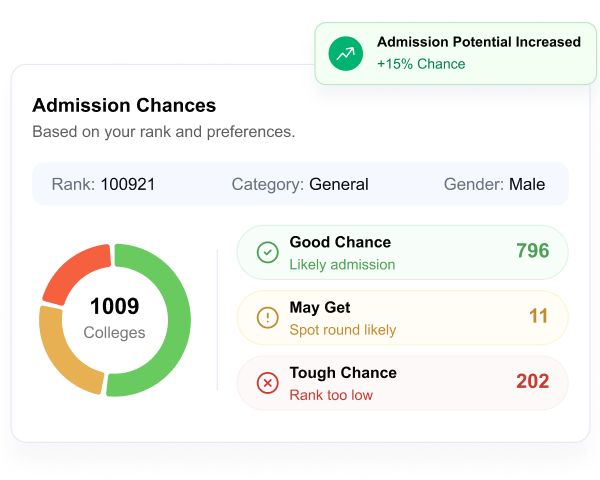
Know Your Admission Chances Instantly
Predict your chances across colleges based on rank, category & preferences.
Top Institutes Covered
Explore all 23 IITs.
Get a Personalized JEE Advanced Report
Receive college matches, cutoff trends & your tailored admission roadmap.
Know Your Admission Chances Instantly
Predict your chances across colleges based on rank, category & preferences.
Top Institutes Covered
Explore all 23 IITs.
Get a Personalized JEE Advanced Report
Receive college matches, cutoff trends & your tailored admission roadmap.
Widely recognized as shockingly accurate we’ve already helped 10+ million students discover their ideal colleges.
What students say about our college predictor
JEE Advanced College Predictor 2026 is an AI driven tool created by Careers360. This JEE Adv college predictor tool uses the latest rank vs college details to give the most accurate information on best available colleges based on JEE Advanced ranks. After the conclusion of the JEE Advanced 2026 exam, students can use this JEE Adv predictor to get their probable colleges. Candidates do note that only the list of IITs and colleges accepting JEE Advanced rank will be listed based on the rank entered. Know the complete process to use the JEE advanced 2026 college predictor to get the right list of colleges.
JEE Advanced College Predictor 2026- Credentials Required
Candidates will require the following details to use the JEE Advanced 2026 college predictor.
JEE Advanced 2026 CRL rank
Caste group
Gender
Disability status.
How to Use the JEE Advanced 2026 College Predictor?
Candidates can use the steps mentioned below to use the college predictor for JEE Advanced 2026 . It is a very easy to use tool that gives candidates an idea of which colleges to apply for
Go to the “JEE Advanced college predictor" from the homepage of Careers360.com website.
Enter the details mentioned above such as JEE Advanced 2026 rank, caste , gender and disability status.
Click on “Predict my college”
Based on the inputs given, the predictor will display a list of possible IITs.
Candidates can determine their JEE Advanced 2026 colleges even before the ranks are released. This can be done using the JEE Advanced 2026 rank predictor by Careers360.
JEE Advanced 2026 College Predictor- Benefits
The JEE Advanced college predictor has the following advantages.
Candidates will be able to determine which IITs they have a chance of joining. Hence they can choose those IITs during the JEE Advanced 2026 counselling.
Chance of admission into preferred IITs
All details regarding the counselling process of JEE Advanced will be available in a comprehensive form to the candidates.
JEE Advanced 2026 Participating Institutes
Candidates who have cleared the JEE Advanced 2026 cutoff will be eligible for admission into the participating institutes. The following are the JEE Advanced 2026 participating institutes. The Careers360’s JEE Advanced college predictor will predict colleges based on the below list.
JEE Advanced 2026 Cutoff
The JEE Advanced 2026 cutoff is necessary for students to determine if they will be eligible for admission into IITs or not. The JEE Advanced cutoff for 2026 will be updated here when released. In the meanwhile, candidates can check the JEE Advanced previous year cutoffs here.
JEE Advanced IIT Madras cutoff
Year | Computer Science and Engineering | Electrical Engineering | Civil Engineering |
2025 | 171 | 741 | 5629 |
2024 | 159 | 835 | 5516 |
2023 | 144 | 908 | 4147 |
2022 | 175 | 1028 | 6106 |
2021 | 163 | 1007 | 5458 |
2020 | 158 | 844 | 5727 |
JEE Advanced IIT Delhi cutoff
Below is the open category closing rank of different streams for Male candidates.The cut off may vary for different categories.
Year | Computer Science and Engineering | Electrical Engineering | Civil Engineering |
2025 | 125 | 591 | 4228 |
2024 | 27 | 382 | 2428 |
2023 | 16 | 354 | 2867 |
2022 | 51 | 304 | 1633 |
2021 | 99 | 543 | 3607 |
2020 | 105 | 594 | 3738 |
JEE Advanced IIT Bombay cutoff
Year | Computer Science and Engineering | Electrical Engineering | Civil Engineering |
2024 | 68 | 464 | 3986 |
2023 | 66 | 463 | 4134 |
2022 | 51 | 304 | 1633 |
2021 | 66 | 420 | 3216 |
2020 | 66 | 298 | 3388 |

Frequently asked questions

Candidates who have their JEE Advanced rank can use the college predictor. There is no time limit to access the tool.

Careers360's JEE Advanced college predictor tool uses advanced AI algorithm and analyse the previous year's JoSAA opening and closing ranks to give the most probable and accurate results.
Top Colleges Accepting JEE Advanced
Questions related to JEE Advanced
On Question asked by student communityCheck the list of the most important chapters for JEE advance from here:
https://engineering.careers360.com/articles/jee-advanced-syllabus-weightage
JEE Main and JEE Advanced are both national-level engineering entrance examinations, but they serve different purposes.
JEE Main is conducted for admission to NITs, IIITs and other participating engineering institutes. It is also the qualifying examination for appearing in JEE Advanced.
JEE Advanced is conducted for admission to the IITs and is considered more advanced in terms of the level of questions.
JEE Main is conducted by the National Testing Agency (NTA), while JEE Advanced is conducted by one of the IITs on a rotational basis.
Candidates need to meet the prescribed eligibility requirements and qualify JEE Main to appear for JEE Advanced.
Therefore, students targeting IITs generally need to qualify JEE Main first and then appear for JEE Advanced.
Start your JEE preparation from Class 11 itself by building strong concepts in Physics, Chemistry and Mathematics. Follow your Class 11 syllabus systematically and avoid studying only for board examinations.
A good approach is:
Complete each chapter conceptually and solve basic questions first.
Gradually move to JEE-level problems.
Practise previous-year JEE questions regularly.
Make short notes and maintain a formula/revision notebook.
Take chapter-wise tests and analyse your mistakes.
Keep Class 11 concepts strong before moving ahead with Class 12 topics.
Consistency is more important than studying for very long hours occasionally. A realistic daily schedule with regular revision and testing will help you prepare effectively for JEE 2027.
After qualifying JEE Advanced and getting an IIT, there is no single course that is best for everyone. Your choice should depend on interest, rank, career goals and the branch available to you.
Generally:
CSE/AI/Data Science – good for software, AI, data and technology careers.
Electrical Engineering – useful for electronics, power, semiconductor and technology fields.
Electronics/ECE – good for electronics, communication, VLSI and semiconductor careers.
Mechanical Engineering – suitable for automobiles, manufacturing, robotics and core engineering.
Chemical Engineering – useful for process industries, energy, materials and higher studies.
Civil Engineering – suitable for infrastructure, construction and government/core engineering careers.
Engineering Physics/BS-MS programmes – good for research and higher studies.
Do not choose a branch only because it is considered popular. **A strong interest in the subject, good academic performance and your long-term career plan are more important.**
Hello Student, I can definitely help you create a balanced plan, but I would not recommend preparing JEE , NEET , KCET , MHT-CET and school exams as five completely separate syllabi. Your Class 11 NCERT/board concepts should become the common base, with JEE-level Maths/Physics and NEET-level Biology/Chemistry added according to your goals. Since your mid-terms are on September 25, I would first prioritise clearing the backlog while bringing the school syllabus up to exam level. A practical approach would be: 60% current/mid-term syllabus + 30% backlog + 10% revision/tests until the exam. After September 25, I can help you shift to a longer-term JEE/NEET/KCET/MHT-CET preparation schedule. If you give me your school timetable and the exact 11th chapters completed/currently being taught, I can make a day-by-day plan for you.
Hello Student, For JEE Main and JEE Advanced preparation, a good test series should include full-length mock tests, chapter-wise tests, previous-year questions, detailed solutions, and performance analysis. It is useful to take regular timed tests and analyse mistakes after every test rather than only checking the score. If you tell me your current Class, preparation level, and whether you want free or paid tests, I can suggest the type of test series that would suit you best.