Amity University Noida-B.Tech Admissions 2026
Among top 100 Universities Globally in the Times Higher Education (THE) Interdisciplinary Science Rankings 2026


JEE Main Formulas 2027 - JEE Mains is a highly competitive entrance examination for engineering courses. To pass this exam, you should know the basic concepts of Mathematics, Physics and Chemistry with their formulas. JEE Mains is conducted by the National Test Agency (NTA). The JEE Mains 2027 exam is an assessment of a candidate’s proficiency in Physics, Chemistry and Mathematics. Since there are many formulas in these three subjects, candidates need a way to recall them for revision purposes. JEE Main important formulas in Math, Physics, and Chemistry are integral to calculating answers for numerical questions according to the JEE Main 2027 syllabus.
This Story also Contains
Candidates must make a handy note of all important formulas to revise frequently. Candidates must have a good command of each topic and the formulas to crack the JEE Main 2027 exam to ace the test. Through this article, students can find the provided JEE Main formulas for all three subjects. Knowing important formulas in depth can help you solve problems fast and accurately, which is important for scoring well in JEE Main. All the formulas given here are according to the JEE Main 2027 syllabus strictly. All JEE formulas PDF, subject-wise, are given below.
Get expert advice on college selection, admission chances, and career path in a personalized counselling session.
The JEE Main 2027 Exam Pattern is such that the exam is divided into two main sections:
Section A: The quizzes contained in this section are 20 MCQs for each course. What the MCQ requires is four options, and only one of them is the right answer.
Section B: This section has 5 numerical value questions for each of the subject areas, and the candidate only has to answer all five of these. These numerical value questions have to be answered accurately, sometimes to the second decimal place.
Aspirants preparing for JEE Mains must remember that, along with concepts, one needs to revise and remember the formulas, which are very important while solving any problems. As JEE Main Physics formulas are given below, these formulas need to be memorised daily, as direct questions and formulas are asked in exams. Students can also solve JEE Main chapter-wise PYQs.
Physics and Measurement
Mean absolute error
$\Delta \bar{a}=\frac{\left|\Delta a_1\right|+\left|\Delta a_2\right|+\ldots\left|\Delta a_n\right|}{n}$
$\begin{aligned} & \text { Relative error }=\frac{\Delta \bar{a}}{a_m} \\ & \Delta \bar{a}=\text { mean absolute error } \\ & a_m=\text { mean value }\end{aligned}$
Percentage error $=\frac{\Delta \bar{a}}{a_m} \times 100 \%$
Kinematics
Some important Formulas of differentiation
$\begin{aligned}
& \frac{d}{d x}\left(x^n\right)=n x^{n-1} \\
& \frac{d}{d x} \sin x=\cos x \\
& \frac{d}{d x} \cos x=-\sin x \\
& \frac{d}{d x} \tan x=\sec ^2 x \\
& \frac{d}{d x} \cot x=-\csc ^2 x \\
& \frac{d}{d x} \sec x=\sec x \tan x \\
& \frac{d}{d x} \csc x=-\csc x \cot x \\
& \frac{d}{d x} e^x=e^x \\
& \frac{d}{d x} a^x=a^x \ln a \\
& \frac{d}{d x} \ln |x|=\frac{1}{x}
\end{aligned}$
Some important Formulas of integration
$\begin{aligned}
& \int x^n d x=\frac{x^{n+1}}{n+1}+C \\
& \int \frac{d x}{x}=\ln |x|+C \\
& \int e^x d x=e^x+C \\
& \int a^x d x=\frac{1}{\ln a} a^x+C \\
& \int \ln x d x=x \ln x-x+C \\
& \int \sin x d x=-\cos x+C \\
& \int \cos x d x=\sin x+C \\
& \int \tan x d x=-\ln |\cos x|+C \\
& \int \cot x d x=\ln |\sin x|+C \\
& \int \sec x d x=\ln |\sec x+\tan x|+C \\
& \int \csc x d x=-\ln |\csc x+\cot x|+C \\
& \int \sec 2 x d x=\tan x+C \\
& \int \csc c^2 x d x=-\cot x+C \\
& \int \sec x \tan x d x=\sec x+C \\
& \int \csc x \cot x d x=-\csc x+C \\
& \int \frac{d x}{\sqrt{a^2-x^2}}=\sin ^{-1} \frac{x}{a}+C \\
& \int \frac{d x}{a^2+x^2}=\frac{1}{a} \tan ^{-1} \frac{x}{a}+C \\
& \int \frac{d x}{x \sqrt{x^2-a^2}}=\frac{1}{a} \sec ^{-1} \frac{|x|}{a}+C
\end{aligned}$
$\vec{A} \times \vec{B}=A B \sin \theta$
Average angular velocity-
$\omega_{a v g}=\frac{\Delta \theta}{\Delta t}$
Time of flight
$T=\frac{2 U \sin \theta}{g \cos \beta}$
Range along incline plane
$R=\frac{2 u^2 \cdot \sin (\alpha-\beta) \cdot \cos \alpha}{g \cos ^2 \beta}$
Laws of motion
Last Date to Apply: 15th June | Ranked #43 among Engineering colleges in India by NIRF | Highest Package 1.3 CR , 100% Placements
Mark presence in the Modern Architectural field with Bachelor of Architecture | Highest CTC : 70 LPA | Accepts NATA Score
Work, Energy,y and Power
Average power-
$P_{a v}=\frac{\Delta w}{\Delta t}=\frac{\int_0^t p \cdot d t}{\int_0^t d t}$
Instantaneous power-
$P=\frac{d w}{d t}=P=\vec{F} \cdot \vec{v}$
Where, $\vec{F} \rightarrow$ force
$\vec{v} \rightarrow \text { velocity }$
Ia perfectly inelastic collision:
When the colliding bodies are moving in the same direction
$\begin{aligned}
& m_1 u_1+m_2 u_2=\left(m_1+m_2\right) v \\
& v=\frac{m_1 u_1+m_2 u_2}{\left(m_1+m_2\right)}
\end{aligned}$
Loss in kinetic energy
$\begin{aligned}
& \Delta K \cdot E=\left(\frac{1}{2} m_1 u_1^2+\frac{1}{2} m_2 u_2^2\right)-\left(\frac{1}{2}\left(m_1+m_2\right) V^2\right) \\
& \Delta K \cdot E=\frac{1}{2}\left(\frac{m_1 m_2}{m_1+m_2}\right)\left(u_1-u_2\right)^2
\end{aligned}$
When the colliding bodies are moving in the opposite direction
$\begin{aligned}
& m_1 u_1+m_2\left(-u_2\right)=\left(m_1+m_2\right) v \\
& v=\frac{m_1 u_1-m_2 u_2}{m_1+m_2}
\end{aligned}$
Loss in kinetic energy
$\begin{aligned}
& \Delta K \cdot E=\left(\frac{1}{2} m_1 u_1^2+\frac{1}{2} m_2 u_2^2\right)-\left(\frac{1}{2}\left(m_1+m_2\right) V^2\right) \\
& \Delta K \cdot E=\frac{1}{2}\left(\frac{m_1 m_2}{m_1+m_2}\right)\left(u_1+u_2\right)^2
\end{aligned}$
Centre of mass:
For a system of N discrete particles
$\begin{aligned}
x_{c m} & =\frac{m_1 x_1+m_2 x_2 \ldots \ldots \ldots}{m_1+m_2 \ldots \ldots} \\
y_{c m} & =\frac{m_1 y_1+m_2 y_2+m_3 y_3 \ldots \ldots \ldots}{m_1+m_2+m_3 \ldots \ldots} \\
z_{c m} & =\frac{m_1 z_1+m_2 z_2+m_3 z_3 \ldots \ldots \ldots}{m_1+m_2+m_3 \ldots \ldots}
\end{aligned}$
Velocity of the centre of mass
$\vec{v}_{C M}=\frac{m_1 \vec{v}_1+m_2 \vec{v}_2 \ldots \ldots \ldots}{m_1+m_2 \ldots \ldots \ldots}$
Acceleration of the centre of mass
$\vec{a}_{C M}=\frac{m_1 \vec{a}_1+m_2 \vec{a}_2 \ldots \ldots \ldots}{m_1+m_2 \ldots \ldots .}$
Moment of inertia of a particle
$I=m r^2$
Radius of gyration (K): $K=\sqrt{\frac{I}{M}}$
Gravitation
$\vec{I}=\frac{\vec{F}}{m}$
$\vec{I} \rightarrow G$. field Intensity
$m \rightarrow$ mass of object
$\vec{f} \rightarrow$ Gravitational Force
Gravitational Potential: $\begin{aligned} & V=-\int \vec{I} \cdot \overrightarrow{d r} \\ & V \rightarrow \text { Gravitational potential } \\ & I \rightarrow \text { Field Intensity } \\ & d r \rightarrow \text { small distance }\end{aligned}$
Mechanical Properties of Solids
$\begin{gathered}
\text { Volumestress }=\frac{F}{A}=\text { Pressure } \\
\qquad B=-\frac{P}{\Delta V / V}
\end{gathered}$
where $\mathrm{P}=$ increase in pressure, $\mathrm{V}=$ original volume, $\Delta V=$ change in volume
Mechanical Properties of Fluids
Where $\mathrm{F}_{\mathrm{B}}=$ Buoyant force
$\rho=\text { density of the fluid }$
V= Volume of the solid body immersed in the liquid or Volume of the fluid displaced
Relative density of a body
$R. D=\frac{\text { density of body }}{\text { density of water }}$
Bernoulli's equation $P+\rho g h+\frac{1}{2} \rho v^2=\text { constant }$
$P \rightarrow$ Pressure energy per unit volume $\rho g h \rightarrow$ Potential Energy per unit volume $\frac{1}{2} \rho v^2 \rightarrow$ Kinetic Energy per unit volume
Velocity gradient $=\frac{\text { chane in velocity }}{\text { change in height }}$
Kinetic Theory of Gases
$r \propto \frac{1}{\sqrt{\rho}} \propto \frac{1}{\sqrt{M}} \propto V_{r m s}$
Where $r=$ rate of diffusion of gas
$\rho=$ Density of the gas
M = Molecular weight of the gas
$V_{r m s}=$ Root mean square velocity
Ideal gas equation $P V=n R T$
Degree of freedom
$f=3 N-R$
Where
$N=$ no. of particle
$R=$ no. of relation
Thermodynamics
Heat transfer -
$\begin{aligned}
& \Delta Q=m L_{\text {(for change of state) }} \\
& \Delta Q=m s \Delta T \text { (for change in temperature) }
\end{aligned}$
First law of thermodynamics $\Delta Q=\Delta U+\Delta W$
Efficiency of Heat Engine $\eta=\frac{\text { Work done }}{\text { Heat input }}=\frac{W}{Q_1}$
Entropy $d S=\frac{\text { Heat absorbed by system }}{\text { Absolute temperature }}$ or $d S=\frac{d Q}{T}$
Oscillations
1. For Displacement:-
$x=A \operatorname{Sin}(w t+\phi) ;$ where $\phi$ is initial phase or epoch and $(\omega t+\phi)$ is called as phase.
Various displacement equations:-
(1) $x=A$ Sin $\omega t \Rightarrow$ when particle starts from mean position towards right.
(2) $x=-$ ASinwt $\Rightarrow$ when particle starts from mean position towards left.
(3) $x=A C o s w t \Rightarrow$ when particle starts from right extreme position towards left
(4) $x=-$ ACoswt $\Rightarrow$ when particle starts from the left extreme position towards the right.
2. For Velocity (v):-
$$
\begin{aligned}
x & =A \operatorname{Sin}(\omega t+\phi) \\
\Rightarrow v & =\frac{d x}{d t}=A \omega \operatorname{Cos}(\omega t+\phi)=A \omega \operatorname{Sin}\left(\omega t+\phi+\frac{\pi}{2}\right)
\end{aligned}
$$
3. For Acceleration:-
$$
\begin{aligned}
x & =A \operatorname{Sin}(\omega t+\phi) \\
\Rightarrow v & =\frac{d x}{d t}=A \omega \operatorname{Cos}(\omega t+\phi)=A \omega \operatorname{Sin}\left(\omega t+\phi+\frac{\pi}{2}\right) \\
\Rightarrow a & =\frac{d v}{d t}=-A \omega^2 \operatorname{Sin}(\omega t+\phi)=A \omega^2 \operatorname{Sin}(\omega t+\phi+\pi)=-\omega^2 x
\end{aligned}
$$
Differential equation of SHM $\begin{aligned} & \frac{d v}{d t}=-\omega^2 x \\ & \Rightarrow \frac{d}{d t}\left(\frac{d x}{d t}\right)=-\omega^2 x \\ & \Rightarrow \frac{d^2 x}{d t^2}+\omega^2 x=0\end{aligned}$
Kinetic Energy $K=\frac{1}{2} m v^2$
Spring Force $F=-k x$
Electric Charges and Fields
Electrostatic Potential and Capacitance
Current Electricity
Moving Charges and Magnetism
Magnetism and Matter
Electromagnetic Induction
Electromagnetic Waves
$\lambda=\frac{\lambda_o}{\mu}$
$\lambda_o=$ Wavelength in vacuum
$\mu$ = Refractive index of medium
Ray Optics and Optical Instruments
Dual Nature of Matter and Radiation
While studying chemistry, they need to revise and practice the chemical equations and symbols. Chemistry is a tough subject, but when candidates practice chemical equations and review the properties, formulas, and symbols, they will have command over the subject. Candidates can check the JEE Main Chemistry formulas below
Some Basic Concepts in Chemistry
Atomic Structure
Line Spectrum of Hydrogen-like atoms
$\frac{1}{\lambda}=R Z^2\left(\frac{1}{n_1^2}-\frac{1}{n_2^2}\right)$
Bohr radius of nth orbit:
$\mathrm{r}_{\mathrm{n}}=0.529 \frac{\mathrm{n}^2}{\mathrm{Z}} \mathrm{~A}^0$
Velocity of electron in the nth orbit:
$\mathrm{V}_{\mathrm{n}}=\left(2.18 \times 10^6\right) \frac{\mathrm{Z}}{\mathrm{n}} \mathrm{~m} / \mathrm{s}$
where Z is the atomic number
Total energy of an electron in the nth orbit:
$\mathrm{E}_{\mathrm{n}}=-13.6 \frac{\mathrm{Z}^2}{\mathrm{n}^2} \mathrm{eV}=-2.18 \times 10^{-18} \frac{\mathrm{Z}^2}{\mathrm{n}^2} \mathrm{~J}$
where Z is the atomic number
Heisenberg Uncertainty Principle: $\Delta x. \Delta P \geq \frac{h}{4 \pi}$
$\mathrm{E}_{\mathrm{n}}=-\frac{1312 \times \mathrm{Z}^2}{\mathrm{n}^2} \mathrm{~kJ} / \mathrm{mol}$
Chemical Thermodynamics
Work done in a reversible isothermal process
$\begin{aligned}
& \mathrm{W}=-2.303 \mathrm{nRT} \log _{10} \frac{\mathrm{~V}_2}{\mathrm{~V}_1} \\
& \mathrm{~W}=-2.303 \mathrm{nRT} \log _{10} \frac{\mathrm{P}_1}{\mathrm{P}_2}
\end{aligned}$
Work done in an irreversible isothermal process
Work $=-\mathrm{P}_{\text {ext. }}\left(\mathrm{V}_2-\mathrm{V}_1\right)$
That is, Work $=-\mathrm{P} \times \Delta \mathrm{V}$
$W=\Delta E=n C_V \Delta T$
Enthalpy: $H=U+p V$
First Law of Thermodynamics: $\Delta U=q+W$
$\Delta \mathrm{G}=\Delta \mathrm{H}-\mathrm{T} \Delta(\mathrm{S})$
$\Delta G=-n F E$
Equilibrium
$\mathrm{mA}+\mathrm{nB} \rightleftharpoons \mathrm{pC}+\mathrm{qD}$ $\frac{\mathrm{K}_{\mathrm{f}}}{\mathrm{K}_{\mathrm{b}}}=\frac{[\mathrm{C}]^{\mathrm{p}}[\mathrm{D}]^{\mathrm{q}}}{[\mathrm{A}]^{\mathrm{m}}[\mathrm{B}]^{\mathrm{n}}}=\mathrm{K}_{\mathrm{c}}$
$\mathrm{pH}=-\log _{10}\left[\mathrm{H}^{+}\right]$
$\mathrm{k}_{\mathrm{w}}=\left[\mathrm{H}^{+}\right]\left[\mathrm{OH}^{-}\right]=10^{-14}$
$\mathrm{pH}=\mathrm{pK}_{\mathrm{a}}+\log _{10} \frac{[\text { Salt }]}{\text { Acid }}$
$\mathrm{pOH}=\mathrm{pK}_{\mathrm{b}}+\log _{10} \frac{[\text { Salt }]}{[\text { Base }]}$
ELECTROCHEMISTRY
$\begin{aligned}
& \frac{E_1}{E_2}=\frac{M_1}{M_2} \text { or } \frac{W_1}{W_2}=\frac{Z_1}{Z_2} \\
& E_1=\text { equivalent weight } \\
& E_2=\text { equivalent weight }
\end{aligned}$
W or M = mass deposited
$\begin{aligned} & E_{\text {cell }} \text { or } E M F=\left[E_{\text {red }}(\text { cathode })-E_{\text {red }}(\text { anode })\right] \\ & E_{\text {eell }}^{\circ} \text { or } E M F^{\circ} \\ & =\left[E_{\text {red }}^{\circ}(\text { cathode })-E_{\text {red }}^{\circ}(\text { anode })\right]\end{aligned}$
$\mathrm{E}=\mathrm{E}^{\circ}-\frac{\mathrm{RT}}{\mathrm{nF}} \ln Q$
$\mathrm{xA}+\mathrm{yB} \xrightarrow{\mathrm{ne}^{-}} \mathrm{mC}+\mathrm{nD}$
The emf can be calculated as
$\text { Ecell }=\mathrm{E}^{\circ} \text { cell }-\frac{0.059}{\mathrm{n}} \log \frac{[\mathrm{C}]^{\mathrm{m}}[\mathrm{D}]^{\mathrm{n}}}{[\mathrm{~A}]^x[\mathrm{~B}]^{\mathrm{y}}}$
$\wedge_{\mathrm{m}}=\kappa \times \frac{1000}{\mathrm{c}}$
$\wedge_{\text {eq }}=\frac{1000 \times \kappa}{\mathrm{N}}$
Solutions
Chemical kinetics
Unit of Rate Constant-
$\begin{aligned}
& \text { The differential rate expression for } \mathrm{n}^{\text {th }} \text { order reaction is as follows: } \\
& \qquad-\frac{\mathrm{dx}}{\mathrm{dt}}=\mathrm{k}(\mathrm{a}-\mathrm{x})^{\mathrm{n}} \\
& \text { or } \quad \mathrm{k}=\frac{\mathrm{dx}}{(\mathrm{a}-\mathrm{x})^{\mathrm{n}} \mathrm{dt}}=\frac{(\text { concentration })}{(\text { concentration })^{\mathrm{n}} \text { time }}=(\text { conc. })^{1-\mathrm{n}} \text { time }^{-1}
\end{aligned}$
For the first-order reaction,
$k=\frac{2.303}{t} \log \frac{[\mathrm{R}]_0}{[\mathrm{R}]}$
$t_{1 / 2}=\frac{0.693}{k}$
For any general nth order reaction, it is evident that,
$\mathrm{t}_{\frac{1}{2}} \propto[\mathrm{~A}]_0^{1-\mathrm{n}}$
It is to be noted that the above formula is applicable for any general nth-order reaction except $\mathrm{n}=1$.
Arrhenius Equation: $\mathrm{k}=\mathrm{Ae}^{-\mathrm{Ea} / \mathrm{RT}}$
$\log \frac{\mathrm{K}_2}{\mathrm{~K}_1}=\frac{\mathrm{Ea}}{2.303 \mathrm{R}}\left[\frac{1}{\mathrm{~T}_1}-\frac{1}{\mathrm{~T}_2}\right]$
Coordination Compounds
$\mathrm{EAN}=Z-O+2 L$
Where:
$\mathbf{Z}=$ Atomic number of the central metal atom/ion
$\mathbf{O}=$ Oxidation state of the metal atom/ion
L = Number of ligands (or donor atoms) $\times$ number of electrons donated per ligand
Crystal Field Stabilisation Energy (CFSE):
Octahedral:
$\mathrm{CFSE}=(-0.4 x+0.6 y) \Delta_0$
Tetrahedral:
$\mathrm{CFSE}=(-0.6 x+0.4 y) \Delta_t$
where $x=t_2 g$ electrons, $y=$ e_g electrons
d- & f-Block Elements
Magnetic Moment:
$\mu=\sqrt{n(n+2)} \mathrm{BM}$
Chemical Bonding and Molecular Structure
Formal Charge:
$\text { F.C. }=V-N-\frac{B}{2}$
( $\mathrm{V}=$ valence electrons, $\mathrm{N}=$ non-bonding, $\mathrm{B}=$ bonding electrons)
Bond Order (Molecular Orbital Theory):
$\text { Bond Order }=\frac{\left(N_b-N_a\right)}{2}$
Dipole Moment:
$\mu=q \times d$
( $q=$ charge,$d=$ distance between charges)
Some Basic Principles of Organic Chemistry
Application of Inductive Effect
The decreasing -I effect or increasing +I effect order is as follows:
$\begin{aligned}
& -\mathrm{NH}_3+>-\mathrm{NO}_2>-\mathrm{SO}_2 \mathrm{R}>-\mathrm{CN}>-\mathrm{SO}_3 \mathrm{H}>-\mathrm{CHO}>-\mathrm{CO}>-\mathrm{COOH}>-\mathrm{F}>-\mathrm{COCl}>-\mathrm{CONH}_2>-\mathrm{Cl}>-\mathrm{Br}>-\mathrm{I}>-\mathrm{OR}>-\mathrm{OH}>-\mathrm{NR}_2>-\mathrm{NH}_2> \\
& -\mathrm{C}_6 \mathrm{H}_5>-\mathrm{CH}=\mathrm{CH}_2>-\mathrm{H}
\end{aligned}$
Degree of Unsaturation (DU or IHD):
$\mathrm{DU}=\frac{2 C+2-H+N-X}{2}$
( $\mathrm{C}=$ carbon, $\mathrm{H}=$ hydrogen, $\mathrm{N}=$ nitrogen, $\mathrm{X}=$ halogen)
Hydrocarbons
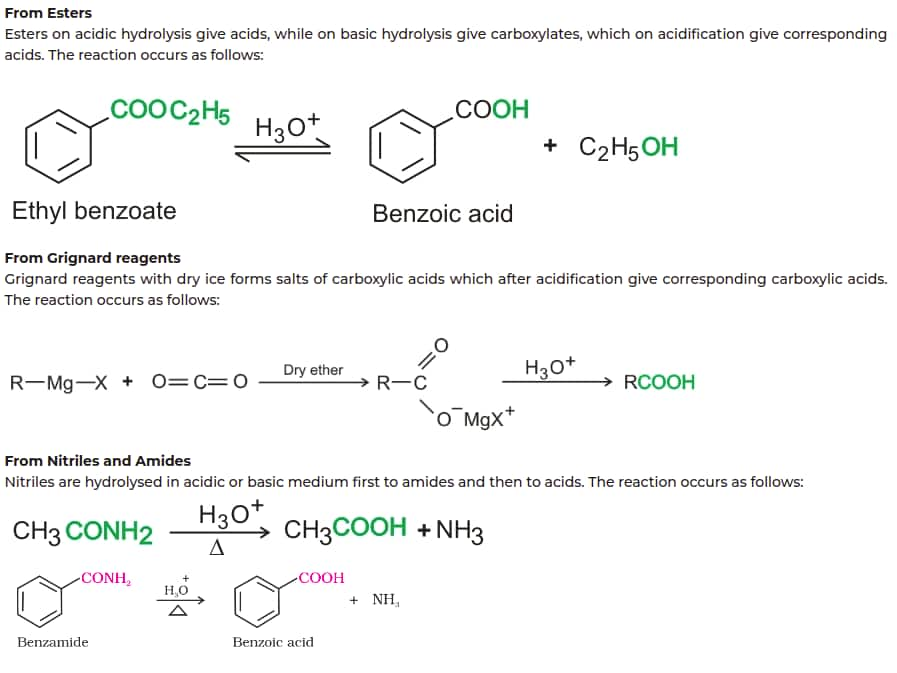
Carboxylic Acids and Derivatives
Method of Preparation of Carboxylic Acid
Candidates must go through all the formulas and practice the mathematical problems. Without formulas, you cannot solve any problem, even if you know how to solve it. Revising the formulas daily is very important. Here we have provided the Mathematics formulas for JEE Mains.
Sets, Relations, and Functions
Complex Numbers and Quadratic Equations
Matrices and Determinants
Sequence and Series
Trigonometry
Co-ordinate Geometry
Limit, Continuity And Differentiability
$(1+x)^n=1+n x+\frac{n(n-1)}{2!} x^2+\frac{n(n-1)(n-2)}{3!} x^3 \ldots$
where, $|x|<1$
DIFFERENTIATION $\frac{d}{d x}($ constant $)=0$ $\frac{d}{d x}\left(\mathbf{x}^{\mathbf{n}}\right)=\mathbf{n} \mathbf{x}^{\mathbf{n}-\mathbf{1}}$ $\frac{d}{d x}\left(\mathbf{a}^{\mathbf{x}}\right)=\mathbf{a}^{\mathbf{x}} \log _{\mathrm{e}} \mathbf{a}$
$\frac{d}{d x}\left(\mathbf{e}^{\mathbf{x}}\right)=\mathbf{e}^{\mathbf{x}} \log _{\mathbf{e}} \mathbf{e}=\mathbf{e}^{\mathbf{x}}$
$\frac{d}{d x}\left(\log _{\mathbf{a}}|\mathbf{x}|\right)=\frac{1}{\mathbf{x} \log _{\mathbf{e}} \mathbf{a}}, \quad \mathbf{x} \neq \mathbf{0}$
$\frac{d}{d x}\left(\log _{\mathrm{e}}|\mathbf{x}|\right)=\frac{1}{\mathbf{x}}, \quad \mathbf{x} \neq \mathbf{0}$
Sum Rule $\frac{d}{d x}(f(x)+g(x))=\frac{d}{d x}(f(x))+\frac{d}{d x}(g(x))$
Difference Rule $\frac{d}{d x}(f(x)-g(x))=\frac{d}{d x}(f(x))-\frac{d}{d x}(g(x))$
Constant Multiple Rule $\frac{d}{d x}(k f(x))=k \frac{d}{d x}(f(x))$
Product Rule $\frac{d}{d x}(f(x) g(x))=g(x) \cdot \frac{d}{d x}(f(x))+f(x) \cdot \frac{d}{d x}(g(x))$
Integral Calculus
Differential Equations
Vector Algebra
$\vec{a} \times \vec{b}=\left|\begin{array}{lll}
\hat{i} & \hat{j} & \hat{k} \\
a_1 & a_2 & a_3 \\
b_1 & b_2 & b_3
\end{array}\right|$
Statistics and Probability
Median of Ungrouped Data. If $n$ is odd :
$\text { Median }=\left(\frac{n+1}{2}\right)^{t h} \text { observation }$
If $\mathbf{n}$ is even :
$\text { Median }=\frac{\text { Value of }\left(\frac{n}{2}\right)^{t h} \text { observation }+ \text { Value of }\left(\frac{n}{2}+1\right)^{t h} \text { observation }}{?}$
Median of Continuous Frequency Distribution: Median $=l+\frac{\left(\frac{N}{2}-c f\right)}{f} \times h$ where,
l = lower limit of median class,
N = number of observations,
cf $=$ cumulative frequency of class preceding the median class,
$\mathrm{f}=$ frequency of median class,
$\mathrm{h}=$ class size (width) (assuming class size to be equal).
Mode $=l+\left(\frac{f_1-f_0}{2 f_1-f_0-f_2}\right) \times h$
where
$\mathrm{l}=$ lower limit of the modal class,
$\mathrm{h}=$ size of the class interval (assuming all class sizes to be equal),
$\mathrm{f}_1=$ frequency of the modal class,
$\mathrm{f}_0=$ frequency of the class preceding the modal class,
$f_2=$ frequency of the class succeeding the modal class.
Standard Deviation $\sigma=\sqrt{\frac{1}{n} \sum_{i=1}^n\left(x_i-\bar{x}\right)^2}$
The JEE Main 2027 syllabus for Physics, Chemistry, and Mathematics is based on the NCERT Class 11 and 12 curriculum. It includes important topics such as Mechanics, Electricity and Modern Physics under Physics, Physical, Organic and Inorganic Chemistry under Chemistry and Algebra, Calculus and Coordinate Geometry under math. The syllabus is designed to test the conceptual understanding, application and problem solving skills. To score high, one needs to study NCERT books thoroughly and solve JEE Main mock tests and previous years’ question papers. For detailed Syllabus Information, visit the JEE Main 2027 Syllabus Page.
Students often find it challenging to learn formulas for the JEE Main, but with the right approach, they can effectively remember them. Given below are some points to remember:
1. Students must try to understand why a formula works. For example, derivations in Physics or Maths often follow a logical pattern.
2. Then break down formulas into chapters or topics.
3. To learn these formulas easily, try to make a formula notebook.
4. Sometimes students must try to make Mnemonics and short tricks, as it helps in quick revision.
5. Try to solve as many questions and revise
6. Try to use diagrams and flowcharts.
Below are some tips on how to revise formulas for JEE Main
Create a formula sheet: Note down all important formulas subject-wise in one place and revise it daily.
Understand the derivation: Knowing how a formula is derived makes it easier to recall during the exam.
Practice with PYQs: Solving previous year questions helps identify which formulas are most frequently tested.
Use spaced repetition: Revise formulas at regular intervals—daily, then alternate days, then weekly—for better retention.
Group-related formulas: Revising interconnected formulas together (e.g., all kinematics equations) helps avoid confusion.
Test yourself regularly: Cover the sheet and try recalling formulas from memory to identify and fill gaps.
Frequently Asked Questions (FAQs)
The formula of molecular mass in terms of vapor density is
Molecular mass = 2 * vapor density
Revision is the best way to remember all the formulas. Practice more questions based on formulas and revise the formulas on a daily basis.
Yes, you can derive the formula during the exam but it is very time-consuming so candidates must learn all the formulas to save time during the exam.
General formula for alkanes is CnH2n+2 , alkenes is CnH2n and for alkynes is C
nH2n-2 respectively.
Formulas from topics like Mechanics, Electrostatics, Calculus, Organic Chemistry reactions, and Thermodynamics carry the highest weightage and must be prioritised.
A formula sheet is a helpful revision tool, but it must be supported by regular practice and concept clarity to be effective.
Revising 10–15 formulas per day across all three subjects is a manageable and effective target.
Mathematics has the highest number of formulas, followed by Physics and Chemistry.

On Question asked by student community
Hello Student,
If you JEE mains 2026 category rank is around 60,000, your chance of getting admission to NITs or IIITs depend largely on your category, CRL Rank, Home state quota and preferred branch based on previous year closing ranks admission to top NIT and popular branches such as CSE,
Hi there,
Considering your JEE Advanced 2026 rank of 1510, it looks like both ECE at IIT Kharagpur and Mathematics & Computing (MnC) at IIT Roorkee are great options.
The choice is a matter of your career prospects, rather than Institute prestige, as both IITs are among the top engineering
Hello Student,
With a PES University JEE main merit rank of 7697, your chances of getting B.Tech CSE (AI) will depend on the number of seats available, category (if applicable), and the closing rank for the current admission cycle. Based on previous year trends, admission to highly sought after branches
Hello student,
If you are seeking admission to B tech programme through your JEE main score for the year 2026 - 2027 academic session, the registration and counselling process is expected to being after the declaration of JEE mains results. For admission to NITs, IIITs and GFTIs, candidate need to
Hello Student,
With a JEE Mains rank of around 2,30,000 getting admission to top NITs through JOSSA counselling under the General category is likely to be difficult, as the closing rank for most NIT branches are usually much lower. However, you chances may improve if you belong to a reserved

Among top 100 Universities Globally in the Times Higher Education (THE) Interdisciplinary Science Rankings 2026
Last Date to Apply: 15th June | Ranked #43 among Engineering colleges in India by NIRF | Highest Package 1.3 CR , 100% Placements
40 LPA Highest Package | Up to 100% Scholarship worth 24 Crore via GUTS exam
3000+ Successful Placements | 100+ Leading Recruiters
4000+ Placements to date | 6000+ Students | Advanced applied research, patents, and partnerships
Mark presence in the Modern Architectural field with Bachelor of Architecture | Highest CTC : 70 LPA | Accepts NATA Score