
Search Colleges, Exams, Schools & more


Login
JoSAA 2026 Seat Matrix Out: 4,470 New Seats Added Across IITs, NITs, IIITs, GFTIs
#JoSAA Counselling
The Joint Seat Allocation Authority (JoSAA) has released the seat matrix for the JOSAA 2026 at josaa.admissions.nic.in. There is a major increase of 4,470 seats in 2026. This increase will create more opportunities for students seeking admission through JEE Main 2026 and JEE Advanced 2026 scores. JOSAA 2026 counselling process started on June 2, and the last date for submitting the choices for mock allotment is June 11, 2026.
This Story also Contains
- JoSAA 2026 Seat Matrix: Total Seats Increased to 67,323
- 666 Seats Increased in IITs
- NITs Increase Seat Intake
- IIITs Record the Highest Growth
- Significant Rise in GFTI Seats
Besides, in 2026, IISc Bangalore is also participating in JoSAA counselling with admission to its four BTech programmes. Also, the number os GFTIs has increased to 56 from 47 in 2025. This addition of colleges is also a major reason for this increase in JOSAA seats.
JoSAA 2026 Seat Matrix: Total Seats Increased to 67,323
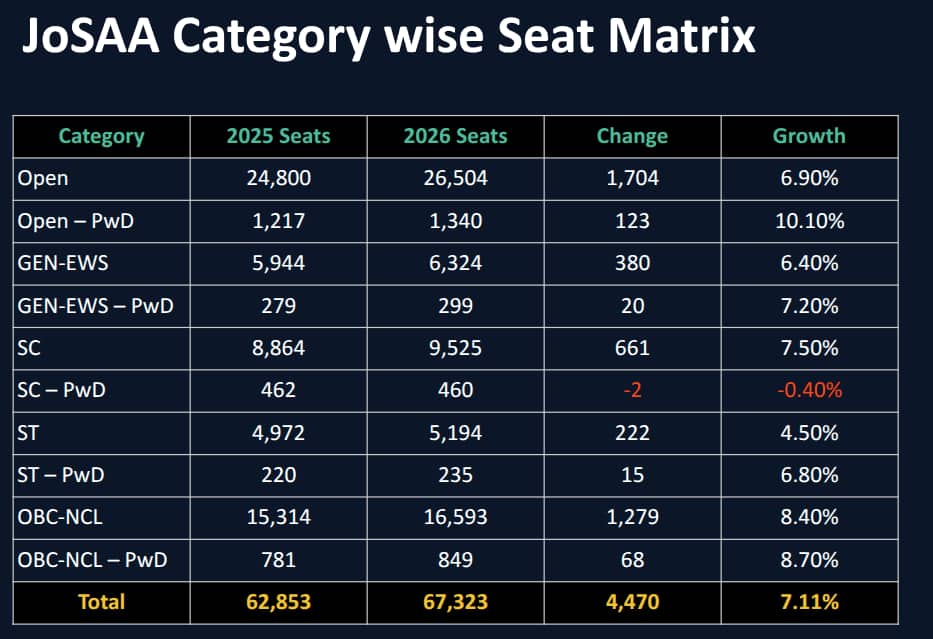
This year, 138 institutes participating in JOSAA counselling are offering a total of 67,323 seats, compared to 62,853 seats in 2025. Of these, 1,017 seats were added to existing courses and institutes, while 3,453 seats were introduced through new courses and programs. There is a growth of 7.11%. The number of seats in the Indian Institutes of Technology (IITs) increased by 666. Below is the increase in the number of seats in all IITs, NITs, IIITs, and GFTIs.
College-Wise Seat Increase in JoSAA 2026
Institute Category | Seats in 2025 | Seats in 2026 | Increase |
IITs | 18,160 | 18,826 | 666 |
IISc Bangalore | - | 125 | 125 |
NITs | 24,525 | 25,162 | 637 |
IIITs | 9,940 | 11,518 | 1,578 |
GFTIs | 10,228 | 11,692 | 1,464 |
Total | 62,853 | 67,323 | 4,470 |
Confused About College Admissions?
Get expert advice on college selection, admission chances, and career path in a personalized counselling session.
Book a Counselling Slot
Select Date
Pick a Slot
666 Seats Increased in IITs
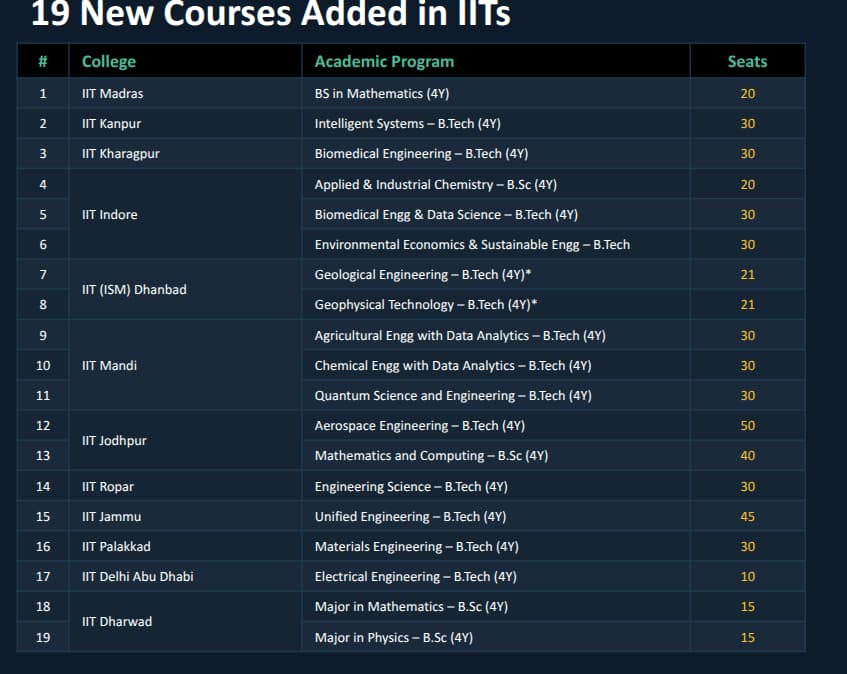
The number of seats in Indian Institutes of Technology (IITs) increased by 666. These seats are increased because of 19 new courses. Last year, the IITs were offering a total of 18160 seats, which have now increased to 18826. Admission to all the IITs and IISc Bangalore is through JEE Advanced 2026 scores.
NITs Increase Seat Intake
The number of seats in the National Institutes of Technology (NITs) has also increased from 24,525 in 2025 to 25,162 in 2026. This increase in the JOSAA seats will improve the chances of candidates of securing admission to some of the best engineering colleges in India.
IIITs Record the Highest Growth
Among all JOSAA participating institutes, IIITs witnessed the largest increase in engineering seats. The total number of seats in IIITs has increased from 9,940 to 11,518, which is a growth of 1,578 seats. This is the highest growth recorded among all categories in the JoSAA 2026 seat matrix.
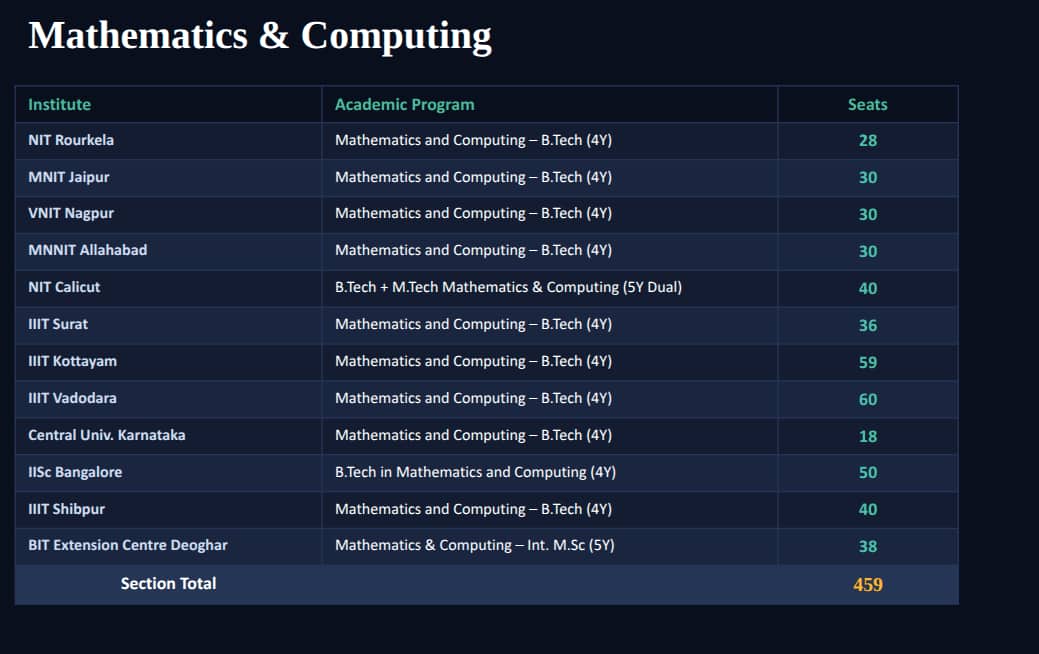
Number of Seats in Mathematics & Computing Course![Number of Seats in Mathematics & Computing Course]()
Significant Rise in GFTI Seats
Government-funded technical institutes (GFTIs) have also increased the number of seats from 10,228 to 11,692, adding 1,464 seats this year. This increase is also because of the addition of some more GFTIs in the list of participating colleges
Articles
Other Stories
|
Upcoming Engineering Exams
Certifications By Top Providers
Explore Top Universities Across Globe
Popular Courses and Specializations
List of colleges accepting JoSAA Counselling


Applications for Admissions are open.
Ranked #43 among Engineering colleges in India by NIRF | Get Upto 100% Scholarships
Woxsen University, Hyderabad
ApplyScholars’ Round Deadline: 14th Nov’26 | Earn upto 50% merit Scholarship + 10% for top performers | EFMD Accredited | AACSB (USA) & AMDISA Member | Highest CTC 28 LPA
Parul Institute of Technology, Vadodara
ApplyDiploma (17 Specializations), B.Tech / B.Tech (Hons.) / IE-B.Tech - 4 years - 25+ specializations | M. Tech - 14+ specializations | Highest CTC – 60 LPA
Parul University, Goa
ApplySpecial Scholarship for Students from Goa (Get an exclusive scholarship of ₹20,000 if you're a Goa-based student) | Bringing Parul Education Trust's 30-year Education Legacy to Goa
JSS Academy of Technical Education, Bangalore
ApplyNAAC A+ Grade | Affiliated to VTU & approved by AICTE.
Dr Vishwanath Karad MIT World Peace University, Pune
ApplyHighest CTC 30 LPA | #9 in Management Category by Times B-School | Merit-Based Scholarship Upto - 50 Crores
JoSAA Counselling Notifications
Explore Career Options
By IndustryNever miss JoSAA Counselling update
Get timely JoSAA Counselling updates directly to your inbox. Stay informed!