School of Computer Science, UPES, Dehradun
Ranked #43 among Engineering colleges in India by NIRF | Get Upto 100% Scholarships


Every year, over 1.5 million students compete in the Joint Entrance Examination (JEE), India's most grueling academic challenge. Only one emerges as the All India Rank (AIR) 1 topper, a title that represents the pinnacle of academic achievement in the country. These students are celebrated as the brightest minds India produces. But what happens to them after they leave the hallowed halls of the IITs?
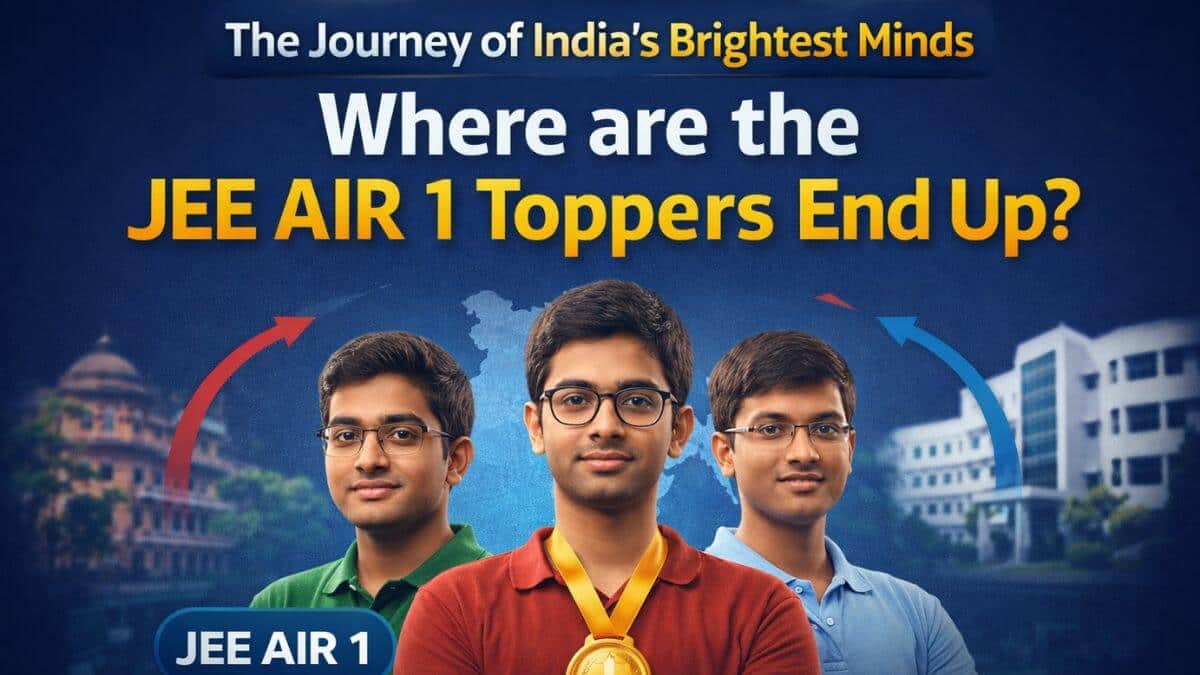
Careers360 conducted a comprehensive study tracking JEE toppers from 1990 to 2020. What it reveals is a startling pattern and raises fundamental questions about India's ability to retain its finest talent. The data paints a picture of ambition, opportunity, and a trend toward global aspiration and migration. The worrying thing is that this trend has only accelerated over the past three decades.
Between 1990 and 2020, of the 31 students who secured the top rank in the JEE:
Category | Count | Percentage |
Outside India | 23 | 74.20% |
India | 8 | 25.80% |
When data from thirty-one JEE toppers between 1990 and 2020 were traced and analyzed, a striking pattern surfaced:
Of these 31 toppers, 23 live and work outside India, while only 8 remain in the country. That is 74% of toppers migrating out of India.
Five of those eight who are based in India work for multinational or foreign-founded companies within India.
Only three of India’s best rank-holders over thirty years are working for Indian-owned institutions or enterprises. So, less than 10% work for Indian Companies!!
Ranked #43 among Engineering colleges in India by NIRF | Get Upto 100% Scholarships
Scholars’ Round Deadline: 14th Nov’26 | Earn upto 50% merit Scholarship + 10% for top performers | EFMD Accredited | AACSB (USA) & AMDISA Member | Highest CTC 28 LPA
In other words, nearly three-quarters of India’s most celebrated students are contributing their skills, research, and innovations to economies outside of India. And of that majority, over half have made the United States their long-term home.
Get expert advice on college selection, admission chances, and career path in a personalized counselling session.
United States Dominates, India Retention Drops to Just 26%
Location | Count | Percentage |
USA | 17 | 54.80% |
India | 8 | 25.80% |
Switzerland | 2 | 6.50% |
Canada | 1 | 3.20% |
Netherlands | 1 | 3.20% |
Hong Kong | 1 | 3.20% |
South Korea | 1 | 3.20% |
More than half of all JEE AIR 1 toppers (17 out of 31) are now based in the United States. This concentration reflects a long-standing pattern where the world’s largest economy, combined with top-tier universities and research institutions, becomes the natural destination for India’s brightest minds. As noted in the transcript, “55% of the students that IIT is producing are based in the USA, and 75% of them are based outside of India.”
The appeal of the US is further reinforced by graduate school choices: among toppers who pursued higher education, Stanford and MIT alone accounted for 55% of all selections, and nearly 90% chose American universities for their master’s or doctoral studies.
The trend becomes even more dramatic when viewed over time:
Period | India | Outside India |
1990–2010 | 7 (33.3%) | 14 (66.70%) |
2011–2020 | 1 (10%) | 9 (90%) |
The evolution in settlement choices among JEE toppers reveals a dramatic acceleration in global migration. Between 1990 and 2010, 7 of the 21 toppers (33%) remained in India, while 14 (67%) settled abroad. In the following decade, from 2011 to 2020, the numbers flipped sharply: only 1 out of 10 toppers (10%) stayed in India, and 9 (90%) chose to work outside the country.
Universities | Count |
Stanford University | 6 |
Massachusetts Institute of Technology USA | 5 |
Carnegie Mellon University | 1 |
ETH Zurich | 1 |
Harvard University | 1 |
Princeton University | 1 |
Rutgers University | 1 |
UC San Diego | 1 |
University of California | 1 |
University of Cambridge | 1 |
Stanford and MIT together claim 11 of the 19 toppers who pursued higher education—55% of all graduate school choices. The United States hosts nearly 90% of these students, with the remaining few scattered across Switzerland, the UK, and other global institutions.
Studied | Course | Count of Name | Total |
IIT Bombay | B.Tech CSE | 13 | 16 (51.60%) |
B.Tech EE | 2 | ||
B.Tech EEE | 1 | ||
IIT Kanpur | B.Tech CSE | 7 | 7 (22.60%) |
IIT Delhi | B.Tech CS | 1 | 4 (12.90%) |
B.Tech CS (Honours) | 1 | ||
B.Tech CSE | 2 | ||
IIT Madras | B.Tech CSE | 2 | 2 (6.50%) |
MIT USA | Bachelor of Computer Science | 1 | 2 (6.50%) |
M.Eng Computer Science | 1 |
More than half of all JEE toppers (16 out of 31) chose IIT Bombay, making it the undisputed leader. IIT Kanpur follows with seven, while IIT Delhi, IIT Madras, and even MIT USA account for the rest. However, since 2007 onwards, nearly every topper has selected IIT Bombay’s Computer Science Engineering program, cementing its dominance.
Country | Count | Outside India | India |
PhD | 13 | 100% | 0% |
Masters | 6 |
Every JEE topper who opted for higher education chose an institution outside India. Of the 31 AIR 1 rank holders between 1990 and 2020, 19 pursued Post Graduate studies abroad. Six completed a master’s, and 13 earned a doctorate. Not a single one studied in India for advanced studies .
As the data confirms, every single student who is an IIT JEE topper has chosen outside of India to pursue their higher education. This complete academic exodus underscores a stark reality: India’s brightest minds consistently look beyond its borders for research and graduate training, with none returning to build their academic careers at home.
Category | Count | Percentage |
Academia / Research | 10 | 32.30% |
Big Tech | 7 | 22.60% |
Quant / Finance | 6 | 19.40% |
Startups / Leadership | 3 | 9.70% |
Intern / Early | 2 | 6.50% |
Government | 1 | 3.20% |
Other | 2 | 6.50% |
Before 2000, toppers overwhelmingly gravitated toward academia and research. Six out of 11 toppers from this era pursued academic careers, many becoming distinguished professors at top global universities.
After 2000, the pattern shifted dramatically. The majority now choose careers in big tech, quantitative finance, and startups moving rapidly up corporate ladders rather than pursuing advanced degrees.
Beyond the numbers lie remarkable human stories that illuminate the choices these exceptional individuals have made
Subhash Khot, The 1995 JEE Topper, is the Julius Silver Professor of Computer Science at NYU's Courant Institute, and is best known for proposing the Unique Games Conjecture in 2002. This is now the most-studied conjecture in theoretical computer science.
Sanjeev Arora, The Jee Topper of 1986, was Subhash Khot’s PhD supervisor. He transferred to MIT after two years at IIT Kanpur, and is now the Charles C. Fitzmorris Professor of Computer Science at Princeton, and founding director of Princeton Language and Intelligence, a unit devoted to the study of large AI models. So the 1986 and 1995 toppers are connected by one of the most celebrated advisor-student relationships in CS history.
Arvind Saraf (1997) From a Marwadi business family in Surat who didn't even start JEE prep until after 10th grade, Saraf went to IIT Kanpur and pursued Post Graduation at MIT. He worked at Google India,quit in 2008 to co-found Swasth India, a technology-powered healthcare NGO targeting India's poor, which attracted one of the first VC investments made by Ratan Tata.
Rina Panigrahy (1991) topped JEE and went on to become a Principal Researcher at Microsoft Research and later Google Research.
Nitin Gupta (2000) made a dramatic pivot from CS to biology at UC San Diego, then returned to IIT Kanpur in 2014 as a faculty member in Biological Sciences. He is one of the very few toppers to permanently return and build an academic career in India.
The pattern: The 1990s toppers overwhelmingly gravitated to academia (6 out of 11), while the post-2000 cohort increasingly split toward Big Tech, finance (quant trading), and startups.
Satvat Jagwani (JEE topper 2015) enrolled at IIT Bombay but dropped out in 2017 to join MIT for BS/MS in Computer Science.
Chitraang Murdia (JEE Topper 2014) joined B.Tech CS at IIT Bombay but dropped out one year later to pursue a Bachelor's in Physics at MIT.
Chirag Falor (JEE Topper 2020) secured the top rank but opted for MIT over any IIT entirely, aiming to pursue space sciences and astrophysics research.
Immadi Prudhvi Tej (2011) pursued Electrical Engineering from IIT Bombay, then cracked UPSC CSE in 2017 with AIR 24 and is now an Assistant Collector in Andhra Pradesh.
Sarvesh Mehtani (JEE Topper 2017) completed his B.Tech CS from IIT Bombay in 2021 and is now working as a Quantitative Trader at Optiver in Amsterdam. Pranav Goel (JEE Topper of 2018), also chose to be a quantitative trader.
Arvind Thiagarajan (JEE Topper, 2001) completed his PhD from MIT, interned at Google and Yahoo, holds 42 patents, and is currently a Research Scientist at Amazon.
Pallerla Sai Sandeep Reddy (JEE Topper, 2013) pursued a PhD in CS from MIT and later worked at American Express before joining Microsoft.
Every topper has the right to pursue the best opportunities available to them. The question is about what these collective choices say about India's ecosystem for talent.
Why do the country's brightest minds see no compelling reason to stay? Why does India lack world-class graduate programs that could retain these students for advanced study? Why do research careers in India not attract the best talent?
This is a damning indictment of how good we are at retaining the best talent to pursue masters and research within India. Everyone who wants to do academic research chooses to pursue it outside of India.
The story of India's JEE toppers is one of extraordinary individual achievement and troubling collective outcomes. These 31 individuals represent the absolute pinnacle of India's education system and the best of the best from a pool of over 1.5 million annual aspirants.
Their trajectories show that Indian talent can compete with and excel anywhere in the world. But they also show that India has not yet created an environment where even its brightest minds feel compelled to stay, build, and contribute within the country.
For a nation aspiring to become a global leader in technology, research, and innovation, this data should serve as both a reality check and a call to action. The best minds India produces are choosing to work elsewhere. The question is: what will it take to make them choose India instead?

On Question asked by student community
Yes IIT Delhi will except admissions from JEE Advanced?
Hello Student,
You can check the resource provided below:
JEE Main Chapter-wise Weightage 2027
Hope this helps!
Hello student!
You can download the JEE Main April 2026 official question paper from the link below. You can also visit the page below for shift-wise question papers and solutions to practise questions and analyse the exam pattern.
JEE Main April 2026 Official Question Paper:
https://engineering.careers360.com/download/ebooks/jee-main-2026-april-session-official-question-paper
JEE Main 2026 Shift-Wise
Hello Student,
You can prepare for JEE Main 2027 by referring to the article below. It provides preparation tips, study strategies, and guidance to help you prepare effectively for the exam.
JEE Main Preparation Tips 2027: Check Preparation Strategy, Tricks
Hope this helps!
Hi Rishabh
Check the link below for the JEE Main Paper 2A question papers.

Ranked #43 among Engineering colleges in India by NIRF | Get Upto 100% Scholarships
Scholars’ Round Deadline: 14th Nov’26 | Earn upto 50% merit Scholarship + 10% for top performers | EFMD Accredited | AACSB (USA) & AMDISA Member | Highest CTC 28 LPA
Diploma (17 Specializations), B.Tech / B.Tech (Hons.) / IE-B.Tech - 4 years - 25+ specializations | M. Tech - 14+ specializations | Highest CTC – 60 LPA
Special Scholarship for Students from Goa (Get an exclusive scholarship of ₹20,000 if you're a Goa-based student) | Bringing Parul Education Trust's 30-year Education Legacy to Goa
NAAC A+ Grade | Affiliated to VTU & approved by AICTE.
Courses designed with CTOs, Data Scientists, and Cybersecurity experts | 50+ elective options