IITs- A Complete Guide
Dive into everything you need to know about IITs—from eligibility and cutoffs to fees and placements.


Chemistry is a high-scoring section in JEE Main when you prepare correctly you focus on right chapters and practise regularly. However, NTA does not release an official chapter-wise weightage for JEE Main 2027. To help students plan their preparation stretagy, in this article we have analysed 475 Chemistry questions from the January and April 2026 JEE Main sessions. It tels you the chapters and topics that appeared most frequently and can help you prioritise your revision for JEE Main exam.
In this article, we will break down the JEE Main Chemistry chapter-wise weightage using exam-pattern data from the 2026 sessions (January and April combined), so you know precisely which chapters deserve your attention first.
This Story also Contains
JEE Main Chemistry is divided into three broad branches. Branch-wise syllabus and weightage are given in the table below:
Branch | Approx. Weightage | Key Chapters |
Physical Chemistry | 37.05% | Atomic Structure, Thermodynamics, Equilibrium, Chemical Kinetics, Redox & Electrochemistry, Solutions, Basic Concepts, Practical Chemistry |
Organic Chemistry | 35.58% | Basic Principles of Organic Chemistry, Hydrocarbons, Halogen/Oxygen/Nitrogen Compounds, Purification & Characterisation, Biomolecules |
Inorganic Chemistry | 27.37% | Classification of Elements & Periodicity, Chemical Bonding, p-Block, d- & f-Block Elements, Co-ordination Compounds |
Also Read: JEE Main Chemistry Syllabus 2027
Get expert advice on college selection, admission chances, and career path in a personalized counselling session.
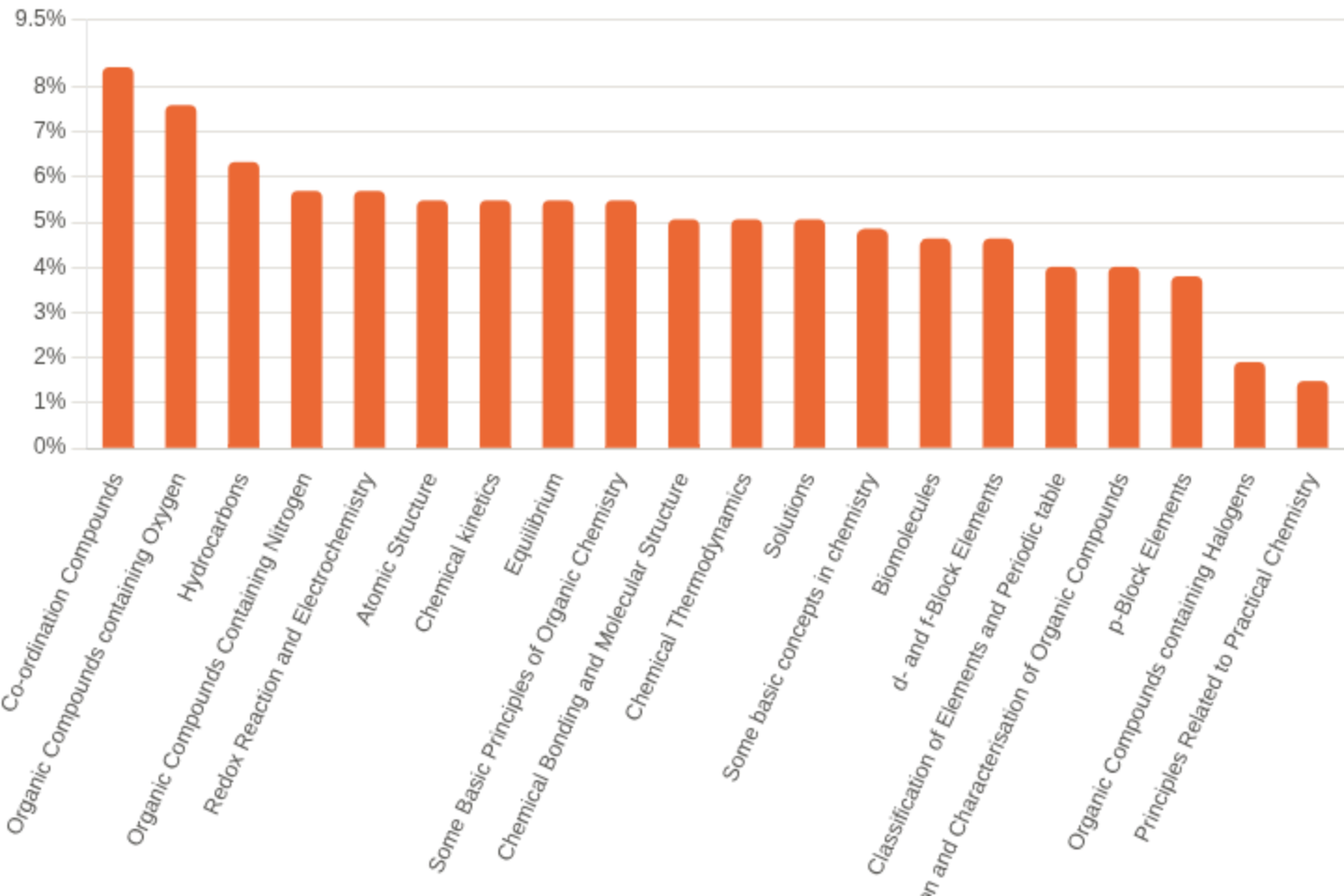
So, based on the January and April 2026 sessions put together, a total of 475 Chemistry questions were asked in JEE Main. The table below shows the overall JEE Main Chemistry chapter-wise weightage, ordered from the highest to the lowest.
Chapter Name | No. of Questions January Session 2026 | No. of Questions April Session 2026 | Weightage |
Co-ordination Compounds | 23 | 17 | 8.42% |
Organic Compounds Containing Oxygen | 22 | 14 | 7.58% |
Hydrocarbons | 13 | 17 | 6.32% |
Organic Compounds Containing Nitrogen | 14 | 13 | 5.68% |
Redox Reactions and Electrochemistry | 16 | 11 | 5.68% |
Atomic Structure | 14 | 12 | 5.47% |
Chemical Kinetics | 13 | 13 | 5.47% |
11 | 15 | 5.47% | |
14 | 12 | 5.47% | |
Chemical Bonding and Molecular Structure | 12 | 12 | 5.05% |
Chemical Thermodynamics | 13 | 11 | 5.05% |
14 | 10 | 5.05% | |
14 | 9 | 4.84% | |
Biomolecules | 9 | 13 | 4.63% |
d- and f-Block Elements | 11 | 11 | 4.63% |
Classification of Elements and Periodicity | 9 | 10 | 4.00% |
Purification and Characterisation of Organic Compounds | 9 | 10 | 4.00% |
10 | 8 | 3.79% | |
4 | 5 | 1.89% | |
Principles Related to Practical Chemistry | 5 | 2 | 1.47% |
Also Check:
Also Read:
If you want to prioritise the most asked chapters, these are the high weightage chapters for JEE Main Chemistry that consistently deliver the most marks:
You can watch the video for more details:
Chapter | Weightage | Frequently Asked Topics |
Coordination Compounds | 8.42% | Crystal Field Theory (CFT), Valence Bond Theory (VBT), magnetic moment, IUPAC nomenclature, geometrical and optical isomerism |
Organic Compounds Containing Oxygen | 7.58% | Alcohols, phenols, ethers, aldehydes, ketones, carboxylic acids, named reactions, reaction mechanisms |
Hydrocarbons | 6.32% | Alkanes, alkenes, alkynes, aromatic compounds, aromaticity, electrophilic substitution, reaction mechanisms |
Organic Compounds Containing Nitrogen | 5.68% | Amines, diazonium salts, coupling reactions, diazotisation (NaNO₂ + HCl), reactions of aromatic amines |
Redox Reactions and Electrochemistry | 5.68% | Oxidation number, balancing redox equations, electrochemical cells, Nernst equation, KMnO₄- and K₂Cr₂O₇-based reactions |
If you want to prioritise the top 10 most-asked chapters from the past year, then this table will help you find those chapters easily.
Rank | Chapter Name | January Session | April Session | Total Questions (2026) | Weightage |
1 | Co-ordination Compounds | 23 | 17 | 40 | 8.42% |
2 | Organic Compounds Containing Oxygen | 22 | 14 | 36 | 7.58% |
3 | Hydrocarbons | 13 | 17 | 30 | 6.32% |
4 | Organic Compounds Containing Nitrogen | 14 | 13 | 27 | 5.68% |
5 | Redox Reactions and Electrochemistry | 16 | 11 | 27 | 5.68% |
6 | Atomic Structure | 14 | 12 | 26 | 5.47% |
7 | Chemical Kinetics | 13 | 13 | 26 | 5.47% |
8 | Equilibrium | 11 | 15 | 26 | 5.47% |
9 | Some Basic Principles of Organic Chemistry (GOC) | 14 | 12 | 26 | 5.47% |
10 | Chemical Bonding and Molecular Structure | 12 | 12 | 24 | 5.05% |
Beyond the chapters, it helps to know which subtopics inside them are constantly being asked. The table below gives a JEE Main Chemistry topic-wise weightage breakdown based on a deep analysis of previous years' questions (PYQs), so you know where to concentrate.
Topic | Approx. Questions (PYQ Trend) |
Mole Concept and Molar Mass | 16 |
Magnetic Moment (based on VBT) | 10 |
10 | |
Percentage Composition and Equivalent Weight | 9 |
8 | |
Reduction and Oxidation Reaction | 7 |
6 | |
Magnetic Properties and Character | 6 |
Ionisation Enthalpy / Ionisation Potential | 6 |
Stereoisomerism | 6 |
5 | |
Solubility and Solubility Product | 5 |
Coupling Reaction | 4 |
Shapes of Molecules | 4 |
4 | |
Elevation in Boiling Point | 4 |
Stoichiometry and Limiting Reagent | 3 |
Applications of CFT | 3 |
KMnO4-Based Reactions | 3 |
Reaction with NaNO2 + HCl | 3 |
3 | |
Types of Equilibrium Constant | 3 |
Oxidation State | 2 |
Disaccharides and Polysaccharides | 1 |
Wet Tests for Identification of Cations | 1 |
Chromatography | 1 |
1 | |
Nucleophilic Addition Reaction | 1 |
1 |
Class-wise Distribution of Chemistry Questions (JEE Main 2026 vs 2025)
Year | Class | April Session | January Session |
2026 | XI | 108 | 123 |
XII | 117 | 127 | |
2025 | XI | 90 | 113 |
XII | 135 | 137 |
Section-wise Question distribution of Chemistry (JEE Main 2026 vs 2025)
Year | Organic Chemistry | Physical Chemistry | Inorganic Chemistry |
2026 | 169 questions | 176 questions | 130 questions |
2025 | 169 questions | 176 questions | 130 questions |
Knowing the weightage is only half the battle, here’s how to turn this data into a real study plan for the best chapters to study for JEE Main Chemistry:
Start with the most “heavy” chapters, like Coordination Compounds, Equilibrium, Chemical Kinetics, and Atomic Structure; these should be your first focus points, kinda thing.
Then go NCERT-first, seriously. In Chemistry, a big chunk of the questions, especially from Inorganic and Organic Chemistry, are basically lifted, not word-for-word but closely, from NCERT lines and the examples they give.
After that, do topic-wise PYQs. Don’t jump into random mixed papers too early, instead, solve chapter-wise and topic-wise sets so you internalise the recurring question patterns and the way they like to trap you.
For low-weightage chapters, revise smartly, not deeply for hours. Like Organic Compounds Containing Halogens and Principles Related to Practical Chemistry, these usually carry less weightage, so a quick revision of formulas and facts is often sufficient, rather than doing heavy concept digging.
Also, keep a formula and reaction notebook. This helps a lot in Physical and Organic, a compact page-style list of formulas, named reactions, and exceptions can be a lifesaver in last-minute revision.
Finally, attempt full-length mock tests. Use them to apply the chapter-wise weightage logic in a timed full-syllabus setting, that way, you figure out the ideal order to attempt chapters on exam day, rather than guessing blindly at the start.
Below are links for JEE Main 2027 Mock Tests and Sample Papers.
Frequently Asked Questions (FAQs)
Good or bad depends upon your category. Scoring 70 marks gives you a percentile score of 82 to 90.
The highest weightage chapter of JEE Main 2026 Chemistry is Coordination Compounds.
There are 20 chapters, which are divided into physical, organic and inorganic chemistry.

On Question asked by student community
Dear Student,
You can access JEE Main Mathematics previous-year questions on Careers360. Practising previous-year questions will help you understand the exam pattern and question types.
Hello, since you are in Intermediate 2nd year with the MPC group and preparing for JEE Main, focus on completing the syllabus, revising important concepts and solving previous years’ JEE Main question papers. Take regular mock tests and analyse your mistakes to improve your score. Keep a realistic study schedule
Dear Student
Please specify whether you want Physics, Chemistry, or Mathematics, and which JEE Main/Advanced exam.
Hi Ansh Chauhan
Check the link below for the high-weightage Physics chapters for JEE Main 2027 based on recent exam trends. Students can use these chapters to prioritise their preparation and focus more on topics that have appeared frequently in previous papers.
https://engineering.careers360.com/articles/most-weightage-chapters-for-jee-main-physics-2027
Hi, three months can still be used productively, but right now you should avoid trying to complete everything at once. First, divide the syllabus into high-priority chapters, moderate-priority chapters and low-priority chapters. Focus on concepts and PYQs for the high-priority areas, take regular timed tests and keep a separate list

100+ Recruiters | 1200+ Placements of 2026 Batch | NBA & NAAC Accredited | Highest CTC 37 LPA
Apply for B.E at East Point College of Engineering and Technology | Affiliated to VTU | AICTE Approved | NBA Accredited | Highest CTC 33 LPA
Last Date to Apply: 17th August | QS I-Gauge Diamond Rated | NAAC A+ Accredited | 621 Recruitment Partners | INR 40 LPA Highest CTC | 4482 Job offers
Merit Scholarships | NAAC A+ Accredited | Top Recruiters : E&Y, CYENT, Nvidia, CISCO, Genpact, Amazon & many more
60+ Years of Education Legacy | UGC & AICTE Approved | Scholarship Worth 6 Crores | H-CTC 35 LPA
Application Free of Cost for Limited Time || NAAC A++ Accredited | Highest CTC 52 LPA | #11 in University Category by NIRF