Integral University B.Tech Admissions 2026
NAAC A+ Accredited | Highest CTC 45 LPA | Scholarships Available


Every year, thousands of JEE Main aspirants underestimate one of the highest-scoring and time-efficient chapters in the Mathematics syllabus, Matrices and Determinants. Ask any JEE topper how they managed to finish the Maths section with time to spare, and there's a good chance this chapter comes up. It's rule-based, pattern-driven, and once you've solved enough matrices JEE Main PYQ sets, the questions start to feel almost easy.
This Story also Contains
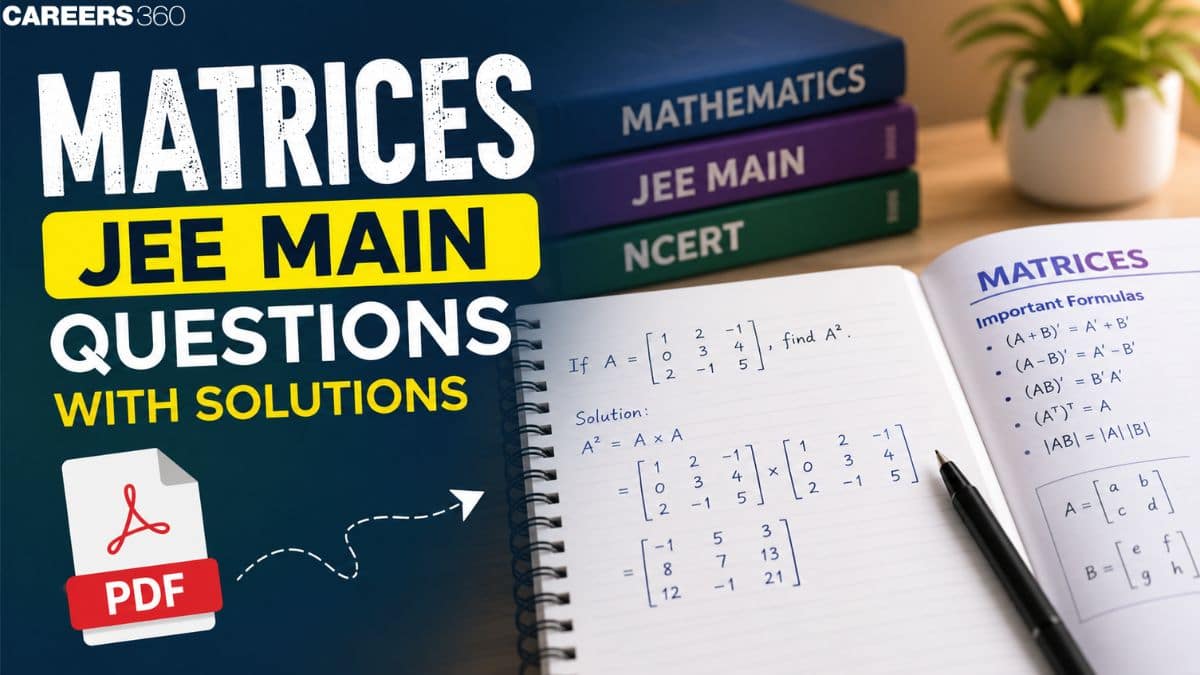
If you're a beginner starting your JEE Main 2027 preparation and searching for clarity on matrices JEE Main questions, this article is for you, covering everything: how much weightage the chapter carries, how many questions to expect, what the last five years of data tell us, and how to actually approach matrices and determinants JEE Main PYQs efficiently.
Also Read: Matrices and Determinants JEE Main Questions free PDF Download
Question 1: For $\alpha, \beta \in \mathbb{R}$, suppose the system of linear equations
$ \begin{aligned} x-y+z &= 5,\\ 2x+2y+\alpha z &= 8,\\ 3x-y+4z &= \beta \end{aligned} $
has infinitely many solutions. Then $\alpha$ and $\beta$ are the roots of
1) $x^2+14 x+24=0$
2) $x^2+18 x+56=0$
3) $x^2-18 x+56=0$
4) $x^2-10 x+16=0$
Correct Answer: (C) $x^2-18 x+56=0$
Solution:
$ \begin{aligned} \left|\begin{array}{ccc} 1 & -1 & 1 \\ 2 & 2 & \alpha \\ 3 & -1 & 4 \end{array}\right| &= 0 \\ 1(8+\alpha)+1(8-3\alpha)+1(-2-6) &= 0 \\ 8+\alpha+8-3\alpha-8 &= 0 \\ -2\alpha &= -8 \\ \alpha &= 4 \end{aligned} $
Since
$D_1=0$, $ \begin{aligned} \left|\begin{array}{ccc} 5 & -1 & 1 \\ 8 & 2 & 4 \\ \beta & -1 & 4 \end{array}\right| &= 0 \\ 5(8+4)+1(32-4\beta)+1(-8-2\beta) &= 0 \\ 60+32-4\beta-8-2\beta &= 0 \\ -6\beta &= -84 \\ \beta &= 14 \end{aligned} $
Therefore, the equation whose roots are $\alpha$ and $\beta$ is $ x^2-(\alpha+\beta)x+\alpha\beta=0 $ $ x^2-18x+56=0 $
Question 2: For the system of linear equations
$ \begin{aligned} x+y+z &= 6 \\ \alpha x+\beta y+7z &= 3 \\ x+2y+3z &= 14 \end{aligned} $
Which of the following is NOT true?
1) If α = β and α ≠ 7, then the system has a unique solution
2) If α = β = 7, then the system has no solution
3) For every point (α, β) ≠ (7,7) on the line x − 2y + 7 = 0, the system has infinitely many solutions
4) There is a unique point (α, β) on the line x + 2y + 18 = 0 for which the system has infinitely many solutions
Correct Answer: For every point (α, β) ≠ (7,7) on the line x − 2y + 7 = 0, the system has infinitely many solutions
Solution:
$ \begin{aligned} x+y+z &= 6 \\ \alpha x+\beta y+7z &= 3 \\ x+2y+3z &= 14 \end{aligned} $
Equation (3) $-$ Equation (1)
$ \begin{aligned} y+2z &= 8 \\ y &= 8-2z \end{aligned} $
From Equation (1),
$ \begin{aligned} x+(8-2z)+z &= 6 \\ x &= -2+z \end{aligned} $
Substituting the values of $x$ and $y$ into Equation (2),
$ \begin{aligned} \alpha(-2+z)+\beta(8-2z)+7z &= 3 \\ -2\alpha+\alpha z+8\beta-2\beta z+7z &= 3 \\ (\alpha-2\beta+7)z &= 2\alpha-8\beta+3 \end{aligned} $
if $\alpha-2 \beta+7 \neq 0$ then system has unique solution
if $(\alpha-2 \beta+7=0)$ and $2 \alpha-8 \beta+3 \neq 0$ then system has no solution if $(\alpha-2 \beta+7=0)$ and $2 \alpha-8 \beta+3=0$ then system has infinite solution
Question 3: Let $P=\left[\begin{array}{lll}1 & 0 & 0 \\ 3 & 1 & 0 \\ 9 & 3 & 1\end{array}\right]$ and $Q=\left[q_{i j}\right]$ be two $3 \times 3$ matrices such that $Q-P^5=I_3$. Then $\frac{q_{21}+q_{31}}{q_{32}}$ is equal to :
1) 15
2) 9
3) 135
4) 10
Correct Answer: 10
Solution:
$ \begin{aligned} &\left( \begin{array}{lll} a_{11} & a_{12} & a_{13} \\ a_{21} & a_{22} & a_{23} \\ a_{31} & a_{32} & a_{33} \end{array} \right) \left( \begin{array}{lll} b_{11} & b_{12} & b_{13} \\ b_{21} & b_{22} & b_{23} \\ b_{31} & b_{32} & b_{33} \end{array} \right) \\[6pt] &= \left( \begin{array}{lll} a_{11}b_{11}+a_{12}b_{21}+a_{13}b_{31} & a_{11}b_{12}+a_{12}b_{22}+a_{13}b_{32} & a_{11}b_{13}+a_{12}b_{23}+a_{13}b_{33} \\ a_{21}b_{11}+a_{22}b_{21}+a_{23}b_{31} & a_{21}b_{12}+a_{22}b_{22}+a_{23}b_{32} & a_{21}b_{13}+a_{22}b_{23}+a_{23}b_{33} \\ a_{31}b_{11}+a_{32}b_{21}+a_{33}b_{31} & a_{31}b_{12}+a_{32}b_{22}+a_{33}b_{32} & a_{31}b_{13}+a_{32}b_{23}+a_{33}b_{33} \end{array} \right) \end{aligned} $
$ P= \left[ \begin{array}{ccc} 1 & 0 & 0 \\ 3 & 1 & 0 \\ 9 & 3 & 1 \end{array} \right], \qquad P^2= \left[ \begin{array}{ccc} 1 & 0 & 0 \\ 6 & 1 & 0 \\ 27 & 6 & 1 \end{array} \right], \qquad P^3= \left[ \begin{array}{ccc} 1 & 0 & 0 \\ 9 & 1 & 0 \\ 54 & 9 & 1 \end{array} \right] $
$ Q= \left[ \begin{array}{ccc} 1 & 0 & 0 \\ 15 & 1 & 0 \\ 135 & 15 & 1 \end{array} \right] + \left[ \begin{array}{ccc} 1 & 0 & 0 \\ 0 & 1 & 0 \\ 0 & 0 & 1 \end{array} \right] = \left[ \begin{array}{ccc} 2 & 0 & 0 \\ 15 & 2 & 0 \\ 135 & 15 & 2 \end{array} \right] $
So, ans $\frac{15+135}{15}=10$
Question 4: Let A be any $3 \times 3$ invertible matrix. Then which one of the following is not always true?
1) $\operatorname{adj}(A)=|A| . A^{-1}$
2) $\operatorname{adj}(\operatorname{adj}(A))=|A| . A$
3) $\operatorname{adj}(\operatorname{adj}(A))=|A|^2 \cdot(\operatorname{adj}(A))^{-1}$
4) $\operatorname{adj}(\operatorname{adj}(A))=|A| \cdot(\operatorname{adj}(A))^{-1}$
Correct Answer: (4) $\operatorname{adj}(\operatorname{adj}(A))=|A| \cdot(\operatorname{adj}(A))^{-1}$
Solution:
The inverse of a matrix -
$A^{-1}=\frac{1}{|A|} \cdot \operatorname{adj} A$
Option 1: $A^{-1}=\frac{\operatorname{adj}(A)}{|A|}$ (By formula)
Option 2: $\operatorname{adj}(\operatorname{adj}(\mathrm{A}))==|A|^{n-2} A$
Put $\mathrm{n}=3$
$\therefore \operatorname{adj}(\operatorname{adj}(A))=|A|^{3-2} A=|A| A$
Option 3: and 4
$ \begin{aligned} \because\; A(\operatorname{adj} A) &= |A|I_n \\[4pt] (\operatorname{adj} A)^{-1} &= \frac{A}{|A|} \\[4pt] \operatorname{adj}(\operatorname{adj} A) &= |A|^2(\operatorname{adj} A)^{-1} \\[4pt] &= |A|^2\left(\frac{A}{|A|}\right) \\[4pt] &= |A|A \end{aligned} $
Question 5: Suppose A is any $3 \times 3$ non-singular matrix and $(\mathrm{A}-3 \mathrm{I})(\mathrm{A}-5 \mathrm{I})=\mathrm{O}$, where $\mathrm{I}=\mathrm{I}_3$ and $\mathrm{O}=\mathrm{O}_3$. If $\alpha \mathrm{A}+\beta \mathrm{A}^{-1}=4 \mathrm{I}$, Then $\alpha+\beta$ is equal to:
1) 8
2) 7
3) 13
4) 12
Correct Answer: (1) 8
Solution:
The Inverse of a matrix -
A non-singular square matrix of order $n$ is invertible if there exists a square matrix B of the same order such that $A B=I=B A$
$ \begin{aligned} (A-3I)(A-5I) &= 0 \\ \Rightarrow A^2-8A+15I &= 0 \qquad \cdots (i) \end{aligned} $
Also given that $\alpha A+\beta A^{-1}=4 I$
Multiply both sides by A
$\Rightarrow \alpha A^2-4 A+\beta I=0 \cdots \cdots(i i)$
Compare (i) and (ii)
$ \begin{aligned} A^2-8A+15I &= 0,\\ \alpha A^2-4A+\beta I &= 0. \end{aligned} $
Thus, $\frac{1}{\alpha}=\frac{8}{4}=\frac{15}{\beta}$
Thus, $\alpha=\frac{1}{2}$ and $\beta=\frac{15}{2}$
$\Rightarrow \alpha+\beta=8$
Question 6: For two 3 × 3 matrices A and B, let A + B = 2B' and 3A + 2B = I3, where B' is the transpose of B and I3 is 3 × 3 identity matrix. Then :
1) 5A + 10B = 2I3
2) 10A + 5B = 3I3
3) B + 2A = I3
4) 3A + 6B = 2I3
Correct Answer: (2) 10A + 5B = 3I3
Solution:
Given A + B = 2B' .............(1)
Taking transpose of both the sides
(A + B)' = (2B')'
A' + B' = 2(B')'
A' + B' = 2B ...........(2)
Also given, 3A + 2B = I ....(3)
Taking transpose of both sides
3A' + 2B' = I ....(4)
(Note: Transpose of I is I itself)
Now from these 4 equations, we need to get a relation in A and B by eliminating A' and B'
Let us first eliminate B'
From (4): 3A' + A + B = I (Using (1)) ....(5)
And 2 x (2):
2A' + 2B' = 4B
2A' + A + B = 4B
2A' + A - 3B = 0 .....(6)
From (5) and (6) we can eliminate A' as well
From (5): 3A' = I - A - B .....(7)
From (6): 2A' = 3B - A .....(8)
2x(7) - 3x(8): 0 = 2I + A - 11B .....(9)
From (9) and (3): A = B = I/5
For option (B) : 10A + 5B = 2I + I = 3I
Question 7: If the matrices $A=\left[\begin{array}{ccc}1 & 1 & 2 \\ 1 & 3 & 4 \\ 1 & -1 & 3\end{array}\right], B=\operatorname{adj} A$ and $C=3 A$, then $\frac{|\operatorname{adj} B|}{|C|}$ is equal to:
1) 16
2) 12
3) 8
4) 72
Correct Answer: (3) 8
Solution:
$\begin{aligned} & |A|=\left|\begin{array}{ccc}1 & 1 & 2 \\ 1 & 3 & 4 \\ 1 & -1 & 3\end{array}\right|=6 \\ & |\operatorname{adj} B|=|\operatorname{adj} \operatorname{adj} A|=|A|^{(n-1)^2}=|A|^4=(36)^2 \\ & |C|=|B A|=3^3 \times 6 \frac{|\operatorname{adjB}|}{|C|}=\frac{36 \times 36}{3^3 \times 6}=8\end{aligned}$
Question 8: The following system of linear equations
$ \begin{aligned} 7x+6y-2z &= 0, \\ 3x+4y+2z &= 0, \\ x-2y-6z &= 0. \end{aligned} $
has
1) infinitely many solutions, $(x, y, z)$ satisfying $y=2 \approx$
2) infinitely many solutions, $(x, y, z)$ satisfying $x=2 z$.
3) no solution
4) only the trivial solution.
Correct Answer: (2) infinitely many solutions, $(x, y, z)$ satisfying $x=2 z$.
Solution:
(1) $7 x+6 y-2 z=0$
[2) $3 x+4 y+2 z=0$
(3) $x-2 y-6 z=0$
$ \left| \begin{array}{ccc} 7 & 6 & -2 \\ 3 & 4 & 2 \\ 1 & -2 & -6 \end{array} \right| =7(-20)-6(-20)-2(-10) =-140+120+20=0 $
So infinite non-trivial solutions exist
Now equation (1) +3 equation (3)
$ \begin{aligned} 10x-20z &= 0 \\ x &= 2z \end{aligned} $
Question 9: Let $A=\left\{X=(x, y, z)^2: P x=0\right.$, and,$\left.x^2+y^2+z^2=1\right\}$ where $P=\left(\begin{array}{ccc}1 & 2 & 1 \\ -2 & 3 & -4 \\ 1 & 9 & -1\end{array}\right)$ then Set A contains :
1) exactly two elements
2) is an empty set,
3) is a singleton set
4) contains more than 2 elements
Correct Answer: (1) exactly two elements
Solution:
Given $P=\left[\begin{array}{ccc}1 & 2 & 1 \\ -2 & 3 & -4 \\ 1 & 9 & -1\end{array}\right],|\mathrm{P}|=1(3 \times(-1)-(-4) \times 9)-2((-1) \times(-2)-(-4) \times 1)+1(9 \times(-2)-3 \times 1)|P|=0$ Here $|P|=0$ also given $P X=0$
$ \left. \begin{aligned} &\begin{bmatrix} 1 & 2 & 1 \\ -2 & 3 & -4 \\ 1 & 9 & -1 \end{bmatrix} \begin{bmatrix} x \\ y \\ z \end{bmatrix} =0 \\[6pt] &x+2y+z=0 \\ &-2x+3y-4z=0 \\ &x+9y-z=0 \end{aligned} \right\} \quad D=0, \text{ so the system has infinitely many solutions.} $
By solving these equations
$l \text { we get } x=\frac{-11 \lambda}{2} ; y=\lambda ; z=\frac{7 \lambda}{2}$
Also given, $x^2+y^2+z^2=1$
$ \begin{aligned} \Rightarrow \left(\frac{-11\lambda}{2}\right)^2+\lambda^2+\left(\frac{7\lambda}{2}\right)^2 &= 1 \\[6pt] \Rightarrow \lambda &= \pm \frac{1}{\sqrt{\frac{121}{4}+1+\frac{49}{4}}} \end{aligned} $
So, there are 2 values of $\lambda$
Therefore, there are 2 solution sets of $(\mathrm{x}, \mathrm{y}, \mathrm{z})$.
Question 10: $a, b, c \in R$ non -zero and satisfies $a^3+b^3+c^3=2$ if the matrix $A=\left\{\begin{array}{lll}a & b & c \\ b & c & a \\ c & a & b\end{array}\right\}$ satisfies $A^T A=I$ then the value of abc can be
1) $\frac{-1}{3}$
2) $\frac{1}{3}$
3) $\frac{-2}{3}$
4) 3
Correct answer: 2 $\frac{1}{3}$
Solution:
$\begin{aligned} & A=\left[\begin{array}{lll}a & b & c \\ b & c & a \\ c & a & b\end{array}\right] \\ & A^T=\left[\begin{array}{lll}a & b & c \\ b & c & a \\ c & a & b\end{array}\right] \\ & A \cdot A^T=I \\ & {\left[\begin{array}{lll}a & b & c \\ b & c & a \\ c & a & b\end{array}\right] \times\left[\begin{array}{lll}a & b & c \\ b & c & a \\ c & a & b\end{array}\right]=\left[\begin{array}{lll}1 & 0 & 0 \\ 0 & 1 & 0 \\ 0 & 0 & 1\end{array}\right]} \\ & {\left[\begin{array}{ll}a^2+b^2+c^2 & a b+b c+c a \\ a b+b c+c a & a^2+b^2+c^2 \\ a b+b c+c a & a b+b c+c a \\ a b+c a & a^2+b^2+c^2\end{array}\right]=\left[\begin{array}{lll}1 & 0 & 0 \\ 0 & 1 & 0 \\ 0 & 0 & 1\end{array}\right]} \\ & \Rightarrow a^2+b^2+c^2=1 \text { and } a b+b c+c a=0 \\ & (a+b+c)^2=1 \Rightarrow(a+b+c)= \pm 1 \\ & a^3+b^3+c^3=(a+b+c)\left[a^2+b^2+c^2-a b-b c-a c\right]+3 a b c \\ & 2=1 \times[ \pm 1]+3 a b c \\ & a b c=1 \quad \text { or } \quad a b c=\frac{1}{3}\end{aligned}$
Question 11: If the matrix $\mathrm{A}=\left[\begin{array}{ccc}1 & 0 & 0 \\ 0 & 2 & 0 \\ 3 & 0 & -1\end{array}\right]$ satisfy the equation $A^{20}+\alpha A^{19}+\beta A=\left[\begin{array}{lll}1 & 0 & 0 \\ 0 & 4 & 0 \\ 0 & 0 & 1\end{array}\right]$ for some real numbers $\alpha$ and $\beta$, then $\beta-\alpha$ is equal to $\_\_\_\_$
1) 3
2) 2
3) 1
4) 4
Correct Answer: (4) 4
Solution:
Given that
$ \begin{aligned} A&= \begin{bmatrix} 1 & 0 & 0 \\ 0 & 2 & 0 \\ 3 & 0 & -1 \end{bmatrix} \\[8pt] A^2&= \begin{bmatrix} 1 & 0 & 0 \\ 0 & 4 & 0 \\ 0 & 0 & 1 \end{bmatrix}, \qquad A^3= \begin{bmatrix} 1 & 0 & 0 \\ 0 & 8 & 0 \\ 3 & 0 & -1 \end{bmatrix} \\[8pt] A^4&= \begin{bmatrix} 1 & 0 & 0 \\ 0 & 16 & 0 \\ 0 & 0 & 1 \end{bmatrix} \end{aligned} $ Hence, $ A^{20}= \begin{bmatrix} 1 & 0 & 0 \\ 0 & 2^{20} & 0 \\ 0 & 0 & 1 \end{bmatrix}, \qquad A^{19}= \begin{bmatrix} 1 & 0 & 0 \\ 0 & 2^{19} & 0 \\ 3 & 0 & -1 \end{bmatrix} $
So $A^{20}+\alpha A^{19}+\beta A=\left[\begin{array}{ccc}1+\alpha+\beta & 0 & 0 \\ 0 & 2^{20}+\alpha \cdot 2^{19}+2 \beta & 0 \\ 3 \alpha+3 \beta & 0 & 1-\alpha-\beta\end{array}\right] \quad=\left[\begin{array}{ll}1 & 0 \\ 0 & 0 \\ 0 & 0 \\ 1 & 0\end{array}\right]$
Therefore $\alpha+\beta=0$ and $2^{20}+2^{19} \alpha-2 \alpha=4 \Rightarrow \alpha=\frac{4\left(1-2^{18}\right)}{2\left(2^{18}-1\right)}=-2$ hence $\beta=2$ so $(\beta-\alpha)=4$
Question 12: Let $\theta=\frac{\pi}{5}$ and $A=\left[\begin{array}{cc}\cos \theta & \sin \theta \\ -\sin \theta & \cos \theta\end{array}\right]$. If $B=A+A^4$, then $\operatorname{det}(B):$
1) is one
2) Lies in (2,3)
3) is zero
4) Lies in (1,2)
Correct Answer: (4 )Lies in (1,2)
Solution:
$A=\left[\begin{array}{cc}\cos \theta & \sin \theta \\ -\sin \theta & \cos \theta\end{array}\right] A^2=\left[\begin{array}{cc}\cos \theta & \sin \theta \\ -\sin \theta & \cos \theta\end{array}\right]\left[\begin{array}{cc}\cos \theta & \sin \theta \\ -\sin \theta & \cos \theta\end{array}\right] A^2=\left[\begin{array}{cc}\cos 2 \theta & \sin 2 \theta \\ -\sin 2 \theta & \cos 2 \theta\end{array}\right]$
$B=A+A^4=\left[\begin{array}{cc}\cos \theta & \sin \theta \\ -\sin \theta & \cos \theta\end{array}\right]+\left[\begin{array}{cc}\cos 4 \theta & \sin 4 \theta \\ -\sin 4 \theta & \cos 4 \theta\end{array}\right] B=\left[\begin{array}{cc}(\cos \theta+\cos 4 \theta) & (\sin \theta+\sin 4 \theta) \\ -(\sin \theta+\sin 4 \theta) & (\cos \theta+\cos 4 \theta)\end{array}\right]$
$|\mathrm{B}|=\left(\cos \theta+\cos ^4 \theta\right)^2+(\sin \theta+\sin 4 \theta)^2|\mathrm{~B}|=2+2 \cos 3 \theta$,
when $\theta=\frac{\pi}{5}|\mathrm{~B}|=2+2 \cos \frac{3 \pi}{5}=2(1-\sin 18)|\mathrm{B}|=2\left(1-\frac{\sqrt{5}-1}{4}\right)=2\left(\frac{5-\sqrt{5}}{4}\right)=\frac{5-\sqrt{5}}{2}$
Question 13: Let $a \in \mathbf{R}$ and $A$ be a matrix of order $3 \times 3$ such that $\operatorname{det}(A)=-4$ and $A+I=\left[\begin{array}{lll}1 & a & 1 \\ 2 & 1 & 0 \\ a & 1 & 2\end{array}\right]$, where $I$ is the identity matrix of order $3 \times 3$.
If $\operatorname{det}((a+1) \operatorname{adj}((a-1) A))$ is $2^{m} 3^{n}, m, n \in$ $\{0,1,2, \ldots . .20\}$, then $m+n$ is equal to :
1) 14
2) 17
3) 15
4) 16
Correct Answer: (4) 16
Solution:
The value of the matrix, $A=\left[\begin{array}{lll}1 & a & 1 \\ 2 & 1 & 0 \\ a & 1 & 2\end{array}\right]-I=\left[\begin{array}{lll}0 & a & 1 \\ 2 & 0 & 0 \\ a & 1 & 1\end{array}\right]$
Use the given determinant,
$|\mathrm{A}|=-4$
$0(0(1)-0(1))-a(2(1)-0(a))+1(2(1)-a(0))=-4$
$\Rightarrow 2-2 \mathrm{a}=-4 \Rightarrow \mathrm{a}=3$
Now, find the value of
$|(\mathrm{a}+1) \operatorname{adj}(\mathrm{a}-1) \mathrm{A}|$ by putting $a=3$
$|(\mathrm{a}+1) \operatorname{adj}(\mathrm{a}-1) \mathrm{A}|=|4 \operatorname{adj} 3 \mathrm{~A}|$
$=4^{3}|\operatorname{adj} 3 \mathrm{~A}|$
$=4^{3} \times|3 \mathrm{~A}|^{3-1}=64|3 \mathrm{~A}|^{2}$
$=64 \times\left(3^{3}\right)^{2}|\mathrm{~A}|^{2}$
Put the value of the determinant $|A|=4$
$=2^{6} \times 3^{6} \times 16$
Compare,
$2^{\mathrm{m}} \times 3^{\mathrm{n}}=2^{10} \times 3^{6}$
For the same bases on both sides, the exponents will be equal on both sides,
$\therefore \mathrm{m}=10, \mathrm{n}=6$
$\Rightarrow \mathrm{m}+\mathrm{n}=16$
Question 14: Let $A$ be a $3 \times 3$ real matrix such that $A^{2}(A-2 I)-$ $4(\mathrm{~A}-\mathrm{I})=\mathrm{O}$, where I and O are the identity and null matrices, respectively. If $\mathrm{A}^{5}=\alpha \mathrm{A}^{2}+\beta \mathrm{A}+\gamma \mathrm{I}$, where $\alpha, \beta$ and $\gamma$ are real constants, then $\alpha+\beta+\gamma$ is equal to:
1) 12
2) 20
3) 76
4) 4
Correct Answer: (1) 12
Solution:
Given matrix equation:
$A^{2}(A - 2I) - 4(A - I) = O$
Expanding,
$A^{3} - 2 A^{2} - 4 A + 4 I = O$
Rearranged as,
$A^{3} = 2 A^{2} + 4 A - 4 I \quad (1)$
To find $A^{5}$, write
$A^{5} = A^{2} \cdot A^{3}$
Using equation $(1)$,
$A^{5} = A^{2}(2 A^{2} + 4 A - 4 I) = 2 A^{4} + 4 A^{3} - 4 A^{2}$
Express $A^{4}$ as
$A^{4} = A \cdot A^{3} = A (2 A^{2} + 4 A - 4 I) = 2 A^{3} + 4 A^{2} - 4 A$
Substitute back,
$A^{5} = 2 (2 A^{3} + 4 A^{2} - 4 A) + 4 A^{3} - 4 A^{2}$
$= 4 A^{3} + 8 A^{2} - 8 A + 4 A^{3} - 4 A^{2}$
$= (4 A^{3} + 4 A^{3}) + (8 A^{2} - 4 A^{2}) - 8 A$
$= 8 A^{3} + 4 A^{2} - 8 A$
Use equation $(1)$ again for $A^{3}$,
$A^{5} = 8 (2 A^{2} + 4 A - 4 I) + 4 A^{2} - 8 A$
$= 16 A^{2} + 32 A - 32 I + 4 A^{2} - 8 A$
$= (16 A^{2} + 4 A^{2}) + (32 A - 8 A) - 32 I$
$= 20 A^{2} + 24 A - 32 I$
Therefore,
$\alpha = 20, \quad \beta = 24, \quad \gamma = -32$
Sum is
$\alpha + \beta + \gamma = 20 + 24 - 32 = 12$
Question 15: If $\mathrm{A}, \mathrm{B}$ and $\left(\operatorname{adj}\left(\mathrm{A}^{-1}\right)+\operatorname{adj}\left(\mathrm{B}^{-1}\right)\right)$ are non-singular matrices of same order, then the inverse of $\mathrm{A}\left(\operatorname{adj}\left(\mathrm{A}^{-1}\right)+\operatorname{adj}\left(\mathrm{B}^{-1}\right)\right)^{-1} \mathrm{~B}$, is equal to
1) $\mathrm{AB}^{-1}+\mathrm{A}^{-1} \mathrm{~B}$
2)$\operatorname{adj}\left(\mathrm{B}^{-1}\right)+\operatorname{adj}\left(\mathrm{A}^{-1}\right)$
3) $\frac{1}{|\mathrm{AB}|}(\operatorname{adj}(\mathrm{B})+\operatorname{adj}(\mathrm{A}))$
4) $\frac{\mathrm{AB}^{-1}}{|\mathrm{~A}|}+\frac{\mathrm{BA}^{-1}}{|\mathrm{~B}|}$
Correct Answer: (3) $\frac{1}{|\mathrm{AB}|}(\operatorname{adj}(\mathrm{B})+\operatorname{adj}(\mathrm{A}))$
Solution:
Given the expression:
$
\left[ A \left( \operatorname{adj}(A^{-1}) + \operatorname{adj}(B^{-1}) \right)^{-1} \cdot B \right]^{-1}
$
First, apply the inverse to the product inside the bracket:
$
= B^{-1} \cdot \left( \operatorname{adj}(A^{-1}) + \operatorname{adj}(B^{-1}) \right) \cdot A^{-1}
$
Distribute $ B^{-1} $ and $ A^{-1} $:
$
= B^{-1} \operatorname{adj}(A^{-1}) A^{-1} + B^{-1} \operatorname{adj}(B^{-1}) A^{-1}
$
Using the property of adjoint and determinant for inverse matrices:
$
\operatorname{adj}(M^{-1}) = |M^{-1}| \cdot M
$
Thus,
$
B^{-1} \operatorname{adj}(A^{-1}) A^{-1} = B^{-1} |A^{-1}| I
$
and
$
B^{-1} \operatorname{adj}(B^{-1}) A^{-1} = |B^{-1}| I A^{-1}
$
Since
$
|A^{-1}| = \frac{1}{|A|} \quad \text{and} \quad |B^{-1}| = \frac{1}{|B|}
$
we get:
$
= \frac{B^{-1}}{|A|} + \frac{A^{-1}}{|B|}
$
Rewrite by expressing inverses in terms of adjoints and determinants:
$
= \frac{\operatorname{adj} B}{|B| |A|} + \frac{\operatorname{adj} A}{|A| |B|}
$
Combine the terms:
$
= \frac{1}{|A||B|} \left( \operatorname{adj} B + \operatorname{adj} A \right)
$
Get expert advice on college selection, admission chances, and career path in a personalized counselling session.
Based on the 2026 exam analysis, matrices and determinants together contribute 6.95% weightage in the JEE Main Mathematics paper. In practical terms, this usually translates to 2 to 3 questions appearing in almost every shift of the exam and around 33 overall in both sessions, worth roughly 8 to 12 marks out of the 100 marks allotted to mathematics.
|
Session |
Total Questions Asked |
Approx. Marks |
Weightage |
|
January 2026 |
15 |
60 Marks |
6.00% |
|
April 2026 |
18 |
72 Marks |
8.00% |
|
Overall (2026) |
33 Questions |
132 Marks |
6.95% |
Not every sub-topic within Matrices and Determinants carries equal weight. Based on analysis of previous JEE Main papers, here's how the marks typically break down:
|
Topic |
January Session |
April Session |
Total Questions |
|
Adjoint of a Matrix |
1 |
0 |
1 |
|
Determinant of a Matrix, Singular & Non-Singular Matrix |
2 |
0 |
2 |
|
1 |
2 |
3 | |
|
Properties of Adjoint of a Matrix |
3 |
3 |
6 |
|
1 |
3 |
4 | |
|
Properties of Matrix Multiplication |
2 |
1 |
3 |
|
Multiplication of Two Matrices |
0 |
1 |
1 |
|
0 |
1 |
1 | |
|
Solution of System of Linear Equations Using Matrix Method |
1 |
0 |
1 |
|
System of Homogeneous Linear Equations |
3 |
1 |
4 |
|
3 |
1 |
4 | |
|
1 |
1 |
2 | |
|
0 |
1 |
1 | |
|
Total Questions |
18 |
15 |
33 |
Also Read: JEE Main Sample Paper 2027
Matrices and Determinants have come in almost every shift of JEE Main across all sessions.
|
Rank |
Topic |
Questions Asked (Last 10 Years) |
|
1 |
155 | |
|
2 |
Multiplication of Two Matrices |
85 |
|
3 |
Solution of System of Linear Equations Using Matrix Method |
66 |
|
4 |
Determinant of a Matrix, Singular & Non-Singular Matrix |
74 |
|
5 |
System of Linear Equations |
50 |
|
6 |
45 | |
|
7 |
Inverse of a Matrix |
42 |
|
8 |
System of Homogeneous Linear Equations |
38 |
|
9 |
Properties of Determinants |
44 |
|
10 |
Properties of Inverse of a Matrix |
31 |
|
11 |
Adjoint of a Matrix |
17 |
|
12 |
Properties of Adjoint of a Matrix |
31 |
|
13 |
11 | |
|
14 |
Types of Matrices |
11 |
|
15 |
Elementary Row Operations |
10 |
|
16 |
Piecewise Function |
10 |
Also Read: JEE Mains 2027: Maths Set of 5 Sample Papers with solutions free PDF
Speed matters the most in JEE Main, and this chapter gives that to the students:
Substitution: When a determinant problem involves variables, try plugging in simple values like a = 1, b = 1 to quickly test which option satisfies the equation. This is often faster than expanding the full determinant symbolically.
Row/Column Operations: Standard operations such as R1 → R1 + R2 + R3 are used again and again in matrix questions to simplify determinants before solving. Getting comfortable with these operations can turn a two-minute problem into a thirty-second one.
Frequently Asked Questions (FAQs)
Yes, matrices and determinants are quite easy compared to the other chapters of maths.
On average, 2 to 3 questions can be asked from this chapter according to previous year trends.
Based on previous years' analysis (PYQs), the high-weightage topics in Matrices are:

On Question asked by student community
Hi, three months can still be used productively, but right now you should avoid trying to complete everything at once. First, divide the syllabus into high-priority chapters, moderate-priority chapters and low-priority chapters. Focus on concepts and PYQs for the high-priority areas, take regular timed tests and keep a separate list
Hello!
Given below are the links to access the JEE Main Question Papers (Hindi Medium):
https://engineering.careers360.com/hi/articles/jee-main-question-paper-hindi-medium
https://engineering.careers360.com/hi/articles/jee-main-question-paper
Dear Student,
You can access the JEE Main Last Five Years' Analysis (2026–2022) on Careers360. It provides insights into previous-year trends, difficulty levels, and important topics to help with exam preparation.
Dear Student,
You can access JEE Main Previous 10 Years Question Papers with Detailed Solutions on Careers360. These papers are useful for understanding the exam pattern, important topics and question types, and for practising Physics, Chemistry and Mathematics.
JEE Main Previous 10 Years Question Papers with Detailed Solutions
You can
Dear Student,
Can you clarify what do you want to know about the JEE Main exam . Are you looking for the JEE Main syllabus, eligibility criteria, or preparation strategy.

100+ Recruiters | 1200+ Placements of 2026 Batch | NBA & NAAC Accredited | Highest CTC 37 LPA
NAAC A++ Grade | Recognized as Category-1 Deemed to be University by UGC | 41,000 + Alumni Imprints Globally
Apply for B.E at East Point College of Engineering and Technology | Affiliated to VTU | AICTE Approved | NBA Accredited | Highest CTC 33 LPA
NAAC A+ Accredited | Highest CTC 45 LPA | Scholarships Available
Admission Against Cancellation/Lapsed Seats | Pay 500 Application Fee instead of ₹1500 | NIRF Ranked 87 | NAAC A+ Grade | Upto 100% scholarship
10000+ Alumni across the globe | Scholarships available