
Search Colleges, Exams, Schools & more


Login
Vector JEE Questions PDF with Solutions: Download Practice Questions
JEE Vectors is about representing quantities that have both magnitude and direction. Vectors are one of the most important chapters in JEE Main and Advanced. Every year, around 10-15 questions are asked from this unit in JEE Main and 1-2 questions in JEE Advanced. Practising vector chapter JEE questions helps students understand the exam pattern, the types of questions asked, and the difficulty level of vector problems for JEE.
Live | Oct 27, 2026 | 9:23 AM IST
This Story also Contains
- Vector JEE Last 10 Years' Most Asked Topics
- JEE Main 2026 Vector Most Asked Concepts
- Difficulty Level of Vector JEE Questions
- Important Vector Formulas
- Vector JEE Questions with Solutions
- Best Books for JEE Vector Questions
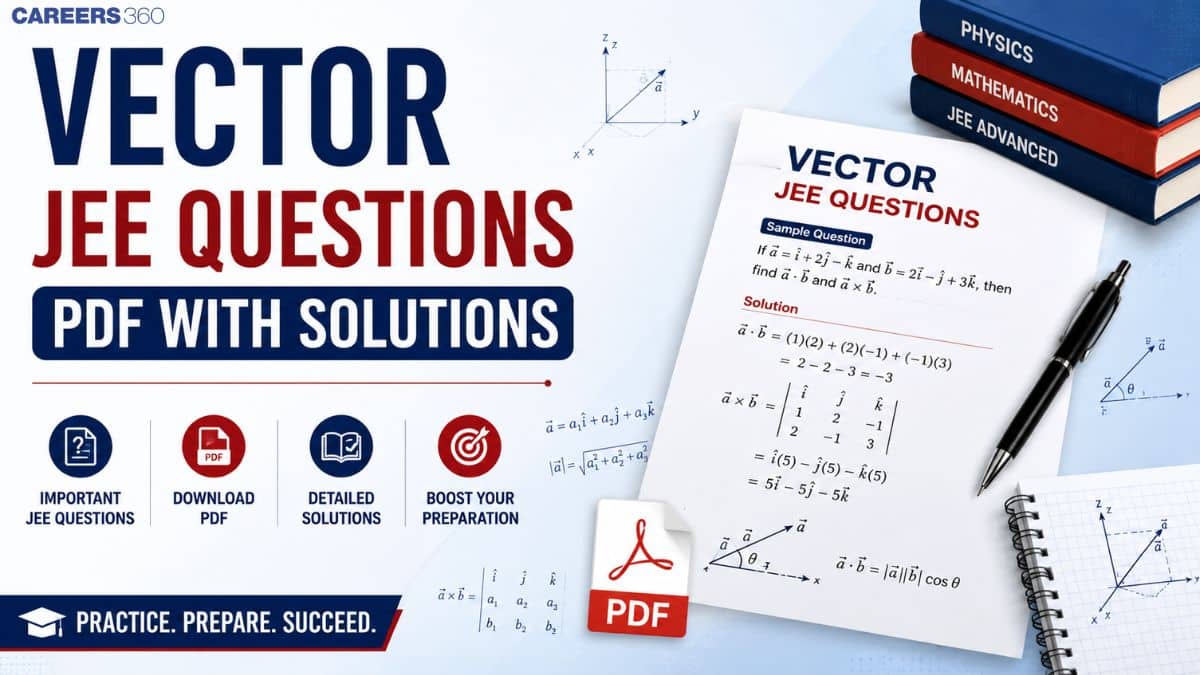
In this article, we have provided vector practice questions for JEE, topic -wise weightage, important formulas, JEE Advanced and JEE Main vector questions with solutions PDF, JEE 2027 preparation tips.
Vector JEE Last 10 Years' Most Asked Topics
JEE Main Vector questions over the last 10 years have covered various topics. The table below shows the most asked JEE Main and JEE Advanced vector question topics.
|
Topics |
No of Questions |
|
Vector (or Cross) Product of Two Vectors |
53 |
|
Dot (Scalar) Product of Two Vectors |
34 |
|
Vector Triple Product |
19 |
|
Dot (Scalar) Product in Terms of Components |
18 |
|
Scalar Triple Product |
17 |
|
Vector Product in Terms of Components |
15 |
|
9 | |
|
Geometrical Interpretation of Scalar Triple Product |
8 |
|
Finding Components of a vector Along and Perpendicular to another Vector |
6 |
|
5 | |
|
Direction Cosines and Direction Ratio |
5 |
|
4 | |
|
Linear Dependent Vectors |
4 |
|
2 | |
|
2 | |
|
1 | |
|
Multiplication of a Vector by a Scalar |
1 |
|
1 | |
|
Total |
208 |
Confused About College Admissions?
Get expert advice on college selection, admission chances, and career path in a personalized counselling session.
Book a Counselling Slot
Select Date
Pick a Slot
JEE Main 2026 Vector Most Asked Concepts
Refer to the table given below for Vector PYQ JEE Main most asked concepts in 2026. In JEE Main, questions were asked from different topics.
|
Concept Name |
JEE Main 2026 January Session |
JEE Main 2026 April Session |
|
8 |
4 | |
|
4 |
3 | |
|
1 |
0 | |
|
1 |
0 | |
|
Vectors and Scalars |
1 |
0 |
|
Linear Combination of Vectors |
0 |
1 |
|
Component of vector and Vector Joining Two Points |
0 |
1 |
|
Section Formula |
0 |
1 |
|
Total |
15 |
10 |
Difficulty Level of Vector JEE Questions
JEE Main questions on vectors were direct, formula-based, and easy, while vector JEE Advanced questions were more conceptual and multi-concept type questions:
|
Exam |
Difficulty Level |
No. of Questions Asked |
|
JEE Main Vector Questions |
Moderate |
10-14 |
|
JEE Advanced Vector Questions |
Moderate to Difficult |
1-2 |
Also Check: JEE Main 2027 Study Guide Complete Notes, Important Concepts, Formulae and Practice Questions
Important Vector Formulas
Before you solve vector questions for JEE PDF, it’s important to learn the basic vector formulas. These formulae are used quite often in numericals.
1. For vector $\vec{A}=a \hat{i}+b \hat{j}+c \hat{k}$, the magnitude $|\vec{A}|=\sqrt{a^2+b^2+c^2}$
2. Unit Vector: $\hat{A}=\frac{\vec{A}}{|\vec{A}|}$
3. The position vector of $P(x, y, z)$, is $\overrightarrow{O P}=x \hat{i}+y \hat{j}+z \hat{k}$
4. $\vec{A}+\vec{B}=\left(a_1+b_1\right) \hat{i}+\left(a_2+b_2\right) \hat{j}+\left(a_3+b_3\right) \hat{k}$
5. $\vec{A}-\vec{B}=\left(a_1-b_1\right) \hat{i}+\left(a_2-b_2\right) \hat{j}+\left(a_3-b_3\right) \hat{k}$
6. Distance between 2 vectors
$A B=\sqrt{\left(x_2-x_1\right)^2+\left(y_2-y_1\right)^2+\left(z_2-z_1\right)^2}$
7. Dot products: $\vec{A} \cdot \vec{B}=|\vec{A}||\vec{B}| \cos \theta$
8. Angle between 2 vectors: $\cos \theta=\frac{\vec{A} \cdot \vec{B}}{|\vec{A}||\vec{B}|}$
9. Cross product: $|\vec{A} \times \vec{B}|=|\vec{A}||\vec{B}| \sin \theta$
10. Projection of One Vector on Another
-
Scaler: $\frac{\vec{A} \cdot \vec{B}}{|\vec{B}|}$
-
Vector: $\frac{\vec{A} \cdot \vec{B}}{|\vec{B}|^2} \vec{B}$
11. Vector Triple Product: $\vec{A} \times(\vec{B} \times \vec{C})=\vec{B}(\vec{A} \cdot \vec{C})-\vec{C}(\vec{A} \cdot \vec{B})$
Also Check: JEE 2027 Important Formulas
JEE Main Syllabus: Subjects & Chapters
Select your preferred subject to view the chapters
Vector JEE Questions with Solutions
The vector questions for JEE help you prepare effectively for exam. Solving vectors chapter jee questions is one of the best ways to prepare for IIT JEE.
Question 1: If $\vec{a}=\hat{i}+\hat{j}+\hat{k}, \vec{b}=\hat{j}-\hat{k}$ and $\vec{c}$ be three vectors such that $\overrightarrow{\mathrm{a}} \times \overrightarrow{\mathrm{c}}=\overrightarrow{\mathrm{b}}$ and $\overrightarrow{\mathrm{a}} \cdot \overrightarrow{\mathrm{c}}=3$, then $\overrightarrow{\mathrm{c}}(\overrightarrow{\mathrm{a}}-2 \overrightarrow{\mathrm{~b}})$ is equal to $\_\_\_\_$ .
(1) 3
(2) 1
(3) 2
(4) 4
Correct Answer: (1)
Solution:
Using triple product identity with $\overrightarrow{\mathrm{a}} \times \overrightarrow{\mathrm{c}}=\overrightarrow{\mathrm{b}}$
$\begin{aligned}
& \overrightarrow{\mathrm{a}} \times(\overrightarrow{\mathrm{a}} \times \overrightarrow{\mathrm{c}})=\overrightarrow{\mathrm{a}} \times \overrightarrow{\mathrm{b}} \\
& (\overrightarrow{\mathrm{a}} \cdot \overrightarrow{\mathrm{c}}) \overrightarrow{\mathrm{a}}-(\overrightarrow{\mathrm{a}} \cdot \overrightarrow{\mathrm{a}}) \overrightarrow{\mathrm{c}}=\overrightarrow{\mathrm{a}} \times \overrightarrow{\mathrm{b}}
\end{aligned}$
As $\vec{a} \times \vec{b}=\left|\begin{array}{ccc}\hat{i} & \hat{j} & \hat{k} \\ 1 & 1 & 1 \\ 0 & 1 & -1\end{array}\right|=-2 \hat{i}+\hat{j}+\hat{k}$
Substituting given values
$\begin{aligned}
& 3 \vec{a}-3 \vec{c}=-2 \hat{i}+j+k \\
& 3(\hat{i}+\hat{j}+\hat{k})+2 \hat{i}+\hat{j}+\hat{k}=3 \vec{c} \\
& \vec{c}=\frac{1}{3}(5 \hat{i}+2 \hat{j}+2 \hat{k})
\end{aligned}$
Now $\overrightarrow{\mathrm{c}} \cdot(\overrightarrow{\mathrm{a}}-2 \overrightarrow{\mathrm{~b}})=\frac{1}{3}(5 \hat{\mathrm{i}}+2 \hat{\mathrm{j}}+2 \hat{\mathrm{k}}) \cdot(\hat{\mathrm{i}}-\hat{\mathrm{j}}+3 \hat{\mathrm{k}})$
$=\frac{1}{3}[5-2+6]=3$
Question 2: Let $\vec{a}=2 \hat{i}+3 \hat{j}+3 \hat{k}$ and $\vec{b}=6 \hat{i}+3 \hat{j}+3 \hat{k}$. Then the square of the area of the triangle with adjacent sides determined by the vectors $(2 \vec{a}+3 \vec{b})$ and $(\overrightarrow{\mathrm{a}}-\overrightarrow{\mathrm{b}})$ is :
(1) 450
(2) 900
(3) 1800
(4) 2400
Correct Answer: (3)
Solution:
$\begin{aligned}
& 2 \vec{a}+3 \vec{b}=2(2 \hat{i}+3 \hat{j}+3 \hat{k})+3(6 \hat{i}+3 \hat{j}+3 \hat{k}) \\
& \Rightarrow 22 \hat{i}+15 \hat{j}+15 \hat{k} \\
& \vec{a}-\vec{b}=-4 \hat{i} \\
& \text { Area }=\frac{1}{2}|(2 \vec{a}+3 \vec{b}) \times(\vec{a}-\vec{b})| \\
& =\frac{1}{2}|-60 \hat{j}+60 \hat{k}|=\frac{1}{2} \sqrt{(60)^2 \times 2} \\
& A=\frac{60}{\sqrt{2}}
\end{aligned}$
Square of area is $\mathrm{A}^2=1800$
Question 3: Let $\vec{a}=4 \hat{i}-\hat{j}+3 \hat{k}, \vec{b}=10 \hat{i}+2 \hat{j}-\hat{k}$ and a vector $\vec{c}$ be such that $2(\vec{a} \times \vec{b})+3(\vec{b} \times \vec{c})=\overrightarrow{0}$. If $\vec{a} \cdot \vec{c}=15$, then $\overrightarrow{\mathrm{c}} \cdot(\hat{\mathrm{i}}+\hat{\mathrm{j}}-3 \hat{\mathrm{k}})$ is equal to :
(1) -6
(2) -5
(3) -4
(4) -3
Correct Answer: (2)
Solution:
$\begin{aligned}
& 2(\vec{a} \times \vec{b})-3(\vec{c} \times \vec{b})=\overrightarrow{0} \\
& (2 \vec{a}-3 \vec{c}) \times \vec{b}=\overrightarrow{0} \\
& \vec{b} \|(2 \vec{a}-3 \vec{c}) \\
& 2 \vec{a}-3 \vec{c}=\lambda \vec{b} \\
& \vec{c}=\frac{2 \vec{a}-\lambda \vec{b}}{3} \\
& \vec{a} \cdot \vec{c}=15 \\
& \left(\frac{2 \vec{a}-\lambda \vec{b}}{3}\right) \cdot \vec{a}=15 \\
& \frac{2|a|^2-\lambda \vec{b} \cdot \vec{a}}{3}=15 \\
& 2(26)-\lambda(40-2-3)=45 \\
& \lambda=\frac{1}{5} \\
& \Rightarrow \vec{c} \cdot(\hat{i}+\hat{j}-3 \hat{k})=\frac{\left(2(4 \hat{i}-\hat{j}+3 k)-\frac{1}{5}(10 \hat{i}+2 \hat{j}-k) \cdot(\hat{i}+\hat{j}-3 \hat{k})\right)}{3} \\
& =\frac{2(4-1-9)-\frac{1}{5}(10+2+3)}{3}=-5
\end{aligned}$
Question 4: Let O be the origin, $\overrightarrow{\mathrm{OP}}=\overrightarrow{\mathrm{a}}$ and $\overrightarrow{\mathrm{OQ}}=\overrightarrow{\mathrm{b}}$. If R is the point on $\overrightarrow{\mathrm{OP}}$ such that $\overrightarrow{\mathrm{OP}}=5 \overrightarrow{\mathrm{OR}}$, and M is the point such that $\overrightarrow{\mathrm{OQ}}=5 \overrightarrow{\mathrm{RM}}$, then $\overrightarrow{\mathrm{PM}}$ is equal to:
(1) $\frac{1}{5}(\vec{a}-4 \vec{b})$
(2) $\frac{1}{5}(\vec{b}-4 \vec{a})$
(3) $\frac{1}{5}(-\vec{a}+4 \vec{b})$
(4) $\frac{1}{5}(-\vec{b}+4 \vec{a})$
Correct Answer: (2)
Solution:
$\begin{aligned} & \overrightarrow{\mathrm{OR}}=\frac{\overrightarrow{\mathrm{OP}}}{5}=\frac{\vec{a}}{5} \\ & \overrightarrow{\mathrm{RM}}=\frac{\overrightarrow{\mathrm{OQ}}}{5}=\frac{\vec{b}}{5} \\ & \overrightarrow{\mathrm{OM}}-\overrightarrow{\mathrm{OR}}=\frac{\vec{b}}{5} \\ & \overrightarrow{\mathrm{OM}}=\frac{\vec{a}+\bar{b}}{5} \\ & \overrightarrow{\mathrm{PM}}=\overrightarrow{\mathrm{OM}}-\overrightarrow{\mathrm{OP}} \\ & \frac{\vec{a}+\vec{b}}{5}-\vec{a} \\ & =\frac{\vec{b}-4 \vec{a}}{5}\end{aligned}$
Question 5: Let $\vec{a}=\sqrt{7} \hat{i}+\hat{j}-\hat{k}$ and $\vec{b}=\hat{j}+2 \hat{k}$. If $\vec{r}$ is a vector such that $\overrightarrow{\mathrm{r}} \times \overrightarrow{\mathrm{a}}+\overrightarrow{\mathrm{a}} \times \overrightarrow{\mathrm{b}}=\overrightarrow{0}$ and $\overrightarrow{\mathrm{r}} \cdot \overrightarrow{\mathrm{a}}=0$, then $|3 \overrightarrow{\mathrm{r}}|^2$ is equal to :
(1) 44
(2) 54
(3) 86
(4) 132
Correct Answer: (1)
Solution:
$\begin{aligned} & \vec{r} \times \vec{a}-\vec{b} \times \vec{a}=\overrightarrow{0} \\ & (\vec{r}-\vec{b}) \times \vec{a}=\overrightarrow{0} \\ & \vec{r}-\vec{b}=\lambda \vec{a} \\ & \vec{r}=\vec{b}+\lambda \vec{a} \\ & \vec{r} . a=0 \Rightarrow \vec{a} \vec{b}+\lambda|\vec{a}|^2=0 \\ & \lambda=-\frac{\vec{a} \cdot \vec{b}}{|\vec{a}|^2}=-\frac{(1-2)}{9}=\frac{1}{9} \\ & \vec{r}=\vec{b}+\frac{\vec{a}}{9} \\ & |3 \vec{r}|^2=9|\vec{r}|^2=9\left(b^2+\frac{a^2}{81}+\frac{2(\vec{a} \cdot \vec{b})}{9}\right)=44\end{aligned}$
Question 6: Let $\hat{\mathrm{u}}$ and $\hat{\mathrm{v}}$ be unit vectors inclined at an acute angle such that $|\hat{\mathrm{u}} \times \hat{\mathrm{v}}|=\frac{\sqrt{3}}{2}$. If
$\overrightarrow{\mathrm{A}}=\lambda \hat{\mathrm{u}}+\hat{\mathrm{v}}+(\hat{\mathrm{u}} \times \hat{\mathrm{v}})$. Then $\lambda$ is equal to :
(1) $\frac{4}{3}(\vec{A} \cdot \hat{u})-\frac{2}{3}(\vec{A} \cdot \hat{v})$
(2) $\frac{2}{3}(\overrightarrow{\mathrm{~A}} \cdot \hat{\mathrm{u}})-\frac{1}{3}(\overrightarrow{\mathrm{~A}} \cdot \hat{\mathrm{v}})$
(3) $\frac{4}{3}(\vec{A} \cdot \hat{u})+\frac{2}{3}(\vec{A} \cdot \hat{v})$
(4) $(\vec{A} \cdot \hat{u})-\frac{1}{2}(\vec{A} \cdot \hat{v})$
Correct Answer: (1)
Solution:
$\begin{aligned} & |\hat{\mathrm{u}} \times \hat{\mathrm{v}}|=\frac{\sqrt{3}}{2} \\ & |\hat{\mathrm{u}}||\hat{\mathrm{v}}| \sin \theta=\frac{\sqrt{3}}{2} \quad \therefore \theta=\frac{\pi}{3} \\ & \text { and } \hat{\mathrm{u}} \cdot \hat{\mathrm{v}}=|\hat{\mathrm{u}}||\hat{\mathrm{v}}| \cos \frac{\pi}{3}=\frac{1}{2}\end{aligned}$
$\overrightarrow{\mathrm{A}}=\lambda \hat{\mathrm{u}}+\hat{\mathrm{v}}+\hat{\mathrm{u}} \times \hat{\mathrm{v}}$
Dot with û
$\begin{aligned}
& \overrightarrow{\mathrm{A}} \cdot \hat{\mathrm{u}}=\lambda(1)+\hat{\mathrm{u}} \cdot \hat{\mathrm{v}}+\hat{\mathrm{u}} \cdot(\hat{\mathrm{u}} \times \hat{\mathrm{v}}) \\
& \overrightarrow{\mathrm{A}} \cdot \hat{\mathrm{u}}=\lambda+\frac{1}{2} \\
& \Rightarrow 2 \overrightarrow{\mathrm{~A}} \cdot \hat{\mathrm{u}}=2 \lambda+1
\end{aligned}$
Dot equation (1) with $\hat{\mathrm{v}}$
$\begin{aligned}
& \overrightarrow{\mathrm{A}} \cdot \hat{\mathrm{v}}=\lambda(\hat{\mathrm{u}} \cdot \hat{\mathrm{v}})+\hat{\mathrm{v}} \cdot \hat{\mathrm{v}}+\hat{\mathrm{v}} \cdot(\hat{\mathrm{u}} \times \hat{\mathrm{v}}) \\
& \overrightarrow{\mathrm{A}} \cdot \hat{\mathrm{v}}=\frac{\lambda}{2}+1 \\
& \overrightarrow{\mathrm{~A}} \cdot \hat{\mathrm{v}}-\frac{\lambda}{2}=1
\end{aligned}$
From (2) and (3)
$\begin{aligned}
& 2 \overrightarrow{\mathrm{~A}} \cdot \hat{\mathrm{u}}-2 \lambda=\overrightarrow{\mathrm{A}} \cdot \hat{\mathrm{v}}-\frac{\lambda}{2} \\
& \therefore \lambda=\frac{4}{3} \overrightarrow{\mathrm{~A}} \cdot \hat{\mathrm{u}}-\frac{2}{3} \overrightarrow{\mathrm{~A}} \cdot \hat{\mathrm{v}}
\end{aligned}$
Question 7: Let $\overrightarrow{\mathrm{a}}_{\mathrm{k}}=\left(\tan \theta_{\mathrm{k}}\right) \hat{\mathrm{i}}+\hat{\mathrm{j}}$ and $\overrightarrow{\mathrm{b}}_{\mathrm{k}}=\hat{\mathrm{i}}-\left(\cos \theta_{\mathrm{k}}\right) \hat{\mathrm{j}}$, where $\theta_k=\frac{2^{k-1} \pi}{2^n+1}$, for some $n \in N, n>5$. Then the value of $\frac{\sum_{k=1}^n\left|\vec{a}_k\right|^2}{\sum_{k=1}^n\left|\vec{b}_k\right|^2}$ is $\_\_\_\_$ .
(1) 3
(2) 4
(3) 2
(4) 1
Correct Answer: (1)
Solution:
$\begin{aligned} & \left|a_k\right|^2=1+\tan ^2 \theta_k=\sec ^2 \theta_k \\ & \left|b_k\right|^2=1+\cot ^2 \theta_k=\operatorname{cosec}^2 \theta_k \\ & \text { Since, } \cot \theta-\tan \theta=2 \cot 2 \theta \\ & \therefore-\operatorname{cosec}^2 \theta-\sec ^2 \theta=-4 \operatorname{cosec}^2 2 \theta \\ & \sec ^2 \theta=4 \operatorname{cosec}^2 2 \theta-\operatorname{cosec}^2 \theta \\ & \Sigma \sec ^2 \theta_k=4 \Sigma \operatorname{cosec}^2 2 \theta_k-\Sigma \operatorname{cosec}^2 \theta_k \\ & \text { Now } \\ & \Sigma \operatorname{cosec} 2 \theta_k=\Sigma \operatorname{cosec}^2 \theta_k \\ & \text { since } \\ & \sum_{k=1}^n \operatorname{cosec}^2 \frac{2^k \pi}{2^n+1}=\sum_{k=1}^n \operatorname{cosec}^2 \frac{2^{k-1} \pi}{2^n+1} \\ & \text { because } \operatorname{cosec}^n \frac{2^n \pi}{2^n+1}=\operatorname{cosec} \frac{\pi}{2^n+1} \\ & \therefore \Sigma \sec ^2 \theta_k=3 \Sigma \operatorname{cosec}^2 \theta_k \\ & \frac{\sum \sec ^2 \theta_k}{\sum \operatorname{cosec}^2 \theta_k}=3\end{aligned}$
Question 8: Two adjacent sides of a parallelogram PQRS are given by $\overrightarrow{\mathrm{PQ}}=\hat{\mathrm{j}}+\hat{\mathrm{k}}$ and $\overrightarrow{\mathrm{PS}}=\hat{\mathrm{i}}-\hat{\mathrm{j}}$. If the side PS is rotated about the point P by an acute angle $\alpha$ in the plane of the parallelogram so that it becomes perpendicular to the side PQ , then $\sin ^2\left(\frac{5 \alpha}{2}\right)-\sin ^2\left(\frac{\alpha}{2}\right)$ is equal to :
(1) $\frac{1}{2}$
(2) $\frac{\sqrt{3}}{2}$
(3) $\frac{\sqrt{3}}{4}$
(4) $\frac{2 \sqrt{3}}{5}$
Correct Answer: (2)
Solution:
Let angle between $\overrightarrow{\mathrm{PQ}} \& \overrightarrow{\mathrm{PS}}$ is $\theta$
$\begin{aligned}
& \cos \theta=\frac{\overrightarrow{\mathrm{PQ}} \cdot \overrightarrow{\mathrm{PS}}}{|\overrightarrow{\mathrm{PQ}}||\overrightarrow{\mathrm{PS}}|} \\
& \cos \theta=\frac{0-1+0}{\sqrt{2} \sqrt{2}} \\
& \cos \theta=\frac{-1}{2} \\
& \theta=\frac{2 \pi}{3} \\
& \alpha=\frac{2 \pi}{3}-\frac{\pi}{2} \text { So } \alpha=\frac{\pi}{6} \\
& \sin ^2 \frac{5 \alpha}{2}-\sin ^2 \frac{\alpha}{2}=\sin \left(\frac{5 \alpha}{2}+\frac{\alpha}{2}\right) \sin \left(\frac{5 \alpha}{2}-\frac{\alpha}{2}\right) \\
& =\sin \frac{6 \alpha}{2} \times \sin \frac{4 \alpha}{2} \\
& =\sin 3 \alpha \times \sin 2 \alpha \\
& =\sin \frac{\pi}{2} \times \sin \frac{\pi}{3} \\
& =1 \times \frac{\sqrt{3}}{2}=\frac{\sqrt{3}}{2}
\end{aligned}$
Question 9: Let the vectors $\vec{a}=-\hat{i}+\hat{j}+3 \hat{k}$ and $\vec{b}=\hat{i}+3 \hat{j}+\hat{k}$. For some $\lambda, \mu \in \mathbf{R}$, let $\overrightarrow{\mathrm{c}}=\lambda \overrightarrow{\mathrm{a}}+\mu \overrightarrow{\mathrm{b}}$. If $\vec{c} \cdot(3 \hat{i}-6 \hat{j}+2 \hat{k})=10$ and $\vec{c} \cdot(\hat{i}+\hat{j}+\hat{k})=-2$, then $|\overrightarrow{\mathrm{c}}|^2$ is equal to :
(1) 8
(2) 12
(3) 14
(4) 15
Correct Answer: (2)
Solution:
$\begin{aligned}
& \overrightarrow{\mathrm{c}}=\lambda \overrightarrow{\mathrm{a}}+\mu \overrightarrow{\mathrm{b}} \\
& \overrightarrow{\mathrm{c}}=(\mu-\lambda) \hat{\mathrm{i}}+(\lambda+3 \mu) \hat{\mathrm{j}}+(3 \lambda+\mu) \hat{\mathrm{k}} \\
& \overrightarrow{\mathrm{c}} \cdot(3 \hat{\mathrm{i}}-6 \hat{\mathrm{j}}+2 \hat{\mathrm{k}})=10 \\
& 3(\mu-\lambda)-6(\lambda+3 \mu)+2(3 \lambda+\mu)=10 \\
& -3 \lambda-13 \mu=10 \\
& \overrightarrow{\mathrm{c}} \cdot(\hat{\mathrm{i}}+\hat{\mathrm{j}}+\hat{\mathrm{k}})=-2 \\
& 5 \mu+3 \lambda=-2
\end{aligned}$
Solving (1) & (2)
$\begin{aligned}
& \lambda=1, \mu=-1 \\
& \overrightarrow{\mathrm{c}}=-2 \hat{\mathrm{i}}-2 \hat{\mathrm{j}}+2 \hat{\mathrm{k}} \\
& |\overrightarrow{\mathrm{c}}|^2=12
\end{aligned}$
Question 10: If $\vec{a}$ and $\vec{b}$ are two vectors such that $|\vec{a}|=2$ and $|\overrightarrow{\mathrm{b}}|=3$, then the maximum value of $3|(3 \vec{a}+2 \vec{b})|+4|(3 \vec{a}-2 \vec{b})|$ is :
(1) 30
(2) 36
(3) 60
(4) 72
Correct Answer: (3)
Solution:
$\begin{aligned} & \mathrm{E}=3 \sqrt{9 \mathrm{a}^2+4 \mathrm{~b}^2+12 \mathrm{a} \overrightarrow{\mathrm{b}}}+4 \sqrt{9 \mathrm{a}^2+4 \mathrm{~b}^2-12 \overrightarrow{\mathrm{a}} \cdot \overrightarrow{\mathrm{b}}} \\ & =3 \sqrt{36+36+12 \times 6 \cos \theta}+4 \sqrt{36+36-72 \cos \theta} \\ & =3 \sqrt{72+72 \cos \theta}+4 \sqrt{72-72 \cos \theta} \\ & =18 \sqrt{2} \sqrt{1+\cos \theta}+24 \sqrt{2} \sqrt{1-\cos \theta} \\ & =18 \sqrt{2} \sqrt{2} \cos \frac{\theta}{2}+24 \sqrt{2}\left(\sqrt{2} \sin \frac{\theta}{2}\right) \\ & =36\left(\cos \frac{\theta}{2}\right)+48 \sin \left(\frac{\theta}{2}\right) \\ & \mathrm{E}_{\max }=\sqrt{(36)^2+(48)^2}=\sqrt{6^4+6^2 \times 8^2}=60\end{aligned}$
Question 11: Let P be a point in the plane vectors $A B=3 \hat{i}+\hat{j}-\hat{k}$ and $A C=\hat{i}-\hat{j}+3 \hat{k}$ such that P is equidistant from the lines AB and AC . If $|A P|=\frac{\sqrt{5}}{2}$, then the area of the triangle ABP is :
(1) $\frac{\sqrt{26}}{4}$
(2) 2
(3) $\frac{\sqrt{30}}{4}$
(4) $\frac{3}{2}$
Correct Answer: (3)
Solution:
$\begin{aligned} & \cos 2 \theta=\frac{-1}{11} \Rightarrow \operatorname{Sin} \theta=\sqrt{\frac{6}{11}} \\ & \text { Area }=\frac{1}{2} \sqrt{11} \times \sqrt{5} / 2 \times \sqrt{\frac{6}{11}}=\frac{\sqrt{30}}{4}\end{aligned}$
Question 12: For three unit vectors $a, b, c$ satisfying $|a-b|^2+|b-c|^2+|c-a|^2=9$ and $|2 a+k b+k c|=3$, the positive value of $k$ is
(1) 3
(2) 5
(3) 4
(4) 6
Correct Answer: (2)
Solution:
$6-2(\bar{a} \cdot \bar{b}+\bar{b} \cdot \bar{c}+\bar{c} \cdot \bar{a})=9$
$\bar{a} \cdot \bar{b}+\bar{b} \cdot \bar{c}+\bar{c} \cdot \bar{a}=\frac{-3}{2}$
$|2 \bar{a}+k \bar{b}+k \bar{c}|=3$
$|2 \bar{a}+k(-\bar{a})|=3$
$|(2-k)||(\bar{a})|=3$
$2-k= \pm 3 \Rightarrow k=5,-1$
Question 13: Let $\vec{a}$ and $\vec{b}$ be two unit vectors such that the angle between them is $\frac{\pi}{3}$. If $\lambda \vec{a}+2 \vec{b}$ and $3 \vec{a}-\lambda \vec{b}$ are perpendicular to each other, then the number of values of in [-1,3] is:
(1) 3
(2) 2
(3) 1
(4) 0
Correct Answer: (4)
Solution:
We are given that $ \vec{a} $ and $ \vec{b} $ are unit vectors and the angle between them is $ \frac{\pi}{3} $, so:
$
\vec{a} \cdot \vec{b} = \cos\left(\frac{\pi}{3}\right) = \frac{1}{2}
$
We are also given that the vectors $ \lambda \vec{a} + 2 \vec{b} $ and $ 3 \vec{a} - \lambda \vec{b} $ are perpendicular. Therefore:
$
(\lambda \vec{a} + 2 \vec{b}) \cdot (3 \vec{a} - \lambda \vec{b}) = 0
$
Expanding the dot product:
$
= \lambda \cdot 3 (\vec{a} \cdot \vec{a}) - \lambda^2 (\vec{a} \cdot \vec{b}) + 6 (\vec{a} \cdot \vec{b}) - 2\lambda (\vec{b} \cdot \vec{b})
$
Since $ \vec{a} \cdot \vec{a} = \vec{b} \cdot \vec{b} = 1 $ and $ \vec{a} \cdot \vec{b} = \frac{1}{2} $, we get:
$
3\lambda - \lambda^2 \cdot \frac{1}{2} + 6 \cdot \frac{1}{2} - 2\lambda = 0
$
$
3\lambda - \frac{\lambda^2}{2} + 3 - 2\lambda = 0
$
$
\lambda - \frac{\lambda^2}{2} + 3 = 0
\Rightarrow -\frac{\lambda^2}{2} + \lambda + 3 = 0
$
Multiply through by 2 to eliminate the denominator:
$
-\lambda^2 + 2\lambda + 6 = 0
\Rightarrow \lambda^2 - 2\lambda - 6 = 0
$
Solving this quadratic equation:
$
\lambda = \frac{2 \pm \sqrt{(-2)^2 + 4 \cdot 1 \cdot 6}}{2} = \frac{2 \pm \sqrt{28}}{2} = \frac{2 \pm 2\sqrt{7}}{2} = 1 \pm \sqrt{7}
$
We now check whether these values lie within the interval $ [-1, 3] $:
$
1 + \sqrt{7} \approx 1 + 2.645 \approx 3.645 \notin [-1, 3]
$
$
1 - \sqrt{7} \approx 1 - 2.645 \approx -1.645 \notin [-1, 3]
$
None of the values lie in the interval $ [-1, 3] $. So, the number of values of $ \lambda $ in the interval is: 0
Hence, the answer is option (4).
Question 14: Let $\overline{\mathrm{a}}=2 \hat{\mathrm{i}}+\hat{\mathrm{j}}-2 \hat{\mathrm{k}}, \overline{\mathrm{b}}=\hat{\mathrm{i}}+\hat{\mathrm{j}}$ and $\overline{\mathrm{c}}=\overline{\mathrm{a}} \times \overline{\mathrm{b}}$. Let $\overline{\mathrm{d}}$ be a vector such that $|\overline{\mathrm{d}}-\overline{\mathrm{a}}|=\sqrt{11},|\overline{\mathrm{c}} \times \overline{\mathrm{d}}|=3$ and angle between $\overline{\mathrm{c}}$ and $\overline{\mathrm{d}}$ is $\frac{\pi}{4}$. Then $\overline{\mathrm{a}} . \overline{\mathrm{d}}$ is equal to:
(1) 11
(2) 0
(3) 1
(4) 3
Correct Answer: (2)
Solution:
$\begin{aligned} & \varepsilon=\left|\begin{array}{ccc}\hat{\mathrm{i}} & \hat{\mathrm{j}} & \hat{\mathrm{k}} \\ 2 & 1 & -2 \\ 1 & 1 & 0\end{array}\right|=\hat{\mathrm{i}}(2)-\hat{\mathrm{j}}(2)+\hat{\mathrm{k}}(1) \\ & |\overline{\mathrm{c}} \times \overline{\mathrm{d}}|=3 \Rightarrow|\overline{\mathrm{c}}||\overline{\mathrm{d}}| \sin (\overline{\mathrm{c}}, \overline{\mathrm{d}})=3 \Rightarrow 3|\overline{\mathrm{~d}}| \frac{1}{\sqrt{2}}=3 \\ & |\mathrm{~d}|=\sqrt{2} \\ & |\overline{\mathrm{~d}}-\overline{\mathrm{a}}|=\sqrt{11} \Rightarrow \overline{\mathrm{~d}}^2+\overline{\mathrm{a}}^2-2 \overline{\mathrm{a}} \cdot \overline{\mathrm{d}}=1 \overline{1} \Rightarrow \overline{\mathrm{~d}}^2+9-2 \overline{\mathrm{a}} \cdot \overline{\mathrm{d}}=11 \Rightarrow \overline{\mathrm{a}} \cdot \overline{\mathrm{d}}=0\end{aligned}$
Question 15: Let $\overrightarrow{\mathrm{a}}=\hat{\mathrm{i}}+2 \hat{\mathrm{j}}+\hat{\mathrm{k}}$ and $\overrightarrow{\mathrm{b}}=2 \hat{\mathrm{i}}+\hat{\mathrm{j}}-\hat{\mathrm{k}}$. Let $\hat{\mathrm{c}}$ be a unit vector in the plane of the vectors $\vec{a}$ and $\vec{b}$ and be perpendicular to $\vec{a}$. Then such a vector $\hat{\mathbf{c}}$ is :
(1) $\frac{1}{\sqrt{5}}(\hat{\mathrm{j}}-2 \hat{\mathrm{k}})$
(2) $\frac{1}{\sqrt{3}}(-\hat{\mathrm{i}}+\hat{\mathrm{j}}-\hat{\mathrm{k}})$
(3) $\frac{1}{\sqrt{3}}(\hat{\mathrm{i}}-\hat{\mathrm{j}}+\hat{\mathrm{k}})$
(4) $\frac{1}{\sqrt{2}}(-\hat{\mathrm{i}}+\hat{\mathrm{k}})$
Correct Answer: (4)
Solution:
$\begin{aligned} & \vec{c}=x \vec{a}+y \vec{b} \\ & \vec{c}=x(\hat{i}+2 \hat{j}+\hat{k})+y(2 \hat{i}+\hat{j}-\hat{k}) \\ & \vec{a} \cdot \vec{c}=(\hat{i}+2 \hat{j}+\hat{k}) \cdot(x(\hat{i}+2 \hat{j}+\hat{k})+y(2 \hat{i}+\hat{j}-\hat{k})) \\ & (\hat{i}+2 \hat{j}+\hat{k}) \cdot(x \hat{i}+2 x \hat{j}+x \hat{k})+2 y \hat{i}+y \hat{j}-y \hat{k}=0 \\ & \Rightarrow \quad(x+2 y)+2(x+9)+(x-y)=0 \\ & \Rightarrow \quad y=-2 x \\ & \therefore \quad \vec{c}=x(-3 \hat{i}+3 \hat{k}) \\ & |\vec{c}|=|x| \sqrt{9+9}=3|x| \sqrt{2} \\ & \therefore|\vec{c}|=1 \\ & 3|x| \sqrt{2}=1 \\ & |x|=\frac{1}{3 \sqrt{2}} \\ & \text { Let } x=\frac{1}{3 \sqrt{2}} \\ & \vec{c}=\frac{1}{3 \sqrt{2}}(-3 \hat{i}+3 \hat{k}) \\ & \text { or } \vec{c}=\frac{1}{\sqrt{2}}(-\hat{i}+\hat{k})\end{aligned}$
Hence, the answer is option (4).
Also check: JEE Mains 2027: Maths Set of 5 Sample Paper with Solution
Best Books for JEE Vector Questions
While preparing vector questions for JEE, it is very important to follow the best books because they help properly cover all the concepts. Refer to the Best Books for JEE Main 2027 given below for solving vector questions for JEE PDF.
|
|
|
|
|
Frequently Asked Questions (FAQs)
Q: How many JEE Vector questions are asked in the exam?
A:
In JEE Main, around 10-15 vector questions are asked, while in JEE Advanced around 1-2 questions are asked every year.
Q: Is the Vector JEE Advanced questions PDF helpful for preparation?
A:
Yes, vector questions are important, and it is often mixed up with calculus, coordinate geometry, and trigonometry in JEE Advanced. Using this PDF is very useful for exam preparation.
Q: Which topics in Vector are the most important for IIT JEE?
A:
Some of the most asked topics from which vector chapter JEE questions were asked are Vector (or Cross) Product of Two Vectors, cross products, combination of vectors, etc.
Articles
Related Stories
|
Upcoming Engineering Exams

Certifications By Top Providers
Explore Top Universities Across Globe
Popular Courses and Specializations
List of colleges accepting JEE Main
Browse Engineering Colleges by State
Questions related to JEE Main
On Question asked by student community
Have a question related to JEE Main ?
Yes IIT Delhi will except admissions from JEE Advanced?
Hello student!
You can download the JEE Main April 2026 official question paper from the link below. You can also visit the page below for shift-wise question papers and solutions to practise questions and analyse the exam pattern.
JEE Main April 2026 Official Question Paper:
https://engineering.careers360.com/download/ebooks/jee-main-2026-april-session-official-question-paper
JEE Main 2026 Shift-Wise
Hello Student,
You can prepare for JEE Main 2027 by referring to the article below. It provides preparation tips, study strategies, and guidance to help you prepare effectively for the exam.
JEE Main Preparation Tips 2027: Check Preparation Strategy, Tricks
Hope this helps!
Hi Rishabh
Check the link below for the JEE Main Paper 2A question papers.
Hello Student,
Check the useful resources given below:
Hope it helps!

Applications for Admissions are open.
Ranked #43 among Engineering colleges in India by NIRF | Get Upto 100% Scholarships
Woxsen University, Hyderabad
ApplyScholars’ Round Deadline: 14th Nov’26 | Earn upto 50% merit Scholarship + 10% for top performers | EFMD Accredited | AACSB (USA) & AMDISA Member | Highest CTC 28 LPA
Parul Institute of Technology, Vadodara
ApplyDiploma (17 Specializations), B.Tech / B.Tech (Hons.) / IE-B.Tech - 4 years - 25+ specializations | M. Tech - 14+ specializations | Highest CTC – 60 LPA
Parul University, Goa
ApplySpecial Scholarship for Students from Goa (Get an exclusive scholarship of ₹20,000 if you're a Goa-based student) | Bringing Parul Education Trust's 30-year Education Legacy to Goa
JSS Academy of Technical Education, Bangalore
ApplyNAAC A+ Grade | Affiliated to VTU & approved by AICTE.
Dr Vishwanath Karad MIT World Peace University, Pune
ApplyHighest CTC 30 LPA | #9 in Management Category by Times B-School | Merit-Based Scholarship Upto - 50 Crores
JEE Main Notifications
Explore Career Options
By IndustryNever miss JEE Main update
Get timely JEE Main updates directly to your inbox. Stay informed!