School of Computer Science, UPES, Dehradun
Ranked #43 among Engineering colleges in India by NIRF | Get Upto 100% Scholarships


If you are a Class 11 student thinking about how to start JEE Main 2027 preparation from Class 11, then, well, you already picked the best step in your engineering journey. Starting early really helps; it feels simple, but it pays off later. Class 11 isn't a warm-up year you can coast through before the real preparation begins in Class 12. It usually brings about 40–45% of the overall JEE Main weightage, and topics like calculus, mechanics, and the mole concept make up the backbone for pretty much everything you’ll study next. Students who take this year lightly almost always end up spending Class 12 in a kind of backtracking mode, instead of moving ahead.
This Story also Contains
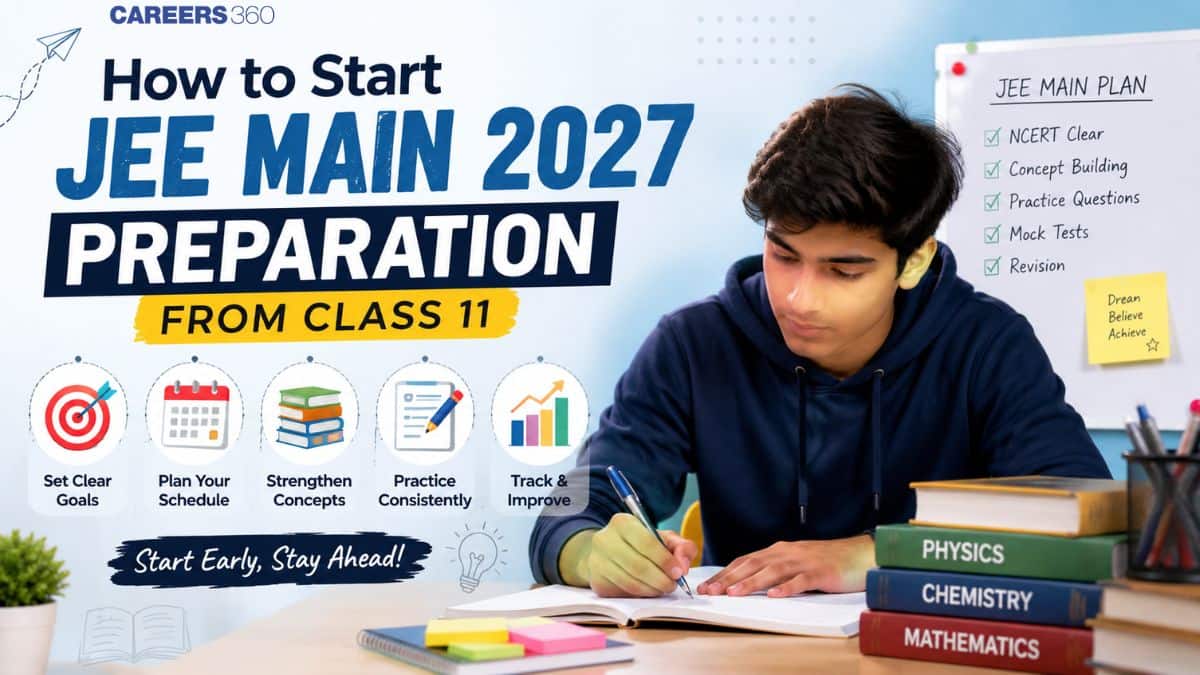
In this article, we will see the complete, step-by-step JEE Main 2027 preparation strategy from fixing your mindset and building subject-wise foundations to designing a daily timetable, picking the right books, and avoiding the mistakes that quietly derail most Class 11 aspirants.
Also Read: JEE Main 2027 Daily Study Plan for Class 11 Students
Follow this plan initially to build a strong foundation and develop consistent JEE preparation habits from Class 11.
| Period | What to do |
|---|---|
| Days 1–3 | Understand JEE Main & Advanced pattern and download syllabus |
| Days 4–7 | Select books/resources and create timetable |
| Week 2 | Start first Physics, Chemistry and Maths chapters |
| Week 3 | Begin chapter-wise questions + revision |
| Week 4 | Take first chapter tests and analyse mistakes |
Also Read: JEE Main Preparation 2027: Pros, Cons, Eligibility & Complete Guide
Get expert advice on college selection, admission chances, and career path in a personalized counselling session.
Before making a study plan, an aspirant should know what they are preparing for. The overview of JEE Main 2027 is given in the table below:
|
Aspect |
Details |
|
Exam Sessions |
JEE Main is conducted in two sessions: Session 1 in the last week of January and Session 2 in the first week of April. |
|
Application Window |
Registration for Session 1 generally begins in October–November, along with the release of the Information Bulletin and official syllabus. |
|
Exam Pattern |
The exam consists of 75 questions (25 each from Physics, Chemistry, and Mathematics) for a total of 300 marks. It includes Multiple Choice Questions (MCQs) and compulsory Numerical Value Questions (NVQs), conducted as a 3-hour computer-based test (CBT). |
|
Syllabus |
The syllabus is based almost entirely on the NCERT Class 11 and Class 12 curricula for Physics, Chemistry, and mathematics, with only minor changes in recent years. |
Note: All the exam times given in the above data are based on the last few years' pattern; this can be changed, so check this information regularly on the official website.
The JEE Main 2027 syllabus is likely to be based on the NCERT Class 11 and Class 12 curriculum, more or less. The table below sort of outlines the main areas candidates should prepare for across each subject.
|
Subject |
Major Topics Covered |
|
Physics and Measurement, Kinematics, Laws of Motion, Work, Energy & Power, Rotational Motion, Gravitation, Properties of Solids & Liquids, Thermodynamics, Kinetic Theory of Gases, Oscillations & Waves, Electrostatics, Current Electricity, Magnetic Effects of Current, Electromagnetic Induction, Alternating Current, Electromagnetic Waves, Optics, Dual Nature of Matter, Atoms & Nuclei, Electronic Devices, Experimental Skills. | |
|
Some Basic Concepts of Chemistry, Atomic Structure, Chemical Bonding, Thermodynamics, Chemical & Ionic Equilibrium, Redox Reactions, Solutions, Electrochemistry, Chemical Kinetics, Periodic Table, p-Block, d- & f-Block Elements, Coordination Compounds, Purification and Characterisation of Organic Compounds, Some Basic Principles of Organic Chemistry, Hydrocarbons, Haloalkanes & Haloarenes, Alcohols, Phenols & Ethers, Aldehydes & Ketones, Carboxylic Acids, Amines, Biomolecules. | |
|
Sets, Relations & Functions, Complex Numbers, Matrices & Determinants, Permutation & Combination, Binomial Theorem, Sequences & Series, Limits, Continuity & Differentiability, Integral Calculus, Differential Equations, Coordinate Geometry, Vector Algebra, Three-Dimensional Geometry, Probability, Statistics, Trigonometry. |
Also Read: JEE Main Latest Syllabus 2027
| Subject | Recommended Chapter Sequence |
|---|---|
| Physics | Units & Measurements → Kinematics → Laws of Motion → Work, Energy & Power → Centre of Mass → Rotational Motion → Gravitation → Thermodynamics → Oscillations & Waves |
| Physical Chemistry | Some Basic Concepts of Chemistry → Atomic Structure → Thermodynamics → Equilibrium → Redox Reactions |
| Organic Chemistry | Basic Principles of Organic Chemistry → GOC → Isomerism → Hydrocarbons |
| Inorganic Chemistry | Classification of Elements & Periodicity → Chemical Bonding → p-Block Elements |
| Mathematics | Sets → Relations & Functions → Basic Algebra → Quadratic Equations → Sequence & Series → Trigonometry → Straight Lines → Circles → Permutations & Combinations → Binomial Theorem → Complex Numbers → Limits & Continuity → Differentiation → Statistics & Probability |
Ranked #43 among Engineering colleges in India by NIRF | Get Upto 100% Scholarships
Scholars’ Round Deadline: 14th Nov’26 | Earn upto 50% merit Scholarship + 10% for top performers | EFMD Accredited | AACSB (USA) & AMDISA Member | Highest CTC 28 LPA
Think of your JEE Main 2027 preparation like this: a two-year journey, not just a sprint. You’ll run into hard topics and unexpected distractions along the way, plus school commitments that pop up, and of course, regular tests. Sometimes it feels a bit messy but that’s normal, you keep moving, one small step after another.
|
Preparation Stage |
Focus Area |
Strategy to Follow |
|
Difficult Chapters |
Topics like Rotational Motion, Chemical Equilibrium, Coordinate Geometry, and other concept-intensive chapters require extra attention. |
Spend more time understanding the concepts, revise them regularly, and solve sufficient practice questions before moving to the next topic. |
|
Avoiding Distractions |
Social media, excessive gaming, binge-watching, and other time-consuming activities can reduce study efficiency. |
Set daily study goals, limit screen time, and maintain a disciplined routine to stay focused throughout your preparation. |
|
Balancing School & JEE Preparation |
Managing school studies, coaching classes, homework, and self-study together can be challenging. |
Create a practical timetable that accommodates all commitments. If you miss a target, adjust your schedule and get back on track without losing consistency. |
|
Rest and Recovery |
Continuous studying without breaks can lead to stress and burnout. |
Take short breaks, get adequate sleep, exercise regularly, and enjoy occasional family or social events to maintain long-term productivity. |
|
Mock Tests & Performance Analysis |
Regular tests help evaluate preparation and identify weak areas. |
Attempt chapter-wise and full-length mock tests, analyze every mistake, improve time management, and revise weak topics before the next test. |
Focus Area: Newton's Laws, Work-Energy Theorem, Rotational Motion, Waves, and Thermodynamics.
Approach: Physics isn’t just “math with extra steps” it’s more like you read the theory really carefully, then you draw diagrams. Like, you define the system first, and you identify every force that’s actually in play before you write even one single equation.
Practice: Mix conceptual and numerical problems every day, start kind of at the basic level, like real easy stuff first, and then move gradually toward JEE Main difficulty, step by step
Treat chemistry as three different subject and make study plan according to all three.
Physical Chemistry: Essentially physics with more calculation. Master mole concept, thermodynamics, and equilibrium, and drill numericals until they're automatic.
Organic Chemistry: Don't memorise reactions in Class 11. Focus on mechanisms inductive effect, resonance, SN1/SN2, E1/E2. Named reactions come later, in Class 12.
Inorganic Chemistry: NCERT is non-negotiable here. Read every line of the Class 11 chapters on Chemical Bonding, s-Block, p-Block, and Hydrogen a large share of JEE Main inorganic questions come almost directly from NCERT.
Diploma (17 Specializations), B.Tech / B.Tech (Hons.) / IE-B.Tech - 4 years - 25+ specializations | M. Tech - 14+ specializations | Highest CTC – 60 LPA
Special Scholarship for Students from Goa (Get an exclusive scholarship of ₹20,000 if you're a Goa-based student) | Bringing Parul Education Trust's 30-year Education Legacy to Goa
Focus areas: Coordinate Geometry, Trigonometry, Quadratic Equations, and — most importantly — Calculus basics (Limits, Continuity, Differentiation).
Approach: Math rewards volume. Solve a fixed number of quality problems every day, and maintain a dedicated formula and revision notebook.
Also Read:
A easy to do preparation timetable matters more than an aggressive one you'll abandon within a month.
|
Time Block |
Activity |
|
School / Coaching |
Attend regularly and stay present in class — don't skip sessions to “self-study” instead. |
|
2–3 hours |
New theory + solved examples from one subject. |
|
1.5–2 hours |
Problem-solving from a different subject (active recall, not passive reading). |
|
30–45 minutes |
Revision of a chapter studied 3–7 days ago. |
|
Weekends |
Chapter-end tests, topic-wise PYQs, and error-log review. |
A lot of aspirants think that coaching is basically must have for cracking JEE Main, but honestly that isn’t always like that. If you kick off your JEE Main exam preparation from Class 11, and you follow a clear study routine , while staying consistent, you can still build a solid base via self-study. The main upsides of going without coaching are that you get flexibility, you learn at your own speed and, you can put more attention on the areas where you’re less confident.
|
Preparation Step |
What You Should Do |
Why It Matters |
|
Understand the Syllabus |
Go through the complete JEE Main 2027 syllabus and exam pattern before starting your preparation. |
It helps you, plan your studies a bit, and keep that focus on the right topics, so you don’t get stuck on the wrong stuff. |
|
Study NCERT First |
Complete NCERT books for Physics, Chemistry, and Mathematics before using any standard books. |
Builds a really strong conceptual base, mainly for Chemistry, |
|
Create a Study Timetable |
Prepare a daily and weekly study target that balances school, self-study, revision, and practice. |
Make sure you should be consistent and prevents last-minute syllabus backlog. |
|
Choose the Right Books |
Use one standard reference book per subject after completing NCERT book. |
It helps in problem solving, without fully overwhelming you with too many resources. |
|
Practice Previous Year Questions |
Solve chapter-wise JEE Main PYQs after finishing each topic. |
Helps familiarize you with the exam pattern and with the concepts that are frequently asked, kind of the usual suspects that keep coming up. |
|
Take Regular Mock Tests |
Give chapter tests initially and full-length mock tests as your syllabus cover. |
Increase speed, accuracy, confidence, and time management. |
|
Revise Constantly |
Revise formulas, reactions, and important topics every week, and maintain a mistake notebook. |
It improves retention, and it also helps to avoid repeating mistakes in the exam, really makes it easier later on. |
|
Use Online Resources Wisely |
Learn from trusted online lectures and practice platforms one place at a time don’t jump around between multiple sources. |
Keeps your preparation focused and avoid confusion. |
|
Stay Disciplined |
Track your weekly progress, complete study targets, and maintain a consistent routine. |
Discipline and consistency are the biggest factors in successful self-study preparation. |
Dont practice so many book one time instead practice from one book multiple time.
|
Subject |
Primary Resource |
Secondary / Practice |
|
Physics |
Notes / NCERT / Concepts of Physics (HC Verma) |
DC Pandey (JEE Main-specific problem sets) |
|
Chemistry |
Notes + NCERT (all three parts) |
MS Chauhan (Organic mechanisms); N Awasthi (Physical Chemistry) |
|
Mathematics |
Notes / Cengage or Arihant series |
Previous Year Questions (PYQ) compilation |
Also Read: Which are the best books for JEE Main?
Starting your JEE Main 2027 preparation online from Class 11, you basically get enough time to build solid concepts, practice with some consistency, and do the revision part in a smarter way. Just follow the step-by-step online preparation strategy below, so you can form a focused routine, and honestly maximize your chances for getting a top JEE Main rank.
| Step | What to Do | Recommended Time |
|---|---|---|
| Understand the Syllabus | Learn the complete JEE Main 2027 syllabus and exam pattern before starting. | 1–2 days |
| Choose One Online Course | Enroll in one structured online batch instead of following multiple teachers. | Once at the beginning |
| Study NCERT First | Complete NCERT theory for Physics, Chemistry, and Mathematics before advanced practice. | Daily |
| Attend Online Classes Regularly | Watch live/recorded lectures and make short notes during every class. | 3–5 hours/day |
| Practice Questions Daily | Solve DPPs, coaching sheets, and previous years' questions after every chapter. | 2–3 hours/day |
| Revise Every Week | Revise formulas, concepts, and mistakes from your notebook every Sunday. | 3–4 hours/week |
| Take Mock Tests | Start chapter-wise tests first, then full-length mock tests after syllabus completion. | Weekly/Monthly |
| Analyze Mistakes | Maintain an error notebook and revise weak topics regularly. | After every test |
| Avoid Distractions | Limit social media and maintain a fixed daily study schedule. | Daily |
| Stay Consistent | Follow your timetable for two years without long breaks or backlogs. | Throughout preparation |
Running ahead of your teacher: Trying to outpace your coaching instructor, or buying every “colour-coded” reference book on the market before finishing the basics, usually creates confusion.
Over-dependence on teachers: Teachers guide you, but revision and short notes are your responsibility. No one can revise a chapter for you.
Laziness: Delaying today's DPP “for the weekend” is how small backlogs turn into unmanageable ones by December.
Over-comparison: Constantly measuring yourself against the highest scorer in your batch drains motivation. Track your own performance last month's you versus this month's you.
Restarting all over again after a gap: If illness or a journey makes you skip the syllabus, don’t go back and restart the whole topic. Just join wherever your teacher currently is, and cover the missed part in parallel, every day.
Measuring effort by hours, not outcomes: Ten hours of distracted studying is worth less than four hours of focused work. Count the problems you solved correctly and the concepts you can explain clearly, not only the hours time logged.
Ignoring your weakest subject: if you really dislike Inorganic Chemistry or Trigonometry, then study it first in the day while your mind is fresh, not last, when you’re already too tired to properly engage with it.
Frequently Asked Questions (FAQs)
No, it’s the ideal time, because roughly 40–45% of what you’ll see in JEE Main comes from Class 11 material, and starting now kinda gives you these two full years to build some real depth rather than just rushing through everything in Class 12 by itself.
Giving four to five hours, with school or coaching, is kind of a sustainable target for most students. Like, it’s the steady pace over two years that counts more than those occasional longer study sessions, every now and then.
For most students, good coaching notes and the DPPs are usually enough. Those extra books can be handy only as supplementary practice, not really as a replacement for completing your main syllabus thoroughly.
Class 12 students apply to appear for the exam, but not class 11 students.

On Question asked by student community
Yes IIT Delhi will except admissions from JEE Advanced?
Hello Student,
You can check the resource provided below:
JEE Main Chapter-wise Weightage 2027
Hope this helps!
Hello student!
You can download the JEE Main April 2026 official question paper from the link below. You can also visit the page below for shift-wise question papers and solutions to practise questions and analyse the exam pattern.
JEE Main April 2026 Official Question Paper:
https://engineering.careers360.com/download/ebooks/jee-main-2026-april-session-official-question-paper
JEE Main 2026 Shift-Wise
Hello Student,
You can prepare for JEE Main 2027 by referring to the article below. It provides preparation tips, study strategies, and guidance to help you prepare effectively for the exam.
JEE Main Preparation Tips 2027: Check Preparation Strategy, Tricks
Hope this helps!
Hi Rishabh
Check the link below for the JEE Main Paper 2A question papers.

Ranked #43 among Engineering colleges in India by NIRF | Get Upto 100% Scholarships
Scholars’ Round Deadline: 14th Nov’26 | Earn upto 50% merit Scholarship + 10% for top performers | EFMD Accredited | AACSB (USA) & AMDISA Member | Highest CTC 28 LPA
Diploma (17 Specializations), B.Tech / B.Tech (Hons.) / IE-B.Tech - 4 years - 25+ specializations | M. Tech - 14+ specializations | Highest CTC – 60 LPA
Special Scholarship for Students from Goa (Get an exclusive scholarship of ₹20,000 if you're a Goa-based student) | Bringing Parul Education Trust's 30-year Education Legacy to Goa
NAAC A+ Grade | Affiliated to VTU & approved by AICTE.
Highest CTC 30 LPA | #9 in Management Category by Times B-School | Merit-Based Scholarship Upto - 50 Crores