
Search Colleges, Exams, Schools & more


Login
Foreign University in India vs Studying Abroad – Which Is Better?
Confused about studying in India or going abroad? It is a crucial decision to choose between studying abroad or staying in India. While foreign university campuses in India are set up to provide students with globally recognized degrees, students still need a clear and practical guide to help them evaluate and make important decisions. This article provides a detailed analysis and comparison of three major higher education options available to students in India:
- Studying in Indian universities (public or private)
- Studying abroad
- Studying at foreign university campuses established in India
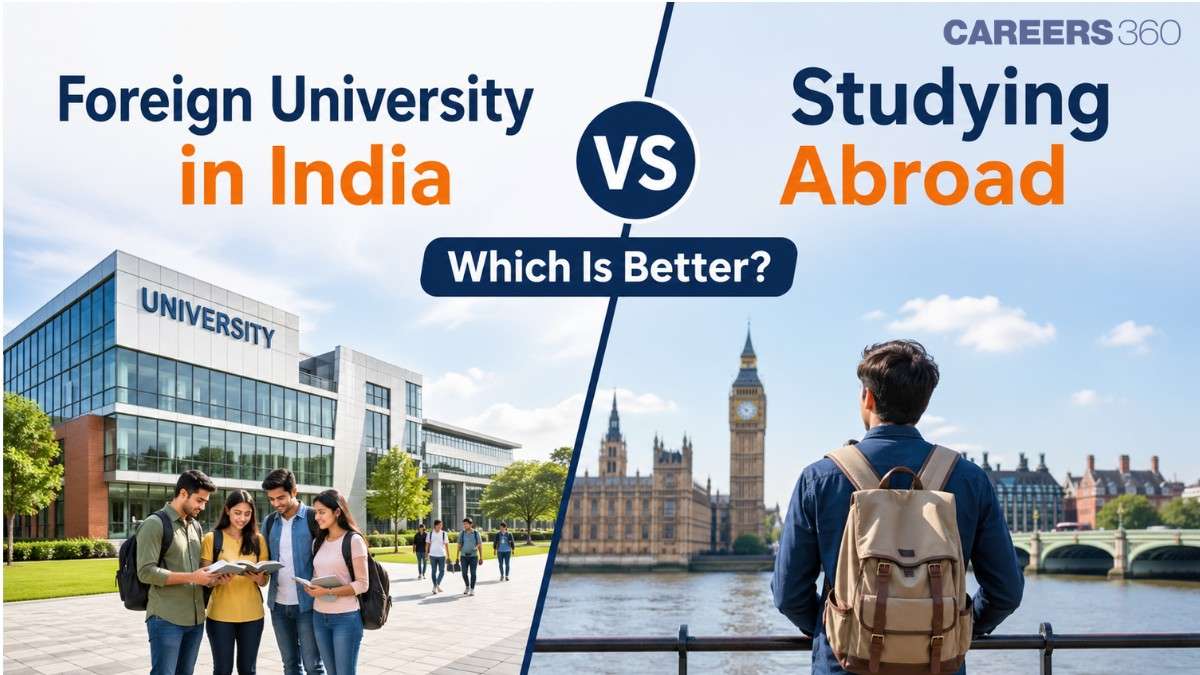
The purpose of this comparison is to assist students in understanding the education ecosystem, benefits, challenges, alignment of each option with the student goals, considering cost, global exposure, safety perception, parent comfort and other aspects.
Watch The Video Here
Understanding the Ecosystem of Higher Education in India
Indian Public Institutions: The Indian public higher education sector or government institutions in India include recognized institutions of national importance like IITs, IIITs, NITs, AIIMS, IIMs, and other government universities.
These institutions offer high-quality education and outstanding placement opportunities, but they are extremely competitive. Apart from this, there are many other government institutes in India whose fees are affordable, but their student and placement outcomes are unsatisfactory.
Private Institutions in India: Same is in the case of private universities in India, there are some leading and prestigious private institutes which offer excellent student outcomes and placements, while there are some other private institutes which are sustaining mainly by degree credibility and low fees, but showing poor outcomes.
Foreign University Campuses in India: This is an emerging option in the Indian higher education system. Top foreign universities are setting up their campuses in India and offering internationally recognized degrees at a comparatively lower cost than overseas study.
Only those foreign universities that are ranked among the top 500 global universities (QS or Times Higher Education) are eligible to establish campuses in India, ensuring the quality of education. The foreign university campuses launched in India are similar to their parent campuses in terms of curriculum and pedagogy.
Campuses established in India are of two types:
1- Campuses in GIFT City: These campuses are set up within the GIFT City in Gujarat, India, and are not approved by UGC. GIFT city Foreign university campuses are regulated by IFSCA.
2- Campuses Across India: These are the campuses with UGC approval and are outside GIFT city.
Key Details of Foreign Universities in India
Institute Name | Establishment | THE / QS World Rankings University | Origin Country | Location City |
1963 | 169.00 | United Kingdom | Mumbai | |
1495 | 208 | United Kingdom | Mumbai | |
1890 | 591 | United States | Mumbai | |
1992 | 501-600 | Australia | Gurugram | |
1881 | 147 | United Kingdom | Karnataka | |
1876 | 51 | United Kingdom | Mumbai | |
1,862 | 87 | United Kingdom | Gurugram | |
1911 | 77 | Australia | Mumbai & Chennai | |
1964 | 157.00 | United Kingdom | Karnataka | |
1989 | 400 | Australia | Greater Noida | |
1964 | 233.00 | Australia | - | |
1949 | 20.00 | Australia | Karnataka |
This table highlights the key details of foreign universities, including their year of establishment, country of origin, THE/QS world rankings, and location of campus in India. Check out the table above for the list of top foreign universities in India.
Indian Private Universities Vs Study Abroad Vs Foreign Universities in India
Aspect | Indian Private Universities | Study Abroad (Foreign Universities) | Foreign University Campuses in India |
Global Exposure | Good faculty and student exchange programs; international scholars visit | Highest level of global exposure due to immersion in foreign country | Partial global exposure; international faculty and curriculum but India-based student life |
International Mobility | Limited to semester exchanges | Complete mobility; direct access to global education and work markets | Moderate; degree recognized globally, possible pathway to study/work abroad |
Curriculum & Pedagogy | Flexible, often interdisciplinary, discussion-based (especially liberal universities) | Most flexible, research-oriented, project and lab-based | Modern, industry-linked, current curriculum identical to parent campus but narrower program range |
Cost | High but comparatively lower (~₹40-50 lakh for 3-4 years) | Very high (~₹2 crore or more due to forex, taxes, living expenses) | Comparable to high-end Indian private universities (~₹35-50 lakh); often offers scholarships |
Forex Risk | None | High; fluctuating exchange rates and additional taxes | None; fees paid in Indian rupees, eliminating forex risk |
Campus Life & Social Experience | Strong residential life with peer learning and some international students | Rich multicultural experience, independence, personal growth | Limited; mostly day scholars, smaller campuses, less residential community |
Parent Comfort & Safety Perception | High; familiar environment but some concerns about student behavior in some campuses | Lower due to visa uncertainties, cultural and geopolitical issues | High; international brand with no need to send children abroad |
Recognition & Regulation | UGC approved and fully recognized in India | Varies; some foreign degrees may lack AIU certification in India | Fully UGC approved (except GIFT City campuses require AIU equivalence certificate), hence recognized |
Career Outcomes & Placements | Well-established placement ecosystem with internships and recruitment | Desired but complicated by visa issues and employer reluctance | Developing placement ecosystem; potential collaborations with multinational companies in India |
Best-Fit Student | Wants flexibility, breadth & strong Indian academic experience | Wants migration, independence, global exposure & accepts risk/volatility | Wants international degree experience with lower cost & risk than going abroad |
This table presents the key comparison among the three study options available for Indian students based on the 10 parameters, which are listed in the above table. Refer to this table for a detailed comparison of Indian Private Universities, Study Abroad, and Foreign Universities in India.
Choosing the Right Pathway
Top-notch public institutions in India, such as IITs, IIITs, NITs, IIMs, and AIIMS, remain the best choice for students who can get admission because of the solid placement outcomes, quality education, and affordability.
Foreign university campuses in India provide a “middle path”.
Globally recognized degree from a global brand at a significantly lower cost and lower forex risk as compared to overseas study.
newer curriculum and pedagogy.
Lower concerns related to visa uncertainties, cultural challenges, safety, and geopolitical factors.
International pathway
Some private universities in India, particularly liberal arts approach universities like Plaksha University, ensure quality education and provide a solid global exposure.
Evaluation of Each Option
Indian Public/Government Universities
If students can secure admission in the leading government universities, then that would be the best option because of the better outcomes.
Indian Private Universities
Opting for private universities can be expensive but offers quality education and flexibility. This option is forex risk-free.
Studying Abroad
Choosing to study overseas continues to be the gold standard for international exposure, but this option is suitable for students who can afford higher costs and forex risks.
Foreign University Campuses in India
Foreign universities in India are a new, emerging, and cost-effective option where students can get an international degree and curriculum without leaving their home and country.
Students and parents need to assess factors like cost, career outcomes and placements, risk factors, and various other factors that have already been discussed above so as to make a final decision.
Upcoming Engineering Exams

Certifications By Top Providers
Explore Top Universities Across Globe
List of colleges accepting exam
Browse Engineering Colleges by State

Applications for Admissions are open.
Among top 100 Universities Globally in the Times Higher Education (THE) Interdisciplinary Science Rankings 2026
Amity University-Noida M.Tech Admissions 2026
ApplyAmong top 100 Universities Globally in the Times Higher Education (THE) Interdisciplinary Science Rankings 2026
Manav Rachna University M.Tech Admissions 2026
ApplyRecognized as Category-1 Deemed to be University by UGC | 41,000 + Alumni Imprints Globally | Students from over 20+ countries
GMRIT Deemed to be University B.Tech Admissions 2026
Apply100+ Recruiters | 1200+ Placements of 2026 Batch | NBA & NAAC Accredited | Highest CTC 37 LPA
Manav Rachna-B.Tech Admissions 2026
ApplyNAAC A++ Grade | Recognized as Category-1 Deemed to be University by UGC | 41,000 + Alumni Imprints Globally
Integral University B.Tech Admissions 2026
ApplyNAAC A+ Accredited | Highest CTC 45 LPA | Scholarships Available
News and Notifications
Explore Career Options
By IndustryNever miss update
Get timely updates directly to your inbox. Stay informed!