
Search Colleges, Exams, Schools & more


Login
Is B.Tech Worth It in 2026? Latest Data & Reality Check
The traditional path to CS related careers is experiencing a massive transformation, leading to questions about the worth of a B.Tech degree in 2026. With increased competition, reduced hiring, and a shift toward skill-based recruitment, the traditional CS degrees are being challenged.

Watch The Video Here
This article gives a data-driven reality check that will help CS students in evaluating the current and projected job market scenario. We have gathered data from the reputed global institutions such as UC Berkeley, MIT, Stanford, and UK Universities, highlighting the enrollment trends, AI disruption, employment rate drop, traditional CS evolution, and global impact.
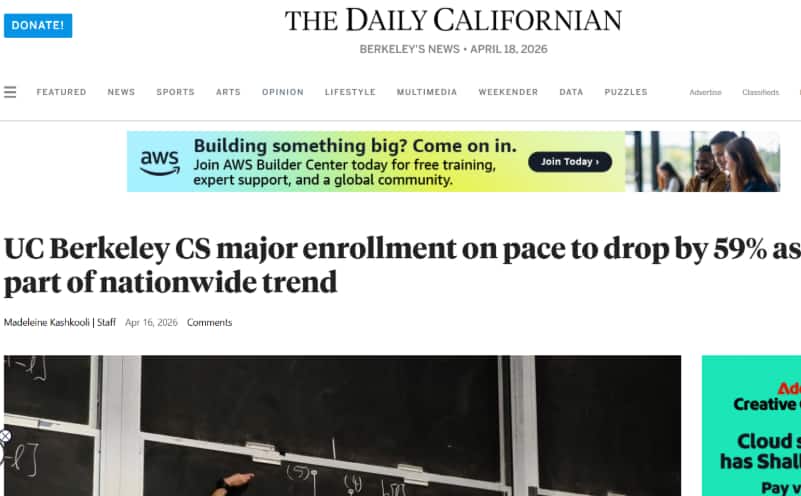
As per news published in The Daily Californian (California’s Newspaper), UC Berkeley CS major enrollment has fallen to 59 per cent as a part of nationwide trend.
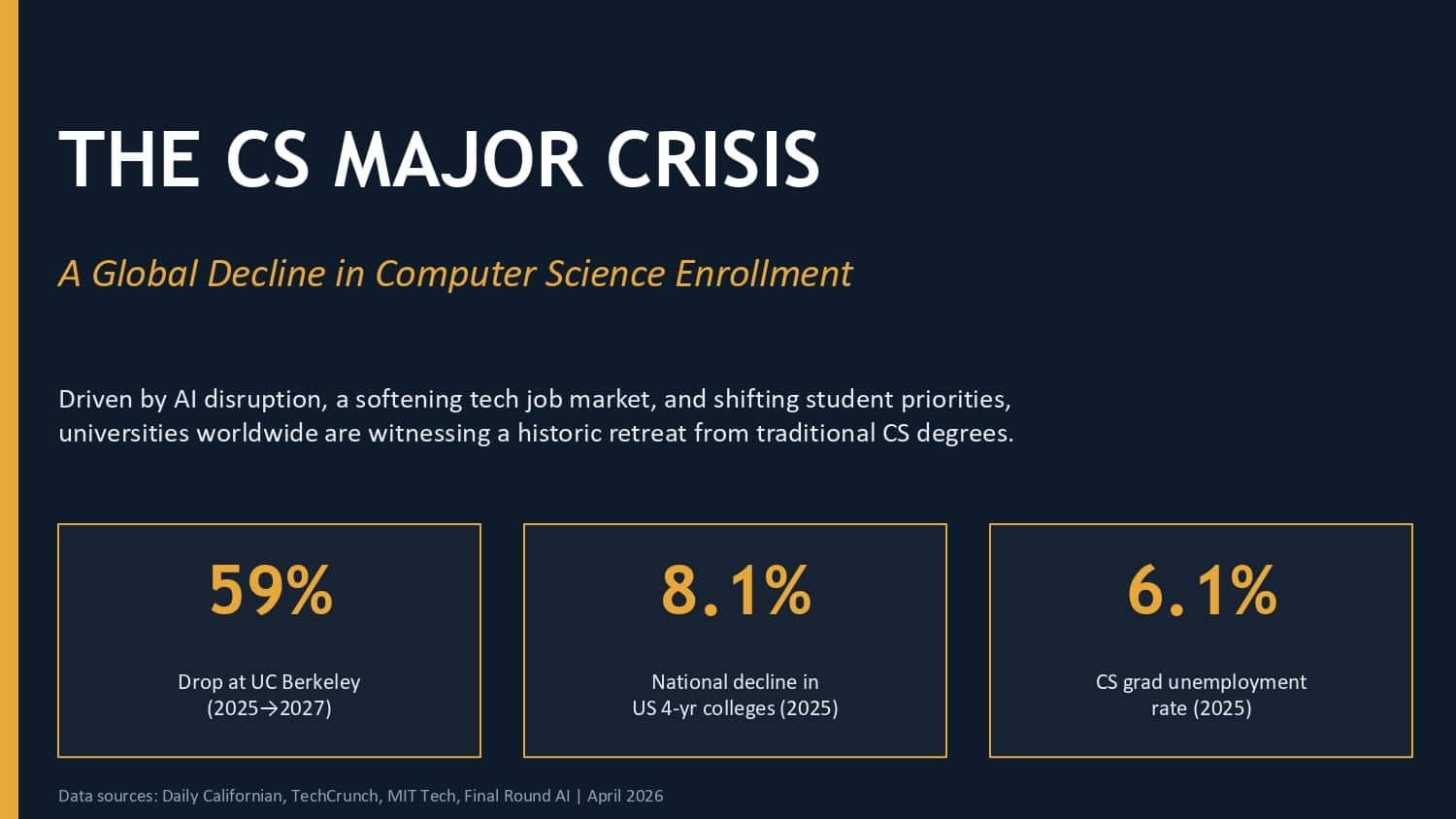
Massive Decline in Traditional CS Enrollment
There is a global decline in Computer Science Enrollment and this decline is driven by AI disruption, a softening tech job market, and shifting priorities of students. Universities worldwide are witnessing a historic retreat from traditional CS degrees.
Major CS enrollment in UC Berkeley’s is projected to decline by 59 per cent from 2025 to 2027, indicating trends across the country.
In 2025, there was an 8.1 per cent CS enrollment decline nationally in the USA.
In 2025, the unemployment rate of CS graduates was 6.1 per cent.
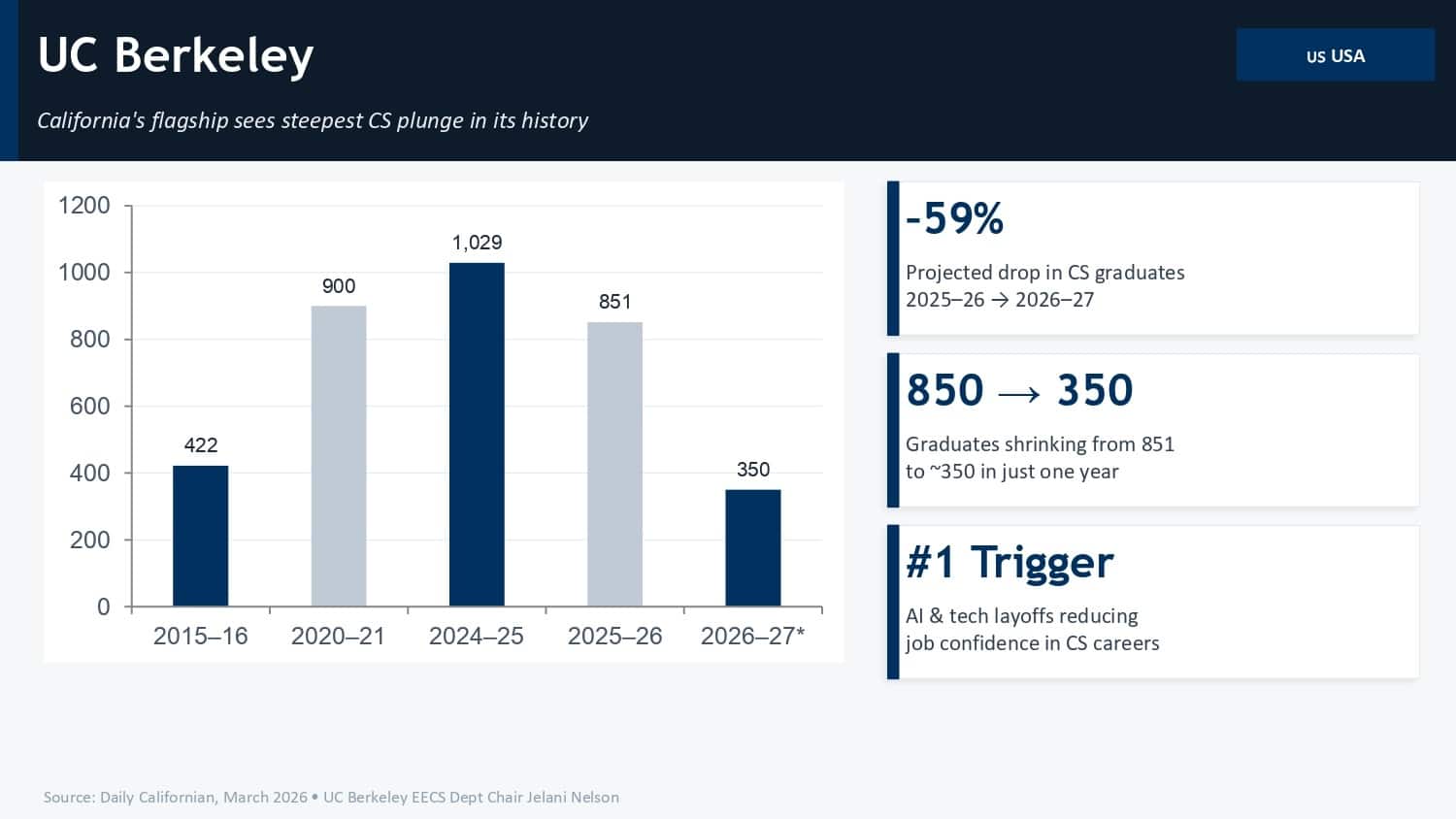
The projected drop of 59 per cent in the CS graduates highlights the decreasing interest and evolving perceptions of tech-related careers. This significant projected drop indicates the potential decline in the demand for traditional Computer Science.
The number of graduates fell from 850 (in the year 2025-2026) to 350 (2026-2027) in just one year.
Increased layoffs in the tech fields and less recruitment have influenced the enrollment and interest of students in traditional Computer Science courses.
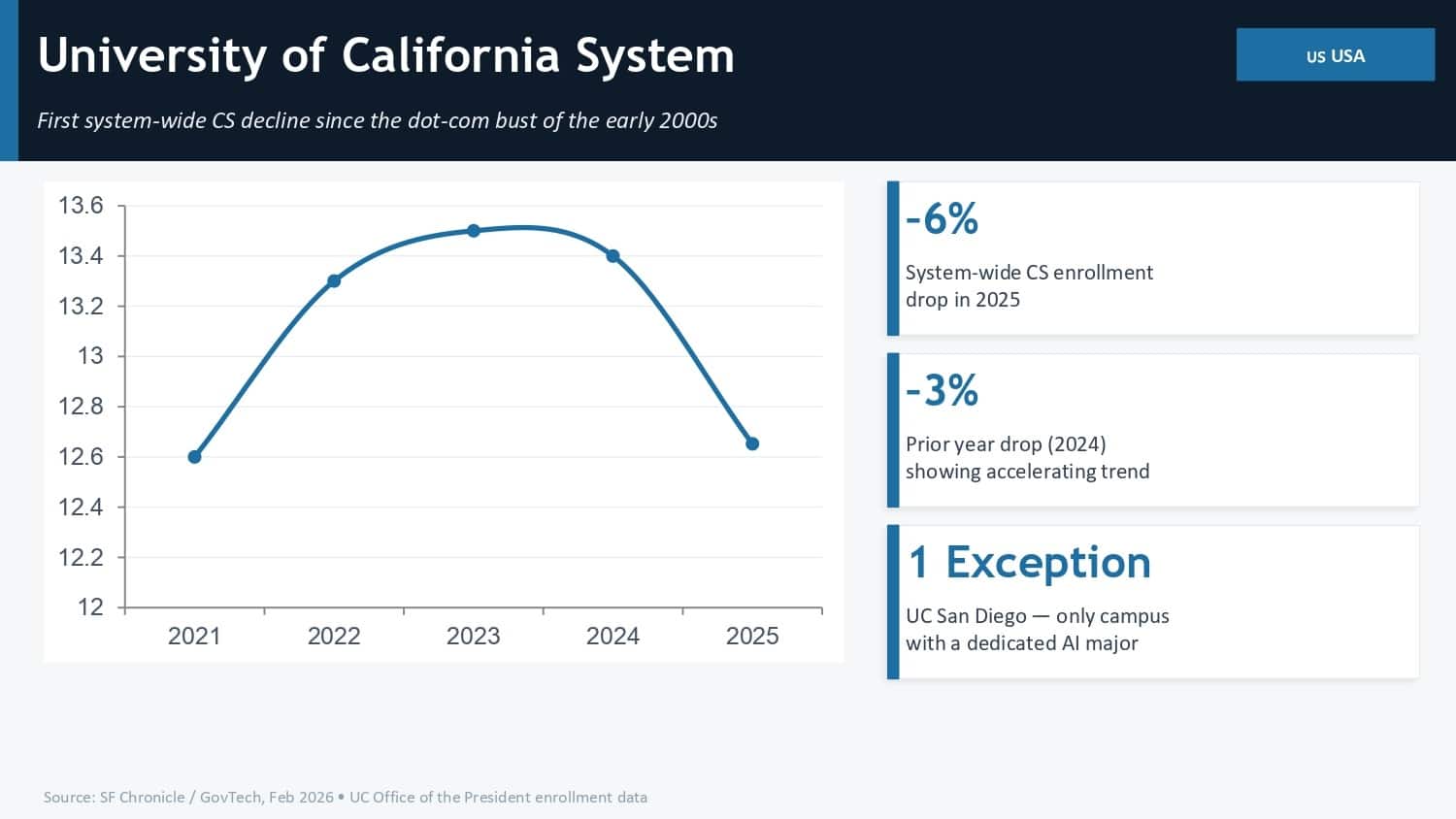
This graph represents UC System-wide Computer Science enrollment from the year 2021 to 2025. The enrollment peaked at approximately 13,700 in 2023 and then dropped to approximately 12,600 in the year 2025. Around six per cent is the overall system-wide CS enrollment drop in 2025, and three per cent is the year-on-year decline.
Only one campus of the University of California System shows growth in enrollment because of the addition of a dedicated AI specialisation.
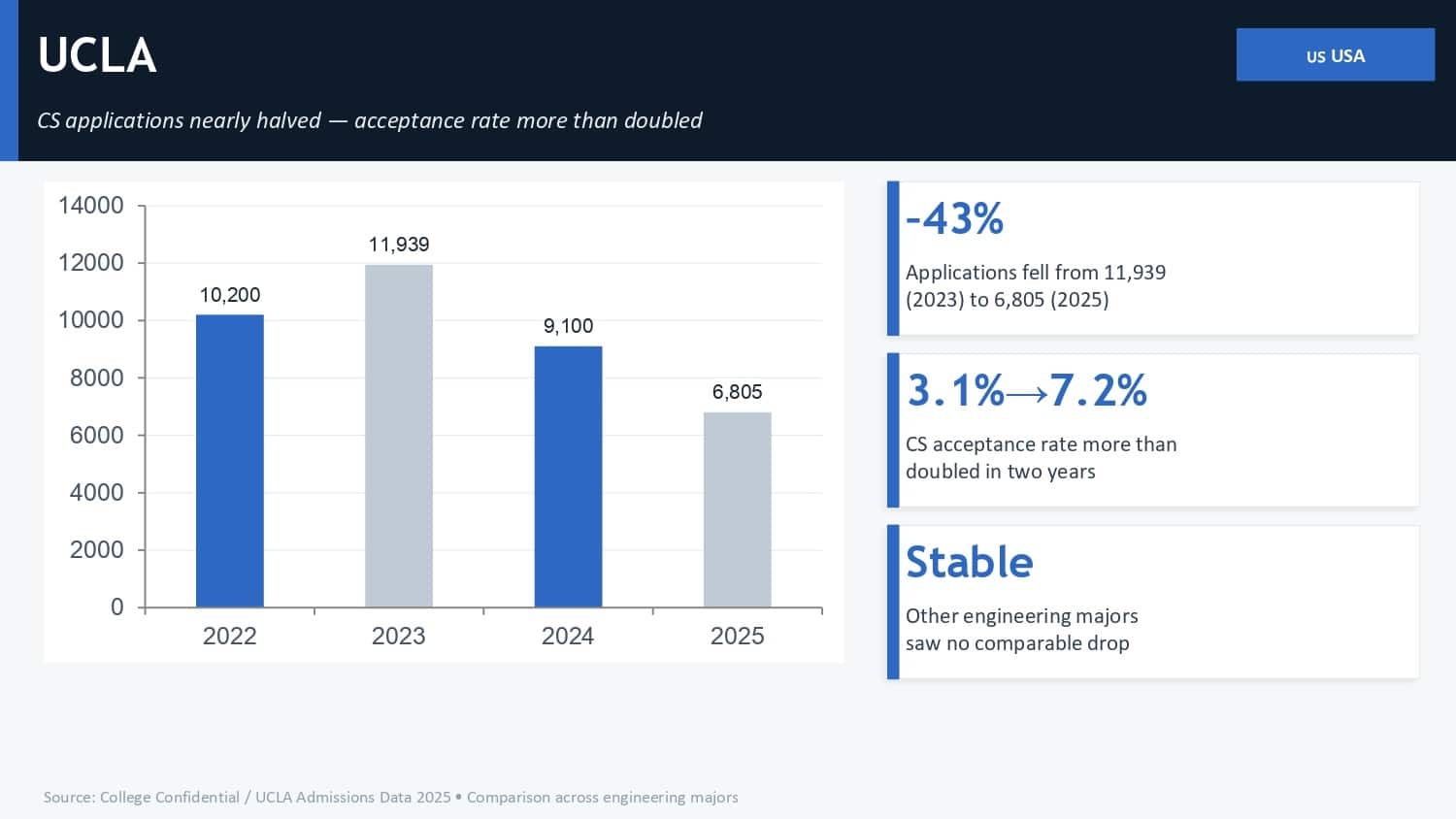
UCLA, another major institution, shows a decline in traditional CS applications from 11,939 (in the year 2023) to 6,805 (in the year 2025). Overall, there is about a 43 per cent drop in applications.
CS acceptance rate increased from 3.1 per cent to 7.2 per cent, more than doubling in two years.
Other major engineering fields show stability, without any drop.
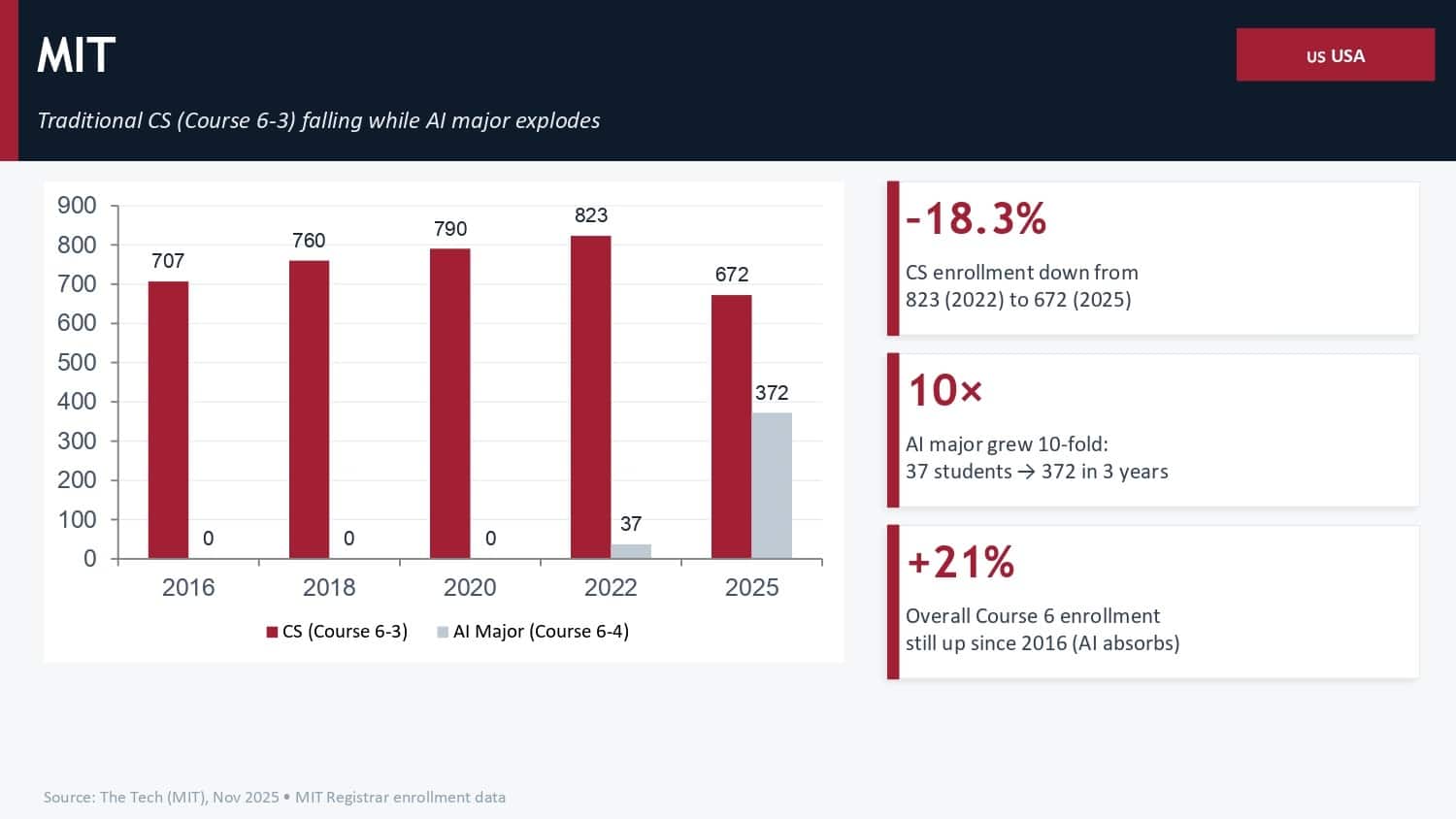
MIT, another major institution, also shows a major drop in traditional CS enrollment from 823 (in the year 2022) to 672 (in the year 2025). Overall, about 18.3 per cent of the decline is seen in CS enrollment. This graph indicates that the AI major increases by 10 times from 37 students to 372 students in three years.
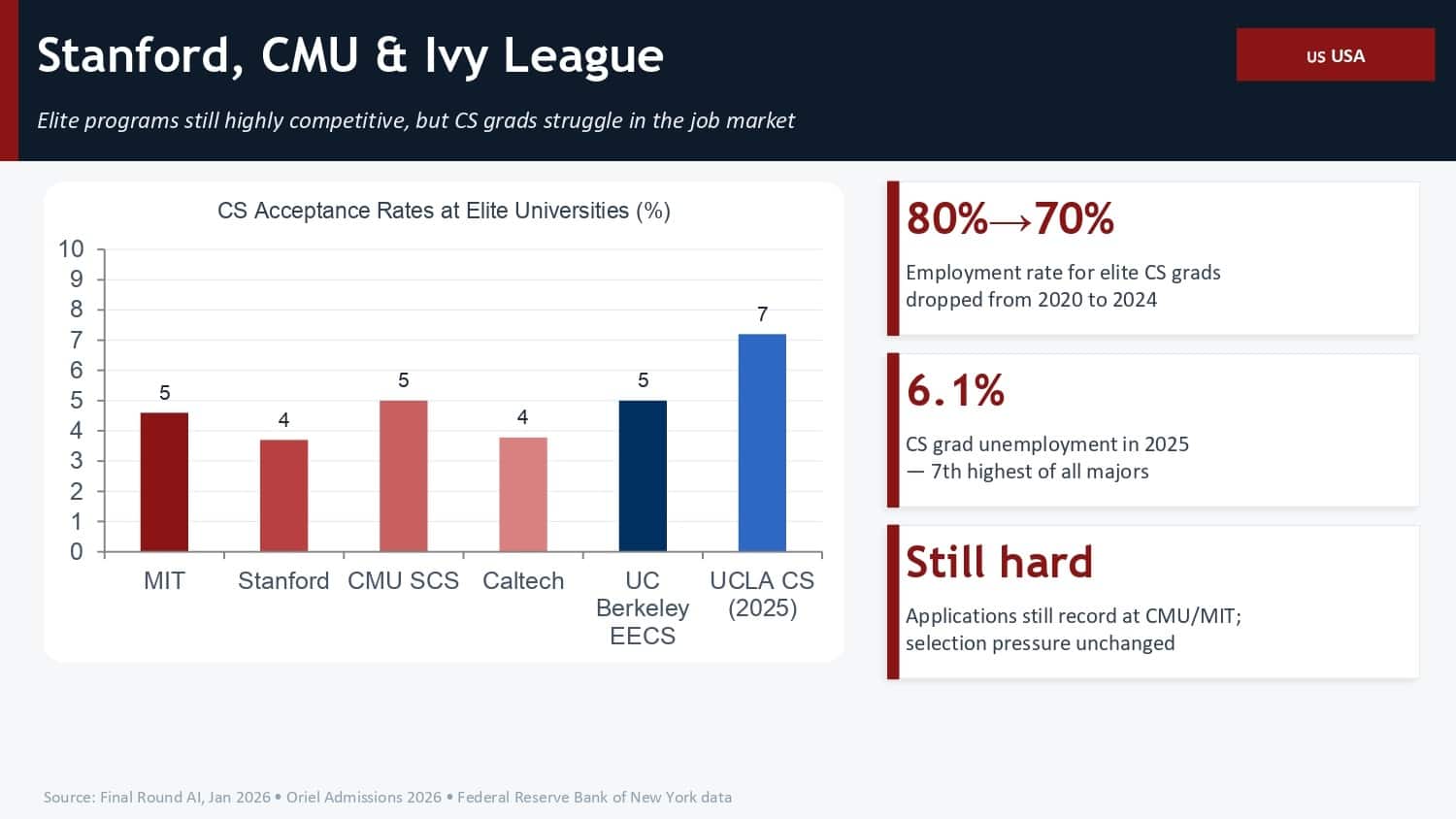
This graph represents the CS acceptance rate at elite universities. The CS acceptance rate at MIT, CMU SCS, and UC Berkeley EECS is five per cent, at Stanford, and Caltech is four per, and at UCLA CS is 7 per cent.
There is a drop of 80 to 70 per cent from 2020 to 2024 in the employment rate for elite CS graduates.
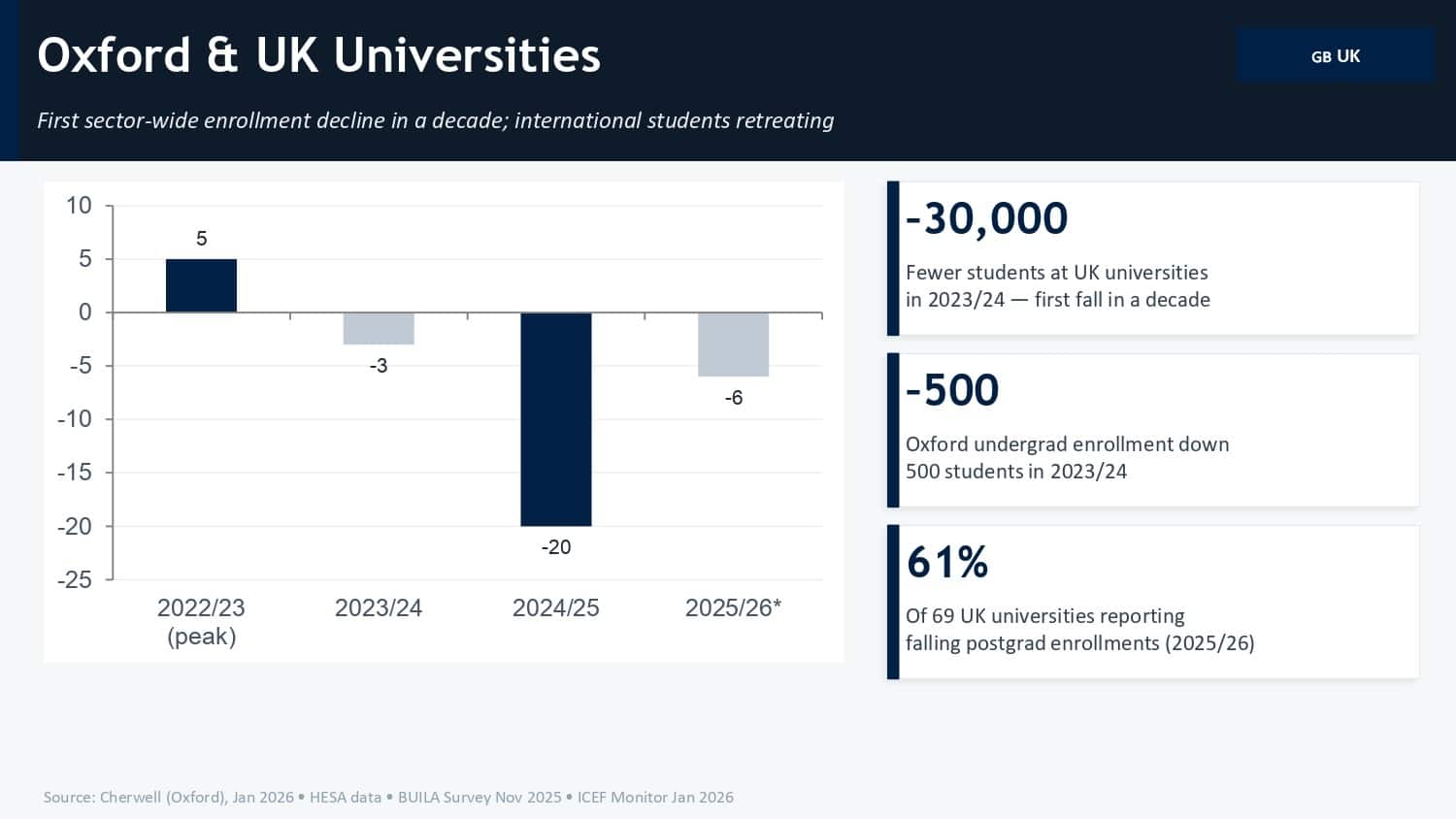
This table highlights the global enrollment trends, considering UK universities' trends, including Oxford University. There is a drop of around 500 Oxford undergraduate enrollment in 2023/24. 61 per cent of the Universities in the UK show a decline in postgraduate enrollments in 2025/26, pointing to a wider trend beyond the undergraduate CS programs.
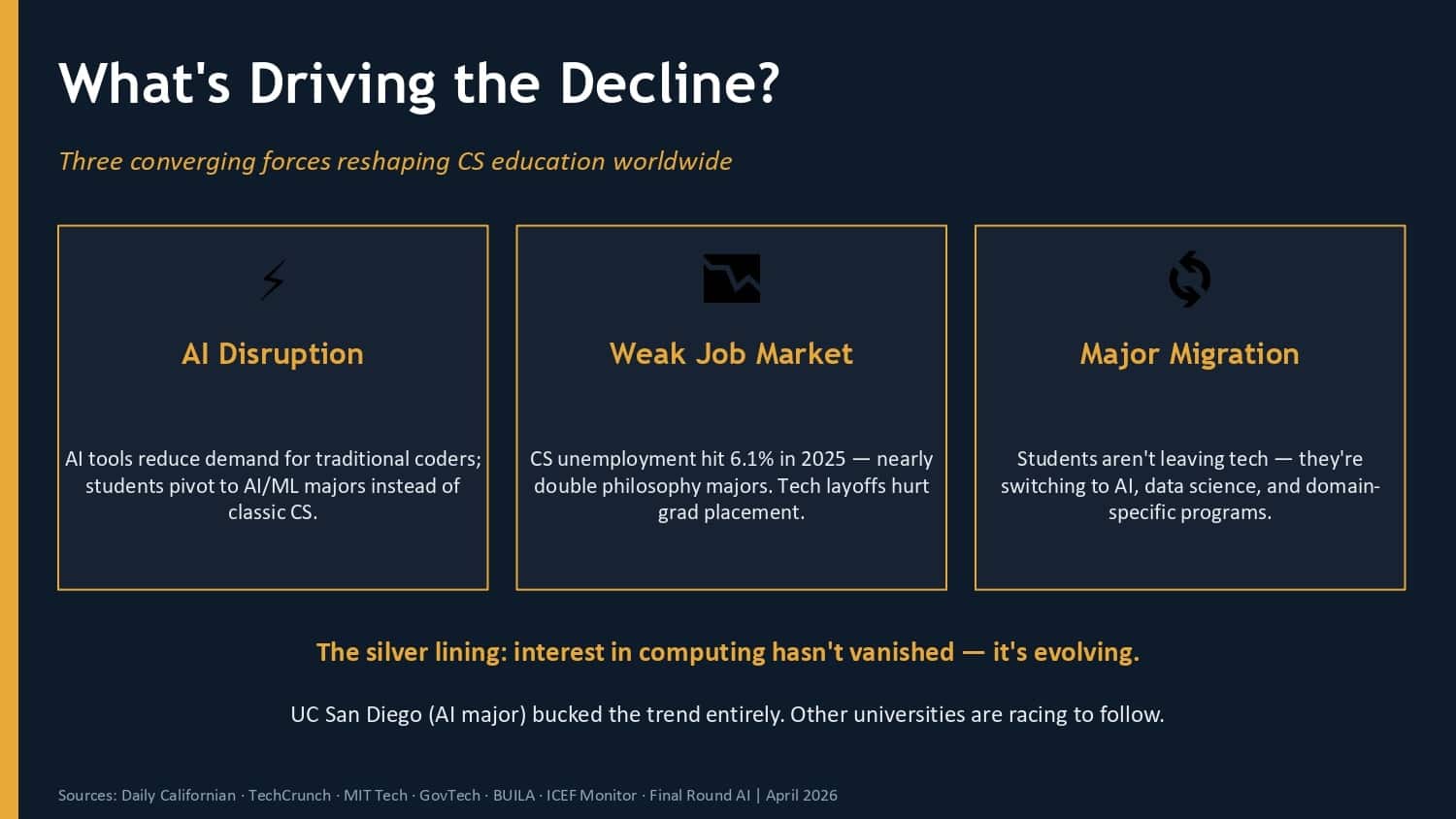
There are primarily three main reasons that are driving the decline
AI Disruption - Advancements in AI and the availability of various AI tools decrease the need for classic coding skills. Students are shifting from traditional CS to AI and ML specializations for better career prospects.
Weak Job Market- The tech job market is weakening because of layoffs and AI automation. Significant drop in employment rate and increased tech layoffs impact the placement of traditional CS graduates.
Major Migration- Students are not leaving tech rather than they are shifting towards AI, data science, and specialized CS fields.
B.Tech remains valuable in 2026, but the need of the hour is to learn specialised skills like AI and ML for successful career outcomes. Students pursuing B.Tech in the CSE stream are advised to pursue B.Tech in CSE with specialization to stay aligned with the industry demands.
Confused About College Admissions?
Get expert advice on college selection, admission chances, and career path in a personalized counselling session.
Book a Counselling Slot
Select Date
Pick a Slot
Articles
Related Stories
|
Upcoming Engineering Exams
Certifications By Top Providers
Explore Top Universities Across Globe
Popular Courses and Specializations
List of colleges accepting JEE Main

Browse Engineering Colleges by State
Questions related to JEE Main
On Question asked by student community
Have a question related to JEE Main ?
Hello, the JEE Main 2027 notification date has not been officially announced yet. The notification and registration dates are expected to be released by NTA around September-October 2026. You can check the latest JEE Main 2027 updates here: https://engineering.careers360.com/articles/jee-main-2027
Hello Student,
For JEE Main, you can use Careers360 resources that cover previous-year questions (PYQs), chapter-wise questions, and repeated concepts. Practising PYQs is useful for identifying recurring question patterns and important topics.
You can check the JEE Main Previous 10 Years Question Papers with Solutions on Careers360 using the link
Dear Student,
To secure an SC category rank of around 4000 in JEE Main 2027, you should aim for a score of 94 to 95 percentile.
Read more at :
Hello, you can access JEE classes and notes through the JEE preparation section on the app. Search for JEE and select the relevant study material or notes section.
Hello Student,
Yes. Starting JEE Main preparation early can help you build strong concepts and maintain a consistent study routine. Focus on Physics, Chemistry, and Mathematics, follow the syllabus, practise previous-year questions, revise regularly, and take mock tests.
For more information, you can click on the link below.
Article Link

B.Tech/B.Arch Admissions OPEN
Among top 100 Universities Globally in the Times Higher Education (THE) Interdisciplinary Science Rankings 2026
Manav Rachna-B.Tech Admissions 2026
ApplyNAAC A++ Grade | Recognized as Category-1 Deemed to be University by UGC | 41,000 + Alumni Imprints Globally
GMRIT Deemed to be University B.Tech Admissions 2026
Apply100+ Recruiters | 1200+ Placements of 2026 Batch | NBA & NAAC Accredited | Highest CTC 37 LPA
Integral University B.Tech Admissions 2026
ApplyNAAC A+ Accredited | Highest CTC 45 LPA | Scholarships Available
Parul University B-TECH Admissions 2026
ApplyIndia's youngest NAAC A++ accredited University | NIRF rank band 151-200 | 2200 Recruiters | 45.98 Lakhs Highest Package
East Point College of Engineering & Tech. Admissions 2026
ApplyApply for B.E at East Point College of Engineering and Technology | Affiliated to VTU | AICTE Approved | NBA Accredited | Highest CTC 33 LPA
JEE Main Notifications
Explore Career Options
By IndustryNever miss JEE Main update
Get timely JEE Main updates directly to your inbox. Stay informed!