Integral University M.Tech Admissions 2026
NAAC A+ Accredited | Highest CTC 45 LPA | Scholarships Available


GATE Preparation Tips for Mechanical Engineering (ME) 2027- Aspirants preparing for GATE 2027 for Mechanical Engineering might be stressed out to prepare for the GATE exam, which involves so much of competition. They must be looking for some good preparation tips for GATE 2027. To help them ease their stress, we have come up with Mechanical Engineering preparation tips for GATE 2027, which are outlined in the article below. Read this article to know various preparation tips, important topics, exam syllabus, recommended books, and preparation strategies for GATE Mechanical Engineering preparation. The article also includes the latest GATE 2027 Mechanical Engineering syllabus.
This Story also Contains
Refer to the table given below for GATE 2027 Exam Schedule
| Updates | Dates |
| GATE Online Application Process Begins | 14 August 2026 |
| GATE 2027 Regular Registration Closes | 21 September 2026 |
| GATE 2027 Extended Registration Closes | 30 September 2026 |
| GATE 2027 City allotment notice | 4 January 2027 |
| GATE 2027 Exam Dates |
Week 1: 6 and 7 Feb 2027 Week 2: 13 and 14 Feb 2027 Week 3: 20 and 21 Feb 2027 |
Aspirants willing to work hard and study for the GATE Exam 2027 might be stuck with the question, “How to prepare for the GATE Mechanical Engineering?” To provide answers to this question, various preparation tips covering the syllabus, books, and other strategies are mentioned below.
Make a schedule - The first step towards planning a preparation strategy is to make a schedule of what topics to cover and when to cover them. The next important and difficult step is to stick to that schedule, which requires a huge amount of motivation and dedication. Ensure that the schedule includes a little bit of play (relaxation time) rather than having all work.
Get familiar with the syllabus - Go through the GATE 2027 syllabus before starting with your preparation to get a better understanding of how to proceed with the preparation. The syllabus of the previous year is mentioned in the table below:
The GATE Mechanical Engineering (ME) Syllabus 2027 include all the key topics that candidates prepare for the exam. Before you start your preparation, go through the newest syllabus in a careful way, to get a clear sense of the subjects.
GATE 2027 Mechanical Engineering Syllabus PDF
|
S.No |
Sections |
Topics |
|
1 |
Engineering Mathematics |
|
|
2 |
Applied Mechanics and Design |
|
|
3 |
Fluid Mechanics & Thermal Sciences |
|
|
4 |
Materials, Manufacturing & Industrial Engineering |
|
Refer to the best books for GATE 2027 preparation. After getting familiar with the syllabus for Mechanical Engineering, go through the list of recommended books for better preparation. A list of important topics and books is mentioned below:
|
S.No |
Topics |
Emphasis should be on |
Books |
|
1 |
Design of Machine Elements |
Design For Static And Dynamic Loading; Failure Theories; Fatigue Strength And The S-N Diagram; Principles Of The Design Of Machine Elements Such As Bolted, Riveted, And Welded Joints, Shafts, Spur Gears, Rolling And Sliding Contact Bearings, Brakes, And Clutches. |
|
|
2 |
Engineering Mechanics |
Resolving Forces, Equilibrium, and Truss |
|
|
3 |
Fluid Mechanics |
Simple & Differential Piezometer, Pressure Column Height Calculation, Reynolds ’ No. Calculation, Hydraulic Power, Nozzle Velocity, etc. Of Turbines, Bernoulli’s Law (Simple Problems), Tapered Sections, Pump Parameters (Speed, Power, Discharge), Force Calculation, |
|
|
4 |
Heat Transfer |
Convection, Conduction, Radiation, Efficiency Calculation, Heat Exchanger (Parallel & Counter Flow) Outlet Temp. Calculation, Biot Number, Prandtl Number, LMTD, Heat Transfer Through Slabs, Shells, Cylinders, Condenser |
|
|
5 |
Forecasting Model, CPM, PERT, Work Study And Measurement, Scheduling, Johnson's Rule Time Study, EOQ, Standard Time, Demand, Poisson’s Arrivals & Departures, LPP Problems (Graphical Queuing Model, Break-Even Analysis |
| |
|
6 |
Machining (Milling, Drilling, EDM, ECM) Tool Geometry, Punching, Blanking, Force; Conceptual & Theoretical Questions; Orthogonal Machining, Heat & Power Required In Welding, Transformations (Rotations, Scaling Etc), Solidification Time, CNC Machine G Codes And M Codes, Sheet Metal, Various Types Of Fits, |
| |
|
7 |
Strength of Materials |
Principe stress and strain BMD and SFD, Macaulay’s theorem (slope & deflection), Thin Pressure Vessels, Problems On Various Theories Of Failure, Torques, and Bending Moment Calculation, |
|
|
8 |
Strength of Materials |
Concepts, Generally Theories Of Failure, Mohr's Circle |
|
|
9 |
Thermal Science |
Rankine Cycle, Brayton Cycle, Regeneration in steam cycles, and other cycles, T-S diagrams, P-V diagrams, enthalpy calculations, C.O.P. parameters of I.C. Engine, DBT, WBT, Relations (Otto, Diesel Cycles), Exit Temperature in Various Stages of Cycles, Pressure of Nozzle, Compressor Work Calculations, Work Done, |
|
|
10 |
Thermo Dynamics |
Cycles, Turbines, Refrigeration, Work & Heat First Law of Thermodynamics, Second Law of Thermodynamics, Entropy, Properties Of Pure Substances |
|
|
11 |
Theory of Machines |
Mechanism, Gear train, Flywheel, Linear Vibration Analysis of Mechanical systems (Goodman or Soderberg or Gerber Criteria), torsion, strain energy, S-N curve, Degrees Of Freedom, Instantaneous Centre Method, Clutch Power, Brake Power, Belt Drive, D.O.F. Of Mechanisms, Simple Gearing Ratio, Spur Gears, Type Of Mechanism, Simple Spur Gear Main, Quick Return Mechanism, Mobility |
|
Practise Mock Tests- Practise the questions by attempting the mock tests. You can also go through the sample papers and previous years’ question papers for more practice. Practicing will help you figure out your strengths and weaknesses so that you can work on them to boost your preparation.
Must Read:-
What are the best GATE Preparation Materials?
What are the best GATE Practice Tests?
Revise all the concepts- Revision and more revision will make your preparation better. Keep revising all the concepts, important topics, and questions. Make handy notes for the last-minute revision.
Time Management - Studying every topic well is important, but it is not enough. Time management skills are required to implement the learned knowledge well in the exam to score better.
Relax and give your best - Try to give your best while preparing as well as while attempting the exam, but don’t stress yourself too much. Keep calm and relax. Stressing out will make it worse. Try to stay calm for a better attempt at the paper.
Complete the entire GATE syllabus and exam pattern before the examination.
Write down brief notes of formulas, Concepts, and commonly made mistakes.
Practice previous years' GATE question papers for understanding the question trends and problem level.
Take a GATE mock test once a week and then twice a week as the exam is near.
Work on the weak areas after an experience of all mock tests and then take the new one.
Do not start fresh reference books or other material during the last months of preparation.
Maintain constant revision of major formulas, shortcuts, and concepts for long-term results.
Don't compromise accuracy for speed, as negative marking is key to scores.
Revise a fixed schedule every day for the achievement of objectives.
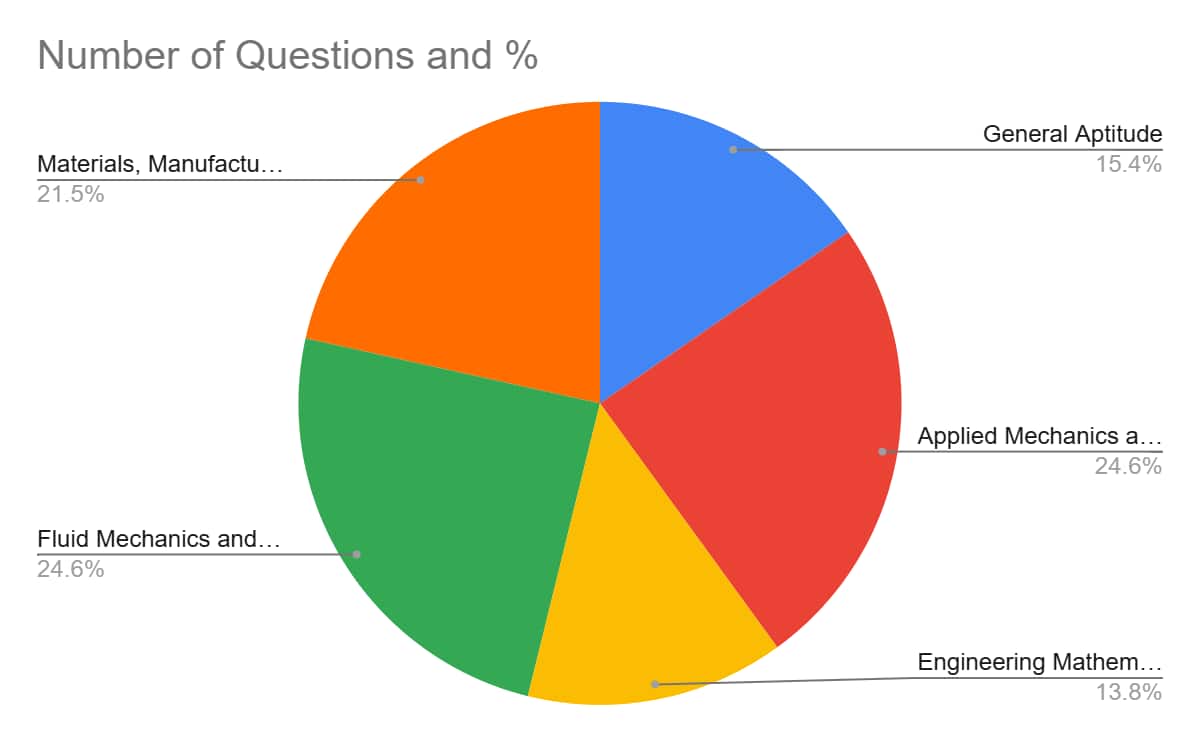
The chapter-wise weightage of all the chapters of the Mechanical Engineering for the exam is given below. For GATE 2027 Preparation:
|
Chapter Name |
Number of Questions |
% |
|
General Aptitude |
10 |
15.38461538 |
|
Applied Mechanics and Design |
16 |
24.61538462 |
|
Engineering Mathematics |
9 |
13.84615385 |
|
Fluid Mechanics and Thermal Sciences |
16 |
24.61538462 |
|
Materials, Manufacturing, and Industrial Engineering |
14 |
21.53846154 |
Starting preparation without knowing the GATE ME syllabus and exam pattern.
Building up a study plan and not following it properly. Not covering all the topics that appear in GATE and scoring more weightage, like Engineering Mathematics and General Aptitude.
Using multiple books and resources, and not having a concrete study plan. Learning all concepts, skipping numerical practice, and not solving a single problem.
Taking more pauses than required.Revising last month. Leaving short notes, a formula list, and remembering all. One subject is taking so much time, and others are being neglected.
Not analyzing his mistakes in the mock test and preparing for new topics in the next few days.
Spending more time than required on a few topics, ignoring others, and keeping himself over-stressed. Continuously ignoring his health and sleep.
Previous Year GATE Mock Test Links
Frequently Asked Questions (FAQs)
Start with the syllabus and exam pattern, prepare a study plan, refer to standard books, practice question papers of various years, and revise and practice.
The important areas would include- Engineering Mathematics, Strength of Materials, Thermodynamics, Fluid Mechanics, Heat Transfer, Theory of Machines, Manufacturing Engineering, and Industrial Engineering.
Candidates should study for about 5-8 hours on a regular basis.
Previous-year papers are very important for GATE ME but should be used along with mock tests, reference books, and revision.
The popular books include P.K. Nag (Thermodynamics), R.K. Bansal (Fluid Mechanics), Gere and Timoshenko (Strength of Materials), and R.K. Jain (Manufacturing Engineering).
Yes, self-study is enough for candidates to prepare and excel in GATE ME, using good study material and mock tests.
Mock tests help the candidate increase their speed, accuracy, and time management capabilities, and identify weak points.
Mock tests should not be missed, revision from different books should be avoided, and revision from previous-year question papers should not be avoided.
Make short revision notes, brush up on formulas regularly, revise all GATE ME question papers from older versions, and take mock tests in the last month.
Sectional mock tests should be taken after completing individual sections, and full-length mock tests should be taken once the majority of the syllabus has been completed.

On Question asked by student community
Hello, you can use the GATE College Predictor to check colleges based on your GATE score, rank, category and preferred branch: https://engineering.careers360.com/gate-college-predictor
Dear Student,
Admission rules for OCI candidates may vary depending on the institution and programme. As an Overseas Citizen of India (OCI) cardholder, you can apply for GATE 2027 under the international/foreign candidate section if you reside or have completed your degree outside India, though you can select your appropriate
Hello Student, your CSE background and 4 years of automotive experience can be useful for an Embedded Systems specialization. However, for an M.Tech , I would be cautious about choosing a fully online/distance programme, as recognition and mode of delivery depend on the university and applicable regulatory rules. I can
Hello Student, Please share your B.Tech branch, percentage/CGPA, GATE status and budget, and I can suggest the most suitable colleges for you.
Hello Student,
You can check the GATE Food Technology previous year question papers on Careers360. Food Technology is covered under XE-G (Engineering Sciences) and XL-U (Life Sciences).
https://engineering.careers360.com/articles/gate-question-papers

NAAC A+ Accredited | Highest CTC 45 LPA | Scholarships Available
Campuses in Ropar, Agartala, Aizawl, Ajmer, Aurangabad, Calicut, Imphal, Itanagar, Kohima, Gorakhpur, Patna & Srinagar
100+ Recruiters | 100+ Placements of 2026 Batch | NBA & NAAC Accredited | Highest CTC 37 LPA
NBA Accredited | AICTE Approved | Affiliated to AKTU | Highest CTC 14.2 LPA | Accepts CUET Score
NAAC A+ Accredited | 100% Placement Assistance | Scholarships to Meritorious Students
1st in NPTEL program of 6 IITs | Highest CTC 72 LPA | Scholarships to meritorious students