Amity University Noida-B.Tech Admissions 2026
This round of applications closing on 15th July | Among top 100 Universities Globally in the Times Higher Education (THE) Interdisciplinary Science Rankings 2026


How Many Students Appeared for JEE Mains 2026? - The National Testing Agency has released the number of students who appeared for JEE Main 2026 session 2 on the official website, jeemain.nta.nic.in. As per the latest notification regarding JEE Main 2026 registrations, around 10,34,330 Lakh students appeared for session 2 of the NTA JEE Mains. Candidates can check the complete details regarding the number of students who appeared for JEE Main 2026 session 2 on this page. Students should take a look at the number of candidates appearing for the JEE Mains 2026 to know the level of competition. The JEE Main 2026 exam was conducted from April 2 to 8, 2026. In session 1, 13,04,653 candidates appeared, while 13, 55,293 candidates had registered.
Also Check- Highest Ever Registrations This Year in JEE Main 2026
In 2025, the number of registered candidates was 13,11,544 for session 1 and 10,61,840 for session 2. The authority releases details about the number of applicants for JEE Main 2026, the number of students who appeared for the IIT JEE Main 2026, and the number of students who qualify for the entrance test. Read the article for all the complete details on how many students appeared in the JEE Mains exam 2026.
NTA has released the statistics for the JEE Main exam for session 2 on the official website. Detailed statistics on the number of students who registered for the JEE Main 2026 exam have been released online along with the results. The number of candidates who qualified will be released online. Candidates can check the complete statistics for how many students appeared for JEE Mains 2026 sessions 1 & 2 here.
This round of applications closing on 15th July | Among top 100 Universities Globally in the Times Higher Education (THE) Interdisciplinary Science Rankings 2026
40 LPA Highest Package | Up to 100% Scholarship worth 24 Crore via GUTS exam
| Particulars | Candidates Number |
|---|---|
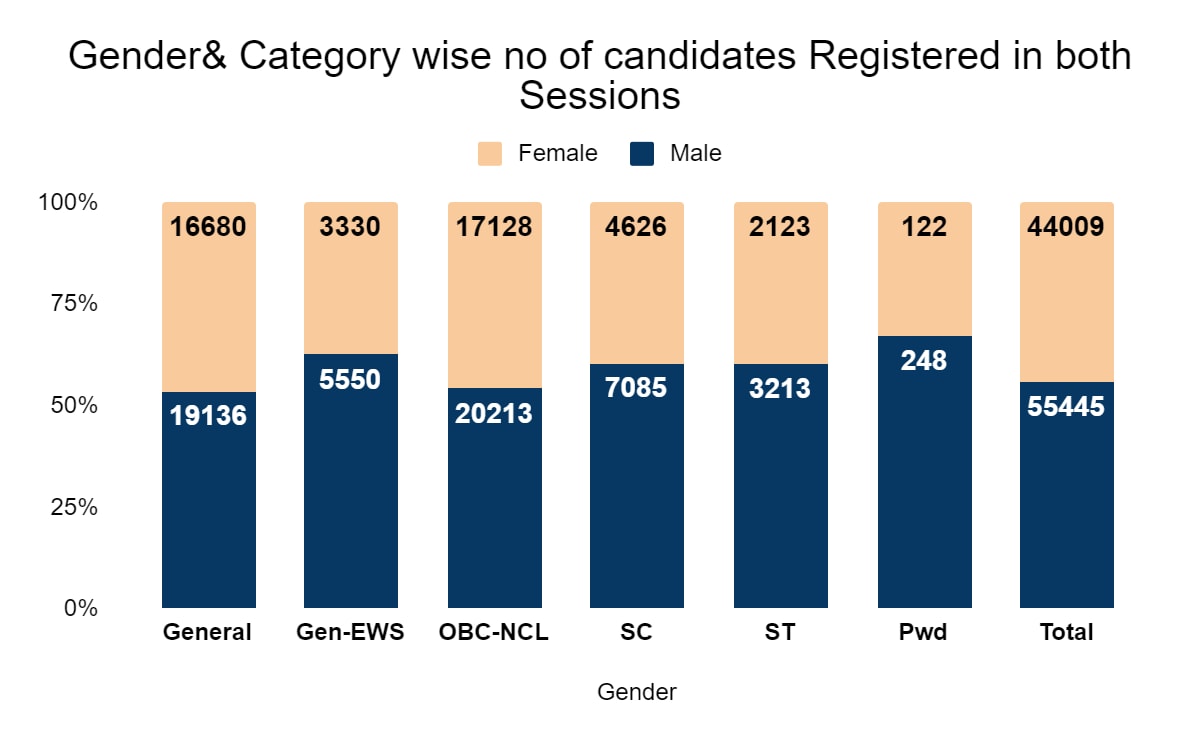
Number of common candidates Registered in both sessions (January/April) of the JEE (Main) – 2026 Examination | 8,61,343 |
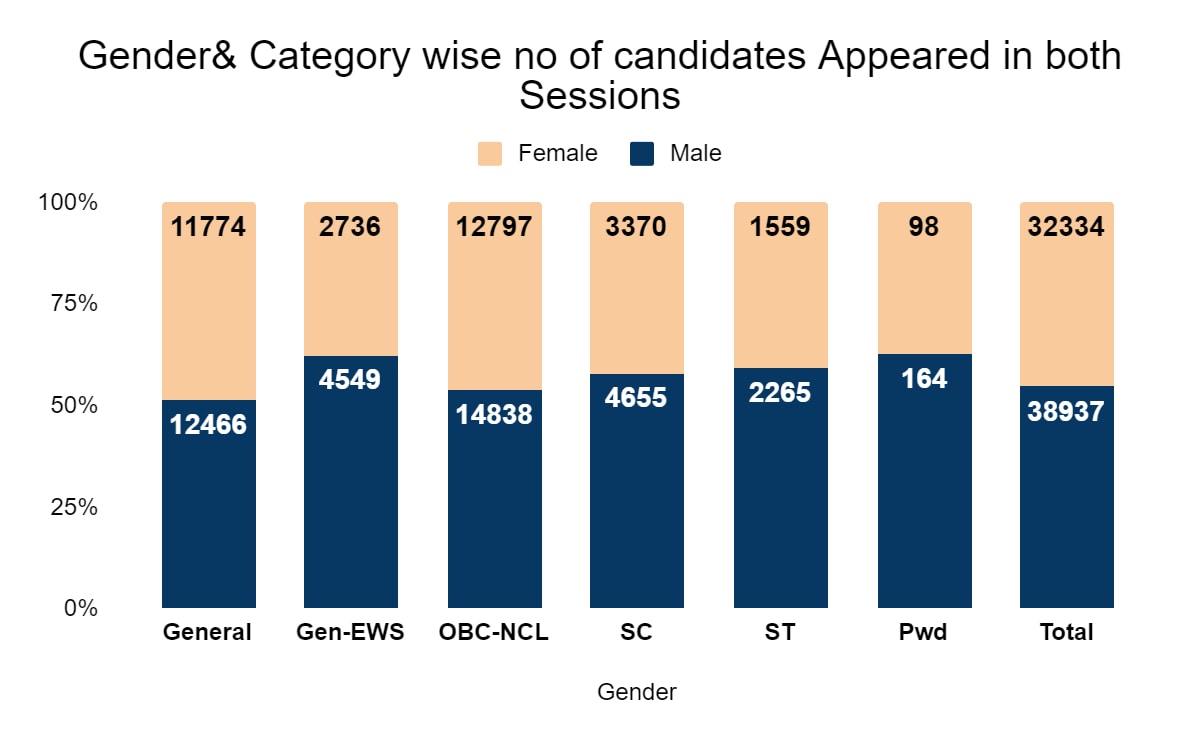
Number of common candidates Appeared in both sessions (January/April) of the JEE (Main) – 2026 Examination | 8,00,516 |
Number of candidates Registered in January 2026 (Session 1) Examination | 13,55,293 |
Number of candidates who Appeared in the January 2026 (Session 1) Examination | 13,04,653 |
Number of candidates Registered in April 2026 (Session 2) Examination | 11,10,904 |
Number of candidates who Appeared in the April 2026 (Session 2) Examination | 10,34,330 |
Total number of Unique Candidates Registered in both Sessions (January/April) of the JEE (Main) – 2026 Examination | 16,04,854 |
Total Number of Unique Candidates Appeared in both Sessions (January/April) of the JEE (Main) – 2026 Examination | 15,38,468 |
| Aspects | All Shifts |
|---|---|
| Registered candidates | B.Tech - 11.10 lakhs B.Arch - 54,953 |
| Candidates Appeared | 11.23 lakhs |
| Attendance (%) | 93% |
| Aadhaar Verification (%) | 97% |
Date of Examination | Shift | Registered Candidates | Appeared Candidates | Percentage |
April 2, 2026 | Shift 1 | 1,23,407 | 1,12,909 | 91.49 |
April 2, 2026 | Shift 2 | 1,23,099 | 1,13,640 | 92.32 |
April 4, 2026 | Shift 1 | 1,23,550 | 1,14,734 | 92.86 |
April 4, 2026 | Shift 2 | 1,23,198 | 1,15,390 | 93.66 |
April 5, 2026 | Shift 1 | 1,23,302 | 1,14,893 | 93.18 |
April 5, 2026 | Shift 2 | 1,23,092 | 1,15,414 | 93.76 |
April 6, 2026 | Shift 1 | 1,23,464 | 1,15,136 | 93.25 |
April 6, 2026 | Shift 2 | 1,23,614 | 1,15,612 | 93.53 |
April 8, 2026 | Shift 2 | 1,24,178 | 1,16,602 | 93.90 |
11,10,904 | 10,34,330 | 93.11 |
Category | General | EWS | SC | ST | OBC | Total |
Male | 2,65,302 | 94,787 | 80,995 | 28,230 | 2,87,662 | 7,56,976 |
Female | 1,31,698 | 39,303 | 36,201 | 12,941 | 1,33,785 | 3,53,928 |
Total | 3,97,000 | 1,34,090 | 1,17,196 | 41,171 | 4,21,447 | 11,10,904 |
| Aspects | All Shifts |
|---|---|
| Registered candidates | 13,55,293 |
| Candidates Appeared | 13,04,653 |
| Attendance (%) | 96.26% |
| Aadhaar Verified Candidates | 9,96,774 |
| Aadhaar Verification (%) | 96.19% |
| PwD Candidates | 4314 |
Last Date to Apply: 15th July | Ranked #43 among Engineering colleges in India by NIRF | Get Upto 100% Scholarships | Spot Admissions via CUET
Mark presence in the Modern Architectural field with Bachelor of Architecture | Highest CTC : 70 LPA | Accepts NATA Score
Related- Total Number of JEE Main 2026 Registrations
| Category | Male | Female | Total |
|---|---|---|---|
| General | 3,08,011 | 1,65,622 | 4,73,633 |
| Gen-EWS | 1,10,436 | 53,824 | 1,64,260 |
| OBC-NCL | 3,47,364 | 1,86,607 | 5,33,971 |
| SC | 90,767 | 46,440 | 1,37,207 |
| ST | 30,898 | 15,324 | 46,222 |
| Total | 8,87,476 | 4,67,817 | 13,55,293 |
| Category | Male | Female | Total |
|---|---|---|---|
| General | 2,95,078 | 1,57,747 | 4,52,825 |
| Gen-EWS | 1,08,054 | 52,904 | 1,60,958 |
| OBC-NCL | 3,36,860 | 1,80,476 | 5,17,336 |
| SC | 85,904 | 43,998 | 1,29,902 |
| ST | 29,189 | 14,443 | 43,632 |
| Total | 8,55,085 | 4,49,568 | 13,04,653 |
Get expert advice on college selection, admission chances, and career path in a personalized counselling session.
According to the previous year's notification, a total of 12,58,126 candidates appeared for the JEE Main 2025 B.Tech exam in the January session. Of these, 44,144 candidates appeared for B.Arch, and 18,596 candidates appeared for B.Planning. The attendance percentage for B.Arch was 69.54%, while for B.Planning, it was 65.63%. The attendance percentage was 95.93% this year. This year, NTA saw an increase of 89920 JEE Main application forms with over 13,11,544 registrations. The attendance rate for the JEE Main exam stood at 94.4%.
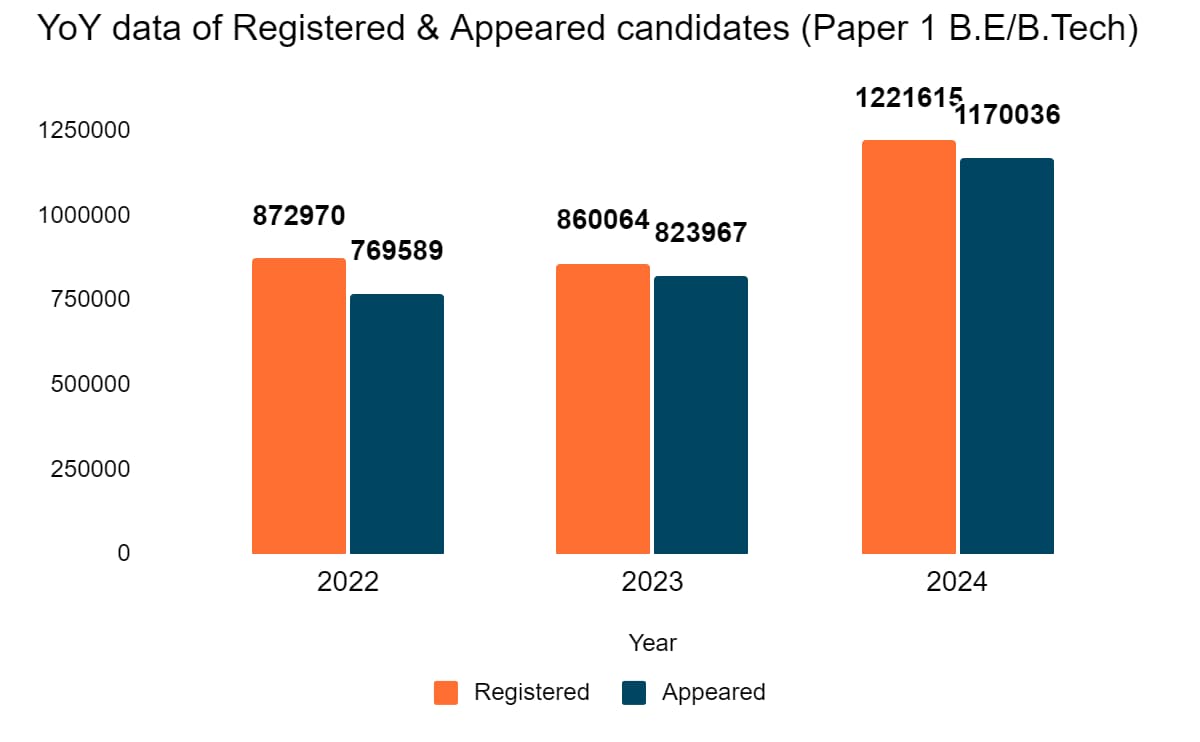
Candidates can check the table below for the total registered candidates in Session 1 and Session 2 for JEE Main (2022–2025):
| Year | Session 1 – Registered Candidates | Session 2 – Registered Candidates | Total Unique Registered Candidates |
|---|---|---|---|
| 2025 | 13,11,544 | 10,61,840 | 15,39,848 |
| 2024 | 12,21,624 | 11,79,569 | 14,76,557 |
| 2023 | 8,60,064 | 9,31,334 | 11,62,398 |
| 2022 | 8,72,970 | 6,22,034 | 10,26,799 |
Number of candidates registered and appeared for JEE Main 2025 Paper 1
| Date of Exam | Paper | Registered Candidates | Appeared Candidates | %age |
|---|---|---|---|---|
| 22, 23, 24, 28, and 29 January 2025 | Paper 1 (B.E./B. Tech.) | 13,11,544 | 12,58,136 | 95.93% |
| Category | General | EWS | SC | ST | OBC | Total |
|---|---|---|---|---|---|---|
| Female | 1,67,790 | 45,627 | 42,704 | 13,833 | 1,73,668 | 4,43,622 |
| Male | 3,21,419 | 96,159 | 87,550 | 28,778 | 3,34,014 | 8,67,920 |
| Third Gender | 1 | 0 | 0 | 0 | 1 | 2 |
| Total | 4,89,210 | 1,41,786 | 1,30,254 | 42,611 | 5,07,683 | 13,11,544 |
| Category | General | EWS | SC | ST | OBC | Total |
|---|---|---|---|---|---|---|
| Female | 1,59,378 | 44,762 | 40,282 | 12,965 | 1,67,423 | 4,24,810 |
| Male | 3,06,980 | 93,937 | 82,563 | 26,994 | 3,22,851 | 8,33,325 |
| Third Gender | 0 | 0 | 0 | 0 | 1 | 1 |
| Total | 4,66,358 | 1,38,699 | 1,22,845 | 39,959 | 4,90,275 | 12,58,136 |
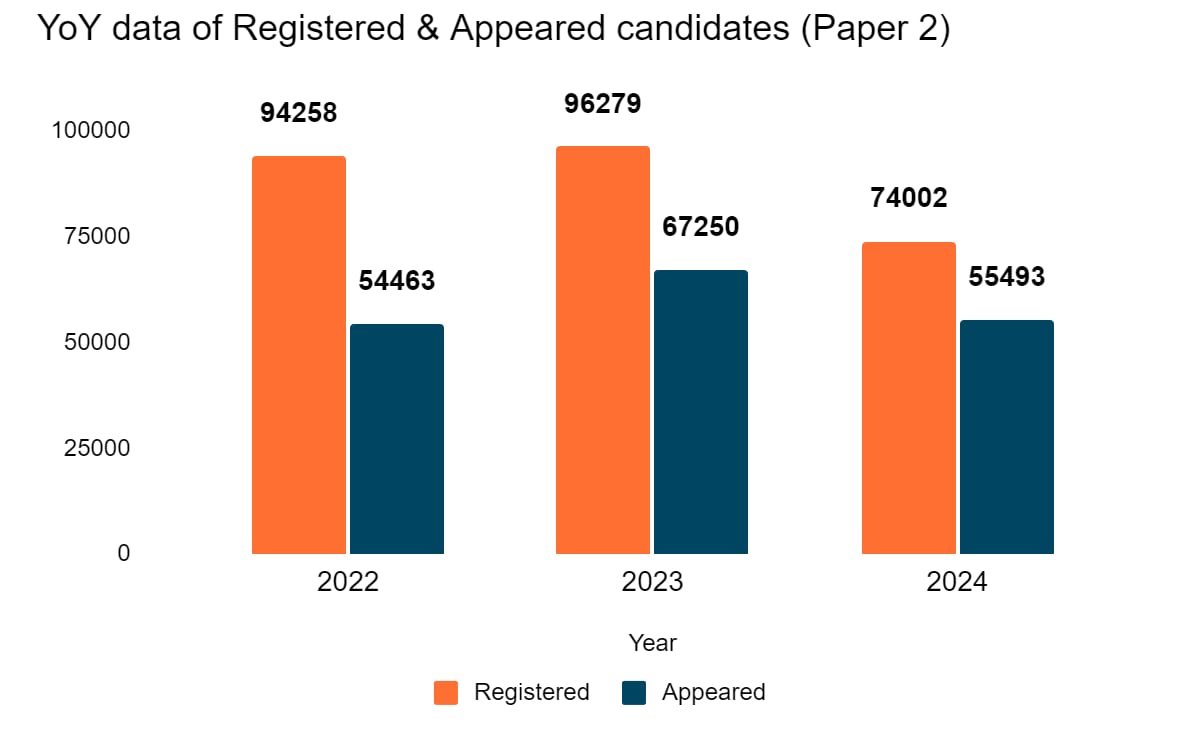
The National Testing Agency (NTA) conducted Joint Entrance Examination (Main) – 2025 Session 1 (January 2025) in 391 Centres in 289 Cities (including 12 cities outside India) for Paper 2 (B. Arch and B. Planning) as per the details given below:
| Date of Exam | Paper | Registered Candidates | Appeared Candidates | %age |
|---|---|---|---|---|
| 30 January 2025 | Paper 2A (B. Arch) | 63,481 | 44,144 | 69.54% |
| Paper 2 B (B. Planning) | 28,335 | 18,596 | 65.63% |
The Gender/Category-wise distribution of Candidates who Registered for Paper 2 A(B.Arch.)
| Category | General | EWS | SC | ST | OBC | Total | PwBD |
|---|---|---|---|---|---|---|---|
| Female | 11,966 | 2,778 | 3,491 | 1,407 | 11,113 | 30,755 | 63 |
| Male | 10,955 | 3,814 | 4,288 | 2,148 | 11,521 | 32,726 | 152 |
| Total | 22,921 | 6,592 | 7,779 | 3,555 | 22,634 | 63,481 | 215 |
The Gender-wise/ Category-wise distribution of Candidates who Appeared for Paper 2A (B.Arch)
| Category | General | EWS | SC | ST | OBC | Total | PwBD |
|---|---|---|---|---|---|---|---|
| Female | 8,296 | 2,076 | 2,402 | 973 | 8,061 | 21,808 | 48 |
| Male | 7,011 | 2,678 | 2,836 | 1,400 | 8,411 | 22,336 | 112 |
| Total | 15,307 | 4,754 | 5,238 | 2,373 | 16,472 | 44,144 | 160 |
The Gender/Category-wise distribution of Candidates who Registered for Paper 2B (B. Planning)
| Category | General | EWS | SC | ST | OBC | Total | PwBD |
|---|---|---|---|---|---|---|---|
| Female | 4,555 | 1,016 | 1,598 | 668 | 4,506 | 12,343 | 36 |
| Male | 5,014 | 2,053 | 2,320 | 984 | 5,621 | 15,992 | 95 |
| Total | 9,569 | 3,069 | 3,918 | 1,652 | 10,127 | 28,335 | 131 |
The Gender/Category-wise distribution of Candidates who Appeared for Paper 2B (B. Planning)
| Category | General | EWS | SC | ST | OBC | Total | PwBD |
|---|---|---|---|---|---|---|---|
| Female | 2,831 | 794 | 1,026 | 440 | 3,041 | 8,132 | 27 |
| Male | 2,902 | 1,496 | 1,509 | 578 | 3,979 | 10,464 | 71 |
| Total | 5,733 | 2,290 | 2,535 | 1,018 | 7,020 | 18,596 | 98 |
Candidates can check the complete statistics for how many students appeared for JEE Mains 2024 session 1 and more for the previous years from the table below.
| Particulars | Details |
|---|---|
Number of common candidates registered in both sessions (January/April) of the JEE Main 2024 | 9,24,636 |
Number of common candidates appeared in both sessions (January/April) of the JEE Main 2024 exam | 8,22,899 |
| Number of candidates registered in January 2024 Session 1 exam | 12,21,624 |
| Number of candidates who appeared in the January 2024 Session 1 exam | 11,70,048 |
Number of candidates registered in the April 2024 exam | 11,79,569 |
Number of candidates who appeared in the April Session exam | 10,67,959 |
| Total number of Unique Candidates Registered in both Sessions (January/April) of the JEE (Main) - 2024 Examination | 14,76,557 |
| Total Number of Unique Candidates Appeared in both Sessions (January/April) of the JEE (Main) - 2024 Examination | 14,15,110 |
| Particulars | Details |
|---|---|
Number of common candidates registered in all the Two (January/April) Sessions of JEE (Main) - 2024 for Paper 2. | 99086 |
Number of common candidates appeared in all the Two (January/April) Sessions of JEE (Main) - 2024 for Paper 2 | 71009 |
| Number of candidates registered in B.Arch (Session 2) for JEE (Main) - 2024 Examination | 73362 |
| Number of candidates appeared in B.Arch (Session 2) for JEE (Main) - 2024 Examination | 36707 |
Number of candidates registered in B.Planning (Session 2) for JEE (Main) – 2024 Examination | 38105 |
Number of candidates appeared in B.Planning (Session 2) for JEE (Main) – 2024 Examination | 16228 |
| Category wise | Total registration |
|---|---|
Male Candidates | 8,24,945 |
Female Candidates | 4,06,920 |
Third-Gender Candidates | 9 |
| Category wise | Total registration |
|---|---|
Male Candidates | 8,06,045 |
Female Candidates | 3,73,515 |
Third-Gender Candidates | 9 |
| Category wise | Total registration |
|---|---|
| General | 4,16,086 |
| EWS | 1,54,840 |
| OBC-NCL | 4,98,179 |
| SC | 1,21,394 |
| ST | 41,375 |
| Category wise | Total registration |
|---|---|
| General | 4,19,114 |
| EWS | 1,42,564 |
| OBC-NCL | 4,58,782 |
| SC | 1,17,778 |
| ST | 41,331 |
| Day Wise | Shift | Gender | Students appeared | Total |
|---|---|---|---|---|
| Shift | Gender | Students appeared | Total | |
| January 27 | 1 | Male | 82371 | 122187 |
| Female | 39816 | |||
| 2 | Male | 85659 | 125272 | |
| Female | 39613 | |||
January 29 | 1 | Male | 82589 | 122323 |
| Female | 39734 | |||
| 2 | Male | 84089 | 124848 | |
| Female | 40759 | |||
| January 30 | 1 | Male | 80761 | 121798 |
| Female | 41037 | |||
| 2 | Male | 80936 | 121028 | |
| Female | 40092 | |||
| January 31 | 1 | Male | 83389 | 125094 |
| Female | 41705 | |||
| 2 | Male | 81088 | 120917 | |
| Female | 39829 | |||
| February 1 | 1 | Male | 81237 | 121205 |
| Female | 39968 | |||
| 2 | Male | 78568 | 116952 | |
| Female | 38384 |
| Session 2 | Shift | Registered candidates | Students appeared | Percentage |
|---|---|---|---|---|
| April 4 | 1 | 118246 | 105288 | 89.04 |
| 2 | 118160 | 105795 | 89.54 | |
| April 5 | 1 | 118255 | 106970 | 90.46 |
| 2 | 118161 | 107160 | 90.69 | |
| April 6 | 1 | 118378 | 107635 | 90.92 |
| 2 | 118084 | 107494 | 91.03 | |
| April 8 | 1 | 117867 | 106992 | 90.77 |
| 2 | 117437 | 106952 | 91.07 | |
| April 9 | 1 | 118169 | 107254 | 90.76 |
| 2 | 116812 | 106419 | 91.10 |
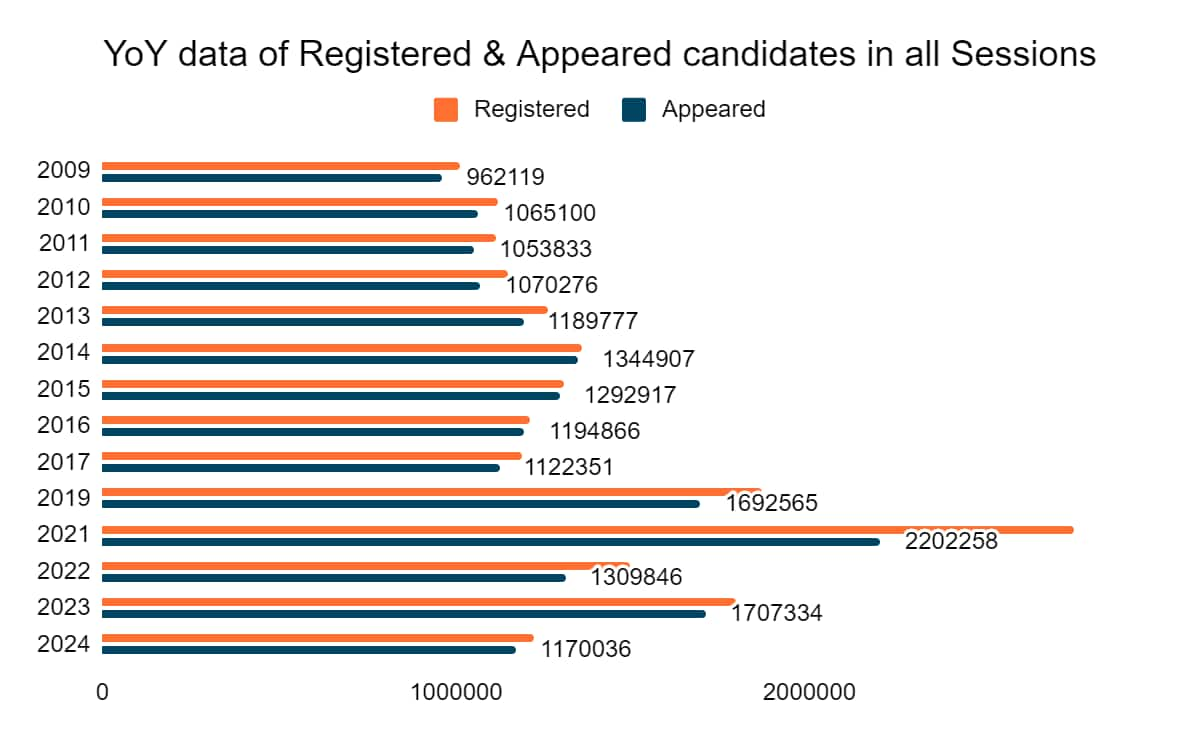
The National Testing Agency has released the details on the no. of students who appeared in JEE Mains 2023 in both sessions. As per the NTA official notification, the number of students who appeared in JEE Main 2023 in both sessions is 11,13,325.
Number of common candidates Registered in both sessions (January/April) of JEE (Main) – 2023 Exam | 629000 |
Number of common candidates who Appeared in both sessions (January/April) of JEE (Main) - 2023 Exam | 594013 |
Number of candidates registered in January 2023 (Session 1) Examination | 860064 |
Number of candidates appeared in January 2023 (Session 1) Examination | 823967 |
Number of candidates registered in April 2023 (Session 2) Examination | 931334 |
Number of candidates appeared in April 2023 (Session 2) Examination | 883367 |
Total Number of unique candidates Registered in both Sessions (January/April) of JEE (Main) - 2023 Exam | 1162398 |
Total Number of Unique Candidates Appeared in both Sessions (January/April) of JEE (Main) - 2023 Exam | 1113325 |
| Gender | General | Gen-EWS | OBC-NCL | SC | ST | PwD | Total |
|---|---|---|---|---|---|---|---|
Female | 139417 | 35397 | 136172 | 33198 | 12709 | 652 | 357545 |
Male | 303169 | 86919 | 303919 | 80254 | 28050 | 2537 | 804848 |
Third Gender | 2 | 1 | 2 | 0 | 0 | 0 | 5 |
Total | 442588 | 122317 | 440093 | 113452 | 40759 | 3189 | 1162398 |
| Gender | General | Gen-EWS | OBC-NCL | SC | ST | PwD | Total |
|---|---|---|---|---|---|---|---|
Female | 132176 | 34798 | 129190 | 30677 | 11503 | 619 | 338963 |
Male | 290936 | 85696 | 293488 | 75658 | 26154 | 2427 | 774359 |
Third Gender | 0 | 1 | 2 | 0 | 0 | 0 | 3 |
Total | 423112 | 120495 | 422680 | 106335 | 37657 | 3046 | 1113325 |
| Particular | Details |
|---|---|
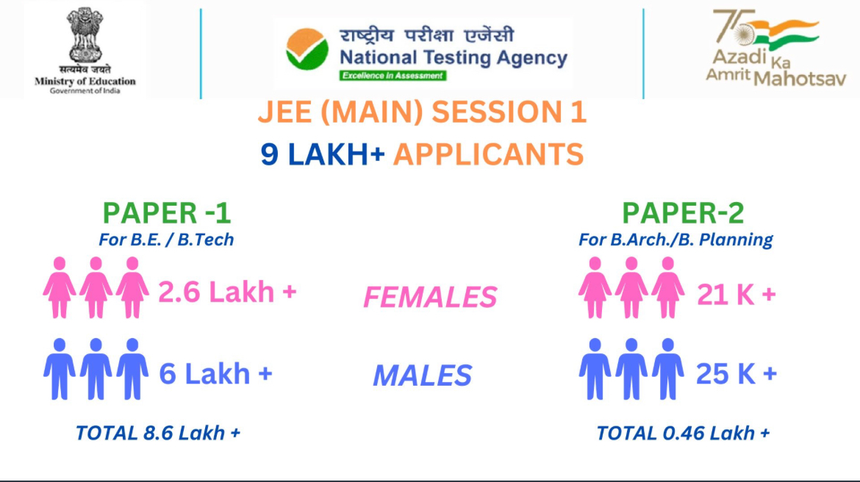
Total number of students applied for JEE Main 2023 January session | Paper 1 - 8.6 lakh Paper 2 - 0.46 Lakh |
Number of females registered for JEE Main 2023 exam session 1 | Paper 1 - 2.6 lakh Paper 2 - 21 K |
Number of males registered for NTA JEE Main 2023 session 1 | Paper 1 - 6 Lakh Paper 2 - 25 K |
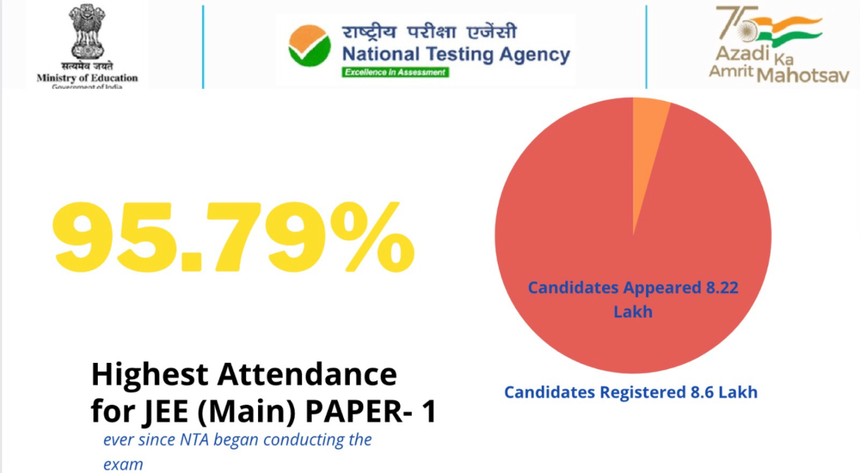
Total number of students who appeared for JEE Main Jan session | 8.22 Lakh |
Total percentage of candidates appeared | 95.79 % |
Based on the official notification released by NTA, the number of students who appeared in JEE Main 2022 in both sessions was 1026799. Candidates can check the below table to know detailed information on the no of aspirants who appeared in JEE Main.
| Particulars | Details |
|---|---|
Number of common candidates Registered in both sessions (June/July) of JEE (Main) - 2022 Examination. | 468205 |
Number of common candidates Appeared in both sessions (June/July) of JEE(Main) - 2022 Examination. | 404256 |
Number of candidates registered in June 2022 (Session 1) Examination | 872970 |
Number of candidates appeared in June 2022 (Session 1) Examination | 769604 |
Number of candidates registered in July 2022 (Session 2) Examination | 622034 |
Number of candidates appeared in July 2022 (Session 2) Examination | 540242 |
Total Number of unique candidates Registered in both Sessions (June/July) of JEE (Main) - 2022 Examination. | 1026799 |
Total Number of unique candidates Appeared in both Sessions (June/July) of JEE (Main) - 2022 Examination. | 905590 |
Total Number of unique candidates Appeared in both Sessions (June/July) of JEE (Main) - 2022 Examination. |
| Gender General Gen | General | EWS | OBC | SC | ST | PWD | Total |
|---|---|---|---|---|---|---|---|
Male | 302486 | 63372 | 261837 | 72825 | 26858 | 2259 | 727378 |
Female | 128746 | 24712 | 107837 | 27260 | 10862 | 545 | 299417 |
Third Gender | 1 | 1 | 2 | 4 | |||
Total | 431233 | 88085 | 369676 | 100085 | 37720 | 2804 | 1026799 |
| Gender General Gen | General | EWS | OBC | SC | ST | PWD | Total |
|---|---|---|---|---|---|---|---|
Male | 267982 | 60052 | 234798 | 63125 | 22598 | 2009 | 648555 |
Female | 110224 | 22990 | 92411 | 22813 | 8593 | 471 | 257031 |
Third Gender | 1 | 1 | 2 | 4 | |||
Total | 378207 | 83043 | 327211 | 85938 | 31191 | 2480 | 905590 |
Frequently Asked Questions (FAQs)
The number of candidates who appeared for JEE Main Session 1 in 2026 is 13,04,653, according to the official data released by the National Testing Agency. The exam for Session 1 took place from January 21 to 28, 2026.
As per a press release by NTA, 13,11,544 candidates have appeared for the JEE Man 2025 January session exam
As per the official notification by NTA, a total of 2,52,954 students appeared for JEE Main 2021. Refer to the table below for detailed information on the number of aspirants who participated in the exam.
For JEE Main 2022, 10,26,799 unique students registered, and 9,05,590 unique students appeared for the exam.
According to the National Testing Agency, a total of 11,13,325 students appeared in both sessions of JEE Main 2023, as mentioned in the official notification.
In 2024, a total of 12,21,624 students appeared across both sessions of the JEE Main examination.

On Question asked by student community
Hello Student,
With your rank og 129537 as an OBC candidate, it is highly unlikely that you will get a seat in core branches. There is a possibility, though, that you might get a seat in lower-tier NITs or GFTIs, in branches such as Biotechnology , Mining, Metallurgy and Civil
Hey there,
With 94.95 percentile in JEE Main, Rajasthan home state, and REAP OBC-NCL merit rank 202, you have a very good chance of getting B.Tech CSE at MBM University, Jodhpur. While admission cannot be guaranteed until the official seat allotment is announced, your profile is competitive based on previous
Hello Dear Student,
You will not be able to secure a seat (CS or core branches) at the COEP Technological University with your current score. COEP is highly competitive, and closing ranks for the SC category normally range between \(\approx 10{,}000\) to (20,000), well below your (38,647) category rank.
Hope
Hello Dear Student,
At 64 percentile, your rank is likely between 3.5 to 4 Lakh. While this is insufficient for NITs, IIITs, or top government colleges, you can secure seats in private universities or state-affiliated colleges through state counseling (like MP DTE, REAP, or UPTAC) and direct admission.
You can
Hello Dear Student,
With an 18,000 SC category rank, you can secure top branches at prestigious NITs like NIT Trichy, NIT Surathkal, and VNIT Nagpur.
You can get directly find, check, get more information here:
Hope it helps!

This round of applications closing on 15th July | Among top 100 Universities Globally in the Times Higher Education (THE) Interdisciplinary Science Rankings 2026
100+ Recruiters | 1200+ Placements of 2026 Batch | NBA & NAAC Accredited | Highest CTC 37 LPA
NAAC A++ Grade | Highest Package-30 LPA | 400+ Recruiters
NAAC A+ Grade | Ranked 503 Globally (QS World University Rankings 2026)
40 LPA Highest Package | Up to 100% Scholarship worth 24 Crore via GUTS exam
Last Date to Apply: 15th July | Ranked #43 among Engineering colleges in India by NIRF | Get Upto 100% Scholarships | Spot Admissions via CUET