Amity University Noida-B.Tech Admissions 2026
Among top 100 Universities Globally in the Times Higher Education (THE) Interdisciplinary Science Rankings 2026


If you are in Class 11, Class 12, or have just finished Class 12, you have probably realised that getting into a good engineering college in India isn't just about clearing one exam. It's about JEE Main, possibly JEE Advanced, and then a whole list of other names like BITSAT, VITEEE, SRMJEEE, COMEDK, and your state's own CET. Each has its own exam date, pattern, and syllabus.
This Story also Contains
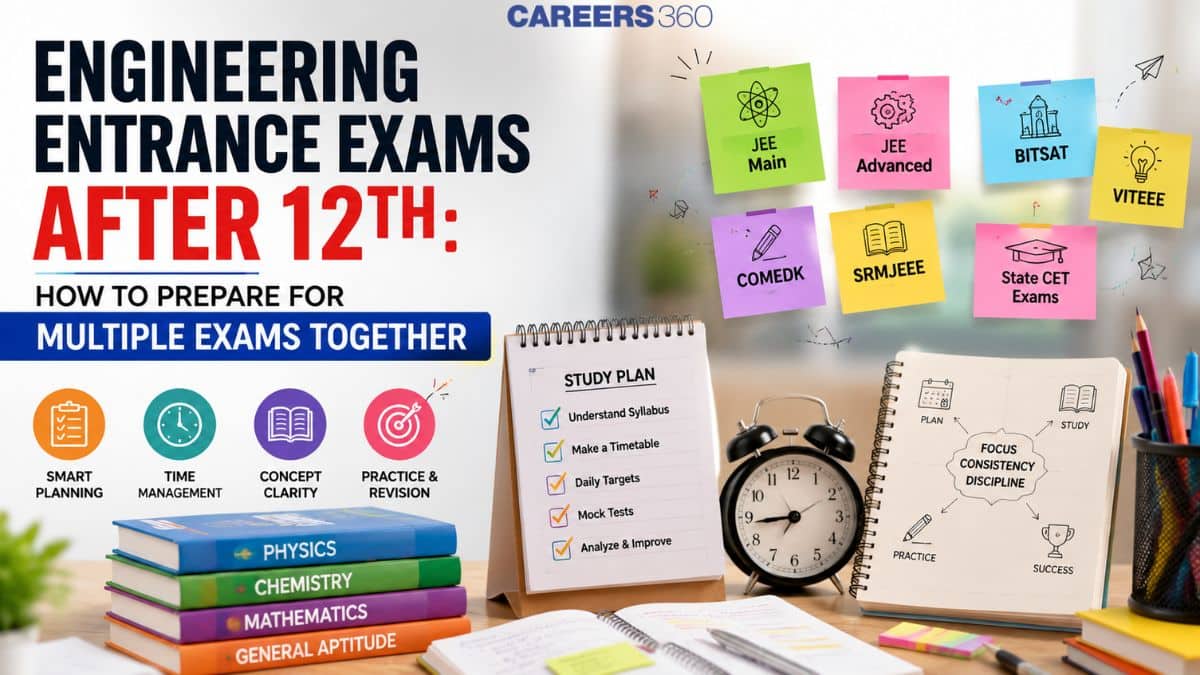
In this article, we will give you a preparation plan to prepare for multiple exams together because most engineering exams in India are based on the Class 11 and 12 NCERT syllabus of physics, chemistry and mathematics. With a good and focused preparation strategy, students will be able to take multiple exams.
Also Read: Inorganic Chemistry Exceptions for JEE Main 2027: Complete Revision Guide
A list of some engineering exams after Class 12 is given below:
|
Examination |
Conducting Body |
Subjects |
Difficulty Level |
|
JEE Main |
National Testing Agency (NTA) |
Physics, Chemistry, Mathematics |
Moderate to difficult |
|
IITs |
Physics, Chemistry, Mathematics |
Difficult | |
|
BITSAT |
BITS Pilani |
PCM, English, Logical Reasoning |
Moderate to difficult |
|
VIT University |
PCM, Aptitude, English |
Moderate | |
|
COMEDK |
COMEDK Consortium |
PCM |
Moderate |
|
Maharashtra CET Cell |
PCM |
Moderate | |
|
Karnataka Examinations Authority |
PCM |
Moderate | |
|
WBJEE |
West Bengal Joint Entrance Examinations Board |
PCM |
Moderate to difficult |
|
SRMJEEE |
SRM Institute of Science and Technology |
PCM |
Moderate |
Also Read: JEE Main 2027 Study Guide Complete Notes, Important Concepts, Formulae and Practice Questions
Get expert advice on college selection, admission chances, and career path in a personalized counselling session.
A lot of students make the mistake of treating every entrance exam as a different syllabus to study, which causes a mess and weakens the preparation. In exams like JEE Main, BITSAT, VITEEE, SRMJEEE, COMEDK, and most state CETs has core concepts from the same NCERT-based Class 11 and 12 curriculum. The difference only lies in the:
Question difficulty (JEE Advanced is tougher than most state CETs)
Question format (some exams include more application-based or speed-based questions)
Exam pattern (number of questions, negative marking rules, sectional weightage)
Additional sections (BITSAT has a Logical Reasoning and English section; some exams test aptitude)
A well-planned study plan for multiple entrance exams is given below:
Before making any strategy to learn how to prepare for engineering exams together, identify the common chapters and topics appears in almost every exam. Here is the list of chapter which appears in almost every exam:
|
Physics |
Chemistry |
Mathematics |
|
Kinematics |
Algebra | |
|
Trigonometry | ||
|
Coordinate Geometry | ||
|
Differential Calculus | ||
|
Electrostatics |
Integral Calculus | |
|
Organic Chemistry | ||
|
Magnetism |
Biomolecules | |
|
Optics |
d- and f-Block Elements |
Vector Algebra |
|
Modern Physics |
- |
Instead of preparing separately for every examination, divide your preparation into three steps.
Focus on the topics common to all examinations. In this, you should cover:
NCERT books
Concepts of chapters
Revision of formulas
Prepare short notes
Question practice
Once you make your basic concepts strong, focus on topics that are different for particular examinations such as:
|
Examination |
Special Focus Areas |
|
JEE Advanced |
Advanced problem-solving and analytical thinking |
|
BITSAT |
Speed, English proficiency, and logical reasoning |
|
MHT CET |
Accuracy and quick calculations |
|
VITEEE |
Aptitude and conceptual clarity |
|
COMEDK |
Time management and moderate-level questions |
This step is important for all the exams. It includes:
Previous-year question papers
Full-length mock tests
Formula revision
Error analysis
Time management practice
Highest CTC 81.25 LPA | NAAC A++ Accredited | Ranked #62 in India by NIRF Ranking 2025 | JEE & JET Scores Accepted
Campuses in Ropar, Agartala, Aizawl, Ajmer, Aurangabad, Calicut, Imphal, Itanagar, Kohima, Gorakhpur, Patna & Srinagar
Also read:
Preparing for multiple engineering entrance exams becomes much easier when you divide your preparation into clear phases. The following month-wise strategy ensures steady progress from syllabus completion to mock tests and final revision.
|
Preparation Phase |
Duration |
Key Objectives |
Focus Areas |
|
Phase 1: Build the Foundation |
Months 1–4 |
Complete the syllabus, strengthen conceptual understanding, and develop problem-solving skills. |
Finish core topics in Physics, Chemistry, and Mathematics while building strong fundamentals. |
|
Phase 2: Practice & Revision |
Months 5–7 |
Solve previous-year papers, practise advanced-level questions, and revise important formulas. |
Focus on improving accuracy, identifying weak concepts, and mastering exam-level questions. |
|
Phase 3: Final Preparation |
Final Months |
Take full-length mock tests, identify weak areas, improve speed and accuracy, and prioritise revision over learning new topics. |
Simulate real exam conditions, analyse mock tests, and revise short notes, formulas, and key concepts. |
|
Exam-Specific Sprint |
1–2 Months Before Each Exam |
Customise preparation according to the target exam pattern. |
JEE Main/Advanced: Multi-concept problems and full-syllabus mocks. BITSAT: Speed-based MCQs, English, and Logical Reasoning. State CETs: State-specific previous-year papers with formula-based practice. VITEEE/SRMJEEE/COMEDK: Attempt exam-specific mock tests to understand question patterns and difficulty level. |
Switching books constantly: Pick one or two reliable resources per subject and stick with them
Ignoring NCERT: Many state CETs and even JEE Main draw direct concepts and occasionally near-identical questions from NCERT
Neglecting revision: New topics without revision cycles lead to forgetting; schedule revision weeks, not just learning weeks
Overloading on exam count: Preparing for 5+ exams often dilutes focus; 2-4 well-chosen exams work better than trying to cover everyone
Skipping analysis after mock tests: A mock test without a follow-up review session teaches you very little
Choosing the right book for any exam is the biggest step of preparation. An aspirant should buy the books that cover all the common topics of the engineering entrance exam to practice regularly. Given below are some books that are helpful for all engineering exams:
|
Subject |
Recommended Books |
|
Physics |
NCERT, H.C. Verma, D.C. Pandey |
|
Chemistry |
NCERT, O.P. Tandon, M.S. Chauhan |
|
Mathematics |
R.D. Sharma, Cengage, Arihant Series |
Frequently Asked Questions (FAQs)
Yes, it is possible because the core syllabus for all these engineering exams is the same, with some variation in the difficulty level of questions and the exam pattern.
You can mainly focus on JEE Main because its difficulty level and syllabus cover overlap all other exams mostly.
Students should start their preparation from class 11 because this gives you enough time to master the basics and fundamental concepts of every subject.
Yes, it is. Most engineering entrance exams (like JEE Main, BITSAT, VITEEE, MHT-CET, SRMJEEE, etc.) share the same syllabus based on Class 11 and 12 Physics, Chemistry, and Mathematics (PCM). Preparing for multiple exams acts as a safety net, reduces the pressure of a single exam and increases your chances of securing a seat in a good institution.
While preparing for a different exam, first check the exam pattern. In most exams, the exam pattern varies; the core syllabus remains almost the same.

On Question asked by student community
Hello Student,
You can access JEE Main Mathematics previous years' question papers through the Careers360 resource below. It includes previous years’ papers for practice and preparation.
https://engineering.careers360.com/articles/jee-main-question-papers
Hope this helps!
Hello Student, the eligibility criteria are different from the score or percentile required for admission. Your Class 12 subjects, passing year and applicable eligibility rules are important. If you mean the minimum score or percentile required for admission, please specify the college or course you are targeting.
Hello Student,
You can check the JEE Main and JEE Advanced exam patterns on Careers360 using the resources below:
Hope this Helps!
You may be able to register/appear for JEE without having the certificate immediately, depending on the application rules for that year. However, if you claim a reserved category, the required certificate must be available within the prescribed deadline for counselling/admission. If you fail to produce a valid certificate when required,
Hello Student,
The “Download Link” mentioned in the JEE Main 2027 Important Notes and Formulas eBook may not be clickable in the PDF. Please try opening the eBook on a different PDF reader or device.
If the link is still not opening, please share a screenshot of the page where

Among top 100 Universities Globally in the Times Higher Education (THE) Interdisciplinary Science Rankings 2026
NAAC A++ Grade | Recognized as Category-1 Deemed to be University by UGC | 41,000 + Alumni Imprints Globally
100+ Recruiters | 1200+ Placements of 2026 Batch | NBA & NAAC Accredited | Highest CTC 37 LPA
NAAC A+ Accredited | Highest CTC 45 LPA | Scholarships Available
India's youngest NAAC A++ accredited University | NIRF rank band 151-200 | 2200 Recruiters | 45.98 Lakhs Highest Package
Apply for B.E at East Point College of Engineering and Technology | Affiliated to VTU | AICTE Approved | NBA Accredited | Highest CTC 33 LPA