
Search Colleges, Exams, Schools & more


Login
Atoms and Nuclei JEE Main Questions 2027: Practice Questions with Solutions
If you have solved JEE Main papers, you have probably noticed that the Atoms and Nuclei question is asked almost every single year. It's a small chapter compared to Mechanics or electrostatics, but it's also one of the most learnable chapters in the syllabus. It has few formulas and more concepts, and once you understand the patterns of the questions, the JEE Main 2027 questions become easy.
This Story also Contains
- Weightage of Atoms and Nuclei in JEE Main 2026
- Atoms And Nuclei JEE Main Questions
- Topic-Wise Weightage and Number of Questions
- Last 10 Years' Weightage of Atoms and Nuclei in JEE Main
- Important Formulas of Atoms and Nuclei for JEE Main 2027
In this article, we will provide you with how much weightage it carries in the exam every year, important formulas, and Atoms and Nuclei JEE Main practice questions to know the pattern of questions, along with Atoms and Nuclei JEE questions PDF to download
Also Read:
Weightage of Atoms and Nuclei in JEE Main 2026
The analysis of JEE Main 2026 shows that the Atoms and Nuclei chapter is one of the highest-scoring chapters in the JEE Main Physics exam․ The analysis of the questions on this chapter from the January and April 2026 sessions shows that it was frequently asked․
|
Session |
Total Questions Asked |
Approx. Marks |
Weightage |
|
January 2026 |
13 |
52 Marks |
5.20% |
|
April 2026 |
11 |
44 Marks |
4.40% |
|
Overall (2026) |
24 Questions |
96 Marks |
5.05% |
Confused About College Admissions?
Get expert advice on college selection, admission chances, and career path in a personalized counselling session.
Book a Counselling Slot
Select Date
Pick a Slot
Atoms And Nuclei JEE Main Questions
Download JEE Main 2027 Atoms & Nuclei: Previous Year Questions with Solutions Free PDF
Question 1: A hydrogen atom in ground state is given an energy of 10.2 eV. How many spectral lines will be emitted due to the transition of electrons?
1) 6
2) 3
3) 10
4) 1
Correct answer: (4)
Solution:
Hydrogen will be first excited; therefore, it will emit one spectral line corresponding to the transition between energy level 2 and 1
Question 2: Given below are two statements :
Statement (I): The dimensions of Planck's constant and angular momentum are the same.
Statement (II): In Bohr's model electron revolve around the nucleus only in those orbits for which angular momentum is an integral multiple of Planck's constant.
In the light of the above statements, choose the most appropriate answer from the options given below.
1) Both Statement I and Statement II are incorrect
2) Both Statement I and Statement II are correct
3) Statement I is incorrect, but Statement II is correct
4) Statement I is correct, but Statement II is incorrect
Correct answer: (4)
Solution:
$E = hf$
$[E] = [h][f]$
$ML^2T^{-2} = [h][T^{-1}]$
$[h] = ML^2T^{-1}$
$J = mvr$
$[J] = [M][LT^{-1}][L]$
$[J] = ML^2T^{-1}$
$\therefore [h] = [J] = ML^2T^{-1}$
In Bohr's model, electrons revolve around the nucleus only in those orbits for which angular momentum is an integral multiple of $\frac{\mathrm{h}}{2 \pi}$. L is integral multiple of $\frac{h}{2 \pi}$
Question 3: In a hydrogen like ion, the energy difference between the 2nd excitation energy state and ground is 108.8 eV . The atomic number of the ion is
1) 4
2) 2
3) 1
4) 3
Correct answer: (4)
Solution:
$\begin{aligned} & \Delta E=-13.6 z^2\left(\frac{1}{n_2^2}-\frac{1}{n_1^2}\right) \\ & =-13.6 z^2\left(\frac{1}{9}-1\right) \\ & =-13.6 z^2\left(\frac{1}{9}-1\right) \\ & =-13.6 z^2 \frac{(-8)}{9} \\ & 108.8=\frac{13.6 \times(z)^2 \times(8)}{9} \\ & z^2=\frac{1.08 .8 \times 9}{13.6 \times 8}=\frac{972.9}{18.8} \\ & z=3\end{aligned}$
Question 4: Choose the correct, nuclear process from the below options
[p: proton, n : neutron, $\mathrm{e}^{-}$: electron, $\mathrm{e}^{+}$: positron, $v$ : neutrinc $\bar{v}$ : antineutrino]
1) $n \rightarrow p+e^{-}+\bar{v}$
2) $n \rightarrow p+e^{-}+v$t
3) $\mathrm{n} \rightarrow \mathrm{p}+\mathrm{e}^{+}+\overline{\mathrm{v}}$
4) $n \rightarrow p+e^{+}+v$
Correct answer: (1)
Solution:
Theoretical equation for $\beta^{-}$ decay
$\mathrm{n}_0^1 \rightarrow \mathrm{p}_1^1+\mathrm{e}_{-1}^{-0}+\bar{v}$
Question 5: The frequency of revolution of the electron in Bohr's orbit varies with n , the principal quantum number, as
1) $\frac{1}{n}$
2) $\frac{1}{n^3}$
3) $\frac{1}{n^4}$
4) $\frac{1}{n^2}$
Correct answer: (2)
Solution:
For electron in $n^{th}$ orbit,
$ r_n=0.53 \frac{n^2}{Z} \text{Å}$
$v_n=2.2 \times 10^6 \times\frac{Z}{n} \mathrm{~m} / \mathrm{sec}$
$\therefore T \propto \frac{r_n}{v_n} \implies T \propto n^3$
Thus, Frequency of revolution $\propto \frac{1}{n^3}$
Question 6: An electron projected perpendicular to a uniform magnetic field B moves in a circle. If Bohr's quantisation is applicable, then the radius of the electronic orbit in the first excited state is:
1) $\sqrt{\frac{2 \mathrm{~h}}{\pi \mathrm{eB}}}$
2) $\sqrt{\frac{4 h}{\pi e B}}$
3) $\sqrt{\frac{\mathrm{h}}{2 \pi \mathrm{eB}}}$
4) $\sqrt{\frac{\mathrm{h}}{\pi e B}}$
Correct answer: (4)
Solution:
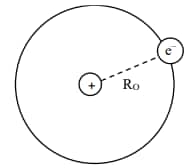
$\mathrm{mvR}_0 = \frac{nh}{2\pi}$
For $1^{\text{st}}$ excited state, $n=2$
$\left(R_0 = \frac{mv}{qB}\right)$
In a magnetic field,
$\left(R_0 \cdot qB\right)\left(R_0\right) = \frac{2h}{2\pi}$
$R_0 = \sqrt{\frac{h}{\pi eB}}$
Question 7: The number of spectral lines emitted by atomic hydrogen that is in the 4th
energy level is
1) 6
2) 0
3) 3
4) 1
Correct answer: (1)
Solution:
Number of spectral lines $=\frac{n(n-1)}{2}$
For $n=4$ :
$\frac{4(4-1)}{2}=\frac{4\times3}{2}=6$
Total possible transition = 6
Question 8: A radioactive nucleus $n_2$ has 3 times the decay constant as compared to the decay constant of another radioactive nucleus $n_1$. If the initial number of both nuclei is the same, what is the ratio of the number of nuclei of $n_2$ to the number of nuclei of $n_1$ after one half-life of $n_1$?
1) 1/4
2) 1/8
3) 4
4) 8
Correct answer: (1)
Solution:
Given $\lambda_2=3 \lambda_1 \quad \& \quad \mathrm{~N}_{0_1}=\mathrm{N}_{0_2}$ we know, $\mathrm{T}_{1 / 2}=\frac{\ln 2}{\lambda}$
$\therefore T_2=\frac{T_1}{3}$
$\Rightarrow 3T_2=T_1$
After 1 half-life of $n_1$, number of nuclei $=\frac{N_0}{2}$
1 half-life of $n_1=3$ half-lives of $n_2$
$\therefore$ after $3T_{1/2}$ of $n_2$, number of nuclei $=\frac{N_0}{2^3}=\frac{N_0}{8}$
Ratio of $n_2$ to $n_1=\frac{N_0/8}{N_0/2}$
$=\frac{2}{8}$
$=\frac{1}{4}$
Question 9: X-rays of wavelength $1.54 A$ are incident on a crystal lattice. The first-order Bragg reflection occurs at an angle of $20^{\circ}$. What is the interplanar spacing $d$ of the crystal?
1) 2.25
2) 3.12
3) 4.51
4) 1.98
Correct answer: (1)
Solution:
Bragg's Law is given by:
$n\lambda=2d\sin\theta$
where:
-
$n=1$ (first-order reflection)
-
$\lambda=1.54$ (X-ray wavelength)
-
$\theta=20^\circ$ (Bragg angle)
-
$d=$ interplanar spacing
Substituting the values:
$1.54=2d\sin20^\circ$
Since $\sin20^\circ\approx0.342$,
$1.54=2d(0.342)$
$d=\frac{1.54}{2\times0.342}$
$d=\frac{1.54}{0.684}\approx2.25$
Question 10: Considering Bohr's atomic model for the hydrogen atom:
(A) the energy of the H atom in the ground state is the same as energy of $\mathrm{He}^{+}$ion in its first excited state.
(B) the energy of the H atom in the ground state is same as that for $\mathrm{Li}^{++}$ion in its second excited state.
(C) The energy of the H atom in its ground state is same as that of $\mathrm{He}^{+}$ion for its ground state.
(D) The energy of $\mathrm{He}^{+}$ion in its first excited state is same as that for $\mathrm{Li}^{++}$ion in its ground state
Choose the correct answer from the options given below :
1) (B), (D) only
2) (A), (B) only
3) (A), (D) only
4) (A), (C) only
Correct answer: (2)
Solution:
$E \propto \frac{Z^2}{n^2}$
$Z_{\mathrm{H}}=1,\quad Z_{\mathrm{He}^{+}}=2,\quad Z_{\mathrm{Li}^{2+}}=3$
$1^{\text{st}}\text{ excited state} \Rightarrow n=2$
$2^{\text{nd}}\text{ excited state} \Rightarrow n=3$
From the given statements, only A & B are correct.
Question 11: For a nucleus of mass number A and radius R, the mass density of the nucleus can be represented as
1) $A^3$
2) $\mathrm{A}^{\frac{1}{3}}$
3) $\mathrm{A}^{\frac{2}{3}}$
4) Independent of A
Correct answer: (4)
Solution:
$\begin{aligned} & R=R_0 A^{1 / 3} \\ & \text { Density }=\frac{\text { Mass }}{\text { Volume }}=\frac{m A}{\frac{4}{3} \pi R_0^3 A}=\text { constant }\end{aligned}$
Question 12: Given below are two statements. One is labelled as Assertion (A), and the other is labelled as Reason (R).
Assertion (A): The binding energy per nucleon is found to be practically independent of the atomic number A for nuclei with mass numbers between 30 and 170.
Reason (R): Nuclear force is long-range.
In light of the above statements, choose the correct answer from the options given below:
1) (A) is false but (R) is true
2) (A) is true but (R) is false
3) Both (A) and (R) are true and (R) is the correct explanation of (A)
4) Both (A) and (R) are true but (R) is NOT the correct explanation of (A)
Correct answer: (2)
Solution:
The binding energy per nucleon is indeed practically independent of the atomic number for nuclei of mass number in the range of 30 to 170. This is because, in this range, the nuclear forces are balanced in such a way that the binding energy per nucleon remains relatively constant. The reason provided, that nuclear force is short-ranged, is also true. However, the short-range nature of nuclear forces does not directly explain why the binding energy per nucleon remains constant over the given range of mass numbers.
Question 13: Assuming the validity of Bohr's atomic model for hydrogen-like ions, the radius of $\mathrm{Li}^{++}$ion in its ground state is given by $\frac{1}{X} a_0$, where $X=$ $\_\_\_\_$.
1) 2
2) 1
3) 3
4) 9
Correct answer: (3)
Solution:
The radius of a hydrogen-like ion according to Bohr's atomic model is given by the formula:
$r=r_0\frac{n^2}{Z}$
Where:
$r_0$ is the first Bohr radius $\left(a_0\right)$
$n$ represents the principal quantum number
$Z$ is the atomic number of the ion
For the ion $\mathrm{Li}^{++}$, the atomic number $Z=3$, and we are considering the ground state, so $n=1$.
Plugging these values into the formula, we get:
$r=r_0\frac{1^2}{3}=\frac{r_0}{3}$
This shows that the radius of $\mathrm{Li}^{++}$in its ground state is $\frac{1}{3} a_0$, meaning $X=3$.
Question 14: The centripetal acceleration of revolution of an electron in the $n^{\text {th }}$ Bohr orbit of a hydrogen atom is proportional to:
1) $n^2$
2) $n^0$
3) $1 / n^2$
4) $1 / n^4$
Correct answer: (4)
Solution:
$\begin{aligned} & v=v_0\left(\frac{z}{n}\right) \\ & r=r_0\left(\frac{n^2}{z}\right) \\ & a_c=\frac{v^2}{r} \\ & a_c \propto \frac{1}{n^4}\end{aligned}$
Question 15: An electron in the ground state of the hydrogen atom has the orbital radius of $5.3 \times 10^{-11} \mathrm{~m}$ while that for the electron in the third excited state is $8.48 \times 10^{-10} \mathrm{~m}$. The ratio of the de Broglie wavelengths of the electron in the excited state to that in the ground state is:
1) 4
2) 9
3)3
4)16
Correct answer: (4)
Solution:
$\lambda=\frac{\mathrm{h}}{\mathrm{mv}}$
$\begin{aligned} & \mathrm{mvr}=\frac{\mathrm{nh}}{2 \pi} \\ \\& \mathrm{mv}=\frac{\mathrm{nh}}{2 \pi \mathrm{r}} \\ \\& \lambda=\frac{2 \pi \mathrm{rh}}{\mathrm{nh}} \\ \\& \lambda \propto \frac{\mathrm{r}}{\mathrm{n}} \\ \\& \frac{\lambda_1}{\lambda_4}=\frac{\mathrm{r}_1 \mathrm{n}_4}{\mathrm{n}_1 \mathrm{r}_4}=\frac{5.3 \times 10^{-11} \times 4}{1 \times 84.8 \times 10^{-11}} \\ \\& \frac{\lambda_1}{\lambda_4}=\frac{1}{4} \end{aligned}$
$\frac{\lambda_4}{\lambda_1}=\frac{4}{1}$
Topic-Wise Weightage and Number of Questions
The table below shows the distribution of questions asked from the chapter Atoms and Nuclei in the January and April JEE Main 2026 exams․ The table will help students to have an idea about the topics important from the point of view of the exam and on which they should focus․
|
Topic |
January Session |
April Session |
Total Questions |
|
2 |
2 |
4 | |
|
0 |
2 |
2 | |
|
1 |
0 |
1 | |
|
Energy Levels of the Hydrogen Atom |
1 |
0 |
1 |
|
Law of Radioactive Decay |
0 |
1 |
1 |
|
2 |
2 |
4 | |
|
Mass-Energy and Nuclear Binding Energy |
2 |
3 |
5 |
|
1 |
0 |
1 | |
|
Nuclear Structure |
2 |
0 |
2 |
|
Radius of Orbit and Velocity of Electron |
1 |
0 |
1 |
|
1 |
1 |
2 | |
|
Total |
13 |
11 |
24 |
Last 10 Years' Weightage of Atoms and Nuclei in JEE Main
The following table shows the topic-wise distribution of the number of questions from the topic of Atoms and Nuclei asked per year over the last 10 years of the JEE Main exam. Candidates can use this to identify high-weightage topics and plan their preparation strategy effectively․
|
Topic |
Total Questions Asked |
|
32 | |
|
Line Spectra of the Hydrogen Atom |
29 |
|
Energy Levels of the Hydrogen Atom |
22 |
|
Radioactivity |
33 |
|
Bohr's Model of the Hydrogen Atom |
12 |
|
12 | |
|
Radius of Orbit and Velocity of the Electron |
11 |
|
Binding Energy per Nucleon |
7 |
|
Mass-Energy Equivalence and Nuclear Binding Energy |
7 |
Also Read: Last 10 Years JEE Main Question Paper
JEE Main Syllabus: Subjects & Chapters
Select your preferred subject to view the chapters
Important Formulas of Atoms and Nuclei for JEE Main 2027
Bohr's Model of the Atom
|
Radius of nth orbit |
$r_n=\frac{n^2 h^2 \varepsilon_0}{\pi m Z e^2} \propto \frac{n^2}{Z}$ |
|
Velocity of electron in nth orbit |
$v_n \propto \frac{Z}{n}$ |
|
Energy of nth orbit |
$E_n=-\frac{13.6 Z^2}{n^2} \mathrm{eV}$ |
|
Angular momentum |
$L=\frac{n h}{2 \pi}=n \hbar$ |
|
Wavelength of emitted/absorbed photon |
$\frac{1}{\lambda}=R Z^2\left(\frac{1}{n_1^2}-\frac{1}{n_2^2}\right)$ |
|
Ionisation energy from ground state |
$E_i=13.6 Z^2 \mathrm{eV}$ |
Nuclear Structure and Binding Energy
|
Nuclear radius |
$R=R_0 A^{1 / 3}$, where $R_0 \approx 1.2 \mathrm{fm}$ |
|
Mass defect |
$(\Delta m = \left[Zm_p + (A-Z)m_n\right]-M_{\text{nucleus}})$ |
|
Binding energy |
$(\text{BE}=\Delta mc^2)$ |
|
Binding energy (in MeV) |
$(\text{BE}=\Delta m \times 931.5\ \text{MeV})$ |
|
Binding energy per nucleon |
$(\dfrac{\text{BE}}{A})$ |
Radioactivity
|
Number of undecayed nuclei after time (t) |
$N=N_0 e^{-\lambda t}$ |
|
Half-life |
$T_{1 / 2}=\frac{0.693}{\lambda}$ |
|
Mean life |
$\tau=\frac{1}{\lambda}=1.44 T_{1 / 2}$ |
|
Activity of a radioactive substance |
$(A=\lambda N)$ |
|
Fraction of nuclei remaining after (n) half-lives |
$\left(\frac{1}{2}\right)^n$ |
Frequently Asked Questions (FAQs)
Q: What is the weightage of atoms and nuclei in JEE Main 2026?
A:
The overall weightage of atoms and nuclei in the 2026 exam is 5.05%. Almost 0-1 question is asked in almost every shift.
Q: What is the 75% rule for JEE?
A:
The 75% rule for JEE, if you want to give the JEE Main exam, then you should have 75% aggregate marks in Class 12 with the PCM stream
Q: Is Atoms and Nuclei a hard Chapter?
A:
No, Atoms and Nuclei is considered an easy chapter.
Q: Which chapter is the most difficult in Class 12 Physics?
A:
Most Difficult chapter of Class 12 are wave optics, EMI & AC.
Articles
Related Stories
|
Upcoming Engineering Exams

Certifications By Top Providers
Explore Top Universities Across Globe
Popular Courses and Specializations
List of colleges accepting JEE Main
Browse Engineering Colleges by State
Questions related to JEE Main
On Question asked by student community
Have a question related to JEE Main ?
Dear Student,
You can access JEE Main Previous 10 Years Question Papers with Detailed Solutions on Careers360. These papers are useful for understanding the exam pattern, important topics and question types, and for practising Physics, Chemistry and Mathematics.
JEE Main Previous 10 Years Question Papers with Detailed Solutions
You can
Dear Student,
Can you clarify what do you want to know about the JEE Main exam . Are you looking for the JEE Main syllabus, eligibility criteria, or preparation strategy.
Hi!
Given below are the links for
JEE Main Mock Test
https://learn.careers360.com/test-series-jee-main-free-mock-test/
JEE Main Previous Year Question Papers:
https://engineering.careers360.com/articles/jee-main-question-papers
Hello Aspirant,
According to the official NTA notices, JEE (Main) 2026 was conducted in two sessions:
- Session 1: 21, 22, 23, 24 and 28 January 2026 for Paper 1 (B.E./B.Tech).
- Session 2: 2, 4, 5, 6 and 8 April 2026 for Paper 1 (B.E./B.Tech).
- B.Arch and B.Planning: dates were scheduled
Hello Student,
Your question is incomplete. Please specify what type of message you received between July 27–29, 2026, or provide the message so I can answer accurately.
Looking forward to your response!

B.Tech/B.Arch Admissions OPEN
100+ Recruiters | 1200+ Placements of 2026 Batch | NBA & NAAC Accredited | Highest CTC 37 LPA
Manav Rachna-B.Tech Admissions 2026
ApplyNAAC A++ Grade | Recognized as Category-1 Deemed to be University by UGC | 41,000 + Alumni Imprints Globally
Integral University B.Tech Admissions 2026
ApplyNAAC A+ Accredited | Highest CTC 45 LPA | Scholarships Available
East Point College of Engineering & Tech. Admissions 2026
ApplyApply for B.E at East Point College of Engineering and Technology | Affiliated to VTU | AICTE Approved | NBA Accredited | Highest CTC 33 LPA
KR Mangalam University B.Tech Admissions 2026
Apply6 Lakh+ CUET Registrations | 500+ Companies Visited for Placement Top Recruiters: Apple Inc., Amazon, IBM, CISCO, Meta, Microsoft, Google
Dolphin PG Institute B.Tech Admissions 2026
Apply10000+ Alumni across the globe | Scholarships available
JEE Main Notifications
Explore Career Options
By IndustryNever miss JEE Main update
Get timely JEE Main updates directly to your inbox. Stay informed!