School of Computer Science, UPES, Dehradun
Ranked #43 among Engineering colleges in India by NIRF | Get Upto 100% Scholarships


Most Scoring Topics in JEE Main Chemistry 2027: Are you looking for the JEE Main 2027 Chemistry important topics? If your answer is yes, then in this article, we will help you in finding out those Chemistry chapters and topics that require special attention while preparing for JEE Main 2027. We have given some of the most scoring and high-weightage JEE Main Chemistry chapters in the following paragraph based on past year trends and analysis. Out of all three subjects, Chemistry is considered the scoring subject as most of the questions are based on formulas, concepts, and NCERT fundamentals. JEE Main 2027 aspirants should cover all high-weightage chapters, revise regularly, and keep practicing the problems.
Also Read: Inorganic Chemistry Exceptions for JEE Main 2027: Complete Revision Guide
This Story also Contains
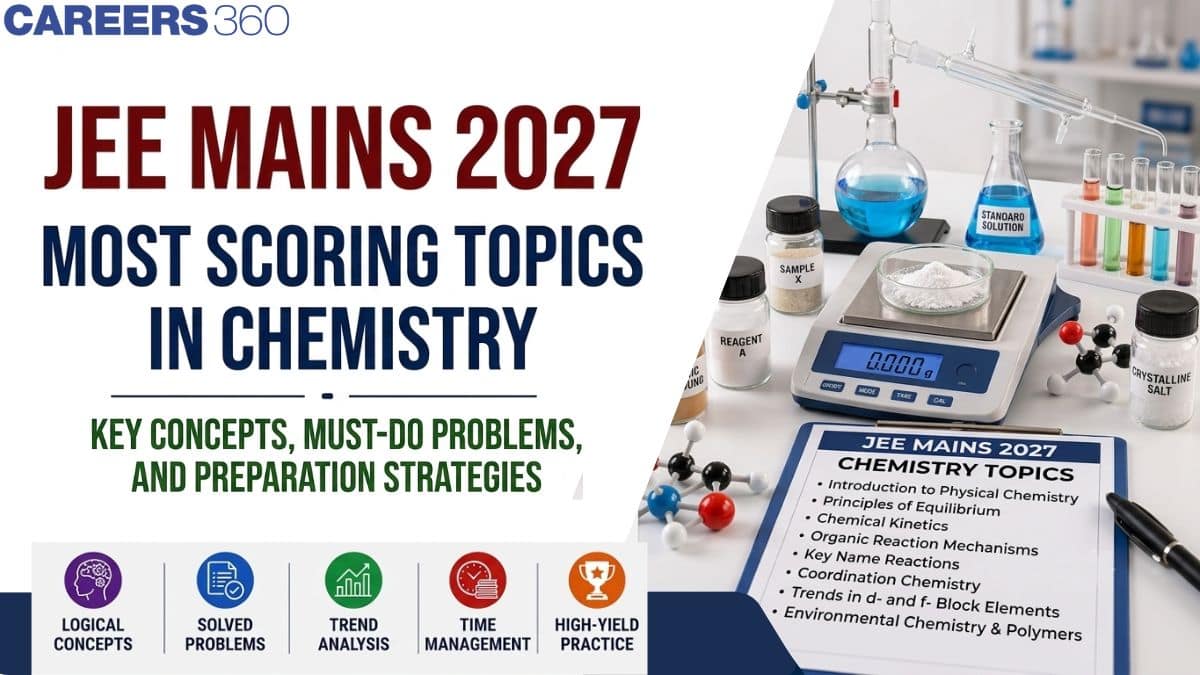
In this article, candidates can go through the important JEE Main Chemistry topics and their estimated weightage in the form of a table to plan their preparation more effectively. Moreover, we have provided certain study resources and tips that could be helpful for students during their studies.
Also Read:
The following table indicates the important chapters for the JEE Main Chemistry 2027 and their weightage as per the previous year papers and trends. JEE Main Chemistry important chapters are given in the table below, as in the JEE Main previous years' papers. This table may be very helpful to students preparing for the JEE Main exam.
| Chapter Name | Overall Questions | Weightage |
|---|---|---|
| Coordination Compound | 40 | 8.42% |
| Organic Compounds Containing Oxygen | 36 | 7.58% |
| Hydrocarbons | 30 | 6.32% |
| Organic Compounds Containing Nitrogen | 27 | 5.68% |
| Redox Reaction and Electrochemistry | 27 | 5.68% |
| Atomic Structure | 26 | 5.47% |
| Chemical Kinetics | 26 | 5.47% |
| Equilibrium | 26 | 5.47% |
| Some Basic Principles of Organic Chemistry | 26 | 5.47% |
| Chemical Bonding and Molecular Structure | 24 | 5.05% |
| Chemical Thermodynamics | 24 | 5.05% |
| Solutions | 24 | 5.05% |
| Some Basic Concepts in Chemistry | 23 | 4.84% |
| Biomolecules | 22 | 4.63% |
| d- and f-Block Elements | 22 | 4.63% |
| Classification of Elements and Periodic Table | 19 | 4.00% |
| Purification and Characterisation of Organic Compounds | 19 | 4.00% |
| P- Block Elements | 18 | 3.79% |
| Organic Compounds Containing Halogens | 9 | 1.89% |
| Principles Related to Practical Chemistry | 7 | 1.47% |
| Grand Total | 475 | 100.00% |
Ranked #43 among Engineering colleges in India by NIRF | Get Upto 100% Scholarships
Scholars’ Round Deadline: 14th Nov’26 | Earn upto 50% merit Scholarship + 10% for top performers | EFMD Accredited | AACSB (USA) & AMDISA Member | Highest CTC 28 LPA
Get expert advice on college selection, admission chances, and career path in a personalized counselling session.
To achieve a high score in JEE Main chemistry, it is important to focus on frequently repeated topics. In this section, we have added the most scoring topics of chemistry on which questions are asked in JEE Main previous years' papers.
Download: JEE Main 2027 Atomic Structure: One-Shot Revision Notes & Numerical Practice
| Co-ordination Compounds | Ligands, coordination numbers, Werner’s theory, isomerism, bonding theories. |
| Organic Compounds Containing Oxygen | Alcohols, phenols, ethers, carbonyl compounds (aldehydes, ketones, carboxylic acids) |
| Hydrocarbons | Alkanes, alkenes, alkynes, aromatic hydrocarbons, properties, and reactions |
| Organic Compounds Containing Nitrogen | Amines, azides, amides, and their reactions |
| Redox Reaction and Electrochemistry | Oxidation-reduction reactions, balancing, electrode potential, Nernst Equation, Electrochemical Cells, Conductivity, Kohlrausch’s Law, Gibbs Energy and EMF |
| Chapter Name | Scoring Topics |
|---|
Chemical Bonding and Molecular Structure
This chapter shows up everywhere. Once you understand ionic bonds, covalent bonds, coordinate bonds, VSEPR theory, and hybridisation, you'll find connections across the entire syllabus. Questions from this chapter aren't usually tricky — they test whether you understood the basics or just memorized them. Expect 1 to 3 questions per session.
Coordination Compounds
Students either love this chapter or avoid it. Don't avoid it. Ligands, coordination numbers, naming rules, and isomerism are all very learnable once you sit with them. This chapter is asked consistently in JEE Main and is one of the more predictable sources of marks in Inorganic Chemistry.
p-Block Elements
Yes, it's a lot of material. But most questions come straight from NCERT trends, properties, specific compounds. The students who score here are the ones who read the chapter more than once and made notes on reactions and exceptions. Don't try to memorize everything; understand the patterns instead.
d-Block Elements
Transition metals, electronic configurations, variable oxidation states — this chapter is manageable and scoring. Focus on why these elements behave the way they do rather than just listing properties. That understanding is what the questions test.
Biomolecules
This is one of the easiest chapters in the entire syllabus to score marks from. Carbohydrates, proteins, enzymes, vitamins, nucleic acids- all of it is theory-based and mostly from NCERT. A few focused reading sessions and some quick revision notes are all you really need here.
Also Check: JEE Main Chemistry: 20 Most Repeated Topic-Based Questions
Scoring Topics in JEE Main Chemistry
Following the previous year's pattern, since the JEE Main 2027 syllabus is expected to be the same as last year, students should devote more time to topics that are high scoring & are frequently asked. The table below has some of the highest-scoring topics in JEE Main Chemistry 2027. The list is based on last year's Trends & Question Paper Analysis.
| Chapter | Topic | No. of Questions (Last 10 Years) |
|---|---|---|
| Some Basic Concepts of Chemistry | Mole Concept and Molar Mass | 96 |
| Equilibrium | Strong and Weak Bases | 88 |
| Coordination Compounds | Stereoisomerism | 81 |
| Solutions | Reactions in Solutions | 81 |
| Co-ordination Compounds | Magnetic Moment (Based on VBT) | 76 |
| Atomic Structure | Radius, Velocity and the Energy of the nth Bohr Orbital | 74 |
| Organic Compounds Containing Oxygen | Methods of Preparation of Carboxylic Acids | 72 |
| Organic Compounds Containing Nitrogen | Azo-Coupling Reaction | 69 |
Application Free of Cost for Limited Time || NAAC A++ Accredited | Highest CTC 52 LPA | #11 in University Category by NIRF
Affiliated to Anna University | Highest CTC 44 LPA | Top Recruiters : JP Morgan Chase & Co, Nielson IQ, QUBE, META, GOOGLE, AMAZON & many more.
Also Read:
It is highly important to understand the importance of covering the highest-scoring topics in JEE Main Chemistry to secure a good score in the exam. The following five key factors that every aspirant of JEE Main needs to keep in mind while selecting important chapters of JEE Main Chemistry:
Weightage: Important chapters of JEE Main Chemistry have higher weightage in the exam.
Total Score: Important chapters of JEE Main Chemistry help in securing a good total score.
Core Topics: These topics cover the basics of the subject.
In-depth Knowledge: Important chapters of JEE Main Chemistry help the candidate understand the subject in depth.
Deeper Understanding: They help in developing a deeper understanding of the subject.
There should be shortcuts and roadmaps that help you to learn the concepts and formulas that are crucial. In case you do not know any shortcuts, you must invent one on your own, but keep using it regularly. You should also maintain a list of important JEE Main formulas that can be accessed by you whenever required.
1. When solving numericals, always remember to round up the data given to you. This will ensure that the solutions become simple, and you will be able to calculate an approximate answer that will be close to some of the options.
2. In case the first attempt does not provide you with the right answers to solve a numerical problem, then you must do the entire calculation. Practice this method.
3. Regarding the application of concepts to real-life problems, it will become easy for you to solve the question given.
4. Revision plays a significant role; therefore, you must revise everything and try to make a timetable in accordance with high-scoring chapters in JEE Main.
5. Mistakes happen with everyone; hence, you must try to anticipate the mistakes you will make in an examination.
Also Read:
Frequently Asked Questions (FAQs)
JEE Main is a national level entrance test. Thus, only NCERT books will not be enough. But the NCERT exemplar, NCERT notes, NCERT solutions are also important and helpful for the exam.
Important topics of Inorganic chemistry are Hybridisation, CFT, VSEPR theory, and d and f- blocks elements etc.
As total of 3 subjects are there in the JEE Main exam and individually all carry equal weightage, therefore 33.33 % weightage of Chemistry is there in the JEE Mains Exam.
Organic compounds containing oxygen, Hydrocarbons, Organic Compounds Containing Nitrogen are few important chapters from Organic Chemistry which carry more Weightage in JEE Main exam.
There has been no official syllabus published for 2027, but with the experience of a number of previous years' papers, the commonly repeated chapters are Chemical Bonding, Coordination Compounds, Electrochemistry, Chemical Kinetics, and General Organic Chemistry. Get these out of the way first.
Chemical Bonding, Coordination Compounds, Periodic Trends, Chemical Kinetics, Electrochemistry, Thermodynamics, General Organic Chemistry, Hydrocarbons, Amines, and Biomolecules have all shown up repeatedly across sessions.
Finish NCERT. Make short notes you can actually use for revision. Solve previous year papers, not just glance at them, but actually work through them. Take weekly mock tests and go back and understand every mistake. Don't guess in the exam; accuracy matters more than speed in Chemistry.
You don't need to finish everything first. Start chapter-wise tests early and full-length mocks once you've covered 70–80% of the syllabus. Earlier testing shows you where your gaps are while there's still time to fix them.

On Question asked by student community
Dear Student,
You can access JEE Main Mathematics previous-year questions on Careers360. Practising previous-year questions will help you understand the exam pattern and question types.
Hello Student,
You can check the resources provided below:
Hope this helps!
Hello, since you are in Intermediate 2nd year with the MPC group and preparing for JEE Main, focus on completing the syllabus, revising important concepts and solving previous years’ JEE Main question papers. Take regular mock tests and analyse your mistakes to improve your score. Keep a realistic study schedule
Dear Student
Please specify whether you want Physics, Chemistry, or Mathematics, and which JEE Main/Advanced exam.
Hi Ansh Chauhan
Check the link below for the high-weightage Physics chapters for JEE Main 2027 based on recent exam trends. Students can use these chapters to prioritise their preparation and focus more on topics that have appeared frequently in previous papers.
https://engineering.careers360.com/articles/most-weightage-chapters-for-jee-main-physics-2027

Ranked #43 among Engineering colleges in India by NIRF | Get Upto 100% Scholarships
Scholars’ Round Deadline: 14th Nov’26 | Earn upto 50% merit Scholarship + 10% for top performers | EFMD Accredited | AACSB (USA) & AMDISA Member | Highest CTC 28 LPA
Application Free of Cost for Limited Time || NAAC A++ Accredited | Highest CTC 52 LPA | #11 in University Category by NIRF
Affiliated to Anna University | Highest CTC 44 LPA | Top Recruiters : JP Morgan Chase & Co, Nielson IQ, QUBE, META, GOOGLE, AMAZON & many more.
Highest CTC 30 LPA | #9 in Management Category by Times B-School | Merit-Based Scholarship Upto - 50 Crores
Courses designed with CTOs, Data Scientists, and Cybersecurity experts | 50+ elective options