
Search Colleges, Exams, Schools & more


Login
Laws of Motion JEE Main Questions 2027: Practice Questions with Solutions
If you solve physics PYQs, you already know that laws of motion JEE Mains questions show up almost every single year. Yet, many students still lose easy marks here because they draw the force diagram incorrectly or mix up the plus and minus signs. In this article, we will tell you everything a Class 11, Class 12, or dropper student needs to prepare this chapter properly, what to study, how the JEE Main exam and JEE Advanced differ in their approach, common mistakes, practice questions, answers and a JEE Main questions on laws of motion PDF download.
This Story also Contains
- Laws of Motion JEE Main Previous Year Questions
- Weightage of Laws of Motion in JEE Main 2026
- Topic-Wise Weightage and Number of Questions
- Last 10 Years' Weightage of Laws of Motion in JEE Main
Laws of Motion JEE Main Previous Year Questions
Download JEE Main 2027 Laws of Motion: Master the Chapter with 100+ Practice Questions FREE PDF
Question 1: A car of mass $m$ drives on a banked road having radius ' r ' and banking angle $\theta$. To avoid slipping from the banked road, the maximum permissible speed of the car is $v_0$. The coefficient of friction $\mu$ between the wheels of the car and the banked road is:-
1) $\mu=\frac{\mathrm{v}_0^2+\mathrm{rg} \tan \theta}{\mathrm{rg}-\mathrm{v}_0^2 \tan \theta}$
2) $\mu=\frac{v_0^2+r g \tan \theta}{r g+v_0^2 \tan \theta}$
3) $\mu=\frac{v_0^2-r g \tan \theta}{r g+v_0^2 \tan \theta}$
4) $\mu=\frac{v_0^2-r g \tan \theta}{r g-v_0^2 \tan \theta}$
Correct answer: (3)
Solution:
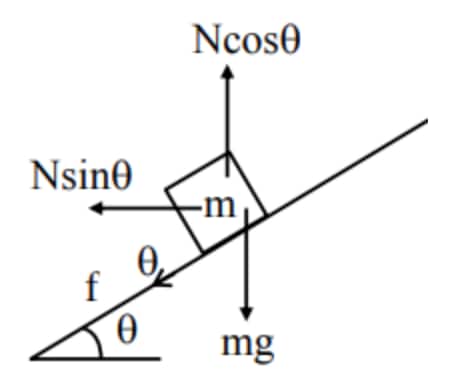
$\begin{aligned} & N \sin \theta+f \cos \theta=\frac{m v^2}{R} \\ & N \cos \theta-f \sin \theta=m g \\ & \frac{\sin \theta+\mu \cos \theta}{\cos \theta-\mu \sin \theta}=\frac{v^2}{R g} \\ & R g \tan \theta+\mu R g=v^2-v^2 \mu \tan \theta\\ & \mu=\frac{v^2-R g \tan \theta}{R g+v^2 \tan \theta}\end{aligned}$
Question 2: A cubic block of mass $m$ is sliding down on an inclined plane at $60^{\circ}$ with an acceleration of $\frac{g}{2}$, the value of coefficient of kinetic friction is
1) (correct) $\sqrt{3}-1$
2) $\frac{\sqrt{3}}{2}$
3) $\frac{\sqrt{2}}{3}$
4)$1-\frac{\sqrt{3}}{2}$
Correct Answer: (1)
Solution:
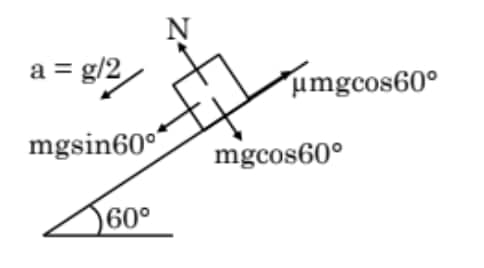
$\begin{aligned} & \mathrm{mg} \sin 60^{\circ}-\mu \mathrm{mg} \cos 60^{\circ}=\mathrm{ma} \\ & g \sin 60-\mu g \cos 60=\frac{g}{2} \\ & \frac{\sqrt{3}}{2}-\frac{\mu}{2}=\frac{1}{2} \\ & \mu=\sqrt{3}-1\end{aligned}$
Question 3: A block of mass 2 kg is attached to one end of a massless spring whose other end is fixed at a wall. The spring-mass system moves on a frictionless horizontal table. The spring's natural length is 2 m and spring constant is $200 \mathrm{~N} / \mathrm{m}$. The block is pushed such that the length of the spring becomes 1 m and then released. At distance $\mathrm{x} \mathrm{m}(\mathrm{x}<2)$ from the wall. the speed of the block will be :
1) $10[1-(2-x)]^{3 / 2} \mathrm{~m} / \mathrm{s}$
2) $10\left[1-(2-x)^2\right]^{1 / 2} \mathrm{~m} / \mathrm{s}$
3) $10\left[1-(2-x)^2\right] \mathrm{m} / \mathrm{s}$
4) $10\left[1-(2-x)^2\right]^2 \mathrm{~m} / \mathrm{s}$
Correct Answer: (2)
Solution:
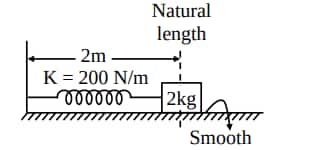
Given,
Natural length of spring $=2 \mathrm{~m}$
Initial compression in spring $\left(\mathrm{x}_{\mathrm{i}}\right)=1 \mathrm{~m}$
Final compression in spring $\left(x_f\right)=(2-x) m$
Using energy conservation
$
\begin{aligned}
& \mathrm{K}_{\mathrm{i}}+\mathrm{U}_{\mathrm{i}}=\mathrm{K}_{\mathrm{f}}+\mathrm{U}_{\mathrm{f}} \\
& 0+\frac{1}{2} \mathrm{Kx}_{\mathrm{i}}^2=\frac{1}{2} \mathrm{mv}^2+\frac{1}{2} \mathrm{Kx}_{\mathrm{f}}^2 \\
& \frac{1}{2} \mathrm{mv}^2=\frac{1}{2} \mathrm{~K}\left(\mathrm{x}_{\mathrm{i}}^2-\mathrm{x}_{\mathrm{f}}^2\right) \\
& \frac{1}{2} \times 2 \times \mathrm{v}^2=\frac{1}{2} \times 200 \times\left(1^2-(2-\mathrm{x})^2\right) \\
& \mathrm{v}^2=100\left[1-(2-\mathrm{x})^2\right] \\
& \mathrm{v}=10\left[1-(2-\mathrm{x})^2\right]^{1 / 2}
\end{aligned}
$
Question 4:
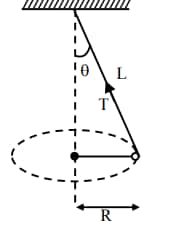
A string of length $L$ is fixed at one end and carries a mass of M at the other end. The mass makes $\left(\frac{3}{\pi}\right)$ rotations per second about the vertical axis passing through the end of the string as shown. The tension in the string is ___ ML.
Correct Answer: 36
Solution:
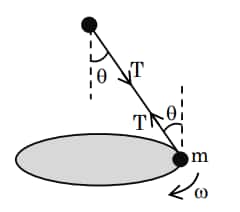
$\mathrm{T} \cos \theta=\mathrm{mg} \quad \ldots(1)$
$\mathrm{T} \sin \theta=\mathrm{M} \omega^2 \mathrm{R} \quad \ldots(2)$
Using equation (2)
$
\begin{aligned}
& T \sin \theta=M \omega^2(L \sin \theta) \\
& T=M \omega^2 L=M\left(\frac{3}{\pi} \times 2 \pi\right)^2 \mathrm{L}
\end{aligned}
$
$
\mathrm{T}=36 \mathrm{ML}
$
Hence, the answer is 36.
Question 5: An object with mass 500 g moves along x -axis with speed $v=4 \sqrt{x} \mathrm{~m} / \mathrm{s}$. The force acting on the object is:
1) 8N
2) 5N
3) 6N
4) 4N
Correct answer: (4)
Solution:
$\begin{aligned} v & =4 \sqrt{x} \\ a & =\frac{v d v}{d x}=4 \sqrt{x}\left(-4 \cdot \frac{1}{2 \sqrt{x}}\right) \\ & =8 \\ F & =\frac{1}{2} \times 8=4 N\end{aligned}$
Question 6: A body of mass 2 kg moving with velocity of $\overrightarrow{\mathrm{v}}_{\mathrm{in}}=3 \hat{\mathrm{i}}+4 \hat{\mathrm{j}} \mathrm{ms}^{-1}$ enters into a constant force field of 6N directed along positive z -axis. If the body remains in the field for a period of $\frac{5}{3}$ seconds, then the velocity of the body when it emerges from the force field is
1) $4 \hat{\mathrm{i}}+3 \hat{\mathrm{j}}+5 \hat{\mathrm{k}}$
2) $3 \hat{\mathrm{i}}+4 \hat{\mathrm{j}}+5 \hat{\mathrm{k}}$
3) $3 \hat{\mathrm{i}}+4 \hat{\mathrm{j}}-5 \hat{\mathrm{k}}$
4) $3 \hat{\mathrm{i}}+4 \hat{\mathrm{j}}+\sqrt{5} \hat{\mathrm{k}}$
Correct Answer: (2)
Solution:
$\begin{aligned} & \mathrm{m}=2 \mathrm{~kg} \\ & V_{\text {in }}=3 \hat{\mathrm{i}}+4 \hat{\mathrm{j}} \mathrm{m} / \mathrm{sec} . \\ & \mathrm{F}=6 \hat{\mathrm{k}} \mathrm{N} \\ & \mathrm{t}=\frac{5}{3} \mathrm{sec}\end{aligned}$
Velocity after t time
$
\begin{aligned}
& \stackrel{\rightharpoonup}{v}=\mathrm{u}+\overrightarrow{\mathrm{a}} \mathrm{t} \\
& V=(3 \hat{\mathrm{i}}+4 \hat{\mathrm{j}})+\frac{\mathrm{F}}{\mathrm{~m}} \mathrm{t} \quad\{\mathrm{~F}=\mathrm{m} \hat{\mathrm{a}}\} \\
& V=(3 \hat{\mathrm{i}}+4 \hat{\mathrm{j}})+\left(\frac{6}{2}\right) \hat{\mathrm{k}} \times \frac{5}{3} \\
& V=3 \hat{\mathrm{i}}+4 \hat{\mathrm{j}}+5 \hat{\mathrm{k}}
\end{aligned}
$
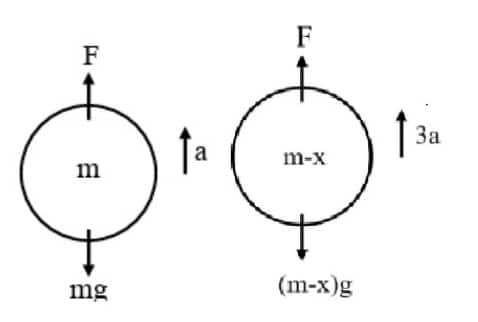
Question 7: A balloon and its contents having mass M are moving up with an acceleration ' $a$ '. The mass that must be released from the content so that the balloon starts moving up with an acceleration '3a' will be : (Take ' g ' as acceleration due to gravity)
1) $\frac{3 \mathrm{Ma}}{2 \mathrm{a}-\mathrm{g}}$
2) $\frac{3 \mathrm{Ma}}{2 \mathrm{a}+\mathrm{g}}$
3) $\frac{2 \mathrm{Ma}}{3 \mathrm{a}+\mathrm{g}}$
4) $\frac{2 \mathrm{Ma}}{3 \mathrm{a}-\mathrm{g}}$
Correct Answer: (3)
Solution:
 l
l
$\begin{aligned} & \mathrm{F}-\mathrm{mg}=\mathrm{ma} \\ & \mathrm{F}=\mathrm{ma}+\mathrm{mg} \\ & F-(m-x) g=(m-x) 3 a \\ & \text { Put } \mathrm{F} \\ & \mathrm{ma}+\mathrm{mg}-\mathrm{mg}+\mathrm{xg}=3 \mathrm{ma}-3 \mathrm{xa} \\ & x=\frac{2 m a}{g+3 a}\end{aligned}$
Question 8:
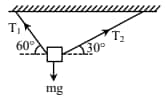
A body of mass 1 kg is suspended with the help of two strings making angles as shown in figure. Magnitude of tensions $T_1$ and $T_2$, respectively, are (in N ):
1) $5,5 \sqrt{3}$
2) $5 \sqrt{3}, 5$
3) $5 \sqrt{3}, 5 \sqrt{3}$
4) 5,5
Correct Answer: (2)
Solution:
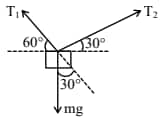
$
\begin{aligned}
& \overrightarrow{F_x}=0 \\
& T_1 \cos 60=T_2 \cos 30 \\
& \frac{1}{2} T_1=\frac{\sqrt{3}}{2} T_2 \\
& T_1=\sqrt{3} T_2 ---(1) \\
& T_1 \sin 60+T_2 \sin 30=10 \\
& \Rightarrow \sqrt{3} T_2 \times \frac{\sqrt{3}}{2}+T_2 \times \frac{1}{2}=10 \\
& \Rightarrow \frac{3 T_2}{2}+\frac{T_2}{2}=10 \\
& \Rightarrow \frac{4 T_2}{2}=10 \\
& \Rightarrow T_2=\frac{10}{2}N \\
& T_2=5 \mathrm{~N}
\end{aligned}
$
from equation (1)
$
\begin{aligned}
& T_1=\sqrt{3} \times 5 \\
& T_1=5 \sqrt{3}
\end{aligned}
$
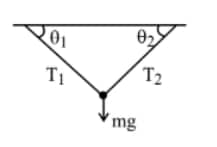
Question 9: A body of mass $m$ is suspended by two strings making angles $\theta_1$ and $\theta_2$ with the horizontal ceiling with tensions $\mathrm{T}_1$ and $\mathrm{T}_2$ simultaneously. $\mathrm{T}_1$ and $\mathrm{T}_2$ are related by $T_1=\sqrt{3} T_2$. the angles $\theta_1$ and $\theta_2$ are
1) $\theta_1=30^{\circ}, \theta_2=60^{\circ}$ with $\mathrm{T}_2=\frac{3 \mathrm{mg}}{4}$
2) $\theta_1=30^{\circ}, \theta_2=60^{\circ}$ with $\mathrm{T}_2=\frac{3 \mathrm{mg}}{4}$
3) $\theta_1=45^{\circ}, \theta_2=45^{\circ}$ with $\mathrm{T}_2=\frac{3 \mathrm{mg}}{4}$
4) $\theta_1=30^{\circ}, \theta_2=60^{\circ}$ with $\mathrm{T}_2=\frac{4 \mathrm{mg}}{5}$
Correct Answer: (2)
Solution:
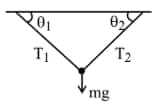
$\mathrm{T}_1 \sin \theta_1+\mathrm{T}_2 \sin \theta_2=\mathrm{mg}$
$\mathrm{~T}_1=\sqrt{3} \mathrm{~T}_2 $
$ \Rightarrow \mathrm{~T}_2\left[\sqrt{3} \sin \theta_1+\sin \theta_2\right]=\mathrm{mg} $
$ \text { for } \theta_1=60^{\circ} \& \theta_2=30^{\circ} $
$ \mathrm{T}_2=\frac{\mathrm{mg}}{2}$
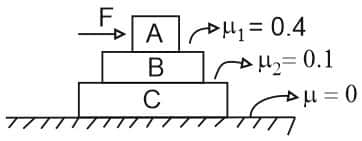
Question 10: Three blocks A, B, C of masses $3 \mathrm{~kg}, 4 \mathrm{~kg}, 7 \mathrm{~kg}$ are stacked as shown, with the ground under $C$ frictionless. The coefficient of friction is $\mu_1=0.4$ and $\mu_2=0.2$. A horizontal force $F$ is applied to block A. Taking $\mathrm{g}=10 \mathrm{~m} / \mathrm{s}^2$, find the maximum F for which all three blocks move together (no slipping at either contact).
1) 12N
2) 14N
3) 7N
4) 21N
Correct answer: (2)
Solution:
For all the blocks to be moving together
$a_{\text {common }}=\frac{\text { Net external force }}{\text { mass }}=\frac{F}{14}$
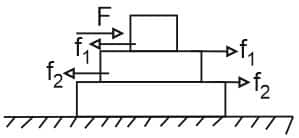
$\begin{gathered}
\left(f_1\right)_L=\mu_1 N_1=0.4 \times 30=12 \mathrm{~N} \\
\left(a_1\right)_{\max }=4 \mathrm{~m} / \mathrm{s}^2
\end{gathered}$
For block 2, $\left(a_2\right)_{\text {max }}=1.25 \mathrm{~m} / \mathrm{s}^2$
For block $3,\left(a_3\right)_{\text {max }}=1 \mathrm{~m} / \mathrm{s}^2$
$a_{{ common }}=\frac{F}{14} \leqslant 1 \mathrm{~m} / \mathrm{s}^2 \quad F=14 \mathrm{~N}$
Question 11: A massless spring gets elongated by an amount $\mathrm{x}_1$ under a tension of 5 N. Its elongation is $\mathrm{x}_2$ under the tension of 7 N. For the elongation of $\left(5 x_1-2 x_2\right)$, the tension in the spring will be,
1) 15N
2) 20N
3) 11N
4) 39N
Correct Answer: (3)
Solution:
$\begin{aligned} & \mathrm{kx}_1=5 \mathrm{~N} \\ & \mathrm{kx}_2=7 \mathrm{~N} \\ & \mathrm{k}\left(5 \mathrm{x}_1-2 \mathrm{x}_2\right)=5 \mathrm{kx}_1-2 \mathrm{kx}_2 \\ & =5 \times 5-2 \times 7=11 \mathrm{~N}\end{aligned}$
Question 12: A vehicle of mass 200 kg is moving along a levelled curved road of radius 70 m with an angular velocity of 0.2 rad/s. The centripetal force acting on the vehicle is:
1) 2800 N
2) (correct) 560 N
3) 2240 N
4) 14 N
Correct Answer: (2)
Solution:
$\begin{aligned} & F_c=m \omega^2 r=200 \times(0.2)^2 \times 70 \\ & =560 \mathrm{~N}\end{aligned}$
Question 13: An average force of 125 N is applied on a machine gun firing bullets each of mass 10 g at the speed of 250 m/s to keep it in position. The number of bullets fired per second by the machine gun is :
1) 25
2) 5
3)100
4) (correct) 50
Correct Answer: (4)
Solution:
$\begin{aligned} & \mathrm{F}=125 \mathrm{~N} \\ & \mathrm{~F}=\frac{\mathrm{dp}}{\mathrm{dt}} \quad \mathrm{n} \rightarrow \text { No. of bullets } \\ & \mathrm{F}=\frac{\mathrm{d}(\mathrm{nmv})}{\mathrm{dt}}=\mathrm{mv} \frac{\mathrm{dn}}{\mathrm{dt}} \\ & 125=\frac{10 \mathrm{n}}{1000} \times 250 \times \frac{\mathrm{dn}}{\mathrm{dt}} \\ & \frac{125 \times 1000}{2500}=\frac{\mathrm{dn}}{\mathrm{dt}} \\ & \frac{\mathrm{dn}}{\mathrm{dt}}=50\end{aligned}$
Question 14: The position vector of a particle related to time t is given by
$\overrightarrow{\mathrm{r}}=\left(10 \mathrm{t} \hat{\mathrm{i}}+15 \mathrm{t}^2 \hat{\mathrm{j}}+7 \hat{\mathrm{k}}\right) \mathrm{m}$
The direction of the net force experienced by the particle is:
1) Positive z-axis
2) In x – y plane
3) (correct) Positive y–axis
4) Positive x–axis
Correct Answer: (3)
Solution:
Given, $\overrightarrow{\mathrm{r}}=10 \hat{t} \hat{i}+15 \mathrm{t}^2 \hat{\mathrm{j}}+7 \hat{\mathrm{k}}$
$\begin{aligned}
& \overrightarrow{\mathrm{v}}=\frac{\mathrm{dr}}{\mathrm{dt}}=10 \hat{\mathrm{j}}+30 \mathrm{t} \hat{\mathrm{j}} \\
& \overrightarrow{\mathrm{a}}=\frac{\mathrm{d} \overrightarrow{\mathrm{v}}}{\mathrm{dt}}=30 \hat{\mathrm{j}} \\
& \overrightarrow{\mathrm{~F}}=\mathrm{ma} \rightarrow \text { along }(+) y \text {-axis }
\end{aligned}$
Question 15: A machine gun of mass 10 kg fires 20 g bullets at the rate of 180 bullets per minute with a speed of $100 \mathrm{~m} \mathrm{~s}^{-1}$ each. The recoil velocity of the gun is
1) $1.5 \mathrm{~m} / \mathrm{s}$
2) $0.6 \mathrm{~m} / \mathrm{s}$
3) $2.5 \mathrm{~m} / \mathrm{s}$
4) $0.02 \mathrm{~m} / \mathrm{s}$
Correct Answer: (2)
Solution:
$\begin{aligned} & 20 \times 10^{-3} \times \frac{180}{60} \times 100=10 \mathrm{~V} \\ & \mathrm{~V}=0.6 \mathrm{~ms}^{-1}\end{aligned}$
Confused About College Admissions?
Get expert advice on college selection, admission chances, and career path in a personalized counselling session.
Book a Counselling Slot
Select Date
Pick a Slot
Weightage of Laws of Motion in JEE Main 2026
Based on the 2026 exam analysis, Laws of Motion contribute 3.79% weightage in the JEE Main Physics paper. In practical terms, 1 question appears in most of the shifts of the exam and around 18 overall in both sessions, worth roughly 4 to 8 marks out of the 100 marks allotted to Physics.
|
Session |
Total Questions Asked |
Approx. Marks |
Weightage |
|
January 2026 |
8 |
32 Marks |
3.20% |
|
April 2026 |
10 |
40 Marks |
4.00% |
|
Overall (2026) |
18 Questions |
72 Marks |
3.79% |
Topic-Wise Weightage and Number of Questions
Not every sub-topic within laws of motion carries equal weightage. On the basis of analysis 2026 JEE Main papers, the topic-wise breakdown of questions is given below:
|
Topic |
January Session |
April Session |
Total Questions |
|
Calculation of Required Force in Different Situations |
1 |
0 |
1 |
|
1 |
1 |
2 | |
|
Motion of Block in Contact |
2 |
0 |
2 |
|
1 |
0 |
1 | |
|
Motion of Connected Blocks over a Pulley |
1 |
1 |
2 |
|
Newton's Second and Third Laws of Motion |
1 |
1 |
2 |
|
1 |
0 |
1 | |
|
Coefficient of Friction Between a Body and a Wedge |
0 |
3 |
3 |
|
Force in Non-Uniform Circular Motion |
0 |
1 |
1 |
|
0 |
1 |
1 | |
|
0 |
1 |
1 | |
|
Sticking of a Person to the Wall of a Rotor (Death Well) |
0 |
1 |
1 |
|
Total |
8 |
10 |
18 |
Also Read: JEE Mains 2027: Physics Set of 5 Sample Paper with Solution
Last 10 Years' Weightage of Laws of Motion in JEE Main
The Laws of Motion chapter question is appearing constantly over the past 10 years has remained the important topic of JEE Main, with questions frequently appearing from friction, circular motion, pulley systems, Newton's laws of motion, and equilibrium concepts.
Last 10 Years' Previous Year Questions with Solutions
|
Topic |
Number of Questions |
|
69 | |
|
Acceleration of a Block Against Friction |
25 |
|
Centripetal Force and Centrifugal Force |
16 |
|
Coefficient of Friction Between a Body and a Wedge |
16 |
|
16 | |
|
16 | |
|
Acceleration of a Block on a Smooth Inclined Plane |
10 |
|
Common Forces in Mechanics |
9 |
|
Linear Momentum |
9 |
|
9 |
JEE Main Syllabus: Subjects & Chapters
Select your preferred subject to view the chapters
Frequently Asked Questions (FAQs)
Q: What is the weightage of the Laws of Motion in the JEE Main exam?
A:
The Weightage of the Laws of Motion was 3.79% in the JEE Main 2026 exam. On average, 1-2 questions appear in the exam every year.
Q: Is Laws of Motion question are hard in JEE Advanced than JEE Main?
A:
Yes, the laws of motion questions are harder in JEE Advanced because the questions asked in JEE advanced has multi step calculation but the questions asked in JEE Main are easier.
Q: What are the most important topics in Laws of Motion for JEE Main 2027?
A:
Based on the previous year's analysis, the important topics are:
- Newton's Second and Third Laws of Motion
- Acceleration of a Block Against Friction
- Centripetal Force and Centrifugal Force
- Coefficient of Friction Between a Body and a Wedge
Articles
Related Stories
|
Upcoming Engineering Exams

Certifications By Top Providers
Explore Top Universities Across Globe
Popular Courses and Specializations
List of colleges accepting JEE Main
Browse Engineering Colleges by State
Questions related to JEE Main
On Question asked by student community
Have a question related to JEE Main ?
Hello Student,
You can access JEE Main Mathematics previous years' question papers through the Careers360 resource below. It includes previous years’ papers for practice and preparation.
https://engineering.careers360.com/articles/jee-main-question-papers
Hope this helps!
Hello Student, the eligibility criteria are different from the score or percentile required for admission. Your Class 12 subjects, passing year and applicable eligibility rules are important. If you mean the minimum score or percentile required for admission, please specify the college or course you are targeting.
Hello Student,
You can check the JEE Main and JEE Advanced exam patterns on Careers360 using the resources below:
Hope this Helps!
You may be able to register/appear for JEE without having the certificate immediately, depending on the application rules for that year. However, if you claim a reserved category, the required certificate must be available within the prescribed deadline for counselling/admission. If you fail to produce a valid certificate when required,
Hello Student,
The “Download Link” mentioned in the JEE Main 2027 Important Notes and Formulas eBook may not be clickable in the PDF. Please try opening the eBook on a different PDF reader or device.
If the link is still not opening, please share a screenshot of the page where

B.Tech/B.Arch Admissions OPEN
Among top 100 Universities Globally in the Times Higher Education (THE) Interdisciplinary Science Rankings 2026
Manav Rachna-B.Tech Admissions 2026
ApplyNAAC A++ Grade | Recognized as Category-1 Deemed to be University by UGC | 41,000 + Alumni Imprints Globally
GMRIT Deemed to be University B.Tech Admissions 2026
Apply100+ Recruiters | 1200+ Placements of 2026 Batch | NBA & NAAC Accredited | Highest CTC 37 LPA
Integral University B.Tech Admissions 2026
ApplyNAAC A+ Accredited | Highest CTC 45 LPA | Scholarships Available
Parul University B-TECH Admissions 2026
ApplyIndia's youngest NAAC A++ accredited University | NIRF rank band 151-200 | 2200 Recruiters | 45.98 Lakhs Highest Package
East Point College of Engineering & Tech. Admissions 2026
ApplyApply for B.E at East Point College of Engineering and Technology | Affiliated to VTU | AICTE Approved | NBA Accredited | Highest CTC 33 LPA
JEE Main Notifications
Explore Career Options
By IndustryNever miss JEE Main update
Get timely JEE Main updates directly to your inbox. Stay informed!