Amity University Noida-B.Tech Admissions 2026
Among top 100 Universities Globally in the Times Higher Education (THE) Interdisciplinary Science Rankings 2026


Chemical Bonding JEE Main Questions—If you are aiming for a top rank in the upcoming JEE Main 2027 exam, mastering Chemical Bonding is NOT optional. It forms the basics of several chapters in Inorganic Chemistry, and is a high-scoring chapter with 2-3 direct questions typically asked in every exam session. To score well, you not only need to memorize NCERT rules and concepts but also need to practice high-yield Chemical Bonding JEE Main exam questions to be able to crack NTA's changing question patterns. Focused practice of JEE Main PYQs alongside regular study will surely earn you the much-needed marks and make all your percentile goals a reality!
This Story also Contains

Go through the JEE Main 2027 Syllabus to get better insights into the Chemical bonding syllabus. The total Chemical Bonding JEE Main weightage is given below:
|
Chapter Name |
Number of Questions |
Weightage |
|
21 |
4.42% |
Get expert advice on college selection, admission chances, and career path in a personalized counselling session.
Some of the previously asked JEE Main Chemistry Questions and answers are given below. These chemical bonding PYQs JEE Main will help you get an idea of what kind of questions you need to practice to score good marks in JEE Main 2027. All the questions below are given according to the latest JEE Main syllabus:
Question 1:Given below are two statements:
Statement (I) : for $C \ell \mathrm{F}_3$, all three possible structures may be drawn as follows.
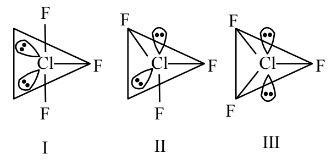
Statement (II) : Structure III is most stable, as the orbitals having the lone pairs are axial, where the $\ell \mathrm{p}-\mathrm{bp}$ repulsion is minimum.
In light of the above statements, choose the most appropriate answer from the options given below:
1) Statement I is incorrect but Statement II is correct.
2) Statement I is correct but Statement II is incorrect.
3) Both Statement I and Statement II are correct.
4) Both Statement I and Statement II are incorrect.
Solution:
Statement 1 is correct.
Statement 2 is incorrect since in $\mathrm{sp}^3 \mathrm{~d}$ hybridization, a lone pair cannot occupy an axial position due to lone pair-bond pair repulsion. The lone pairs will be at the equatorial position for maximum stability.
Hence, the correct answer is option (2).
Question 2: $\mathrm{sp}^3 \mathrm{~d}^2$ hybridization is not displayed by :
1) $\mathrm{BrF}_5$
2) $\mathrm{SF}_6$
3) $\left[\mathrm{CrF}_6\right]^{3-}$
4) $\mathrm{PF}_5$
Solution:
$\mathrm{sp}^3 \mathrm{~d}^2$ hybridization is not displayed by $\mathrm{PF}_5$. The central P atom has 5 sets of electron pairs (all of which are bonding) hence it shows $\mathrm{sp}^3 \mathrm{~d}$ hybridization. $\mathrm{sp}^3 \mathrm{~d}^2$ hybridization corresponds to 6 sets of electron pairs.
Rest all other options display $\mathrm{sp}^3 \mathrm{~d}^2$ hybridization.
Hence, the answer is option (4).
Question 3: The incorrect geometry is represented by :
1)$B F_3$ - trigonal planar
2) $\mathrm{H}_2 \mathrm{O}$ - bent
3) $N F_3$ - trigonal planar
4) $A s F_5$ - trigonal bipyramidal
Solution:
As we have learned
Determination of the shape of molecules using VSEPR Theory -
calculate $X$
$X=($ No. of valence electronsof central atom $)+($ No.of other atom $)+$ (Negative charge on the molecule) - (Positive charge on the molecule)
The geometry of $N F_3$ is pyramidal.
Hence, the answer is option (3).
Question 4: Among the following species, the diamagnetic molecule is :
1) NO
2)$C O$
3)$B_2$
4) $O_2$
Solution:
If the molecular orbitals have unpaired electrons then the molecule will be paramagnetic.
or if all are paired then the molecule will be diamagnetic.
In CO, molecular orbital configuration
$\sigma_{1 s}^2, \sigma_{1 s}^{* 2}, \sigma_{2 s}^2, \sigma_{2 s}^{* 2}, \pi_{2 p_x}^2=\pi_{2 p_y}^2, \sigma_{2 p_z}^2$
There are no unpaired electrons thus CO is a diamagnetic.
Hence, the answer is the option (2).
Question 5: During the change of $\mathrm{O}_2$ to $\mathrm{O}_2^{-}$, the incoming electron goes to the orbital:
1) $\pi 2 p_y$
2) $\sigma^* 2$
3) $\pi^* 2 p_x$
4) $\pi 2 p_x$
Solution:
For $O_2$ molecule, the molecule orbital sequence follows the given order :
$\sigma 1 s^2 \sigma^* 1 s^2 \sigma 2 s^2 \sigma^* 2 s^2 \sigma 2 p_z^2 \pi 2 p_x^2=\pi 2 p_y^2 \pi^* 2 p_x^1=\pi^* 2 p_y^1$
Now, from $O_2$ to $O_2^{-}$, the incoming electron will go into ( $\pi^* 2 p_x$ ) orbital and thus
The final sequence will be
$\sigma 1 s^2 \sigma^* 1 s^2 \sigma 2 s^2 \sigma^* 2 s^2 \sigma 2 p_z^2 \pi 2 p_x^2=\pi 2 p_y^2 \pi^* 2 p_x^2=\pi^* 2 p_y^1$
Hence, the answer is option (3).
Question 6: The total number of electrons in all bonding molecular orbitals of $\mathrm{O}_2^{2-}$ is $\_\_\_\_$ (Round off to the nearest integer)
Solution:
The orbital configuration of $\mathrm{O}_2^{2-}$ is
$\sigma_{1 S}^2 \sigma_{1 s}^{* 2} \sigma_{2 s}^2 \sigma_{2 s}^{* 2} \sigma_{2 p z}^2 \pi_{2 p x}^2=\pi_{2 p_y}^2 \pi_{2 p x}^2=\pi_{2 p y}^{* 2}$
Thus, there are a total of 10 electrons present in the bonding molecular orbitals.
Hence, the answer is (10).
Question 7: In $\mathrm{SO}_2, \mathrm{NO}_2^{-}$and $\mathrm{N}_3^{-}$the hybridizations at the central atom are respectively :
1) $\mathrm{sp}^2, \mathrm{sp}^2$ and sp
2) $\mathrm{sp}^2, \mathrm{sp}$ and sp
3) $\mathrm{sp}^2, \mathrm{sp}^2$ and $\mathrm{sp}^2$
4) $\mathrm{sp}, \mathrm{sp}^2$ and sp
Solution:
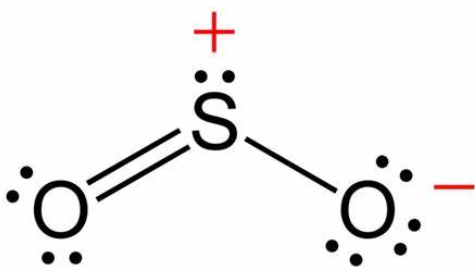
$\mathrm{SO}_2 \Rightarrow 2 \sigma$ bond +1 l.p. $\Rightarrow s p^2$ hybridisation
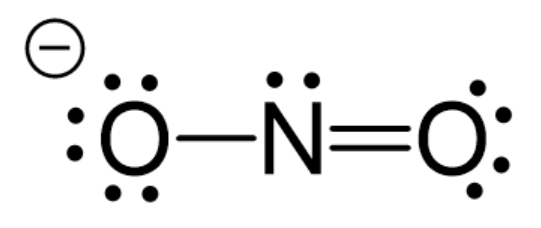
$\mathrm{NO}_2^{-} \Rightarrow 2 \sigma$ bond +1 l.p. $\Rightarrow s p^2$ hybridisation
$\mathrm{N}_3^{-} \Rightarrow 2 \sigma$ bond $\Rightarrow s p$ hybridisation

Hence, the correct answer is option (1).
Question 8: The bond order and the magnetic characteristics of $\mathrm{CN}^{-}$are:
1) 3, paramagnetic
2) $2 \frac{1}{2}$, diamagne
3) 3, diamagnetic
4) $2 \frac{1}{2}$, paramagnetic
Solution:
The bond order of $\mathrm{CN}^{-}$is 3, and all the electrons are paired in this ion, thus it is diamagnetic.
Hence, the answer is option(3).
Question 9: The interaction energy of London forces between two particles is proportional to $r^x$, where $r$ is the distance between the particles. The value of $x$ is :
1) 6
2) -6
3) 3
4) -3
Solution:
As we have learned, the interaction energy of London Forces between two particles $\alpha \frac{1}{r^6}$
Thus, the value of $x=-6$
Hence, the answer is option (2).
Question 10: Which of the following molecules(s) show/s paramagnetic behavior ?
(A) $\mathrm{O}_2$
(B) $\mathrm{N}_2$
(C) $\mathrm{F}_2$
(D) $\mathrm{S}_2$
(E) $\mathrm{Cl}_2$
Choose the correct answer from the options given below :
1) B only
2) A & C only
3) A & E only
4) A & D only
Solution:
| No. of unpaired $e^{-}$ | ||
| (A) | $\mathrm{O}_2$ | 2 |
| (B) | $\mathrm{~N}_2$ | 0 |
| (C) | $\mathrm{~F}_2$ | 0 |
| (D) | $\mathrm{~S}_2$ | 2 |
| (E) | $\mathrm{Cl}_2$ | 0 |
If species contain unpaired electron than it is paramagnetic.
So A & D are paramagnetic.
Hence, the correct answer is option (4).
Question 11:
Match the LIST-I with LIST-II
| LIST-I (Molecules/ion) | LIST-II (Hybridisation of central atom) | ||
| A. | $\mathrm{PF}_5$ | I. | $\mathrm{dsp}^2$ |
| B. | $\mathrm{SF}_6$ | II. | $\mathrm{sp}^3 \mathrm{~d}$ |
| C. | $\mathrm{Ni}(\mathrm{CO})_4$ | III. | $\mathrm{sp}^3 \mathrm{~d}^2 $ |
| D. | $\left[\mathrm{PtCl}_4\right]^{2-}$ | IV. | $\mathrm{sp}^3$ |
Choose the correct answer from the options given below :
1) A-II, B-III, C-IV, D-I
2) A-IV, B-I, C-II, D-III
3) A-I, B-II, C-III, D-IV
4) A-III, B-I, C-IV, D-II
Solution:
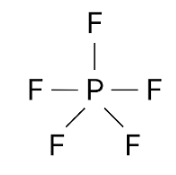
$\mathrm{PF}_5: 5 \sigma+0 \ell \mathrm{p} \rightarrow \mathrm{sp}^3 \mathrm{~d}$
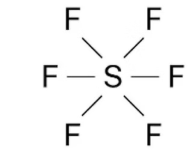
$\mathrm{SF}_6: 6 \sigma+0 \ell \mathrm{p} \rightarrow \mathrm{sp}^3 \mathrm{~d}^2$
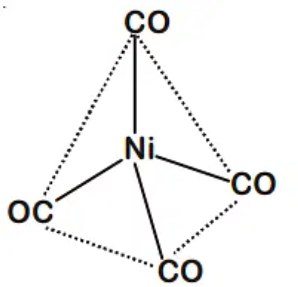
$\mathrm{Ni}(\mathrm{CO})_4: \mathrm{Ni} \rightarrow 0$
$\left[\mathrm{PtCl}_4\right]^{2-}: \mathrm{Pt} \rightarrow+2$

In the presence of a ligand field:-
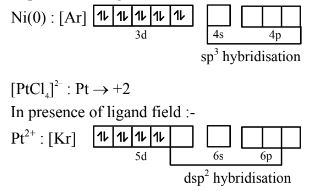
A-II, B-III, C-IV, D-I
Hence, the correct answer is option (1).
Question 12: A molecule with the formula AX4Y has all it’s elements from p-block. Element A is rarest,
monoatomic, non-radioactive from its group and has the lowest ionization enthalpy value among A, X and Y. Elements X and Y have first and second highest electronegativity values respectively among all the known elements. The shape of the molecule is :
1) Square pyramidal
2) Octahedral
3) Pentagonal planar
4) Trigonal bipyramidal
Solution:
Given A is rarest, monoatomic, non-radioactive p-block element and form $\mathrm{AX}_4 \mathrm{Y}$ type of molecule.
$\therefore$ It is concluded that it is Xe
It is given the electronegativity of A is less than X & Y
It is given the electronegativity of $\mathrm{X} \& \mathrm{Y}$ is highest and second highest respectively among all element.
$\therefore \mathrm{X} \& \mathrm{Y}$ are $\mathrm{F} \& \mathrm{O}$
$\therefore$ Compound is consider as $\mathrm{XeOF}_4$ with square pyramidal shape.

Hence, the correct answer is option (1).
Question 13: Among $\mathrm{SO}_2, \mathrm{NF}_3, \mathrm{NH}_3, \mathrm{XeF}_2, \mathrm{ClF}_3$ and $\mathrm{SF}_4$, the hybridization of the molecule with non-zero dipole moment and highest number of lone-pairs of electrons on the central atom is
1) $\mathrm{sp}^3$
2) $\mathrm{dsp}^2$
3) $\mathrm{sp}^3 \mathrm{~d}^2$
4) $\mathrm{sp}^3 \mathrm{~d}$
Solution:
| Molecule | Hybridisation | Dipole Moment | Lone pair on the central atom |
| $\mathrm{SO}_2$ | $\mathrm{sp}^2$ | Non - zero | 1 |
| $\mathrm{NF}_3$ | $\mathrm{sp}^3$ | Non - zero | 1 |
| $\mathrm{NH}_3$ | $\mathrm{sp}^3$ | Non - zero | 1 |
| $\mathrm{XeF}_2$ | $\mathrm{sp}^3 \mathrm{~d}$ | zero | 3 |
| $\mathrm{C} \ell \mathrm{~F}_3$ | $\mathrm{sp}^3 \mathrm{~d}$ | Non - zero | 2 |
| $\mathrm{SF}_4$ | $ \mathrm{sp}^3 \mathrm{~d}$ | Non - zero | 1 |
Highest CTC 81.25 LPA | NAAC A++ Accredited | Ranked #62 in India by NIRF Ranking 2025 | JEE & JET Scores Accepted
Campuses in Ropar, Agartala, Aizawl, Ajmer, Aurangabad, Calicut, Imphal, Itanagar, Kohima, Gorakhpur, Patna & Srinagar
ClF3 has 2 lone pairs and a non-zero dipole moment, the highest among molecules with a dipole.
XeF2 has 3 lone pairs but zero dipole moment due to linear symmetry.
Hence, the correct answer is option (4)
Question 14: Which among the following molecules is (a) involved in sp3d hybridization, (b) has different bond lengths and (c) has lone pair of electrons on the central atom ?
1) PF5
2) XeF4
3) SF4
4) XeF2
Solution:
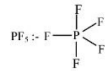
(a) Hybridisation $=\mathrm{sp}^3 \mathrm{~d}$
(b) All bonds are not identical
(c) No lone pair on central atom
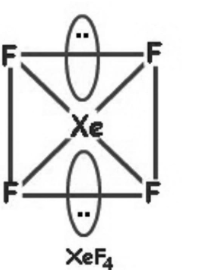
(a) $\mathrm{XeF}_4:-\mathrm{sp}^3 \mathrm{~d}^2$ Hybridisation
(b) 2 lone pairs on central atom
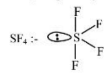
(a) Hybridisation $=\mathrm{sp}^3 \mathrm{~d}$
(b) All bonds are not identical
(c) 1 lone pair on central atom
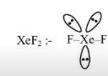
(a) Hybridisation $=\mathrm{sp}^3 \mathrm{~d}$
(b) All bonds are identical
(c) 3 lone pairs on the central atom
From all the given molecules, SF4 molecule is involved in sp3d hybridization, has different bond lengths, and has a lone pair of electrons on the central atom
Hence, the correct answer is option (3).
Question 15: Total number of non bonded electrons present in $\mathrm{NO}_2^{-}$ion based on Lewis theory is _________ .
Solution :
The $\mathrm{NO}_2^{-}$(nitrite ion) has a total of 18 valence electrons, with one double bond and one single bond between nitrogen and oxygen. The double-bonded oxygen has 2 lone pairs ( 4 electrons), the single-bonded oxygen has 3 lone pairs ( 6 electrons), and nitrogen has 1 lone pair ( 2 electrons). Adding them together, the total number of non-bonded electrons in $\mathrm{NO}_2^{-}$is 12.
Hence, the answer is (12).
Question 16: The molecules having square pyramidal geometry are
(1) $\mathrm{BrF}_5 \& \mathrm{XeOF}_4$
(2) $\mathrm{SbF}_5 \& \mathrm{XeOF}_4$
(3) $\mathrm{SbF}_5 \& \mathrm{PCl}_5$
(4) $\mathrm{BrF}_5 \& \mathrm{PCl}_5$
1) $\mathrm{BrF}_5 ~\& \mathrm{~XeOF}_4$
2) $\mathrm{SbF}_5 ~\& \mathrm{~XeOF}_4$
3) $\mathrm{SbF}_5 ~\& \mathrm{~PCl}_5$
4) $\mathrm{BrF}_5 ~\& \mathrm{~PCl}_5$
Solution:
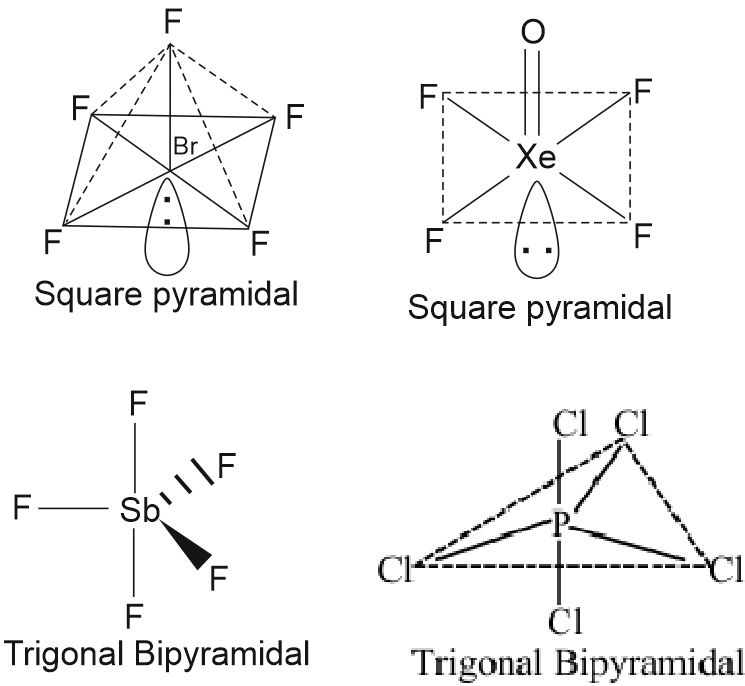
$\mathrm{BrF}_5$ : Square pyramidal
$\mathrm{XeOF}_4$ : Square pyramidal
$\mathrm{SbF}_5$ : Trigonal bipyramidal
$\mathrm{PCl}_5$ : Trigonal bipyramidal
Hence, the correct answer is option (1).
Question 17: Given below are two statements:
Statement(I) : Experimentally determined oxygen-oxygen bond lengths in the $\mathrm{O}_3$ are found to be same and the bond length is greater than that of a $\mathrm{O}=\mathrm{O}$ (double bond) but less than that of a single $(\mathrm{O}-\mathrm{O})$ bond.
Statement (II) : The strong lone pair-lone pair repulsion between oxygen atoms is solely responsible for the fact that the bond length in ozone is smaller than that of a double bond $(\mathrm{O}=\mathrm{O})$ but more than that of a single bond $(\mathrm{O}-\mathrm{O})$.
In light of the above statements, choose the correct answer from the options given below:
1) Statement I is true but Statement II is false
2) Both Statement I and Statement II are true
3) Both Statement I and Statement II are false
4) Statement I is false but Statement II is true
Solution:
The first statement states that oxygen–oxygen bond lengths in ozone (O₃) are equal and fall between the lengths typical of an O–O single bond and an O=O double bond. This statement is correct. Ozone has a bent structure and exhibits resonance. The two resonance structures involve the shifting of a π-bond between the oxygen atoms, which leads to the delocalization of electrons across the molecule. As a result, the actual structure of O₃ is a resonance hybrid, with both O–O bonds having the same bond order—approximately 1.5 and the bond length is shorter than a single bond (about 148 pm) but longer than a double bond (about 121 pm), with the observed bond length being around 128 pm. Therefore, Statement I accurately reflects the experimental and theoretical understanding of ozone’s bonding.
The second statement states that the lone pair–lone pair repulsion between oxygen atoms is responsible for the observed bond lengths in ozone being between those of a single and a double bond. This statement is incorrect. While it is true that lone pair–lone pair repulsion exists and can influence the molecular geometry (such as the bond angle in O₃), it is not the main reason for the intermediate bond length. Therefore, Statement II is not correct.
Hence, the correct answer is option (1)
Some of the most important concepts asked in Chemical Bonding JEE Mains questions with solutions are listed below:
|
Topic Name |
Important Sub-Concepts |
|
Lattice energy, Born–Haber cycle, stability factors | |
|
Lewis structure, shape prediction, lone pair effect | |
|
sp, sp², sp³ mapping with geometry | |
|
Bond order, magnetic nature, MO diagrams |
Frequently Asked Questions (FAQs)
Yes. Chemical Bonding is a high-weightage and concept-driven chapter, frequently contributing 1–2 direct questions in JEE Main, often linked with molecular shape, bond orderand hybridisation.
The most scoring areas are Ionic Bonding, VSEPR-based shape prediction, Hybridisation–geometry mapping, and Molecular Orbital Theory (bond order and magnetic nature).
Focus on NCERT theory, practise shape and hybridisation-based MCQs, master MO diagrams up to N₂ and O₂, and revise standard results and trends rather than lengthy derivations.
Chemical Bonding PYQs help students understand the exam pattern and frequently asked concepts, but they should be supplemented with mock tests and additional practice questions.
NCERT is an excellent starting point for Chemical Bonding, but students should also solve JEE Main-level questions and previous years' papers for better preparation.
Focus on understanding fundamental concepts, revising NCERT regularly, solving PYQs, and attempting mock tests to improve accuracy and speed.
Previous year questions help identify important concepts, recurring question patterns, and the difficulty level of questions asked in JEE Main.

On Question asked by student community
Hello Student,
You can access JEE Main Mathematics previous years' question papers through the Careers360 resource below. It includes previous years’ papers for practice and preparation.
https://engineering.careers360.com/articles/jee-main-question-papers
Hope this helps!
Hello Student, the eligibility criteria are different from the score or percentile required for admission. Your Class 12 subjects, passing year and applicable eligibility rules are important. If you mean the minimum score or percentile required for admission, please specify the college or course you are targeting.
Hello Student,
You can check the JEE Main and JEE Advanced exam patterns on Careers360 using the resources below:
Hope this Helps!
You may be able to register/appear for JEE without having the certificate immediately, depending on the application rules for that year. However, if you claim a reserved category, the required certificate must be available within the prescribed deadline for counselling/admission. If you fail to produce a valid certificate when required,
Hello Student,
The “Download Link” mentioned in the JEE Main 2027 Important Notes and Formulas eBook may not be clickable in the PDF. Please try opening the eBook on a different PDF reader or device.
If the link is still not opening, please share a screenshot of the page where

Among top 100 Universities Globally in the Times Higher Education (THE) Interdisciplinary Science Rankings 2026
NAAC A++ Grade | Recognized as Category-1 Deemed to be University by UGC | 41,000 + Alumni Imprints Globally
100+ Recruiters | 1200+ Placements of 2026 Batch | NBA & NAAC Accredited | Highest CTC 37 LPA
NAAC A+ Accredited | Highest CTC 45 LPA | Scholarships Available
India's youngest NAAC A++ accredited University | NIRF rank band 151-200 | 2200 Recruiters | 45.98 Lakhs Highest Package
Apply for B.E at East Point College of Engineering and Technology | Affiliated to VTU | AICTE Approved | NBA Accredited | Highest CTC 33 LPA