
Search Colleges, Exams, Schools & more


Login
3D Geometry Class 12 JEE Main Questions: Weightage, PYQs, and Formulas
Three-Dimensional Geometry is one of the most scoring yet most feared chapters in the JEE Main syllabus. Students often shy away from it because it has more formulas, but the truth is simpler: once you understand the logic behind direction cosines, lines, and planes, most 3D geometry JEE Main questions can be solved simply by putting the values into the formulas.
This Story also Contains
- 3D Geometry Practice Questions for JEE Main
- Important Formulas of Three-Dimensional Geometry for JEE Main
- Weightage of 3D Geometry in JEE Main 2026
- Topic-Wise Weightage and Number of Questions
- Last 10 Years' Weightage of Three-Dimensional Geometry in JEE Main
This article is for Class 12 students revising for JEE Main, and droppers doing a final revision. It covers every important concept, last year's weightage, and the last 10 years' weightage of 3D Geometry questions in the JEE Main exam, along with Practice questions and answers
Also Read: JEE Main 2027 Laws of Motion: Master the Chapter with 100+ Practice Questions
3D Geometry Practice Questions for JEE Main
Download JEE Main 2027 3D Geometry: Top Questions to Boost Your Maths Score
Question 1: Let $\mathrm{L}_1: \frac{\mathrm{x}-1}{3}=\frac{\mathrm{y}-1}{-1}=\frac{\mathrm{z}+1}{0}$ and $\mathrm{L}_2: \frac{\mathrm{x}-2}{2}=\frac{\mathrm{y}}{0}=\frac{\mathrm{z}+4}{\alpha}, \alpha \in \mathrm{R}$, be two lines, which intersect at the point $B$. If $P$ is the foot of perpendicular from the point $\mathrm{A}(1,1,-1)$ on $\mathrm{L}_2$, then the value of $26 \alpha(\mathrm{~PB})^2$ is_____________.
1) 216
2) 195
3) 224
4) 167
Correct answer: (1)
Solution:
We are given two lines:
$
L_1: \frac{x - 1}{3} = \frac{y - 1}{-1} = \frac{z + 1}{0}, \quad
L_2: \frac{x - 2}{2} = \frac{y}{0} = \frac{z + 4}{\alpha}
$
Let the parameter for $ L_1 $ be $ \lambda $. Then a point on $ L_1 $ is given by:
$
x = 3\lambda + 1, \quad y = -\lambda + 1, \quad z = -1
$
Let the parameter for $ L_2 $ be $ \mu $. Then a point on $ L_2 $ is:
$
x = 2\mu + 2, \quad y = 0, \quad z = \alpha \mu - 4
$
Equating the coordinates (since lines intersect), we get:
$
3\lambda + 1 = 2\mu + 2 \quad \text{(1)}
$
$
-\lambda + 1 = 0 \quad \text{(2)}
$
$
-1 = \alpha \mu - 4 \quad \text{(3)}
$
From equation (2):
$
\lambda = 1
$
Substitute into equation (1):
$
3(1) + 1 = 2\mu + 2 \Rightarrow 4 = 2\mu + 2 \Rightarrow \mu = 1
$
Substitute into equation (3):
$
-1 = \alpha(1) - 4 \Rightarrow \alpha = 3
$
So, the point of intersection $ B $ is:
$
x = 2(1) + 2 = 4, \quad y = 0, \quad z = 3(1) - 4 = -1
\Rightarrow B = (4, 0, -1)
$
Now, find the foot of the perpendicular from point $ A(1,1,-1) $ to line $ L_2 $.
Let a general point on $ L_2 $ be given by a parameter $ \delta $:
$
P = (2\delta + 2, 0, 3\delta - 4)
$
Then, vector $ \vec{AP} $ is:
$
\vec{AP} = \langle 2\delta + 2 - 1, \ 0 - 1, \ 3\delta - 4 + 1 \rangle
= \langle 2\delta + 1, -1, 3\delta - 3 \rangle
$
Direction vector of $ L_2 $ is $ \langle 2, 0, 3 \rangle $. Since $ \vec{AP} $ is perpendicular to the line, their dot product is zero:
$
(2\delta + 1)(2) + (-1)(0) + (3\delta - 3)(3) = 0
\Rightarrow 4\delta + 2 + 9\delta - 9 = 0
\Rightarrow 13\delta - 7 = 0 \Rightarrow \delta = \frac{7}{13}
$
Substitute into $ P $:
$
x = 2\cdot \frac{7}{13} + 2 = \frac{14}{13} + \frac{26}{13} = \frac{40}{13}
$
$
y = 0
$
$
z = 3\cdot \frac{7}{13} - 4 = \frac{21}{13} - \frac{52}{13} = \frac{-31}{13}
$
So, the foot of the perpendicular is:
$
P = \left( \frac{40}{13}, 0, \frac{-31}{13} \right)
$
Now compute $ PB^2 $, where $ B = (4, 0, -1) $:
$
PB^2 = \left(4 - \frac{40}{13} \right)^2 + (0 - 0)^2 + \left(-1 - \left(\frac{-31}{13}\right)\right)^2
= \left( \frac{12}{13} \right)^2 + \left( \frac{18}{13} \right)^2
$
$
PB^2 = \frac{144}{169} + \frac{324}{169} = \frac{468}{169}
$
Given $ \alpha = 3 $, we calculate:
$
26 \cdot \alpha \cdot PB^2 = 26 \cdot 3 \cdot \frac{468}{169}
= \frac{36504}{169} = 216
$
Hence, the answer is 216.
Question 2: Let the circle C touch the line $\mathrm{x}-\mathrm{y}+1=0$, have the centre on the positive $x$-axis, and cut off a chord of length $\frac{4}{\sqrt{13}}$ along the line $-3x+2y=1$. Let H be the hyperbola $\frac{x^2}{\alpha^2}-\frac{y^2}{\beta^2}=1$, whose one of the foci is the centre of C and the length of the transverse axis is the diameter of C . Then $2 \alpha^2+3 \beta^2$ is equal to_______________.
1) 19
2) 7
3) 23
4) 11
Correct answer: (1)
Solution:
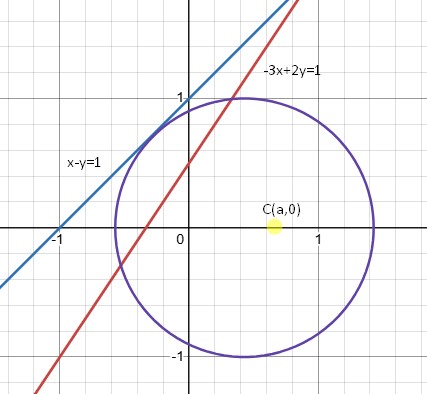
Let the center of the circle $C$ be at $(a,0)$, since it lies on the positive $x$-axis. Let the radius be $r$.
The circle touches the line $x - y + 1 = 0$. The distance from the center to this line must be equal to the radius:
$
\frac{|a - 0 + 1|}{\sqrt{1^2 + (-1)^2}} = r \Rightarrow \frac{|a + 1|}{\sqrt{2}} = r \Rightarrow r = \frac{a + 1}{\sqrt{2}} \quad \text{(1)}
$
Now, the circle cuts a chord of length $\frac{4}{\sqrt{13}}$ along the line $-3x + 2y = 1$.
Let the perpendicular distance from the center $(a, 0)$ to this line be $d$.
Use the perpendicular distance formula:
$
d = \frac{|-3a + 2 \cdot 0 - 1|}{\sqrt{(-3)^2 + 2^2}} = \frac{| -3a - 1 |}{\sqrt{13}} = \frac{3a + 1}{\sqrt{13}} \quad \text{(2)}
$
Let $2l = \frac{4}{\sqrt{13}}$ be the length of the chord, then $l = \frac{2}{\sqrt{13}}$. The perpendicular from the center to the chord bisects it.
Using the right triangle formed by the radius, the half-chord, and the perpendicular, apply the Pythagorean theorem:
$
r^2 = d^2 + l^2 = \left( \frac{3a + 1}{\sqrt{13}} \right)^2 + \left( \frac{2}{\sqrt{13}} \right)^2
\Rightarrow r^2 = \frac{(3a + 1)^2 + 4}{13} \quad \text{(3)}
$
Now substitute $r = \frac{a + 1}{\sqrt{2}}$ from equation (1):
$
\left( \frac{a + 1}{\sqrt{2}} \right)^2 = \frac{(3a + 1)^2 + 4}{13}
\Rightarrow \frac{(a + 1)^2}{2} = \frac{(3a + 1)^2 + 4}{13}
$
Multiply both sides by 26:
$
13(a + 1)^2 = 2[(3a + 1)^2 + 4]
\Rightarrow 13(a^2 + 2a + 1) = 2(9a^2 + 6a + 1 + 4)
\Rightarrow 13a^2 + 26a + 13 = 18a^2 + 12a + 10
\Rightarrow -5a^2 + 14a + 3 = 0
$
Solve the quadratic:
$
5a^2 - 14a - 3 = 0
\Rightarrow a = \frac{14 \pm \sqrt{196 + 60}}{10} = \frac{14 \pm \sqrt{256}}{10} = \frac{14 \pm 16}{10}
\Rightarrow a = 3 \text{ or } a = -\frac{1}{5}
$
Since $a$ is on the positive $x$-axis, $a = 3$.
Now, the radius is:
$
r = \frac{a + 1}{\sqrt{2}} = \frac{4}{\sqrt{2}} = 2\sqrt{2}
\Rightarrow \text{Diameter} = 2r = 4\sqrt{2}
$
The center of the hyperbola is at the origin, and one focus is at $(3, 0)$, so $c = 3$ (distance from center to focus).
Also, the transverse axis has length $2\alpha = 4\sqrt{2}$, so $\alpha = 2\sqrt{2}$:
$
\Rightarrow \alpha^2 = (2\sqrt{2})^2 = 8
$
In a hyperbola, $c^2 = \alpha^2 + \beta^2$:
$
9 = 8 + \beta^2 \Rightarrow \beta^2 = 1
$
Finally,
$
2\alpha^2 + 3\beta^2 = 2 \cdot 8 + 3 \cdot 1 = 16 + 3 = 19
$
Hence, the answer is 19.
Question 3: Let P be the image of the point $\mathrm{Q}(7,-2,5)$ in the line $L: \frac{x-1}{2}=\frac{y+1}{3}=\frac{z}{4}$ and $R(5, p, q)$ be a point on $L$. Then the square of the area of $\triangle P Q R$ is_____________.
1) 957
2) 876
3) 245
4) 765
Correct answer: (1)
Solution:
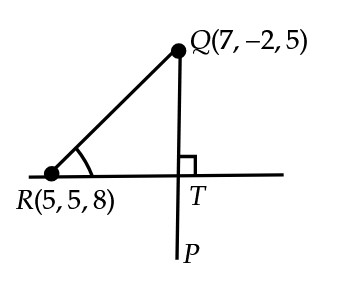
We are given point $ Q = (7, -2, 5) $, and line $ L: \frac{x - 1}{2} = \frac{y + 1}{3} = \frac{z}{4} $. Let point $ R = (5, p, q) $ lie on the line. We are to find the square of the area of triangle $ \triangle PQR $, where $ P $ is the image of $ Q $ in line $ L $.
Let a general point on line $ L $ be:
$
R(\lambda) = (2\lambda + 1, 3\lambda - 1, 4\lambda)
$
Since $ R = (5, p, q) $, equating:
$
2\lambda + 1 = 5 \Rightarrow \lambda = 2
\Rightarrow R = (5, 5, 8)
$
Let the foot of perpendicular from $ Q $ to line $ L $ be $ T = (2\lambda + 1, 3\lambda - 1, 4\lambda) $
Now, vector $ \vec{QT} = (2\lambda - 6)\hat{i} + (3\lambda + 1)\hat{j} + (4\lambda - 5)\hat{k} $
Direction vector of line $ L $ is $ \vec{b} = 2\hat{i} + 3\hat{j} + 4\hat{k} $
Using perpendicularity condition:
$
\vec{QT} \cdot \vec{b} = 0
$
$
(2\lambda - 6)(2) + (3\lambda + 1)(3) + (4\lambda - 5)(4) = 0
$
$
4\lambda - 12 + 9\lambda + 3 + 16\lambda - 20 = 0
\Rightarrow 29\lambda - 29 = 0 \Rightarrow \lambda = 1
$
Substitute $ \lambda = 1 $ to get:
$
T = (3, 2, 4)
$
Now, $ P $ is the reflection of $ Q $ in point $ T $:
$
P = 2T - Q = (6 - 7, 4 - (-2), 8 - 5) = (-1, 6, 3)
$
Now, find lengths $ QT $ and $ RT $:
$
|QT| = \sqrt{(3 - 7)^2 + (2 + 2)^2 + (4 - 5)^2} = \sqrt{16 + 16 + 1} = \sqrt{33}
$
$
|RT| = \sqrt{(5 - 3)^2 + (5 - 2)^2 + (8 - 4)^2} = \sqrt{4 + 9 + 16} = \sqrt{29}
$
Since $ QT \perp RT $, area of triangle is:
ar($\triangle QRT$)$ = \frac{1}{2} \cdot |QT| \cdot |RT| = \frac{1}{2} \cdot \sqrt{33} \cdot \sqrt{29}
$
Since P is the image of Q, then the areas above and below RT will be equal.
And the $ar(\triangle PQR)=2ar(\triangle QTR)$
$ar(\triangle PQR)=2 \times \frac{1}{2} \cdot \sqrt{33} \cdot \sqrt{29}$
$ar(\triangle PQR)= \sqrt{33} \cdot \sqrt{29}=\sqrt957$
$
\Rightarrow \text{Area}^2 = \left(\frac{1}{2} \cdot \sqrt{957}\right)^2 = 957
$
Hence, the answer is 957.
Question 4: If $\alpha=1 + \sum_{r=1}^6 {(-3)^{r-1}}.{^{12} \mathrm{C}_{2 \mathrm{r}-1}}$, then the distance of the point $(12, \sqrt{3})$ from the line $\alpha x-\sqrt{3} y+1=0$ is_____________.
1) 5
2) 2
3) 9
4) 10
Correct answer: (1)
Solution:
We are given:
$\alpha = 1 + \sum_{r=1}^6 (-3)^{r-1} \cdot {^{12}C_{2r - 1}}$
Let us simplify the sum:
This is a sum over all odd binomial coefficients of $^{12}C_k$ multiplied by powers of $-3$ starting from 0.
Let us define the sum:
$\sum_{r=1}^6 (-3)^{r-1} \cdot {^{12}C_{2r - 1}} = S$
Let’s compute $S = \sum_{r=1}^6 (-3)^{r-1} \cdot {^{12}C_{2r - 1}}$
Compute each term:
$r = 1$: $(-3)^0 \cdot {^{12}C_1} = 1 \cdot 12 = 12$
$r = 2$: $(-3)^1 \cdot {^{12}C_3} = (-3) \cdot 220 = -660$
$r = 3$: $(-3)^2 \cdot {^{12}C_5} = 9 \cdot 792 = 7128$
$r = 4$: $(-3)^3 \cdot {^{12}C_7} = (-27) \cdot 792 = -21384$
$r = 5$: $(-3)^4 \cdot {^{12}C_9} = 81 \cdot 220 = 17820$
$r = 6$: $(-3)^5 \cdot {^{12}C_{11}} = (-243) \cdot 12 = -2916$
Now sum all:
$S = 12 - 660 + 7128 - 21384 + 17820 - 2916 = 0$
So $\alpha = 1 + S = 1 + 0 = 1$
Now find the distance of point $(12, \sqrt{3})$ from line:
$\alpha x - \sqrt{3} y + 1 = 0 \Rightarrow x - \sqrt{3} y + 1 = 0$
Distance from point $(x_0, y_0)$ to line $ax + by + c = 0$ is:
$d = \frac{|ax_0 + by_0 + c|}{\sqrt{a^2 + b^2}}$
Here, $a = 1$, $b = -\sqrt{3}$, $c = 1$, $(x_0, y_0) = (12, \sqrt{3})$
$d = \frac{|1 \cdot 12 + (-\sqrt{3}) \cdot \sqrt{3} + 1|}{\sqrt{1^2 + (\sqrt{3})^2}} = \frac{|12 - 3 + 1|}{\sqrt{1 + 3}} = \frac{10}{2} = 5$
Hence, the answer is 5.
Question 5: Let $P$ be the foot of the perpendicular from the point $(1,2,2)$ on the line $L: \frac{x-1}{1}=\frac{y+1}{-1}=\frac{z-2}{2}$. Let the line $\overrightarrow{\mathrm{r}}=(-\hat{\mathrm{i}}+\hat{\mathrm{j}}-2 \hat{\mathrm{k}})+\lambda(\hat{\mathrm{i}}-\hat{\mathrm{j}}+\hat{\mathrm{k}}), \lambda \in \mathbf{R}$, intersect the line L at Q . Then $2(\mathrm{PQ})^2$ is equal to:
1) 27
2) 25
3) 29
4) 19
Correct answer: (1)
Solution:
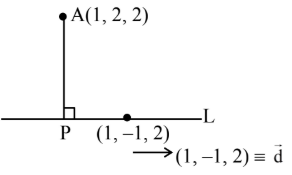
We are given:
- A point $ A = (1, 2, 2) $
- A line $ L: \frac{x - 1}{1} = \frac{y + 1}{-1} = \frac{z - 2}{2} = \mu $
- A second line: $ \vec{r} = (-\hat{i} + \hat{j} - 2\hat{k}) + \lambda(\hat{i} - \hat{j} + \hat{k}) $
Find the foot of perpendicular $ P $ from point $ A $ to line $ L $
Let a general point on $ L $ be:
$
P(\mu + 1, -\mu - 1, 2\mu + 2)
$
The direction vector of line $ L $ is $ \vec{d} = \langle 1, -1, 2 \rangle $
Vector $ \vec{AP} = \langle \mu + 1 - 1, -\mu - 1 - 2, 2\mu + 2 - 2 \rangle = \langle \mu, -\mu - 3, 2\mu \rangle $
Since $ \vec{AP} $ is perpendicular to direction vector $ \vec{d} $, their dot product must be zero:
$
\vec{AP} \cdot \vec{d} = \mu(1) + (-\mu - 3)(-1) + 2\mu(2) = \mu + \mu + 3 + 4\mu = 6\mu + 3 = 0
\Rightarrow \mu = -\frac{1}{2}
$
Now substitute $ \mu = -\frac{1}{2} $ into the coordinates of $ P $:
$
P = \left( \frac{-1}{2} + 1, -\left( -\frac{1}{2} \right) - 1, 2 \cdot \left( -\frac{1}{2} \right) + 2 \right)
= \left( \frac{1}{2}, -\frac{1}{2}, 1 \right)
$
Find point $ Q $, where the second line intersects line $ L $
General point on second line:
$
Q = (-1 + \lambda, 1 - \lambda, -2 + \lambda)
$
Let this point also lie on line $ L $, whose general point is:
$
(x, y, z) = (\mu + 1, -\mu - 1, 2\mu + 2)
$
Equating:
$
\mu + 1 = -1 + \lambda \Rightarrow \mu = \lambda - 2 \tag{1}
$
$
-\mu - 1 = 1 - \lambda \Rightarrow \mu = \lambda - 2 \tag{2}
$
$
2\mu + 2 = -2 + \lambda \Rightarrow 2(\lambda - 2) + 2 = -2 + \lambda
$
$
2\lambda - 4 + 2 = -2 + \lambda \Rightarrow 2\lambda - 2 = -2 + \lambda
\Rightarrow \lambda = 0
\Rightarrow \mu = -2
$
Substitute back:
$
Q = (-1 + 0, 1 - 0, -2 + 0) = (-1, 1, -2)
$
Compute the distance $ PQ $
$
\vec{PQ} = \langle -1 - \tfrac{1}{2}, 1 - (-\tfrac{1}{2}), -2 - 1 \rangle
= \left\langle -\tfrac{3}{2}, \tfrac{3}{2}, -3 \right\rangle
$
$
PQ^2 = \left( \tfrac{3}{2} \right)^2 + \left( \tfrac{3}{2} \right)^2 + 9 = \tfrac{9}{4} + \tfrac{9}{4} + 9 = \tfrac{18}{4} + 9 = \tfrac{54}{4}
$
$
2(PQ)^2 = 2 \cdot \frac{54}{4} = 27
$
Hence, the correct answer is option (1).
Question 6: If the equation of the line passing through the point $\left(0,-\frac{1}{2}, 0\right)$ and perpendicular to the lines $\overrightarrow{\mathrm{r}}=\lambda(\hat{\mathrm{i}}+a \hat{\mathrm{j}}+b \hat{\mathrm{k}})$ and $\overrightarrow{\mathrm{r}}=(\hat{\mathrm{i}}-\hat{\mathrm{j}}-6 \hat{\mathrm{k}})+\mu(-b \hat{\mathrm{i}}+a \hat{\mathrm{j}}+5 \hat{\mathrm{k}})$ is $\frac{x-1}{-2}=\frac{y+4}{d}=\frac{z-c}{-4}$, then $a+b+c+d$ is equal to :
1) 10
2) 14
3) 13
4) 12
Correct answer: (2)
Solution:
Direction ratios of the given line are $-2, d$, and -4
$\Rightarrow-2+a d-4 b=0$
and $2 b+a d-20=0$
subtracting equations (i) and (ii)
$\begin{aligned}
& 6 b-18=0 \\
& b=3
\end{aligned}$
also, line passes through the point $\left(0, \frac{-1}{2}, 0\right)$
$\begin{aligned}
& \Rightarrow \frac{0-1}{-2}=\frac{-\frac{1}{2}+4}{d}=\frac{0-c}{-4} \\
& \Rightarrow d=7, c=2
\end{aligned}$
From equation (i)
$\begin{aligned}
& -2+7 a-12=0 \\
& \Rightarrow a=2 \\
& a+b+c+d=14
\end{aligned}$
Hence, the correct answer is option (2).
Question 7: If the image of the point $\mathrm{P}(1,0,3)$ in the line joining the points $\mathrm{A}(4,7,1)$ and $\mathrm{B}(3,5,3)$ is $Q(\alpha, \beta, \gamma)$, then $\alpha+\beta+\gamma$ is equal to
1) $\frac{47}{3}$
2) $\frac{46}{3}$
3) 18
4) 13
Correct answer: (2)
Solution:
Given:
$P(1, 0, 3), \quad A(4, 7, 1), \quad B(3, 5, 3)$
Direction ratios of line $AB = B - A = (-1, -2, 2)$
Parametric form of line $AB:
\quad x = \lambda + 3, \quad y = 2\lambda + 5, \quad z = -2\lambda + 3$
Let foot of perpendicular from P to line AB be $R(\lambda + 3, 2\lambda + 5, -2\lambda + 3)$
Vector $\overrightarrow{PR} = \langle \lambda + 2, 2\lambda + 5, -2\lambda \rangle$
Direction vector of line $AB = \langle 1, 2, -2 \rangle$
Dot product must be zero: $\overrightarrow{PR} \cdot \vec{d}_{AB} = 0$
$\Rightarrow (\lambda + 2)(1) + (2\lambda + 5)(2) + (-2\lambda)(-2) = 0$
$\Rightarrow \lambda + 2 + 4\lambda + 10 + 4\lambda = 0$
$\Rightarrow 9\lambda + 12 = 0 \Rightarrow \lambda = -\frac{4}{3}$
Coordinates of foot $R:
\quad x = \frac{5}{3}, \quad y = \frac{7}{3}, \quad z = \frac{17}{3}$
Image of P about point R is:
$Q = 2R - P = \left( \frac{10}{3} - 1, \frac{14}{3} - 0, \frac{34}{3} - 3 \right) = \left( \frac{7}{3}, \frac{14}{3}, \frac{25}{3} \right)$
$\Rightarrow \alpha + \beta + \gamma = \frac{7 + 14 + 25}{3} = \frac{46}{3}$
Hence, the correct answer is option (2).
Question 8: Let the line L pass through $(1,1,1)$ and intersect the lines $\frac{x-1}{2}=\frac{y+1}{3}=\frac{z-1}{4}$ and $\frac{x-3}{1}=\frac{y-4}{2}=\frac{z}{1}$ Then, which of the following points lies on the line L ?
1) $(4,22,7)$
2) $(5,4,3)$
3) $(10,-29,-50)$
4) $(7,15,13)$
Correct answer: (4)
Solution:
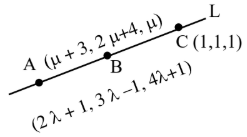
Dr's of $\mathrm{AC} \Rightarrow 2 \lambda, 3 \lambda-2,4 \lambda$
Dr's of BC $\Rightarrow \mu+2,2 \mu+3, \mu-1$
$\Rightarrow \frac{\mu+2}{2 \lambda}=\frac{2 \mu+3}{3 \lambda-2}=\frac{\mu-1}{4 \lambda}$
$\Rightarrow 2(\mu+2)=\mu-1 \Rightarrow \mu=-5$
$\Rightarrow$ Dr's of $\mathrm{BC} \Rightarrow 3,7,6$
$\Rightarrow$ equation of $L \Rightarrow \frac{x-1}{3}=\frac{y-1}{7}=\frac{z-1}{6}$
$(7,15,13)$ satisfies.
Hence, the correct answer is option (4).
Question 9: If the image of the point $(4,4,3)$ in the line $\frac{x-1}{2}=\frac{y-2}{1}=\frac{z-1}{3}$ is $(\alpha, \beta, \gamma)$, then $\alpha+\beta+\gamma$ is equal to:
1) 9
2) 12
3) 8
4) 7
Correct answer: (1)
Solution:
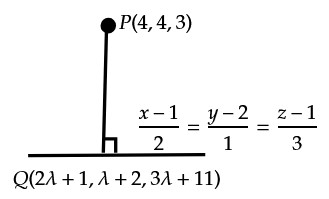
Given the point $P = (4,4,3)$ and the line
$
\frac{x-1}{2} = \frac{y-2}{1} = \frac{z-1}{3},
$
let the image of $P$ in the line be $R(\alpha, \beta, \gamma)$.
The direction vector of the line is
$
\vec{d} = 2\hat{i} + \hat{j} + 3\hat{k}.
$
Let the foot of the perpendicular from $P$ on the line be
$
Q = (1 + 2\lambda, 2 + \lambda, 1 + 3\lambda).
$
Since $\overrightarrow{P Q}$ is perpendicular to $\vec{d}$, we have:
$
\overrightarrow{P Q} \cdot \vec{d} = 0,
$
where
$
\overrightarrow{P Q} = (1 + 2\lambda - 4,\, 2 + \lambda - 4,\, 1 + 3\lambda - 3) = (2\lambda - 3,\, \lambda - 2,\, 3\lambda - 2).
$
Calculate the dot product:
$
2(2\lambda - 3) + 1(\lambda - 2) + 3(3\lambda - 2) = 0,
$
which simplifies to:
$
4\lambda - 6 + \lambda - 2 + 9\lambda - 6 = 0,
$
$
14 \lambda - 14 = 0 \implies \lambda = 1.
$
Substitute $\lambda = 1$ back into $Q$:
$
Q = (1 + 2 \times 1,\, 2 + 1,\, 1 + 3 \times 1) = (3,3,4).
$
Since $R$ is the image of $P$ in the line with foot $Q$, $Q$ is the midpoint of segment $P R$, so:
$
\frac{\alpha + 4}{2} = 3, \quad \frac{\beta + 4}{2} = 3, \quad \frac{\gamma + 3}{2} = 4.
$
Solving for $\alpha, \beta, \gamma$:
$
\alpha + 4 = 6 \implies \alpha = 2,
$
$
\beta + 4 = 6 \implies \beta = 2,
$
$
\gamma + 3 = 8 \implies \gamma = 5.
$
Therefore,
$
\alpha + \beta + \gamma = 2 + 2 + 5 = 9.
$
Hence, the correct answer is option (1).
Question 10: The line $L_{1}$ is parallel to the vector $\vec{a}=-3 \hat{i}+2 \hat{j}+4 \hat{k}$ and passes through the point $(7,6,2)$ and the line $L_{2}$ is parallel to the vector $\overrightarrow{\mathrm{b}}=2 \hat{\mathrm{i}}+\hat{\mathrm{j}}+3 \hat{\mathrm{k}}$ and passes through the point $(5,3,4)$. The shortest distance between the lines $L_{1}$ and $L_{2}$ is :
1) $\frac{23}{\sqrt{38}}$
2) $\frac{21}{\sqrt{57}}$
3) $\frac{23}{\sqrt{57}}$
4) $\frac{21}{\sqrt{38}}$
Correct answer: (1)
Solution:
Given:
Line $L_1$ passes through the point $B(7,6,2)$ and is parallel to the vector $\vec{a} = -3\hat{i} + 2\hat{j} + 4\hat{k}$
Line $L_2$ passes through the point $A(5,3,4)$ and is parallel to the vector $\vec{b} = 2\hat{i} + \hat{j} + 3\hat{k}$
To find: The shortest distance between lines $L_1$ and $L_2$.
Use the formula,
$
\text{Distance} = \frac{|(\vec{b} \times \vec{a}) \cdot \vec{AB}|}{|\vec{b} \times \vec{a}|}
$
Find $\vec{AB}$
$
\vec{AB} = \vec{B}-\vec{A} = (7 - 5)\hat{i} + (6 - 3)\hat{j} + (2 - 4)\hat{k} = 2\hat{i} + 3\hat{j} - 2\hat{k}
$
Calculate $\vec{b} \times \vec{a}$
$
\vec{b} \times \vec{a} =
\begin{vmatrix}
\hat{i} & \hat{j} & \hat{k} \\
2 & 1 & 3 \\
-3 & 2 & 4
\end{vmatrix}
= \hat{i}(1 \cdot 4 - 3 \cdot 2) - \hat{j}(2 \cdot 4 - 3 \cdot (-3)) + \hat{k}(2 \cdot 2 - 1 \cdot (-3))
$
$
= \hat{i}(4 - 6) - \hat{j}(8 + 9) + \hat{k}(4 + 3) = -2\hat{i} -17\hat{j} + 7\hat{k}
$
Similarly, find the dot product $(\vec{b} \times \vec{a}) \cdot \vec{AB}$
$
(-2\hat{i} -17\hat{j} + 7\hat{k}) \cdot (2\hat{i} + 3\hat{j} - 2\hat{k}) = (-2)(2) + (-17)(3) + (7)(-2)
$
$
= -4 - 51 - 14 = -69
$
Now find, $|\vec{b} \times \vec{a}|$
$
|\vec{b} \times \vec{a}| = \sqrt{(-2)^2 + (-17)^2 + 7^2} = \sqrt{4 + 289 + 49} = \sqrt{342}
$
Calculate the shortest distance
$
\text{Distance} = \frac{|-69|}{\sqrt{342}} = \frac{69}{\sqrt{342}}
$
On simplifying,
$
\text{Distance} = \frac{23}{\sqrt{38}}\text{ units}
$
Hence, the correct answer is option (1).
Question 11: The shortest distance between the curves $\mathrm{y}^2=8 \mathrm{x}$ and $x^2+y^2+12 y+35=0$ is :
1) $2 \sqrt{3}-1$
2) $\sqrt{2}$
3) $3 \sqrt{2}-1$
4) $2 \sqrt{2}-1$
Correct answer: (4)
Solution:
Equation of normal:
$y=m x-2 a m-a m^3 \quad(a=2)$ $y=m x-4 m-2 m^3$
Centre of circle: $C(0,-6)$, radius $=1$
$\begin{aligned}
& -6=-4 m-2 m^3 \\
& \Rightarrow m=1 \\
& P\left(a m^2,-2 a m\right) \\
& =P(2,-4)
\end{aligned}$
Shortest distance:
$CP - r$
$\begin{aligned}
& =\sqrt{4+4}-1 \\
& =2 \sqrt{2}-1 \text{ units}
\end{aligned}$
Hence, the correct answer is option (4).
Question 12: The distance of the point $(7,10,11)$ from the line $\frac{x-4}{1}=\frac{y-4}{0}=\frac{z-2}{3}$ along the line $\frac{x-9}{2}=\frac{y-13}{3}=\frac{z-17}{6}$ is
1) 18
2) 14
3) 12
4) 16
Correct answer: (2)
Solution:
Equation of line passing through $P(7,10,11)$ along the line $\frac{x-9}{2}=\frac{y-13}{3}=\frac{z-17}{6}$ is
$\frac{x-7}{2}=\frac{y-10}{3}=\frac{z-11}{6}=\lambda$
Let the point on the line be
$Q(2 \lambda+7,3 \lambda+10,6 \lambda+11)$
$Q$ lies on line $\frac{x-4}{1}=\frac{y-4}{0}=\frac{z-2}{3}$
$\begin{aligned}
& 3 \lambda+10=4 \Rightarrow \lambda=-2 \\
& \therefore \quad Q(3,4,-1) \\
& P Q=\sqrt{16+36+144}=14 \text{ units}
\end{aligned}$
Hence, the correct answer is option (2).
Question 13: Let the shortest distance between the lines $\frac{x-3}{3}=\frac{y-\alpha}{-1}=\frac{z-3}{1}$ and $\frac{x+3}{-3}=\frac{y+7}{2}=\frac{z-\beta}{4}$ be $3 \sqrt{30}$. Then the positive value of $5 \alpha+\beta$ is
1) 42
2) 46
3) 48
4) 40
Correct answer: (2)
Solution:
$\mathrm{A}(3, \alpha, 3)$ and $B(-3,-7, \beta)$
Given lines:
$
L_1: \frac{x-3}{3} = \frac{y-\alpha}{-1} = \frac{z-3}{1}
$
$
L_2: \frac{x+3}{-3} = \frac{y+7}{2} = \frac{z-\beta}{4}
$
Direction vectors:
$
\vec{d_1} = \langle 3, -1, 1 \rangle, \quad \vec{d_2} = \langle -3, 2, 4 \rangle
$
Points on each line:
$
\vec{P_1} = (3, \alpha, 3), \quad \vec{P_2} = (-3, -7, \beta)$
Shortest distance between skew lines:
$
D = \frac{|(\vec{P_2} - \vec{P_1}) \cdot (\vec{d_1} \times \vec{d_2})|}{|\vec{d_1} \times \vec{d_2}|}
$
Calculate $\vec{P_2} - \vec{P_1}$:
$
\vec{P_2} - \vec{P_1} = (-3 - 3, -7 - \alpha, \beta - 3) = (-6, -7 - \alpha, \beta - 3)
$
Calculate $\vec{d_1} \times \vec{d_2}$:
$
\vec{d_1} \times \vec{d_2} =
\begin{vmatrix}
\mathbf{i} & \mathbf{j} & \mathbf{k} \\
3 & -1 & 1 \\
-3 & 2 & 4 \\
\end{vmatrix}
= \mathbf{i}((-1)(4) - 1 \cdot 2) - \mathbf{j}(3 \cdot 4 - 1 \cdot (-3)) + \mathbf{k}(3 \cdot 2 - (-1)(-3))
$
$
= \mathbf{i}(-4 - 2) - \mathbf{j}(12 + 3) + \mathbf{k}(6 - 3)
= \mathbf{i}(-6) - \mathbf{j}(15) + \mathbf{k}(3)
= \langle -6, -15, 3 \rangle
$
Magnitude of $\vec{d_1} \times \vec{d_2}$:
$
|\vec{d_1} \times \vec{d_2}| = \sqrt{(-6)^2 + (-15)^2 + 3^2} = \sqrt{36 + 225 + 9} = \sqrt{270} = 3 \sqrt{30}
$
Calculate the numerator $|(\vec{P_2} - \vec{P_1}) \cdot (\vec{d_1} \times \vec{d_2})|:$
$
= |(-6)(-6) + (-7 - \alpha)(-15) + (\beta - 3)(3)|
= |36 + 15(7 + \alpha) + 3(\beta - 3)|
$
$
= |36 + 105 + 15 \alpha + 3 \beta - 9|
= |132 + 15 \alpha + 3 \beta|
$
Given shortest distance $D = 3 \sqrt{30}$, so:
$
D = \frac{|132 + 15 \alpha + 3 \beta|}{3 \sqrt{30}} = 3 \sqrt{30}
$
Multiply both sides by $3 \sqrt{30}$:
$
|132 + 15 \alpha + 3 \beta| = 9 \times 30 = 270
$
Divide both sides by 3:
$
|44 + 5 \alpha + \beta| = 90
$
So,
$
44 + 5 \alpha + \beta = \pm 90
$
Solve for $5\alpha + \beta$:
1. If
$
44 + 5 \alpha + \beta = 90 \implies 5 \alpha + \beta = 46
$
2. If
$
44 + 5 \alpha + \beta = -90 \implies 5 \alpha + \beta = -134
$
Positive value of $5 \alpha + \beta$ is $46$.
Hence, the correct answer is option (2).
Question 14: Consider the lines $\mathrm{x}(3 \lambda+1)+\mathrm{y}(7 \lambda+2)=17 \lambda+5$, $\lambda$ being a parameter, all passing through a point P . One of these lines (say L) is farthest from the origin. If the distance of L from the point $(3,6)$ is $d$, then the value of $d^2$ is
1) 20
2) 30
3) 10
4) 15
Correct answer: (1)
Solution:
$x(3 \lambda+1)+y(7 \lambda+2)=17 \lambda+5$
$\Rightarrow 3 x \lambda+x+7 y \lambda+2 y=17 \lambda+5$
$\Rightarrow \lambda(3 x+7 y-17)+(x+2 y-5)=0$
For the equation to hold for all $\lambda$, the coefficients of $\lambda$ and the constant term must be zero
$3 x+7 y-17=0$
$x+2 y-5=0$
$-3 x-6 y+15=0$
$y-2=0$, so $y=2$
Substitute $y=2$
$x+2 y-5=0\Rightarrow x+4-5=0$, so $x=1$
The point $P$ is $(1,2)$.
The line farthest from the origin is perpendicular to the line connecting the origin and $P$.
The slope of the line connecting the origin and P is $\frac{2-0}{1-0}=2$.
The slope of the perpendicular line L is $-\frac{1}{2}$.
The equation of line $L$ passing through $(1,2)$ with slope $-\frac{1}{2}$ is:
$y-2=-\frac{1}{2}(x-1)$
$2y-4=-x+1$
$x+2 y-5=0$
The distance from $(3,6)$ to $x+2 y-5=0$
$d=\frac{|1(3)+2(6)-5|}{\sqrt{1^2+2^2}}$
$d=\frac{|3+12-5|}{\sqrt{5}}$
$d=\frac{10}{\sqrt{5}}$
$
\begin{aligned}
d^2 & =\left(\frac{10}{\sqrt{5}}\right)^2 \\
d^2 & =\frac{100}{5} \\
d^2 & =20
\end{aligned}
$
Hence, the answer is option (1).
Question 15: Let $P$ be the foot of the perpendicular from the point $\mathrm{Q}(10,-3,-1)$ on the line $\frac{\mathrm{x}-3}{7}=\frac{\mathrm{y}-2}{-1}=\frac{\mathrm{z}+1}{-2}$. Then the area of the right angled triangle $P Q R$, where $R$ is the point $(3,-2,1)$, is
1) $9 \sqrt{15}$
2) $\sqrt{30}$
3) $8\sqrt{15}$
4) $3\sqrt{30}$
Correct answer: (4)
Solution:
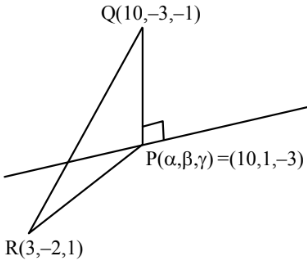
Given: Point $ Q(10, -3, -1) $ and line
$
\frac{x - 3}{7} = \frac{y - 2}{-1} = \frac{z + 1}{-2}.
$
Let this common ratio be $ \lambda $. Then the coordinates of a general point $ P $ on the line are:
$
P = (3 + 7\lambda,\ 2 - \lambda,\ -1 - 2\lambda).
$
Now, vector $ \overrightarrow{PQ} = \vec{Q} - \vec{P} $:
$
\overrightarrow{PQ} = \left(10 - (3 + 7\lambda),\ -3 - (2 - \lambda),\ -1 - (-1 - 2\lambda)\right)
= (7 - 7\lambda,\ -5 + \lambda,\ 2\lambda).
$
Direction vector of the line is $ \vec{d} = \langle 7, -1, -2 \rangle $.
Since $ \overrightarrow{PQ} \perp \vec{d} $, their dot product is zero:
$
(7 - 7\lambda)(7) + (-5 + \lambda)(-1) + (2\lambda)(-2) = 0
$
$
49 - 49\lambda + 5 - \lambda - 4\lambda = 0
$
$
(49 + 5) - (49\lambda + \lambda + 4\lambda) = 0
\Rightarrow 54 - 54\lambda = 0
\Rightarrow \lambda = 1
$
Substitute $ \lambda = 1 $ into point $ P $:
$
P = (3 + 7, 2 - 1, -1 - 2) = (10, 1, -3)
$
So, coordinates of $ P = (10, 1, -3) $, $ Q = (10, -3, -1) $, $ R = (3, -2, 1) $.
Now find vectors:
$
\overrightarrow{PQ} = Q - P = (0, -4, 2), \quad \overrightarrow{PR} = R - P = (-7, -3, 4)
$
Now use the cross product to find area:
$
\vec{A} = \overrightarrow{PQ} \times \overrightarrow{PR}
=
\begin{vmatrix}
\hat{i} & \hat{j} & \hat{k} \\
0 & -4 & 2 \\
-7 & -3 & 4
\end{vmatrix}
= \hat{i}( -4 \cdot 4 - 2 \cdot (-3)) - \hat{j}(0 \cdot 4 - 2 \cdot (-7)) + \hat{k}(0 \cdot (-3) - (-4) \cdot (-7))
$
$
= \hat{i}(-16 + 6) - \hat{j}(0 + 14) + \hat{k}(0 - 28)
= \langle -10, -14, -28 \rangle
$
Magnitude of cross product:
$
|\vec{A}| = \sqrt{(-10)^2 + (-14)^2 + (-28)^2} = \sqrt{100 + 196 + 784} = \sqrt{1080}
$
Area of triangle:
$
\text{Area} = \frac{1}{2} \cdot |\vec{A}| = \frac{1}{2} \sqrt{1080} = \frac{\sqrt{1080}}{2}
$
Simplify:
$
\sqrt{1080} = \sqrt{36 \cdot 30} = 6\sqrt{30}
\Rightarrow \text{Area} = \frac{6\sqrt{30}}{2} = 3\sqrt{30} \text{ sq. units}
$
Hence, the answer is the option (4).
Important Formulas of Three-Dimensional Geometry for JEE Main
1. Direction Cosines (1, m, n) of a line: $1^2+m^2+n^2=1$
2. Direction Ratios (a, b, c) to Direction Cosines: $1=\mathrm{a} / \sqrt{ }\left(\mathrm{a}^2+\mathrm{b}^2+\mathrm{c}^2\right), \mathrm{m}=\mathrm{b} / \sqrt{ }\left(\mathrm{a}^2+\mathrm{b}^2+\mathrm{c}^2\right), \mathrm{n}=$ $\mathrm{c} / \sqrt{ }\left(\mathrm{a}^2+\mathrm{b}^2+\mathrm{c}^2\right)$
3. Equation of a line through a point $\left(x_1, y_1, z_1\right)$ with direction ratios $(a, b, c):\left(x-x_1\right) / a=$ $\left(\mathrm{y}-\mathrm{y}_1\right) / \mathrm{b}=\left(\mathrm{z}-\mathrm{z}_1\right) / \mathrm{c}$
4. Angle between two lines with direction ratios $\left(\mathbf{a}_1, \mathbf{b}_1, \mathbf{c}_1\right)$ and $\left(\mathbf{a}_2, \mathbf{b}_2, \mathbf{c}_2\right): \cos \theta=\mid \mathbf{a}_1 \mathbf{a}_2+$ $\mathrm{b}_1 \mathrm{~b}_2+\mathrm{c}_1 \mathrm{c}_2 / /\left[\sqrt{ }\left(\mathrm{a}_1{ }^2+\mathrm{b}_1{ }^2+\mathrm{c}_1{ }^2\right) \cdot \sqrt{ }\left(\mathrm{a}_2{ }^2+\mathrm{b}_2{ }^2+\mathrm{c}_2{ }^2\right)\right]$
5. Shortest distance between two skew lines (using position vectors and direction vectors): $d=\left|\left(b_1 \times b_2\right) \cdot\left(a_2-a_1\right)\right| /\left|b_1 \times b_2\right|$
6. Equation of a plane (normal form): $\mathrm{ax}+\mathrm{by}+\mathrm{cz}=\mathrm{d}$, where (a, b, c) are direction ratios of the normal
7. Distance of point $\left(\mathbf{x}_{\mathbf{1}}, \mathbf{y}_{\mathbf{1}}, \mathbf{z}_{\mathbf{1}}\right)$ from plane $\mathbf{a x}+\mathbf{b y}+\mathbf{c z}+\mathbf{d}=\mathbf{0}: \mathbf{D}=\left|\mathrm{ax}_1+\mathrm{by}_1+\mathrm{cz}_1+\mathrm{d}\right| /$ $\sqrt{ }\left(\mathrm{a}^2+\mathrm{b}^2+\mathrm{c}^2\right)$
8. Angle between two planes with normals $\left(\mathbf{a}_{\mathbf{1}}, \mathbf{b}_{\mathbf{1}}, \mathbf{c}_{\mathbf{1}}\right)$ and $\left(\mathbf{a}_{\mathbf{2}}, \mathbf{b}_{\mathbf{2}}, \mathbf{c}_{\mathbf{2}}\right): \cos \theta=\mid \mathrm{a}_{\mathbf{1}} \mathrm{a}_{\mathbf{2}}+\mathrm{b}_{\mathbf{1}} \mathrm{b}_2+$ $\mathrm{c}_1 \mathrm{c}_2 \mid /\left[\sqrt{ }\left(\mathrm{a}_1{ }^2+\mathrm{b}_1{ }^2+\mathrm{c}_1{ }^2\right) \cdot \sqrt{ }\left(\mathrm{a}_2{ }^2+\mathrm{b}_2{ }^2+\mathrm{c}_2{ }^2\right)\right]$
9. Condition for coplanarity of two lines through points A and B with direction vectors $\mathrm{b}_1$ and $\mathrm{b}_2:(\mathrm{AB}) \cdot\left(\mathrm{b}_1 \times \mathrm{b}_2\right)=0$
Also Read: JEE Mains 2027: Maths Set of 5 Sample Paper with Solution
Weightage of 3D Geometry in JEE Main 2026
Based on the 2026 exam analysis, 3D Geometry contributes 6.11% weightage in the JEE Main maths paper. In practical terms, 2-3 questions appear in most of the shifts of the exam and around 29 overall in both sessions, worth roughly 8 to 12 marks out of the 100 marks allotted to Maths.
|
Session |
Total Questions Asked |
Approx. Marks |
Weightage |
|
January 2026 |
13 |
52 Marks |
5.20% |
|
April 2026 |
16 |
64 Marks |
6.40% |
|
Overall (2026) |
29 Questions |
116 Marks |
6.11% |
Topic-Wise Weightage and Number of Questions
The table below shows the topic-wise distribution of questions from the Three-Dimensional Geometry chapter in the January and April sessions of the JEE Main 2026 exam.
|
Topic |
January Session |
April Session |
Total Questions |
|
3 |
3 |
6 | |
|
Section Formula, Direction Cosines, and Direction Ratios |
3 |
0 |
3 |
|
3 |
3 |
6 | |
|
2 |
4 |
6 | |
|
2 |
4 |
6 | |
|
0 |
1 |
1 | |
|
Intersection of a Line and a Plane |
0 |
1 |
1 |
|
Total |
13 |
16 |
29 |
JEE Main Syllabus: Subjects & Chapters
Select your preferred subject to view the chapters
Last 10 Years' Weightage of Three-Dimensional Geometry in JEE Main
The 3D geometry chapter question has appeared constantly over the past 10 years and has remained an important topic of JEE Main, with questions frequently appearing from Equations of a line, shortest distance between two lines, image of a point, and perpendicular distance.
|
Three-Dimensional Geometry Topic |
Questions Asked |
|
Shortest Distance Between Two Lines |
40 |
|
24 | |
|
Intersection of Line and Plane |
24 |
|
Distance of a Point from a Plane |
21 |
|
Equations for a Line in Space |
21 |
|
Image of a Point in the Plane |
20 |
|
Equation of a Plane Passing Through Three Non-Collinear Points |
17 |
|
Perpendicular Distance Between a Point and a Line |
17 |
|
Equation of a Plane Perpendicular to a Given Vector and Passing Through a Given Point |
16 |
|
Line of Intersection of Two Planes and Angle Between a Line and a Plane |
14 |
Confused About College Admissions?
Get expert advice on college selection, admission chances, and career path in a personalized counselling session.
Book a Counselling Slot
Select Date
Pick a Slot
Frequently Asked Questions (FAQs)
Q: What are the important topics of 3D Geometry for JEE Main?
A:
The important topics of 3D geometry for JEE Main are:
- Direction Cosines and Direction Ratios of a line.
- Equation of a Line in space (Cartesian and Vector forms).
- Angle between two lines.
- Shortest Distance between two skew lines (and distance between parallel lines).
- Equation of a Plane in various forms.
- Intersection of a Line and a Plane.
- Coplanarity of two lines.
- Angle between a line and a plane / Angle between two planes.
- Distance of a point from a plane.
- Image of a point
Q: How many questions appear in JEE Main from 3D geometry?
A:
1 to 2 questions are generally appear from 3D geometry in every shift in the JEE Main exam.
Q: What is the weightage of 3D Geometry in the JEE Main Mathematics section?
A:
3D Geometry is one of the highest-scoring and most reliable units in JEE Main Mathematics. On average, 2 to 3 questions (worth 8 to 12 marks) are asked from this chapter in every shift.
Q: Write most important formulas I must memorize for 3D Geometry
A:
- Distance between two points: $\sqrt{(x_2-x_1)^2 + (y_2-y_1)^2 + (z_2-z_1)^2}$
- Direction Cosines & Ratios: $l^2 + m^2 + n^2 = 1$, where $\frac{a}{\sqrt{a^2+b^2+c^2}} = l$, etc.
- Equation of a Line: $\frac{x-x_1}{a} = \frac{y-y_1}{b} = \frac{z-z_1}{c}$
- Shortest Distance between two skew lines: $\left|\frac{(\vec{b}_1 \times \vec{b}_2) \cdot (\vec{a}_2 - \vec{a}_1)}{|\vec{b}_1 \times \vec{b}_2|}\right|$
- Equation of a Plane: $Ax + By + Cz + D = 0$
- Perpendicular distance from a point $(x_1, y_1, z_1)$ to a plane: $\frac{|Ax_1 + By_1 + Cz_1 + D|}{\sqrt{A^2 + B^2 + C^2}}$
- Angle between two planes: $\cos\theta = \frac{A_1A_2 + B_1B_2 + C_1C_2}{\sqrt{A_1^2+B_1^2+C_1^2}\sqrt{A_2^2+B_2^2+C_2^2}}$
Articles
Related Stories
|
Upcoming Engineering Exams

Certifications By Top Providers
Explore Top Universities Across Globe
Popular Courses and Specializations
List of colleges accepting JEE Main
Browse Engineering Colleges by State
Questions related to JEE Main
On Question asked by student community
Have a question related to JEE Main ?
Hello Student,
You can access JEE Main Mathematics previous years' question papers through the Careers360 resource below. It includes previous years’ papers for practice and preparation.
https://engineering.careers360.com/articles/jee-main-question-papers
Hope this helps!
Hello Student, the eligibility criteria are different from the score or percentile required for admission. Your Class 12 subjects, passing year and applicable eligibility rules are important. If you mean the minimum score or percentile required for admission, please specify the college or course you are targeting.
Hello Student,
You can check the JEE Main and JEE Advanced exam patterns on Careers360 using the resources below:
Hope this Helps!
You may be able to register/appear for JEE without having the certificate immediately, depending on the application rules for that year. However, if you claim a reserved category, the required certificate must be available within the prescribed deadline for counselling/admission. If you fail to produce a valid certificate when required,
Hello Student,
The “Download Link” mentioned in the JEE Main 2027 Important Notes and Formulas eBook may not be clickable in the PDF. Please try opening the eBook on a different PDF reader or device.
If the link is still not opening, please share a screenshot of the page where

B.Tech/B.Arch Admissions OPEN
Among top 100 Universities Globally in the Times Higher Education (THE) Interdisciplinary Science Rankings 2026
GMRIT Deemed to be University B.Tech Admissions 2026
Apply100+ Recruiters | 1200+ Placements of 2026 Batch | NBA & NAAC Accredited | Highest CTC 37 LPA
Manav Rachna-B.Tech Admissions 2026
ApplyNAAC A++ Grade | Recognized as Category-1 Deemed to be University by UGC | 41,000 + Alumni Imprints Globally
Integral University B.Tech Admissions 2026
ApplyNAAC A+ Accredited | Highest CTC 45 LPA | Scholarships Available
East Point College of Engineering & Tech. Admissions 2026
ApplyApply for B.E at East Point College of Engineering and Technology | Affiliated to VTU | AICTE Approved | NBA Accredited | Highest CTC 33 LPA
Parul University B-TECH Admissions 2026
ApplyIndia's youngest NAAC A++ accredited University | NIRF rank band 151-200 | 2200 Recruiters | 45.98 Lakhs Highest Package
JEE Main Notifications
Explore Career Options
By IndustryNever miss JEE Main update
Get timely JEE Main updates directly to your inbox. Stay informed!