School Of Advanced Engineering, UPES, Dehradun
Ranked #43 among Engineering colleges in India by NIRF | Get Upto 100% Scholarships


The official notification for the GATE 2027 exam is now out; aspirants across every engineering branch are already working through a GATE 2027 revised syllabus that brings a few meaningful changes to the exam pattern they might have assumed. The change of syllabus can be confusing because the old coaching notes, the suggestions from previous batches, and even some PYQs suddenly need re-evaluation. Still, it doesn’t really have to affect your preparation completely if you stay a bit flexible and don't panic.
This Story also Contains
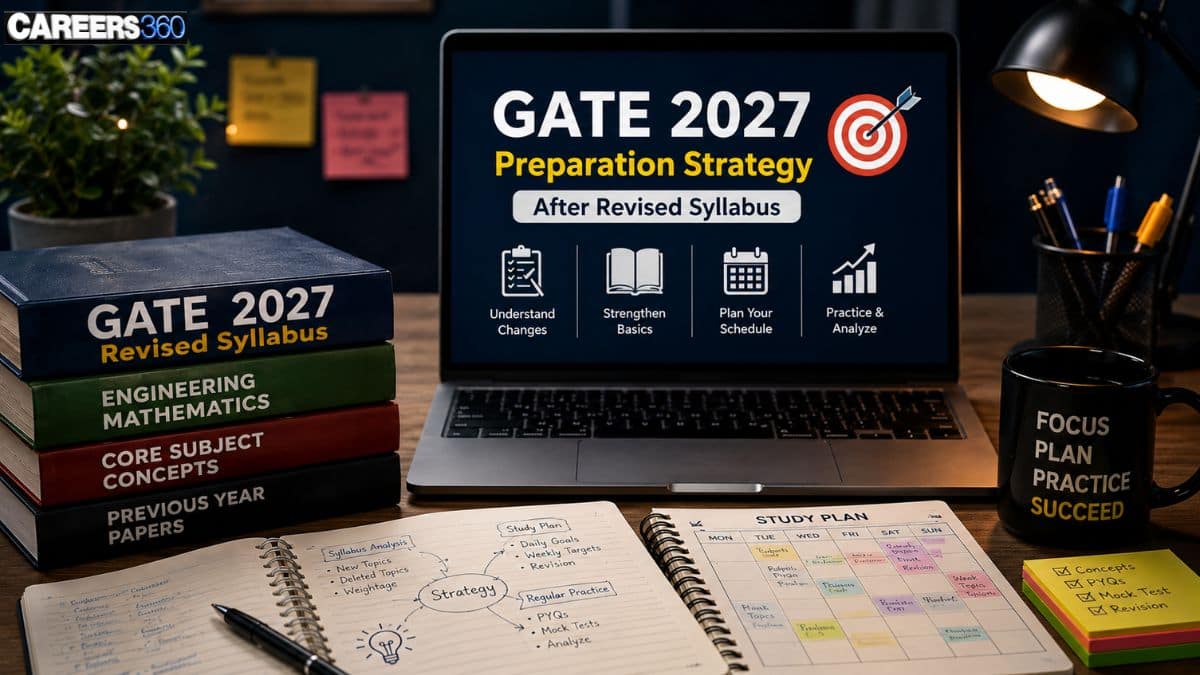
In this article, we will provide you with a structured GATE 2027 preparation strategy built specifically around the updated topics, rather than a generic plan copied from last year’s toppers.
Also Read: GATE 2027 Robotics & Automation (RA): Best Books, Syllabus & Preparation Plan
The GATE 2027 latest syllabus doesn’t really change every single branch in the same way. A few subjects stayed mostly untouched, but other parts have got some new insertions as well as deletions too. Here’s the branch-wise data on what seems to have changed and where not all of it is equally affected.
Added: Statistical independence in engineering mathematics, principles of virtual work, and tertiary wastewater treatment.
Removed: Remote Sensing and GIS have been dropped from the Survey section.
Ranked #43 among Engineering colleges in India by NIRF | Get Upto 100% Scholarships
Diploma (17 Specializations), B.Tech / B.Tech (Hons.) / IE-B.Tech - 4 years - 25+ specializations | M. Tech - 14+ specializations | Highest CTC – 60 LPA
Removed: Several networking protocols, including ARP, DHCP, and SMTP, no longer feature explicitly.
Added: Socket API in Computer Networks.
Added: Two-degree-of-freedom (2-DOF) vibration systems and additive manufacturing are now part of the syllabus.
Removed: The Lagrangian equation has been taken out.
Added: FIR and IIR filter design, scaling in MOSFET, and source coding are new inclusions, pulling the GATE ECE syllabus noticeably closer to the ESE (Engineering Services Examination) curriculum.
If your branch isn’t listed above, don’t assume it’s untouched; you should always cross-check the official syllabus PDF that is released on the GATE website. Instead of only relying on a summary, make sure you confirm it directly.
Also Read: GATE 2027 New Syllabus PDF
Figuring out how to prepare for GATE 2027 after the syllabus revision starts with this one simple principle: treat the newly added topics as high priority, not optional extras. Looking at past GATE revisions, the trends point to the same thing: the newly introduced parts tend to show up more on the exam during their first year or two.
Prioritise concept clarity over memorisation: GATE has always rewarded application-based understanding rather than theory recall. When you meet a new topic like additive manufacturing or FIR/IIR filter design, focus on why the concept works, not just the formula. This is what allows you to solve twisted or unfamiliar problem statements in the actual exam.
Focus on high-weightage subjects first: Engineering Mathematics, General Aptitude, and the core subjects of your branch typically carry the bulk of the marks. Building a strong base here gives you the highest return on your study hours, especially early in your preparation.
Practice previous-year questions, but differently this time: PYQs remain the single best source to know how GATE frames its questions, and honestly which concepts keep repeating over and over. If the topics are unchanged, just solve the PYQs the same way you did before. But for areas that got affected by the revision, use PYQs to understand the question style and the difficulty level.
For the GATE ESE Exam, don't just drop removed GATE topics: A few topics got removed from GATE, like the Lagrangian equation in Mechanical, or some networking protocols in CS, but honestly, they can still matter for ESE or other competitive exams. So for a GATE 2027 revised syllabus preparation, you should shape your plan based on what you’re aiming for overall, not only GATE alone.
Also Read: GATE 2027 Textile Engineering: New Syllabus & Preparation Strategy
A GATE 2027 one-year preparation plan works best when it’s built on consistency rather than the occasional long study sessions. Here’s a simple plan that you can adjust according to your needs, without stressing too much about it.
|
Phase |
Duration |
Primary Focus |
Key Activities |
|
Phase 1 |
Months 1-4 |
Build Strong Fundamentals |
Complete core subjects and Engineering Mathematics, strengthen concepts, prepare short notes, and study 5–6 focused hours daily. |
|
Phase 2 |
Months 5-7 |
Master Advanced & New Topics |
Cover newly added syllabus topics in depth, continue revision cycles, solve topic-wise practice questions, and revisit high-weightage subjects regularly. |
|
Phase 3 |
Months 8-9 |
Revision & PYQ Practice |
Revise the complete syllabus, solve subject-wise previous years' questions, improve weak areas, and update concise revision notes. |
|
Phase 4 |
Months 10-12 |
Mock Tests & Final Revision |
Attempt full-length mock tests regularly, analyse mistakes, improve speed and accuracy, revise formulas and key concepts, and focus on exam strategy and mental well-being. |
Smart GATE 2027 syllabus changes preparation isn't about panicking over new topics; it’s more like realising that a lot of these new additions are not truly unfamiliar if you’ve been following the broader engineering curriculum. For example, PID controllers (now being pushed in Mechanical and Electronics) and source coding (picked up in ECE) were already seen in the ESE syllabus. So if you study with good resources that borrow ideas from multiple competitive exam frameworks, you can get a real advantage.
Some of the expert tips are as follows:
Treat GATE as more like a test of understanding, not just memorised formulas.
You don’t really need to jump on every single question in the exam, because GATE tends to favour accuracy over how many you attempt. Getting 70+ marks is realistically possible by handling only the questions you feel confident about, with careful precision, instead of solving the whole paper.
Cross-verify any syllabus summary, including this one, against the official notification before you lock in your study plan.
The online application process for GATE 2027 is expected to commence in August 2026, with the following official updates:
Frequently Asked Questions (FAQs)
No, most branches keep their basic structure, but there are a few additions and removals in specific topics. Electrical engineering, for instance, has stayed nearly the same, while ECE and mechanical got more noticeable updates.
Yes, for most students who start with a strong UG foundation, the one-year routine, with about 5-6 concentrated hours every day, is usually enough. And revising and taking mock tests daily will help you prepare for GATE in one year.
Check the official GATE website and the syllabus PDF that was put out by the organising institute of GATE. Don’t rely on random summaries, because the real details are there.
No, you will not get 40 marks without studying. For getting 40 mark need a good preparation stretagy.
IIT Madras will conduct the GATE exam in 2027.
First, compare the previous year’s syllabus with the latest GATE 2027 information brochure released by IIT Madras. Don't rely solely on old coaching notes; refer to the standard book according to the new syllabus, check the similar syllabus and then start preparing.

On Question asked by student community
Hello Students,
Yes, subject-wise GATE mock tests are available. You can refer to the article given below to access the available mock tests and practise for GATE 2027.
https://engineering.careers360.com/articles/gate-mock-test
Hello, yes, some PSUs accept GATE CSE scores for software/IT-related roles. IHMCL is one example. In its 2026 System Engineer (ITS) recruitment, B.Tech/B.E. graduates in ECE, CSE, IT, Data Science or AI could apply using GATE CS, EC or DA scores. Other PSUs may have different eligibility rules, so the
Hello, you can use the GATE College Predictor to check colleges based on your GATE score, rank, category and preferred branch: https://engineering.careers360.com/gate-college-predictor
Hello Student,
You can check the relevant resources provided below.
https://engineering.careers360.com/articles/gate-question-papers
https://engineering.careers360.com/articles/gate-practice-paper-2027
Hope it helps!
Hello Student, your CSE background and 4 years of automotive experience can be useful for an Embedded Systems specialization. However, for an M.Tech , I would be cautious about choosing a fully online/distance programme, as recognition and mode of delivery depend on the university and applicable regulatory rules. I can

Ranked #43 among Engineering colleges in India by NIRF | Get Upto 100% Scholarships
Diploma (17 Specializations), B.Tech / B.Tech (Hons.) / IE-B.Tech - 4 years - 25+ specializations | M. Tech - 14+ specializations | Highest CTC – 60 LPA
100+ Recruiters | 100+ Placements of 2026 Batch | NBA & NAAC Accredited | Highest CTC 37 LPA
NAAC A+ Grade | Affiliated to VTU & approved by AICTE.
Industry Projects, Research & Innovation Opportunities | Focus on Innovation, Problem-Solving & Emerging Technologies