School Of Advanced Engineering, UPES, Dehradun
Ranked #43 among Engineering colleges in India by NIRF | Get Upto 100% Scholarships


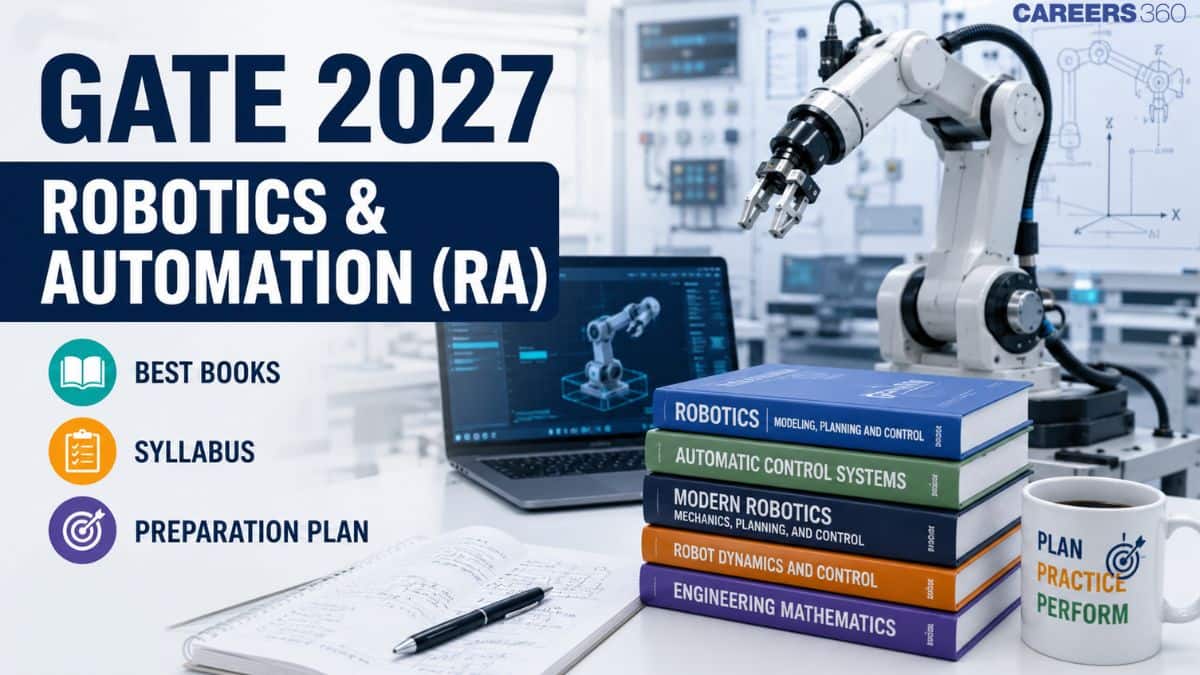
If you're an undergraduate wondering how to prepare for a GATE paper that didn't even exist a year ago, you're not alone. IIT Madras has released key details for GATE 2027, including the exam schedule, a revised syllabus and the introduction of a new Robotics and Automation (RA) paper. For students in mechatronics, robotics, mechanical, or electrical engineering, this is genuinely good news; it's the first GATE paper built specifically around where the industry is heading.
This Story also Contains
But being "new" also means there are no previous year papers to lean on, no established coaching notes, and a lot of confusion about what to study. In this article, we will break down the syllabus, tell you exactly which books and resources to use, and lay out a preparation plan you can start on today.
Also Read: GATE 2027 Preparation Strategy After the Revised Syllabus: Expert Tips
The RA syllabus is split into three parts across an 180-minute exam worth 100 marks total.
The standard verbal and quantitative aptitude section common to every GATE paper. Don't underestimate this in a brand-new paper where the technical sections may have unpredictable difficulty; GA marks are often the most "securable" points on the table.
This is the heart of the paper, and every RA candidate attempts it regardless of background.
Engineering Mathematics:
Linear Algebra
Calculus
Differential Equations
Probability and Statistics
Numerical Methods
Ranked #43 among Engineering colleges in India by NIRF | Get Upto 100% Scholarships
Highest CTC 51 LPA | NAAC ‘A’ & NBA Accredited | Top Platinum Grade in the AICTE-CII Survey | 98% Placement Record | Top Recruiters: AMAZON, Goldman Sachs, CISCO, E&Y, COGNIZANT, Deloitte, IBM, INFOSYS & Many more
Basics of Mechatronics:
Network Elements
Digital Circuits
Sensors
Actuators
Engineering Mechanics
Programming
Data Structures
Principles of Robotics and Automation:
You pick one of the following during the exam itself:
|
Option |
Focus Areas |
|
B1 – Electrical Engineering |
Analog circuits, embedded systems, signals and systems, control systems |
|
B2 – Mechanical Engineering |
Mechanics of materials, kinematics and dynamics, machine design, computer-integrated manufacturing |
Your choice here should align with your undergraduate specialisation, there's no advantage in picking the section further from your background.
Here's the practical reality: there is no dedicated "GATE RA textbook" yet, and you don't need to wait for one. The syllabus is assembled from existing, well-tested subject areas, so your job is to pull the right resources for each part rather than hunt for a single all-in-one book.
|
Subject/Section |
Recommended Books & Study Material |
Why It Is Useful |
|
Part B (Electrical or Mechanical) |
Standard GATE Mechanical Engineering (ME) or GATE Electrical Engineering (EE) reference books |
The optional Part B syllabus has significant overlap with the existing ME and EE GATE syllabus, so dedicated RA books are not required. |
|
Mechatronics & Robotics Fundamentals |
Standard undergraduate textbooks on Mechatronics, Robotics, Industrial Automation, and PLC |
Covers core topics such as sensors, actuators, robot kinematics, control systems, industrial automation, and PLC programming. |
|
Python Programming & Data Structures |
Introductory Python courses, IIT Madras BS in Data Science – Computational Thinking & Python materials, and beginner Python textbooks |
Helps build programming skills required for Python, algorithms, basic data structures, and computational thinking, which are newly introduced in GATE RA. |
|
Engineering Mathematics |
Any standard GATE Engineering Mathematics book (e.g., B.S. Grewal, GKP, Made Easy, ACE Academy notes) |
Covers linear algebra, calculus, differential equations, probability, and numerical methods common to all GATE papers. |
|
General Aptitude |
Previous years' GATE General Aptitude questions, Arihant/Made Easy General Aptitude books |
Strengthens verbal ability, quantitative aptitude, reasoning, and data interpretation, which carry 15 marks in GATE. |
|
Previous Year Questions & Mock Tests |
GATE ME/EE previous year papers, topic-wise practice books, and online mock tests |
Since GATE RA is a new paper, practising ME and EE questions for overlapping topics is the best way to improve speed and accuracy while becoming familiar with the exam pattern. |
Follow these preparation tips and a study plan to get a good score in the newly introduced GATE Robotics & Automation (RA) 2027 paper.
|
Preparation Tip |
What You Should Do |
Why It Matters |
|
Prioritise the Common Section |
Focus first on Engineering Mathematics and Mechatronics (Part A) before moving to the optional section. |
Part A carries 60 out of 100 marks, making it the most important scoring area. |
|
Choose the Right Optional Section |
Select the optional section that matches your academic background—B2 (Mechanical) for Mechanical students and B1 (Electrical) for Electrical students. |
Leveraging your existing knowledge helps maximise marks with less preparation time. |
|
Give Python Dedicated Practice |
Spend regular time coding in Python, practising flowcharts, pseudocode, stacks, queues, trees, and graph traversal. |
GATE RA is the only GATE paper that tests Python, making it a unique and high-priority topic. |
|
Practice ME & EE Previous Year Questions |
Solve GATE Mechanical Engineering (ME) and Electrical Engineering (EE) PYQs for Mathematics and your chosen optional section. |
Since there are no GATE RA previous-year papers yet, ME and EE PYQs provide the best practice for overlapping topics. |
|
Prepare According to Expected Difficulty |
Build a strong foundation in Part A while maintaining regular practice for Part B. |
As the first edition of GATE RA, the common section may be relatively straightforward, while the optional section is expected to follow the standard GATE difficulty level. |
|
Learn Robotics Through Applications |
Visualise concepts like rotation matrices, homogeneous transformations, and robot kinematics using simulations or simple Python programs. |
Understanding practical applications makes robotics concepts easier to grasp and remember than memorising formulas alone. |
The online application process for GATE 2027 is expected to commence in August 2026, with the following official updates:
Frequently Asked Questions (FAQs)
It’s a bit early to say it in a fully definite way since there’s no historical data yet. But because Part A is completely new, maybe its difficulty level would be low, while Part B should line up with the normal GATE rigor for the branch you’ve chosen.
Yes, you can take two GATE papers at the same time.
The official syllabus and its PDF are given on this page or on the GATE official website.
Candidates holding a B.E./B.Tech/B.Sc. (Research)/Equivalent in Mechanical Engineering (ME), Electrical Engineering (EE), Electronics and Communication Engineering (EC), Computer Science and Engineering (CS), Instrumentation Engineering (IN), or Aerospace Engineering are generally eligible. For official eligibility criteria check official website.
The exam pattern for Robotics and Automation is:
Question types include Multiple Choice Questions (MCQs), Multiple Select Questions (MSQs), and Numerical Answer Type (NAT) questions. The GATE RA paper typically consists of 65 questions carrying a total of 100 marks

On Question asked by student community
Hello, yes, some PSUs accept GATE CSE scores for software/IT-related roles. IHMCL is one example. In its 2026 System Engineer (ITS) recruitment, B.Tech/B.E. graduates in ECE, CSE, IT, Data Science or AI could apply using GATE CS, EC or DA scores. Other PSUs may have different eligibility rules, so the
Hello, you can use the GATE College Predictor to check colleges based on your GATE score, rank, category and preferred branch: https://engineering.careers360.com/gate-college-predictor
Hello Student,
You can check the relevant resources provided below.
https://engineering.careers360.com/articles/gate-question-papers
https://engineering.careers360.com/articles/gate-practice-paper-2027
Hope it helps!
Hello Student, your CSE background and 4 years of automotive experience can be useful for an Embedded Systems specialization. However, for an M.Tech , I would be cautious about choosing a fully online/distance programme, as recognition and mode of delivery depend on the university and applicable regulatory rules. I can
Hello Student, Please share your B.Tech branch, percentage/CGPA, GATE status and budget, and I can suggest the most suitable colleges for you.

Ranked #43 among Engineering colleges in India by NIRF | Get Upto 100% Scholarships
Highest CTC 51 LPA | NAAC ‘A’ & NBA Accredited | Top Platinum Grade in the AICTE-CII Survey | 98% Placement Record | Top Recruiters: AMAZON, Goldman Sachs, CISCO, E&Y, COGNIZANT, Deloitte, IBM, INFOSYS & Many more
NAAC A+ Grade | Affiliated to VTU & approved by AICTE.
100+ Recruiters | 100+ Placements of 2026 Batch | NBA & NAAC Accredited | Highest CTC 37 LPA