
Search Colleges, Exams, Schools & more


Login
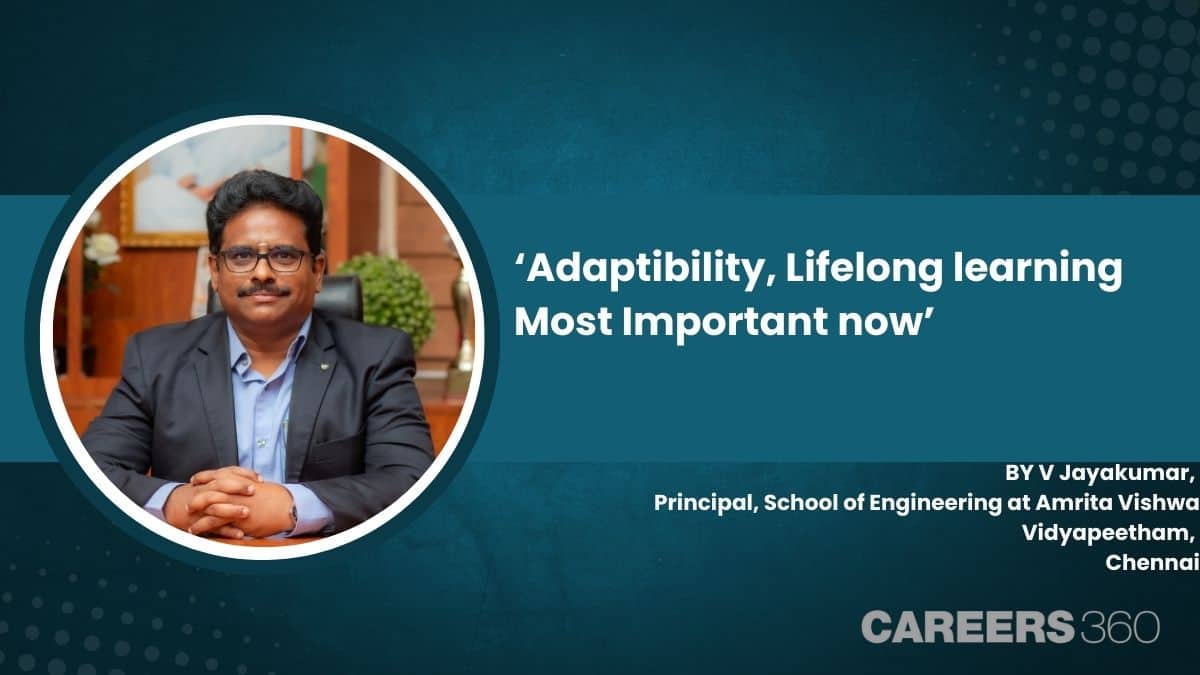
Amrita Vishwa Vidyapeetham, Chennai, principal: ‘Adaptibility, lifelong learning most important now
V Jayakumar, principal of the School of Engineering at Amrita Vishwa Vidyapeetham's Chennai campus speaks to Careers360 about the institute’s various initiatives while also discussing placements, AI, employability, research innovation and the changes required in engineering education.
How is Amrita ensuring students stay relevant and future-ready while balancing core engineering with emerging areas like AI and sustainability?
We live in an era of rapid technological change, and industry expectations evolve just as fast. At Amrita Vishwa Vidyapeetham, we address this through a T-shaped skillset model.
The vertical bar of the “T” represents depth — strong foundations in mathematics, physics, and branch-specific engineering, ensuring students understand the “why” behind technology. The horizontal bar represents breadth — exposure to emerging areas like AI, data science, cybersecurity, sustainability, and interdisciplinary collaboration, along with professional skills like communication, teamwork, and critical thinking.
Emerging technologies are not optional add-ons; micro-credentials and hands-on learning in AI and related fields are integrated directly into the curriculum. By graduation, students combine specialist depth with generalist adaptability, equipping them to solve real-world problems across disciplines and thrive in a rapidly evolving technological landscape.
What recent developments or initiatives at the Chennai campus have made a meaningful difference to student learning or campus life? Any upcoming initiatives that will benefit students in areas like innovation, startups, global exposure, or hands-on experiential learning?
At Amrita Vishwa Vidyapeetham’s Chennai campus, our guiding objective is simple and clear – to make every student career-ready. Career readiness sits at the centre of our academic ecosystem, shaping everything from classroom instruction and lab work to projects, clubs, assessments, and co-curricular activities.
Guided by this philosophy, we have recently launched two major initiatives — PRISM and Career Prep (CAP) — that have significantly strengthened both learning outcomes and campus engagement.
PRISM (Placement-focused Realignment of Instruction, Skilling, and Mentoring) ensures that curriculum, pedagogy, and assessment remain closely aligned with evolving industry needs. Courses are continuously reviewed based on placement trends and skill demand, with designated faculty champions refining content and evaluation methods. High-impact courses are prioritised, and targeted question banks help students prepare for both placements and competitive examinations.
Complementing this is Career Prep (CAP), which focuses on holistic, experiential learning beyond the classroom. CAP brings together hackathons and challenge-based learning (CASH), industry-aligned certifications, internships and capstone projects (ICE), learning through professional societies and technical clubs (RISE), alumni-driven mentoring and exposure (AXE), and structured career guidance from the first semester (CARE).
Together, these initiatives have transformed campus life — students are more engaged, industry-aware, and confident in their career pathways. For us, that clarity and confidence among students is the most meaningful measure of success.
Amrita is often spoken about as being distinct from other engineering institutions. What would you say are its most unique strengths, and how do these translate into better opportunities for students?
Amrita’s distinctiveness stems from a clear and enduring sense of purpose. What truly sets us apart is our philosophy of value-based education — an approach that goes beyond education for employment to education for life. We consciously combine academic rigour with human values, compassion-driven research, and a deep respect for India’s cultural and ethical foundations — the soul of Bharat.
One of the clearest expressions of this philosophy is our flagship Live-in-Labs programme. This immersive initiative places multidisciplinary student teams in rural communities, where they live and work to design and implement sustainable solutions in areas such as water, energy, sanitation, waste management, and education. It is not simulated learning, but real-world problem solving with tangible impact.
Since its launch in 2013, Live-in-Labs has led to over 300 projects across 25 Indian states, positively impacting more than one million rural residents.
Through experiences like these, students develop hands-on technical skills alongside human-centred design, empathy-driven innovation, and cross-cultural collaboration — often translating into meaningful research and publications. More importantly, they graduate with confidence, clarity, and a strong sense of purpose.
That combination of excellence with empathy is what truly makes Amrita distinct — and what opens up deeper, more meaningful opportunities for our students.
How does Amrita ensure students gain real-world industry experience and enhance employability?
Industry exposure is central to learning at Amrita, not an add-on. Our Directorate of Corporate and Industry Relations (CIR) bridges academia and industry through four pillars – Career Competency Development, Internships & Placements, Academia-Industry Partnerships, and the Amrita Centre for Entrepreneurship.
This ecosystem connects students to over 300 recruiting companies and 200+ active MoUs with global industries and institutions. At our Chennai campus, collaborations with Intel, FESTO, Continental Automotive, and others give students hands-on experience on live projects and real-world problem statements.
Professors of Practice from industry bring current insights directly into classrooms, while internships, mentorships, workshops, and industrial visits ensure students understand workplace expectations. Our goal: when an Amrita student enters the workforce, they’re confident, competent, and ready to contribute from day one.
How does Amrita bridge the gap between classroom learning and real-world applications?
At Amrita, we believe engineering education must go beyond theory. Our ecosystem blends practical, industry-oriented, and socially relevant experiences to prepare students for real-world challenges.
Curricula are co-designed with industry experts and enriched with case studies, simulations, and hands-on projects. Mandatory internships give students first-hand exposure to workplace culture and professional expectations. Programs like Live-in-Labs place students in rural communities to tackle real challenges aligned with UN Sustainable Development Goals, fostering technical skills, empathy, and systems thinking.
Global partnerships with IBM, Google, Microsoft, and others offer international internships, certifications, and dual-degree options. Advanced labs — both physical and virtual — provide hands-on experience with Industry 4.0 technologies, ensuring students graduate confident, competent, and ready to contribute from day one.
How does Amrita encourage undergraduates to engage in research and innovation addressing real-world challenges?
Research is a core pillar at Amrita, and undergraduates are actively immersed in it from day one. Our Chennai campus hosts state-of-the-art centres in AI, robotics, nanotechnology, tribology, cybersecurity, and more, creating a vibrant ecosystem for inquiry and experimentation.
Students can join faculty-led research groups, interdisciplinary teams, and live project initiatives, working alongside PhD scholars and industry partners. Mini-projects, capstone projects, and innovation labs enable them to turn ideas into prototypes with tangible impact.
Amrita also provides strong support through seed grants, conference funding, and recognition for student publications. Global research opportunities through collaborations with 200+ universities allow students to gain international exposure. Programs like the E4Life PhD pathway enable those with long-term research ambitions to continue in sustainable, socially impactful work.
By embedding project-based and experiential learning into the curriculum, we ensure research is never abstract — students graduate as confident innovators and problem solvers ready to tackle challenges in climate, healthcare, digital inclusion, and beyond.
Could you share insights on placement outcomes, emerging sectors, and salary trends at Amrita?
Placements at Amrita have consistently been strong, thanks to our dedicated Directorate of Corporate and Industry Relations, which connects students with recruiters and supports internships and full-time opportunities.
In 2025, the highest package reached Rs 80.4 LPA, while the average package was Rs 9.08 LPA and the median for four-year undergraduate programmes Rs 7.75 LPA. Computer Science and allied branches continue to attract the most offers, with salaries ranging Rs 4.5-8 LPA, while Electronics, Mechanical, AI, and Data Science students also see strong demand in sectors like semiconductors, smart manufacturing, robotics, aerospace, and emerging technologies
Internships serve as a key pathway to employment, with nearly all BTech students securing industry internships in 2025, many converting into pre-placement offers. Our focus is not just numbers, but long-term employability: graduates leave with solid fundamentals, industry-relevant skills, and hands-on experience, ready to contribute confidently from day one.
What advice would you give to students considering engineering at Amrita?
We live in an era of unprecedented knowledge growth — engineering and technology knowledge now doubles every one to two years. Many of today’s students will work in jobs that don’t exist yet, while a large portion of current skills may be automated.
The key is mindset. Adaptability and lifelong learning are the most important capabilities a graduate can develop: the ability to learn, unlearn, and relearn as technology and society evolve. At Amrita, our academic ecosystem is designed to nurture this skill, blending rigorous engineering training with opportunities to explore, innovate, and solve real-world problems.
My advice: choose an institution that teaches you not just engineering, but how to think, adapt, and grow. With curiosity, commitment, and a drive to make an impact, Amrita provides the environment and opportunities to thrive in a constantly changing world.
What is the most urgent need in engineering education today, and how is Amrita addressing it?
The most urgent need in engineering education today is to prepare future-ready graduates who can solve problems that do not yet exist. The challenges ahead are complex and interconnected, and technical skills alone are no longer sufficient. Engineers must also think ethically, act responsibly, and design solutions with long-term societal impact.
At Amrita Vishwa Vidyapeetham, we address this through three key focus areas. First, we integrate values and compassion into engineering education, guided by our philosophy of Education for Life and Education for Living. Second, sustainability is embedded across all academic programs, shaping how students approach technology and development. Third, we bridge the real-world gap through experiential and interdisciplinary initiatives such as ARISE 2025, which prepare students to work confidently in uncertain, real-world environments.
Together, these efforts ensure our graduates are technically strong, adaptable, ethical, and ready to lead in a rapidly changing world.
Articles
Related Stories
|
Certifications By Top Providers
Explore Top Universities Across Globe
Popular Courses and Specializations
List of colleges accepting AEEE

Browse Engineering Colleges by State
Questions related to AEEE
On Question asked by student community
Have a question related to AEEE ?
Hello Student,
You have a good chance of getting a seat in CSE with AI and Data Science at Amrita Bengaluru Campus . One of the important factors determining your Slab is the seat availability during the counselling rounds.
Slab one is generally given to top rankers (usually between 500
Hello,
Since you've already got CSE at Amrita Nagercoil , I would suggest thinking carefully before switching to Civil or Chemical at the Coimbatore campus .
If your main focus is placements and future job opportunities, CSE generally offers better prospects than Civil or Chemical. Amrita's placement process includes students
Hello Dear Student,
With an AEEE rank of around 59,000, securing CSE or CSE (AI) at the Amrita Haridwar campus may be challenging, as these branches are usually among the most sought-after. However, admission chances can improve in later counselling rounds depending on seat availability and demand.
Since the Haridwar
Hello Dear Student,
With an AEEE rank of 717, yes, you can comfortably secure CSE core at the Coimbatore campus.
You can check, find and access more information here:
https://engineering.careers360.com/articles/aeee-cutoff
Hope it helps!
Hello Dear Student,
With an AEEE rank of 28,221 , Coimbatore core branches are competitive, but you still have realistic chances for:
- Civil Engineering good possibility
- Chemical Engineering possible, especially in later rounds/slab 3+
at Amrita Vishwa Vidyapeetham Coimbatore Campus.
If you have Tamil Nadu home-state eligibility, your chances improve

B.Tech/B.Arch Admissions OPEN
100+ Recruiters | 1200+ Placements of 2026 Batch | NBA & NAAC Accredited | Highest CTC 37 LPA
Manav Rachna-B.Tech Admissions 2026
ApplyNAAC A++ Grade | Recognized as Category-1 Deemed to be University by UGC | 41,000 + Alumni Imprints Globally
Integral University B.Tech Admissions 2026
ApplyNAAC A+ Accredited | Highest CTC 45 LPA | Scholarships Available
East Point College of Engineering & Tech. Admissions 2026
ApplyApply for B.E at East Point College of Engineering and Technology | Affiliated to VTU | AICTE Approved | NBA Accredited | Highest CTC 33 LPA
Parul University B-TECH Admissions 2026
ApplyIndia's youngest NAAC A++ accredited University | NIRF rank band 151-200 | 2200 Recruiters | 45.98 Lakhs Highest Package
KR Mangalam University B.Tech Admissions 2026
Apply6 Lakh+ CUET Registrations | 500+ Companies Visited for Placement Top Recruiters: Apple Inc., Amazon, IBM, CISCO, Meta, Microsoft, Google
AEEE Notifications
Explore Career Options
By IndustryNever miss AEEE update
Get timely AEEE updates directly to your inbox. Stay informed!