
Search Colleges, Exams, Schools & more


Login
KCET 2026 Chemistry Question Paper with Answer Key (Out): Download Solutions PDF
KCET 2026 Chemistry Question Paper with Answer Key: The KCET 2026 Chemistry question paper was successfully conducted in offline pen-and-paper mode. The Karnataka Examinations Authority (KEA) conducts KCET every year as a way to get admission into undergraduate engineering, pharmacy, and other professional courses across Karnataka. Chemistry is one of the three core science subjects tested in KCET 2026, along with Physics and Mathematics / Biology in different sessions. The KCET 2026 provisional answer key has been released at the official website of KEA. Students can access the provisional answer key using their application number and date of birth.
This Story also Contains
- KCET 2026 Chemistry Question Paper PDF
- KCET 2026 Chemistry Answer Key PDF
- KCET 2026 Chemistry Question Paper Analysis
- KCET 2026 Chemistry Exam Pattern
- KCET Previous Years’ Question Paper
- KCET 2026 Official Answer Key
- How to Calculate KCET Chemistry Score using the Answer Key?
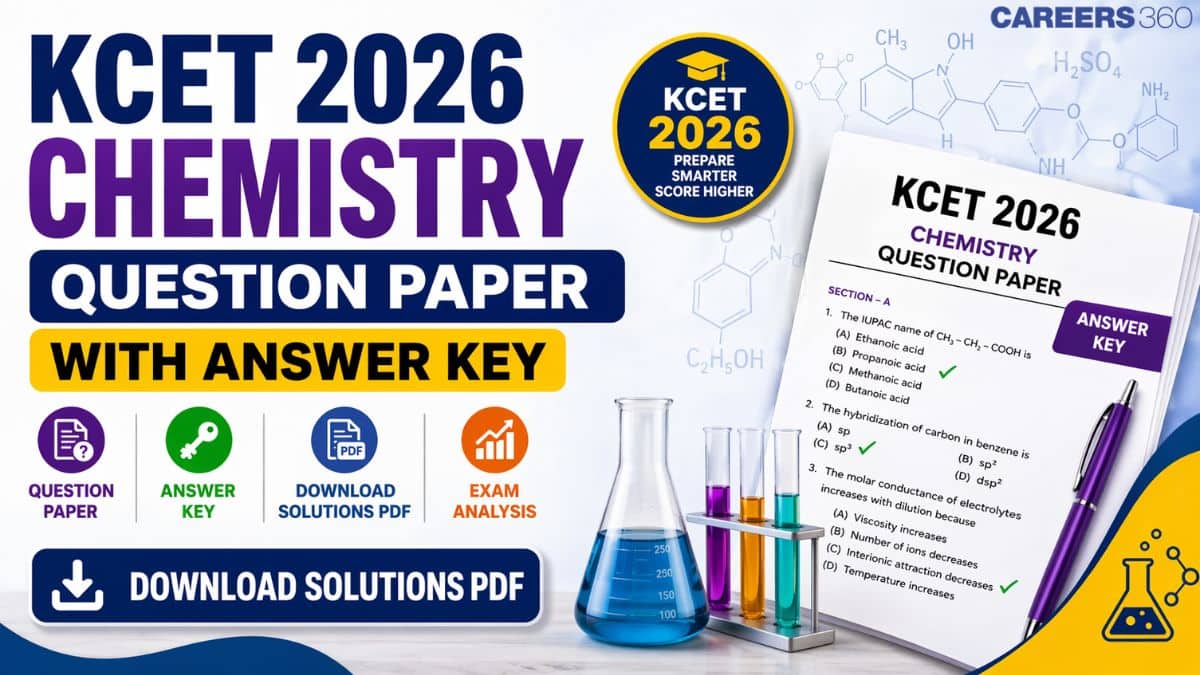
In this article, we have provided you with the KCET 2026 chemistry question paper. It helps you in understanding the exam pattern and chapter-wise weightage, as well as a post-exam analysis and answer key. Candidates who appeared in the exam can check their responses using the answer key, and those planning to appear for the KCET exam in the future can use this article as a complete reference guide.
KCET 2026 Chemistry Question Paper PDF
The KCET 2026 chemistry question paper PDF is provided in this section. You can click on the link given in the table to download the KCET chemistry question paper.
Confused About College Admissions?
Get expert advice on college selection, admission chances, and career path in a personalized counselling session.
Book a Counselling Slot
Select Date
Pick a Slot
KCET 2026 Chemistry Answer Key PDF
The KCET 2026 Chemistry answer key has been released by the KEA. Download the answer key using the link provided below
KCET 2026 Chemistry Question Paper Analysis
The paper analysis has been updated in the table provided below. The analysis covers the difficulty level, type of question, and how questions are framed.
Overall | Moderate |
Physical | Moderate |
Organic | Easy to moderate |
Inorganic | Moderate |
KCET 2026 Chemistry Exam Pattern
You can check the KCET 2026 exam pattern from the table given below:
Parameter | Details |
Exam Conducting Body | Karnataka Examinations Authority (KEA) |
Exam Date | April 23, 2026 |
Session | Afternoon – 2:30 PM to 3:50 PM |
Total Questions | 60 |
Total Marks | 60 |
Marks per Question | 1 Mark |
Negative Marking | No |
Question Type | Multiple Choice Questions (MCQs) |
Mode of Exam | Offline (OMR-based) |
Syllabus | PUC I & PUC II (Karnataka Board) |
KCET Previous Years’ Question Paper
Practicing with the KCET previous years’ question paper is one of the best preparation strategies. The PYQs help us in understanding the exam pattern, types of questions asked, how problems in the KCET exam are framed, concepts that have been repeated in the past years, and the overall difficulty level of the exam. You can access the previous year's question papers from the link provided below:
KCET 2026 Official Answer Key
The KCET 2026 answer key has been released by KEA. You can use the answer key to match your responses, calculate your raw score, and raise an objection if needed.
How to Calculate KCET Chemistry Score using the Answer Key?
To calculate the KCET Chemistry score, refer to the points given below:
1. Download the KCET Chemistry Answer Key
2. Match your responses with the correct answers provided in the answer key.
3. Marking +1 mark for every correct answer and no negative marking for incorrect answers
4. Count Correct Answers
5. Calculate Your Score by multiplying the number of correct answers by 1.
Frequently Asked Questions (FAQs)
Q: What is the date of the KCET 2026 Chemistry Exam?
A:
The KCET 2026 Chemistry exam was cpnducted on 23 April from 2:30 PM to 3:50 PM in the afternoon session.
Q: How many questions were there in the KCET Chemistry paper?
A:
The KCET Chemistry question paper had a total of 60 MCQs, each carrying 1 mark, for a total of 60 marks.
Q: Was there a negative marking in the KCET Chemistry Question Paper?
A:
No, there was no negative marking in the KCET 2026 exam.
Q: Where can I download the KCET 2026 Chemistry question paper PDF?
A:
You can download the KCET chemistry question paper from the link provided on this page.
Articles
Related Stories
|
Upcoming Engineering Exams

Certifications By Top Providers
Explore Top Universities Across Globe
Popular Courses and Specializations
List of colleges accepting KCET
Browse Engineering Colleges by State
Questions related to KCET
On Question asked by student community
Have a question related to KCET ?
Hello Student,
You can check the resources provided below:
Hope this helps!
Hi, college transfer after admission through KCET is not automatically allowed and depends on the university, college and applicable rules. Since you are a B.Pharm student, the transfer may also depend on whether the required seats and approvals are available. Tell me your current college, university and the college you
Hi Manoj
You can practise chapter-wise KCET mock tests on Careers360, covering Physics, Chemistry, Mathematics and Biology based on the KCET exam pattern. From the link below:
Hello, you can find your KCET 2026 counselling/CET number on your KCET verification slip. You can download the verification slip by logging in to the KEA portal using your registration number and password. The CET number is also used during the counselling process.
For more details, check this link: https://engineering.careers360.com/articles/kcet-counselling
Hi Ranga,
Here you can check the KCET question paper
if you need more resources, please let us know.

B.Tech/B.Arch Admissions OPEN
Ranked #43 among Engineering colleges in India by NIRF | Get Upto 100% Scholarships
Woxsen University, Hyderabad
ApplyScholars’ Round Deadline: 14th Nov’26 | Earn upto 50% merit Scholarship + 10% for top performers | EFMD Accredited | AACSB (USA) & AMDISA Member | Highest CTC 28 LPA
Parul Institute of Technology, Vadodara
ApplyDiploma (17 Specializations), B.Tech / B.Tech (Hons.) / IE-B.Tech - 4 years - 25+ specializations | M. Tech - 14+ specializations | Highest CTC – 60 LPA
SRM Institute of Science and Technology, Tiruchirappalli
ApplyApplication Free of Cost for Limited Time || NAAC A++ Accredited | Highest CTC 52 LPA | #11 in University Category by NIRF
Saveetha Engineering College, Chennai
ApplyAffiliated to Anna University | Highest CTC 44 LPA | Top Recruiters : JP Morgan Chase & Co, Nielson IQ, QUBE, META, GOOGLE, AMAZON & many more.
Dr Vishwanath Karad MIT World Peace University, Pune
ApplyHighest CTC 30 LPA | #9 in Management Category by Times B-School | Merit-Based Scholarship Upto - 50 Crores
KCET Notifications
Explore Career Options
By IndustryNever miss KCET update
Get timely KCET updates directly to your inbox. Stay informed!