JEE Main 2021 Question Paper PDF with Solutions

JEE Main 2021 Question Paper PDF with Solutions

Avinash DongreUpdated on 08 Dec 2025, 05:29 PM IST

JEE Main 2021 Question Paper: Candidates can check the JEE Main 2021 question paper with the solution PDF download link here. The JEE Main question paper PDF 2021 serve as the best material for candidates who have taken the exam, allowing them to assess their performance, estimate their scores, and tentatively gauge their ranks. Further, the JEE Main 2021 question papers also serve as a useful source of material for candidates preparing for the upcoming JEE Main exam. The JEE Main question papers and solutions are available for various sessions, including JEE Main previous question papers covering both shift 1 and shift 2 in this article. The authority conducted the JEE Main exam in four sessions in 2021. Due to the COVID pandemic, the JEE Main 2021 paper was conducted in four sessions (i.e. February, March, July, and August).

This Story also Contains

  1. JEE Main 2021 Question Paper with Solutions PDF
  2. JEE Main Sample Paper PDF
  3. Benefits of Solving JEE Main Question Papers 2021
  4. Few Solved Questions from JEE Main 2021 Paper
JEE Main 2021 Question Paper PDF with Solutions

JEE Main 2021 Question Paper with Solutions PDF

Aspirants can find the link for the JEE Mains Question Paper 2021 PDF download for all shift question paper PDFs with solutions PDFs below.

As you can see a total number of 2340 questions are there for practice for candidates which will ultimately be very helpful to understand the JEE main 2025 exam pattern, question types, questions difficulty level etc. Also since the number of questions are very large here so candidates will have access to questions from nearly all the chapters from Physics, Maths and Chemistry subjects.

JEE Main 2021 Question Paper PDF With Solutions July Session

JEE Main 2021 Question Paper PDF by Resonance

JEE Main 2021 Question Paper PDF by Reliable Kota

JEE Main Question Paper 2021

The IIT Question Paper 2021, accessible on this page, is designed for both sessions. Additionally, candidates can access the JEE Main answer key for the question papers provided here. Utilising the JEE Main question paper with solutions, candidates can cross-check their responses following their attempts.

For aspirants gearing up for future exams, the JEE Mains 2021 question paper with solutions PDF offers a valuable window into the exam's format, level of difficulty, and the types of questions typically encountered. Subject matter experts have meticulously provided detailed explanations for each JEE Main 2021 question paper, enhancing their educational value.

The accessibility of JEE Main 2021 Question Paper Solutions in PDF format ensures that these materials are readily available and free to JEE Main 2021 paper download, making them a potent resource for efficient exam readiness. In essence, JEE Main 2021 Question Paper pdf downloads are indispensable assets for both current and future JEE aspirants, providing them with the necessary tools to excel in this fiercely competitive examination.

For effective preparation for the JEE Main examination, it's imperative for aspirants to thoroughly acquaint themselves with the JEE Main syllabus and exam structure. In addition to studying previous years' JEE Main question papers, candidates are encouraged to seek out the wisdom shared by successful JEE Main toppers and experienced educators. These sources can provide invaluable preparation tips and recommendations on essential reference books. Detailed information about JEE Main 2021 question papers is available in the provided article.

JEE Main Sample Paper PDF

Aspirants preparing for the IIT JEE Main examination are encouraged to practise with sample papers. Engaging with JEE Main sample papers enables candidates to gain insights into the question formats commonly featured in the exam. These sample questions are meticulously crafted to align with the official exam syllabus. You can access the JEE Main sample paper in PDF format via the provided link.

JEE Main Sample Paper

Benefits of Solving JEE Main Question Papers 2021

There are some significant benefits of solving JEE Main 2021 question papers. Here we have mentioned a few of them.

  • Clarity on Question Types: Solving JEE Main 2021 question papers helps students understand the variety and difficulty of questions in the exam.

  • Exam Pattern Familiarity: Going through JEE 2021 papers makes students acquainted with the JEE Main exam pattern and marking scheme.

  • Knowledge Assessment: It serves as a tool to assess their knowledge and readiness for the exam.

  • Skill Enhancement: Practice enhances problem-solving abilities and time management skills.

  • Real-time Experience: provides a real-time feel of the exam environment.

  • Effective Preparation Strategy: Helps in devising an efficient and result-oriented preparation plan.

Few Solved Questions from JEE Main 2021 Paper

1. (Subject - Physics, Chapter - Current Electricity, Shift - 20 July shift 1)

Question:-
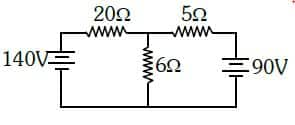
1719990199500

The value of current in the 6\; \Omega resistance is :

  1. 4A

  2. 8A

  3. 10A

  4. 6A

UPES B.Tech Admissions 2026

Ranked #43 among Engineering colleges in India by NIRF | Highest Package 1.3 CR , 100% Placements

Amrita University B.Tech 2026

Recognized as Institute of Eminence by Govt. of India | NAAC ‘A++’ Grade | Upto 75% Scholarships

Answer- 3) 10A

Solution:-

1719990199548

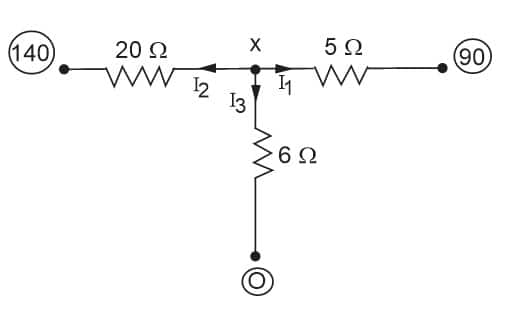
Applying KCL at the junction with voltage x (assigned)
1719990199447

By KCL,

\text{I}_{1}+\text{I}_{2}+\text{I}_{3}= 0

\left(\frac{x-90}{5}\right)+\left(\frac{x-140}{20}\right)+\left(\frac{x-0}{6}\right)=0

\begin{aligned} 24 x-24 \times 90+6 x-6 \times 140+20 x=0 \\ \end{aligned}

\begin{aligned} 50 x &=24 \times 90+6 \times 140 \\ \end{aligned}

\begin{aligned} &=6[4 \times 90+140] \\ \end{aligned}

\begin{aligned} 50 x &=3000 \\ \end{aligned}

\begin{aligned} x &=60 \mathrm{~V} \end{aligned}

Current through 6\; \Omega resistor is

I_{3}=\left(\frac{x-0}{6}\right)=\left(\frac{60-0}{6}\right)=10 \mathrm{~A}

The correct option is (3)

2. (Subject - Maths, Chapter - Integral Calculus, Shift - 27 August Shift 1)

Question:- \int_{6}^{16} \frac{\log _{\mathrm{e}} x^{2}}{\log _{\mathrm{e}} x^{2}+\log _{\mathrm{e}}\left(x^{2}-44 x+484\right)} \mathrm{d} x is equal to:

  1. 5

  2. 10

  3. 8

  4. 6

JEE Main 2026: Preparation Tips & Study Plan
Download the JEE Main 2026 Preparation Tips PDF to boost your exam strategy. Get expert insights on managing study material, focusing on key topics and high-weightage chapters.
Download EBook

Answer- 1) 5

Solution:-

Let\, I= \int_{6}^{16}\frac{\log_{e} x^{2} }{\log_{e}x^{2}+\log_{e}\left ( 22-x \right )^{2}}dx ---\left ( 1 \right )

Using properties of Integral

I= \int_{6}^{16}\frac{\log_{e} \left ( 6+16-x \right )^{2}}{\log_{e}\left ( 6+16-x \right )^{2}+\log_{e}\left ( 22-\left ( 6+16-x \right ) \right )^{2}}dx

\Rightarrow I= \int_{6}^{16}\frac{\log_{e} \left ( 22-x \right )^{2}}{\log_{e}\left ( 22-x \right )^{2}+\log_{e}x^{2}}dx---\left ( 2 \right )

Adding (1) and (2)

2I= \int_{6}^{16}\frac{\log_{e}x^{2}+\log_{e}\left ( 22-x \right )^{2}}{\log_{e}x^{2}+\log_{e}\left ( 22-x \right )^{2}}dx

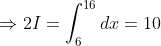
\Rightarrow 2I= \int_{6}^{16}dx= 10

\Rightarrow I= 5

Hence, the answer is the option 1.

3. (Subject - Chemistry, Chapter - Equilibrium, Shift - 31 August Shift 1)

Question:-

\mathrm{A}_{3} \mathrm{~B}_{2} is a sparingly soluble salt of molar mass \mathrm{M (g\ mol^{-1})} and solubility x \mathrm{~g} \mathrm{}^{-1}. The solubility product satisfies \mathrm{K}_{\mathrm{sp}}=a\left(\frac{x}{\mathrm{M}}\right)^{5}. The value of a is __________. (Integer answer)

Answer- (108)

Solution:-

Given,

\mathrm{solubility\, of\, A_{3}B_{2}}= x\ \mathrm{gL^{-1}}

\mathrm{\therefore solubility\, in\,\frac{moles}{lit}= \left ( \frac{x}{M} \right )\, mol\, L^{-1}}

{\therefore \mathrm{s}= \left ( \frac{x}{\mathrm{M}} \right )}

Now, \mathrm{ A_{3}B_{2}} dissolves as

\mathrm{A_{3}B_{2}\rightleftharpoons 3A^{2+}+2B^{3-}}

\quad - \quad\quad\quad 3s\quad\quad\quad2s

Expression for solubility product gives us

\mathrm{\therefore K_{sp}= \left ( 3s \right )^{3}\left ( 2s \right )^{2}} \mathrm{=108 \, s^{5}} \mathrm{=108 \left ( \frac{x}{M} \right )^{5}}

Hence, the answer is (108).

JEE Main Syllabus: Subjects & Chapters
Select your preferred subject to view the chapters

Frequently Asked Questions (FAQs)

Q: What is the mode of examination for JEE Main?
A:

JEE Main is conducted online as a computer-based test. While Paper-1 is entirely computer-based, Paper-2 includes computer-based Mathematics and Aptitude sections, along with a pen-and-paper-based Drawing exam.

Q: Could you explain the exam pattern for JEE Main?
A:

The exam pattern for JEE Main consists of a total of 75 questions (i.e. 25 questions each in Physics, Maths and Chemistry), with candidates required to attempt all 75 questions. Each subject consists of 2 sections (i.e. Section A with 20 MCQs and Section B with 5 questions whose answers are to be filled in as a numerical value). In Section B candidates have to attempt all 5 questions.

Q: What types of questions can I anticipate in JEE Main?
A:

JEE Main question paper primarily comprises 2 types of questions i.e. 1. Multiple-choice type questions and 2. Questions whose answers are to be filled in as a numerical value covering the subjects of Physics, Chemistry, and Mathematics.

Q: Has the NTA modified the syllabus for JEE Main?
A:

Yes, the syllabus for JEE Main has changed from the previous year.

Q: In what languages is the JEE Main question paper available?
A:

The JEE Main question paper is available in a bilingual medium, encompassing 13 different languages, including Hindi, Urdu, Bengali, Gujarati, and more.

Q: Do I need to attempt all the questions in each section of the JEE Main?
A:

Yes, all the questions are compulsory. For each subject, In Section A candidates can attempt all 20 questions and in Section B candidates also attempt all 5 questions.

Q: What are the advantages of practising previous years' JEE Main question papers?
A:

Solving previous years' question papers can help candidates grasp the exam pattern, identify important topics, assess areas of weakness, and enhance speed and accuracy in answering questions.

Articles
|
Upcoming Engineering Exams
Ongoing Dates
HITSEEE Application Date

5 Nov'25 - 22 Apr'26 (Online)

Ongoing Dates
SMIT Online Test Application Date

15 Nov'25 - 12 Apr'26 (Online)

Ongoing Dates
SNUSAT Application Date

19 Nov'25 - 31 Mar'26 (Online)

Certifications By Top Providers
Basic Programming using Python
Via Indian Institute of Technology Bombay
Introduction to Biostatistics
Via Indian Institute of Technology Bombay
Programming Basics
Via Indian Institute of Technology Bombay
C-Based VLSI Design
Via Indian Institute of Technology Guwahati
MERN Stack Developer
Via Indian Institute of Technology Kanpur
Udemy
 1525 courses
Swayam
 817 courses
NPTEL
 773 courses
Coursera
 697 courses
Edx
 608 courses
Explore Top Universities Across Globe

Questions related to JEE Main

On Question asked by student community

Have a question related to JEE Main ?

Hello

If you want to get admission in IIT Delhi, then you will score well in JEE Advanced. Only the JEE Mains score is not sufficient to get admission in the IIT Delhi. You need to score 250+ marks for the general category in CSE. For the reservation category, you also need to score much higher marks and give your best performance. If you score quite well in JEE Advanced, then you will have a chance to get admission through JOSAA counselling.

Thank you

To score good marks in JEE Mains, you need a strong plan, consistent study habits and smart practice. First, finish the entire JEE syllabus from NCERT Class 11 and 12 textbooks, because these are the foundation for questions asked in the exam. After completing the basics, choose good quality reference books for Physics, Chemistry and Mathematics to build problem-solving skills and deepen your understanding. Make a weekly study plan where each day is divided into theory study, problem practice and revision of earlier topics.

Regularly solve previous years’ JEE Main papers and take timed mock tests to improve your speed and accuracy. Analyse every test you take, understand your mistakes and work on weak areas instead of only doing new questions. In subjects like Physics and Mathematics, practising a variety of numerical problems is important, while in Chemistry focus on concepts and reactions that are frequently asked. Revision is crucial, so dedicate time every week to revisit older topics and short notes that you make while preparing.

Stay consistent, avoid last-minute cramming, and maintain good health with adequate sleep and breaks during study. With disciplined planning, regular practice and careful revision, you can significantly improve your JEE Main score. All the best.

Achieving a JEE Rank of below 100 in JEE Main and Advanced 2027 requires a disciplined, two-year preparation strategy starting from Class 11. Your study plan must integrate competitive exam preparation with your school academics:

Phase 1: Class 11 (Foundation Building and Conceptual Clarity)

  • Syllabus Completion: Dedicate this year to rigorously completing the entire Class 11 NCERT syllabus for Physics, Chemistry, and Mathematics (PCM). Focus heavily on fundamental topics like Mechanics (Physics), General Organic Chemistry (GOC) and Chemical Bonding (Chemistry), and Calculus basics (Maths).

  • Concept Mastery: Do not rush. Master concepts thoroughly before moving to problems. Use standard JEE reference books and ensure you solve all NCERT examples and exercises first.

  • Practice: Allocate 60% of your study time to concept building and 40% to problem-solving. Practice JEE Main Previous Year Questions (PYQs) immediately after completing a chapter to gauge the exam pattern.

Phase 2: Class 12 (Advanced Problem Solving and Revision)

  • Advanced Topics: Complete the Class 12 syllabus by November 2026, focusing on high-weightage topics like Electrostatics, Modern Physics, and Electrochemistry.

  • Revision & Mocks: Reserve the period from December 2026 to January 2027 solely for mock tests and revision. Start taking full-length JEE Main mock tests (3 per week) under strict timed conditions. Analyze each mock test thoroughly to eliminate repeated errors.

  • Target JEE Advanced: After the JEE Main attempts in early 2027, shift focus entirely to JEE Advanced PYQs and challenging, multi-concept problems, taking at least 2 JEE Advanced mock tests per week.

A detailed subject-wise study plan and additional tips on effective JEE preparation starting from Class 11 can be found here: https://engineering.careers360.com/articles/jee-preparation-from-class-11

The last 30 days before the JEE Main exam should be dedicated entirely to revision, practice, and error analysis, shifting focus away from learning new concepts.

Here is a concise, 30-day study plan to maximize your score:

1. Revision Strategy (Weeks 1-3)

  • Prioritize High-Weightage Topics: Spend 70% of your revision time reviewing the most scoring and frequently tested chapters (e.g., Modern Physics, Chemical Kinetics, p-Block elements, Vectors & 3D Geometry). Use your short notes and flashcards for quick review, focusing on formulas, key mechanisms, and definitions.

  • Physics & Maths: Master all formulas and derivations. Practice at least 20 numerical problems daily, emphasizing speed and calculation accuracy.

  • Chemistry: Dedicate 50% of your Chemistry time to Inorganic (NCERT-based) and Organic (name reactions, reagents, mechanisms) concepts.

2. Mock Tests & Analysis (Daily)

  • Daily Mock Test: Solve one full-length JEE Main Mock Test every day (3 hours) under strict exam conditions (9 AM–12 PM or 3 PM–6 PM).

  • Error Analysis (Crucial): Immediately after the test, spend 2-3 hours analyzing your performance:

    • Identify every incorrect or unattempted question.

    • Determine the reason for the error (Conceptual mistake, calculation error, or time pressure).

    • Revisit the concept from your notes/NCERT text to correct the mistake permanently.

3. Final Week Focus (Last 7 Days)

  • Stop Learning New Topics: Absolutely avoid picking up new, complex chapters.

  • PYQ Sprint: Revisit only the last 3 years' JEE Main Previous Year Questions (PYQs). Mark any previously incorrect questions and solve them again.

  • Mindset: Focus on maintaining confidence, getting proper sleep, and using the revision breaks for physical activity to keep your mind fresh.

You can find more detailed subject-wise tips and psychological strategies here: https://engineering.careers360.com/articles/jee-main-preparation-tips

The most effective way to prepare for JEE Main 2026 is by focusing on the most important Previous Year Question Papers (PYQs), which highlight high-weightage and frequently repeated questions across Physics, Chemistry, and Mathematics. Since the exam strongly tests NCERT concepts, mastering these PYQs is essential for predicting the question pattern and improving your time management. https://engineering.careers360.com/articles/jee-mains-chapterwise-pyq-previous-year-questions-solutions-pdf