Careers360 Logo
ask-icon
share

    VITEEE Exam 2027: Application Form (Out), Date, Eligibility, Syllabus, Pattern, Admit Card

    author
    Jalla VenkateshUpdated on Oct 21, 2026 02:55 PM

    About VITEEE 2027

    VITEEE 2027 - VIT Vellore has commenced the VITEEE 2027 registration process on October 20, 2026. The VITEEE 2027 application form link is available on the official website, viteee.vit.ac.in. The VITEEE 2027 application fee is Rs. 1,450, which is non-refundable. The last date to submit the VITEEE 2027 application form is March 31, 2027. Candidates are advised to check the VITEEE 2027 eligibility before applying. The VITEEE 2027 exam will be conducted from April 27 to May 2, 2027 at designated centres across India and abroad (No. of days will vary for test cities). The duration of the VIT examination has been reduced to 2 hours with 100  questions. The authority has revised the VITEEE 2027 exam pattern online. Find more details on VITEEE 2027 below.
    Also Check: VITEEE 2027 New Changes

    Candidates will have to select one test city from the list of available test cities. Once a test city is selected and the VITEEE 2027 application form is submitted, it cannot be changed. The Vellore Institute of Technology Engineering Entrance Examination (VITEEE) is conducted for admission to undergraduate engineering programmes in VIT group of Institutions. 

    VITEEE 2027 Latest News and Updates

    • VITEEE 2027 registration has started.
    • The VITEEE 2027 exam notification has been issued on October 20, 2026.

    About VITEEE

    VITEEE full form refers to the Vellore Institute of Technology Engineering Entrance Examination (VITEEE). Every year, VIT Engineering College conducts the VITEEE exam for admission to undergraduate engineering programmes in the VIT group of Institutions. Candidates who have passed 10+2 from a recognised board are eligible for the VITEEE exam. Find the VIT institutes below. 

    Programmes Offered at VIT:

    VITEEE 2027 Support & Contact

    Director - UG Admissions, VIT, Vellore - 632014, Tamil Nadu, India.

    Phone: 0416-220 2020 / 1800-102-0536

    E-mail: ugadmission@vit.ac.in

    WhatsApp: 9566656755

    Read More
    VITEEE Exam 2027: Application Form (Out), Date, Eligibility, Syllabus, Pattern, Admit Card
    VITEEE Exam 2027: Application Form (Out), Date, Eligibility, Syllabus, Pattern, Admit Card

    VITEEE 2027 Highlights

    Full Exam Name
    VIT Engineering Entrance Exam
    Short Exam Name
    VITEEE
    Conducting Body
    Vellore Institute of Technology
    Frequency Of Conduct
    Once a year
    Exam Level
    University Level Exam
    Languages
    English
    Mode Of Application
    online
    Mode Of Exam
    online
    Mode Of Counselling
    offline
    Participating Colleges
    4
    Exam Duration
    2 Hours 30 Minutes

    VITEEE Important Dates

    VITEEE VIT Engineering Entrance Exam (session 2027)

    VIT University has revised the VITEEE 2027 eligibility criteria on the official website, vit.ac.in. The eligibility criteria for VITEEE 2027 include educational qualification, nationality, and age. Applicants must check the VIT eligibility criteria before applying for the VITEEE entrance exam. Moreover, Indian nationals, NRI and foreign national candidates shall be eligible for the VITEEE 2027 exam. Below are the complete VIT eligibility criteria

    VITEEE 2027 New Eligibility Criteria

    Criteria

    Eligibility Criteria

    Nationality

    In the case of Resident Indian, NRI and OCI, it is required to have a residential address in India as mentioned in the text 2027.

    Qualifying Examination

    The candidates must have passed the class XII examination in 2025/2026 or appear for VITEEE and class XII in 2027. Those who have passed out in or before 2024 are not eligible.

    English Subject

    Candidates must have English as one of their subjects in the qualifying examination.

    Single Board Requirement

    Candidates must complete all required subjects through one recognised examination board in a single academic year.

    Combining Board Marks

    Candidates cannot combine subjects or marks from different boards or academic years to satisfy eligibility requirements.

    Multiple Board Examinations

    Candidates who have appeared for multiple board examinations in the same academic year are ineligible. This restriction was also present in 2026, but is restated in 2027.

    Board Code

    The candidates are required to choose the right board code from the list of Board code mentioned in the VITEEE 2027 prospectus. If a wrong/mismatch code is entered, the application may be rejected without notice.

    Subject Combination

    The 2027 text explicitly defines PCM, PCB and PCMB according to the subjects listed on the Class XII/HSC marksheet.

    Community / Nativity Certificate

    Candidates in the specified reserved categories and regions must produce the required certificate at counselling. The 2027 text additionally states that admission may be void ab initio if eligibility norms are not met.

    MPCEA / BPCEA Marks

    The 2027 text explicitly states that PCM marks are considered for MPCEA candidates and PCB marks for BPCEA candidates when determining eligibility.

    Recommended eBooks

    Loading form...

    The authority has commenced the VITEEE 2027 application form process online. The eligible candidates have to apply for the VITEEE registration on the website, vit.ac.in. The application process includes registration, form filling, uploading documents and payment of VITEEE registration fees. No application will be entertained after the last date. Below is the process for filling out the VITEEE application form.

    VITEEE Registration 2027 Documents to be Uploaded:

    Candidates need to keep the required documents handy before filling out the VIT entrance exam form. Here are the documents, which will be required to upload on the website as per the prescribed format.

    • 12th class hall ticket

    • 12th standard mark sheet

    • SAT Score Card 2027

    • Aadhar Card

    How to fill the VITEEE Application Form 2027 online?

    The eligible candidates can follow the steps mentioned below to fill out the VITEEE 2027 application form.

    VITEEE Registration 2027 – Initially, candidates need to complete the VITEEE registration online. Candidates have to provide their name, date of birth, gender, nationality, mobile number, and email id. After successful registration, the VITEEE login password will be sent to the registered email ID of the candidates.

    Filling of VITEEE 2027 Application Form – After completing the VIT registration 2027, candidates have to fill out the VIT application form. Enter all the information about their personal, educational, qualifying exam, and contact details. After all these details are entered, the application number will be generated. 

    Payment of VIT Application Fee – In the next step, candidates have to pay the required application fee through net banking/credit card/debit card.

    VIT Engineering Entrance Exam - Application Fee

    ModeApplication Fee

    Indian Candidates

    Rs. 1450

    Foreign 

    90 USD in INR

    Uploading of Photograph and Signature – After payment of the VIT registration fee, candidates have to upload the scanned images of the photograph and the signature. Candidates have to document the specifications mentioned by the authorities in the brochure. After the uploading process is accomplished, the candidates have to finally submit their VIT application form 2027.

    ImageSize & FormatDimension

    Signature

    10-200 KB

    3.5 X 1.5 cm

    Photograph

    10-200 KB

    3.5 X 4.5 cm

     Final Submission - Candidates need to preview all details provided on the online application form of VITEEE before doing the final submission. Download the filled-in application form as a PDF file and take a printout of the same.

    VITEEE 2027 offline application form-

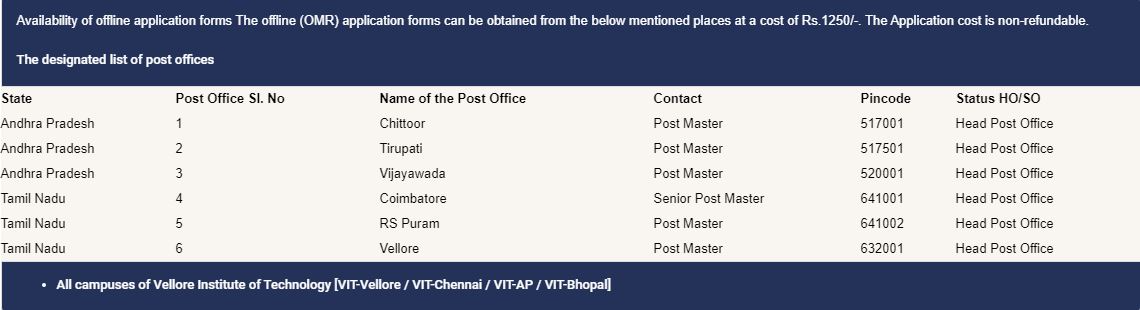
    Vellore Institute of Technology will also allow the candidates to fill out the offline VITEEE application form. Candidates can fill out the offline application form VITEEE and send it to designated post offices on payment of Rs 1450. Applications must reach the authorities before the last date of application.

    Designated Post Offices

    VITEEE_post_offices

    Application Fees

    CategoryQuotaModeGenderAmount

    OBC, EWS, SC, General, ST

    PWD

    Online

    Male, Female

    ₹ 1450

    OBC, EWS, SC, General, ST


    Online

    Male, Female

    ₹ 1450

    Foreign Candidates

    Male, Female$90 in INR

    VITEEE 2027 Sample Papers

    Practice smarter with VITEEE previous year question papers to understand exam pattern, difficulty level, and improve accuracy for better rank and admission chances.

    Download Now

    Documents Required at Exam VITEEE 2027

    VIT Engineering Entrance Exam 2027

    VITEEE Admit Card
    A valid photo ID (Passport, Aadhaar Card, PAN Card, Passport, Voter ID, Driving License, etc.)

    VITEEE 2027 Exam Centers

    StateCity
    Andaman and Nicobar Islands
    Port Blair
    Andhra Pradesh
    Amaravathi
    Anantapur
    Eluru
    Kurnool
    Nellore
    Rajamahendravaram
    Srikakulam
    Tirupati
    Visakhapatnam
    Kakinada
    Chirala
    Ongole
    Vijayawada
    Assam
    Dibrugarh
    Guwahati
    Silchar
    Bihar
    Bhagalpur
    Gaya
    Muzaffarpur
    Patna
    Chhattisgarh
    Bhilai
    Bilaspur
    Raipur
    Delhi
    New Delhi
    Gujarat
    Ahmedabad
    Jamnagar
    Rajkot
    Surat
    Vadodara
    Haryana
    Faridabad
    Gurugram
    Jammu and Kashmir
    Jammu
    Srinagar
    Jharkhand
    Bokaro
    Dhanbad
    Jamshedpur
    Ranchi
    Karnataka
    Bangalore
    Hubballi
    Mangaluru
    Mysuru
    Kerala
    Kozhikode
    Thiruvananthapuram
    Thrissur
    Ernakulam
    Kannur
    Kollam
    Malappuram
    Wayanad
    Madhya Pradesh
    Bhopal
    Gwalior
    Jabalpur
    Indore
    Maharashtra
    Amravati
    Aurangabad
    Latur
    Mumbai
    Nashik
    Nagpur
    Pune
    Solapur
    Navi Mumbai
    Manipur
    Imphal
    Meghalaya
    Shillong
    Mizoram
    Aizawl
    Odisha
    Brahmapur
    Bhubaneshwar
    Rourkela
    Cuttack
    Puducherry
    Puducherry
    Punjab
    Amritsar
    Bathinda
    Ludhiana
    Pathankot
    Sahibzada Ajit Singh Nagar
    Rajasthan
    Ajmer
    Bikaner
    Jaipur
    Jodhpur
    Kota
    Udaipur
    Sikkim
    Gangtok
    Tamil Nadu
    Chennai
    Coimbatore
    Erode
    Madurai
    Nagercoil
    Salem
    Tiruchirappalli
    Tirunelveli
    Vellore
    Thanjavur
    Cuddalore
    Kanyakumari
    Karur
    Namakkal
    Tiruppur
    Viluppuram
    Kanchipuram
    Telangana
    Hyderabad
    Karimnagar
    Khammam
    Mahbubnagar
    Nalgonda
    Warangal
    Tripura
    Agartala
    Uttar Pradesh
    Agra
    Bareilly
    Gorakhpur
    Ghaziabad
    Jhansi
    Kanpur
    Lucknow
    Mathura
    Moradabad
    Prayagraj
    Varanasi
    Noida
    Uttarakhand
    Dehradun
    Haldwani
    West Bengal
    Durgapur
    Kolkata
    Siliguri
    Arunachal Pradesh
    Naharlagun
    Nagaland
    Kohima
    Goa
    Mapusa
    School of Computer Science, UPES, Dehradun

    Ranked #43 among Engineering colleges in India by NIRF | Get Upto 100% Scholarships

    Woxsen University, Hyderabad

    Scholars’ Round Deadline: 14th Nov’26 | Earn upto 50% merit Scholarship + 10% for top performers | EFMD Accredited | AACSB (USA) & AMDISA Member | Highest CTC 28 LPA

    VIT Vellore has released the VITEEE 2027 exam pattern on the official website. Candidates can check the VITEEE paper pattern to know the duration of the exam, types of questions, total marks, marking scheme and more. The authorities will conduct the VITEEE 2027 as a computer-based test (CBT). The duration of the examination will be two hours. The detailed exam pattern for VITEEE 2027 is provided below.

    VITEEE 2027 New Exam Pattern

    Particulars

    Details

    Duration of exam

    2 hours

    Sections

    Mathematics -40 - old

    Physics - 25 questions

    Chemistry - 25 questions

    Aptitude- 5 questions

    English - 5 questions

    VITEEE 2027 total questions

    100

    VITEEE total marks

    400

    Confused About College Admissions?

    Get expert advice on college selection, admission chances, and career path in a personalized counselling session.

    Book a Counselling Slot
    Select Date
    Pick a Slot

    VITEEE 2027 Syllabus

    VITEEE VIT Engineering Entrance Exam Syllabus

    Physics: Unit 01


    Mechanics and properties of matter
    • Law of conservation of linear momentum and its applications
    • Static and kinetic friction, laws of friction-rolling friction, work done by a constant force and a variable force; kinetic energy, work-energy theorem, power
    • Conservative forces: Conservation of mechanical energy (kinetic and potential energies), non-conservative forces: Motion in a vertical circle, elastic and inelastic collisions
    • Elastic behaviour, stress-strain relationship, Hooke's law, Young's modulus, bulk modulus, shear modulus of rigidity, Poisson's ratio, elastic energy. viscosity, Stokes' law, terminal velocity, streamline and turbulent flow, critical velocity
    • Bernoulli's theorem and its applications
    • Heat and thermodynamics: Zeroth law of thermodynamics, temperature. First law of thermodynamics, internal energy, heat, work, isothermal and adiabatic processes. Second law of thermodynamics, reversible and irreversible processes
    • Thermal expansion, heat capacity, Cp, Cv, latent heat, qualitative idea of blackbody radiation: Wien's displacement law, Stefan's law

    Physics: Unit 02


    Electrostatics
    • Charges and their conservation; Coulomb’s law, superposition principle
    • Electric field, electric field due to a point charge, electric field lines; electric dipole, electric field intensity due to a dipole-behaviour of a dipole in a uniform electric field
    • Electric potential, potential difference, electric potential due to a point charge and dipole, equipotential surfaces, electrical potential energy of a system of two point charges
    • Electric flux, Gauss’s law and its applications
    • Electrostatic induction, capacitor and capacitance, dielectrics, electric polarisation, parallel plate capacitor with and without dielectric, applications of capacitor, energy stored in a capacitor, capacitors in series and in parallel
    • Van De Graaff generator

    Physics: Unit 03


    Current electricity & magnetic effects of electric current
    • Electric Current, drift velocity and mobility and their relation with electric current
    • Ohm’s law, electrical resistance, V-I characteristics, electrical resistivity and conductivity, classification of materials in terms of conductivity, carbon resistors, colour code for carbon resistors, combination of resistors, series and parallel
    • Temperature dependence of resistance, internal resistance of a cell, potential difference and EMF of a cell, combinations of cells in series and in parallel
    • Kirchoff’s law, Wheatstone's bridge and its application, metre bridge, special case of Wheatstone bridge, potentiometer principle, comparing the EMF of two cells
    • Magnetic effect of electric current, concept of magnetic field, Oersted’s experiment, Biot–Savart law, magnetic field due to a current carrying straight wire and circular coil, tangent galvanometer, bar magnet as an equivalent solenoid
    • Magnetic field lines
    • Ampere’s circuital law and its application
    • Force on a moving charge in uniform magnetic field and electric field, cyclotron, force on current carrying conductor in a uniform magnetic field, forces between two parallel current carrying conductors, definition of ampere
    • Torque experienced by a current loop in a uniform magnetic field, moving coil galvanometer, conversion to ammeter and voltmeter, current loop as a magnetic dipole, magnetic dipole moment of a revolving electron

    Physics: Unit 04


    Electromagnetic induction and alternating current
    • Electromagnetic induction, Faraday’s law, induced EMF and current, Lenz's law
    • Self induction, mutual induction, self inductance of a long solenoid, mutual inductance of two long solenoids
    • Methods of inducing EMF-(i) by changing magnetic induction, (ii) by changing area enclosed by the coil and, (iii) by changing the orientation of the coil
    • AC generator-(single phase, three phase)
    • Eddy current, applications, transformer, alternating current, AC circuit with resistance, AC circuit with inductor, AC circuit with capacitor, LCR series circuit, resonance and Q-factor, power in AC circuits

    Physics: Unit 05


    Optics
    • Reflection of light, spherical mirrors, mirror formula
    • Refraction of light, total internal reflection and its applications, refraction at spherical surfaces, lenses, thin lens formula, lens maker’s formula
    • Magnification, power of a lens, resolving power, combination of thin lenses in contact, combination of a lens and a mirror. refraction and dispersion of light through a prism
    • Wavefront and Huygens principle, reflection, total internal reflection and refraction of plane wave at a plane surface using wavefronts
    • Interference, Young’s double slit experiment and expression for fringe width, coherent source, formation of colours in thin films, Newton’s rings. diffraction, differences between interference and diffraction of light
    • Polarisation of light waves, polarisation by reflection, Brewster’s law, double refraction, nicol prism, uses of plane polarised light

    Physics: Unit 06


    Dual nature of radiation, atomic & nuclear physics
    • Displacement current, electromagnetic waves and their characteristics, transverse nature of electromagnetic waves, electromagnetic spectrum, photoelectric effect, light waves and photons, particle nature of light, photocells and their applications
    • Atomic structure, discovery of the electron, specific charge (Thomson’s method) and charge of the electron (Millikan’s oil drop method), alpha scattering, Rutherford’s atom model
    • Nuclear properties, nuclear radii, masses, binding energy, density, charge, isotopes, isobars and isotones, nuclear mass defect, binding energy, stability of nuclei
    • Nature of nuclear forces, radioactivity, alpha, beta and gamma radiations and their properties, radioactive decay law, half-life, mean life, artificial radioactivity, radioisotopes, effects and uses
    • Radiocarbon dating. Nuclear fission, chain reaction, atom bomb, nuclear reactor, nuclear fusion

    Physics: Unit 07


    Semiconductor devices and their applications
    • Semiconductor basics, energy bands in solids: Difference between metals, insulators and semiconductors, semiconductor doping, intrinsic and extrinsic semiconductors
    • Formation of P-N Junction, barrier potential and depletion layer-P-N Junction diode, forward and reverse bias characteristics, diode as a rectifier, Zener diode-LED
    • Junction transistors, characteristics, transistor as a switch, transistor as an amplifier, transistor as an oscillator
    • Logic gates, NOT, OR, AND, EXOR using discrete components, NAND and NOR gates as universal gates, De Morgan’s theorem, laws and theorems of Boolean algebra

    Chemistry: Unit 01


    Physical chemistry
    • Atomic structure: Bohr’s atomic model, Sommerfeld’s extension of atomic structure; electronic configuration and quantum numbers; shapes of s, p, d, f orbitals, Pauli’s exclusion principle, Hund’s rule of maximum multiplicity, Aufbau principle
    • Atomic structure: Emission and absorption spectra, line and band spectra; hydrogen spectrum, Lyman, Balmer, Paschen, Brackett and Pfund series; de Broglie’s theory; Heisenberg’s uncertainty principle, wave nature of electron
    • Atomic structure: Schrodinger wave equation (no derivation). Eigenvalues and eigen functions. Chemical bonding and hybridization of atomic orbitals involving s, p and d orbitals
    • Thermodynamics, chemical equilibrium and chemical kinetics: I and II laws of thermodynamics, spontaneous and non-spontaneous processes, entropy, Gibbs free energy, standard Gibbs free energy change (δg ) and chemical equilibrium, significance of entropy
    • Thermodynamics, chemical equilibrium and chemical kinetics: Rate of a chemical reaction, factors affecting rates of reaction: Concentration, temperature, pressure and catalyst; law of mass action, Le Chatelier’s principle
    • Thermodynamics, chemical equilibrium and chemical kinetics: Applications of chemical equilibrium. Rate expression, order, and molecularity of reactions, zero order, first order and pseudo first order reaction, half-life period
    • Thermodynamics, chemical equilibrium and chemical kinetics: Determination of rate constant and order of reaction. Temperature dependence of rate constant, Arrhenius equation, activation energy and its calculation
    • Thermodynamics, chemical equilibrium and chemical kinetics: Elementary concept of collision theory of bimolecular gaseous reactions
    • Solutions: Colligative properties of dilute solutions; different methods for expressing the concentration of solution-molality, molarity, mole fraction, percentage, the vapour pressure of solutions and Raoult's law, ideal and non-ideal solutions
    • Solutions: Vapour pressure-composition, plots for ideal and non-ideal solutions

    Chemistry: Unit 02


    Inorganic and material chemistry
    • The s-block elements: Properties and chemical reactivity of alkali and alkaline earth metals
    • The p-block elements: Phosphorous compounds-PCl3, PCl5-oxides, hydrogen halides, interhalogen compounds and Xenon fluoride compounds
    • General characteristics of d-block elements: Electronic configuration, oxidation states of first-row transition elements and their colours. Occurrence and principles of extraction: Copper, silver, gold and zinc
    • General characteristics of d-block elements: Preparation and properties of CuSo4, AgNO3 and K2Cr2O7
    • Lanthanides: Introduction, electronic configuration, general characteristics, oxidation state-lanthanide contraction, uses, brief comparison of lanthanides and actinides
    • Introduction to coordination chemistry: IUPAC nomenclature of mononuclear coordination compounds; isomerism, geometrical isomerism in 4-coordinate, 6-coordinate complexes. Theories on coordination compounds-Werner’s theory (brief), valence bond theory
    • Introduction to coordination chemistry: Uses of coordination compounds. Bioinorganic compounds (haemoglobin and chlorophyll)
    • Solid-state chemistry: Lattice, unit cell, systems, types of crystals, packing in solids; ionic crystals, imperfections in solids, point defects, X-ray diffraction, electrical property, amorphous solids (elementary ideas only)
    • Surface chemistry: Adsorption, physisorption and chemisorption; catalysis, homogeneous and heterogeneous catalysis

    Chemistry: Unit 03


    Analytical chemistry
    • Electrochemistry: Redox reactions; theory of electrical conductance; metallic and electrolytic conductance. Faraday’s laws, theory of strong electrolytes, specific resistance, specific conductance, equivalent and molar conductance
    • Electrochemistry: Variation of conductance with dilution, Kohlrausch’s law, ionic product of water, ph, and ph-buffer solutions, use of ph values. cells, electrodes and electrode potentials, construction of cell
    • Electrochemistry: EMF values and standard electrode potentials, Nernst equation and its application to chemical cells. Relation between Gibbs energy change and EMF of a cell, dry cell, electrolytic cells and galvanic cells; lead accumulator; fuel cells
    • Electrochemistry: Corrosion and its prevention
    • Environmental chemistry: Environmental pollution-atmospheric, water and soil

    Chemistry: Unit 04


    Basic principles of organic chemistry
    • Carbon: Tetravalency, hybridization; classification of organic compounds, functional groups; homologous series; nomenclature (IUPAC); homolytic and heterolytic bond cleavage; carbocations, carbanions and free radicals; electrophiles and nucleophiles
    • Carbon: Inductive effect, electromeric effect, resonance and hyperconjugation
    • Common organic reactions: Substitution, addition, elimination and rearrangement
    • Isomerism in organic compounds: Definition, classification-structural isomerism, stereo isomerism-geometrical and optical isomerism. Optical activity, chirality, compounds containing chiral centres, R, S notation, D, L notation
    • Detection of the functional groups in organic compounds: Hydroxyl (alcoholic and phenolic), carbonyl (aldehyde and ketones) carboxyl and amino groups

    Chemistry: Unit 05


    Properties and chemistry of functionalized organic compounds
    • Alcohols and ethers: Nomenclature of alcohols, classification of alcohols, distinction between 1°, 2° and 3° alcohols, general methods of preparation of primary alcohols, properties. methods of preparation of dihydric alcohols: Glycol, properties, uses
    • Alcohols and ethers: Methods of preparation of trihydric alcohols, properties, uses. aromatic alcohols, preparation and properties of phenols and benzyl alcohol; ethers, nomenclature of ethers
    • Alcohols and ethers: General methods of preparation of aliphatic ethers, properties, uses. Aromatic ethers, preparation of anisole, uses
    • Carbonyl compounds: Nomenclature of carbonyl compounds, comparison of aldehydes and ketones. General methods of preparation of aldehydes, properties, uses. Aromatic aldehydes, preparation of benzaldehyde, properties and uses
    • Carbonyl compounds: Ketones, general methods of preparation of aliphatic ketones (acetone), properties, uses. aromatic ketones, preparation of acetophenone, properties, uses, preparation of benzophenone, properties. name reactions; Clemmensen reduction
    • Carbonyl compounds: Wolff-Kishner reduction, Cannizzaro reaction, Claisen Schmidt reaction, benzoin condensation, aldol condensation. Preparation and applications of Grignard reagents.
    • Carboxylic acids and their derivatives: Nomenclature, preparation of aliphatic monocarboxylic acids, formic acid, properties, uses. Monohydroxy mono carboxylic acids; lactic acid, synthesis of lactic acid. Aliphatic dicarboxylic acids
    • Carboxylic acids and their derivatives: Preparation of oxalic and succinic acids. Aromatic acids: Benzoic and salicylic acids, properties, uses. Derivatives of carboxylic acids; acetyl chloride (CH3COCl), preparation, properties, uses
    • Carboxylic acids and their derivatives: Preparation of acetamide, properties, acetic anhydride, preparation, properties. Preparation of esters, methyl acetate, properties

    Chemistry: Unit 06


    Organic nitrogen compounds
    • Organic nitrogen compounds: Aliphatic nitro compounds, preparation of aliphatic nitroalkanes, properties, uses. Aromatic nitro compounds, preparation, properties, uses. Distinction between aliphatic and aromatic nitro compounds
    • Organic nitrogen compounds: Amines; aliphatic amines, general methods of preparation, properties, distinction between 1°, 2° and 3°amines. Aromatic amines, synthesis of benzylamine, properties, aniline, preparation, properties, uses
    • Organic nitrogen compounds: Differences between aliphatic and aromatic amines. Aliphatic nitriles, preparation, properties, uses. Diazonium salts, preparation of benzene diazonium chloride, properties

    Chemistry: Unit 07


    Biomolecules and polymers
    • Carbohydrates: Distinction between sugars and non-sugars, structural formula of glucose, fructose, and sucrose, with their linkages, invert sugar-definition, examples of oligo and polysaccharides
    • Amino acids and proteins: Classification of amino acids with examples, peptides-properties of peptide bond; proteins-primary, secondary, tertiary and quaternary structure (qualitative idea only), denaturation of proteins, enzymes
    • Lipids: Definition, classification with examples, difference between fats, oils, and waxes
    • Nucleic acids: Chemical constitution of DNA and RNA
    • Polymers: Classification, natural and synthetic, methods of polymerization (addition and condensation), copolymerization. Some important polymers: Natural and synthetic like polythene, nylon, polyesters, Bakelite, rubber
    • Polymers: Biodegradable and non-biodegradable polymers

    Mathematics: Unit 01


    Matrices and their applications
    • Algebra of matrices, determinants and its properties, adjoint and inverse of a square matrix using determinants and elementary transformations, rank, test of consistency and solution of simultaneous linear equations up to three variables
    • Solution of linear programming problem in two variables

    Mathematics: Unit 02


    Trigonometry and complex numbers
    • Fundamentals of trigonometry, trigonometric, inverse trigonometric functions and their properties, heights and distances
    • Complex number system-conjugate, properties, ordered pair representation
    • Argand diagram, algebra of complex numbers, modulus and argument (or polar form) of a complex number
    • Solution of polynomial equations, De Moivre’s theorem and its applications
    • Roots of a complex number, cube and fourth roots

    Mathematics: Unit 03


    Analytical geometry of two dimensions
    • Coordinate geometry, equation of a straight line and family of straight lines-properties, definition of a conic-general equation of a conic, classification with respect to the general equation of a conic and eccentricity
    • Equations of conic sections (parabola, ellipse and hyperbola) in standard forms and general forms-directrix, focus and Latus-rectum, parametric form of conics and chords
    • Tangents and normals, Cartesian form and parametric form, equation of chord of contact of tangents

    Mathematics: Unit 04


    Vector algebra
    • Scalar product and vector product of two vectors-properties and applications, scalar and vector triple product-properties

    Mathematics: Unit 05


    Analytical geometry of three dimensions
    • Coordinates of a point in space, the distance between two points, section formula, directions ratios and direction cosines, the angle between two intersecting lines. Skew lines, the shortest distance between them and its equation
    • Equations of a line and a plane in different forms, the intersection of a line and a plane, coplanar lines

    Mathematics: Unit 06


    Differential calculus
    • Limits, continuity and differentiability of functions-properties, applications: Tangent, normal and angle between curves
    • Mean value theorem, Rolle’s Theorem, Lagrange mean value theorem, Taylor’s and Maclaurin’s series, stationary points, increasing, minima of decreasing, maxima, functions of one variable, concavity and points of inflexion, errors and approximations

    Mathematics: Unit 07


    Integral calculus and its applications
    • Simple definite integrals, fundamental theorems of calculus, properties of definite integrals, reduction formulae, area of bounded regions, length of the curves

    Mathematics: Unit 08


    Differential equations
    • Differential equations-formation, order and degree
    • Solution of first order differential equations: Variables separable, Homogeneous, linear equations and applications

    Mathematics: Unit 09


    Probability and distributions
    • Basics of probability, axioms, addition law, conditional probability, multiplicative law, Bayes theorem
    • Random variables, probability density function, distribution functions, mathematical expectation, variance, discrete distributions: Binomial and Poisson.

    Mathematics: Unit 10


    Discrete mathematics
    • Sets, relations, functions, binary operations
    • Sequence and series (AP, GP, HP), binomial theorem, counting techniques mathematical logic, logical statements, connectives, truth tables, logical equivalence, tautology, contradiction

    Biology: Unit 01


    Taxonomy
    • Need for classification; three domains of life
    • Linnaean, Whittaker, Bentham and Hooker systems of classification
    • Salient features and classification of non-chordates up to phyla levels and chordates up to class levels
    • Morphology and anatomy of flowering plants
    • Structural organization in insects (cockroach)

    Biology: Unit 02


    Cell and molecular biology
    • Cell theory
    • Prokaryotic cell and its ultrastructure
    • Eukaryotic cell-cell wall, cell membrane, cytoskeleton, nucleus, chloroplast, mitochondria, endoplasmic reticulum, Golgi bodies, ribosomes, lysosomes, vacuoles and centrosomes
    • Cell cycle and division-amitosis, mitosis and meiosis
    • Search for genetic material; structure of DNA and RNA; replication, transcription, genetic code, translation, splicing, gene expression and regulation (lac operon) and DNA repair

    Biology: Unit 03


    Reproduction
    • Asexual reproduction-binary fission, sporulation, budding, gemmule formation and fragmentation, vegetative propagation in plants
    • Sexual reproduction in flowering plants-structure of flowers
    • Pollination, fertilization, development of seeds and fruits, seed dispersal, apomixis, parthenocarpy and polyembryony
    • Human reproductive system-gametogenesis, menstrual cycle, fertilization, implantation, embryo development up to blastocyst formation, pregnancy, parturition and lactation
    • Assisted reproductive technologies

    Biology: Unit 04


    Genetics and evolution
    • Chromosomes-structure and types, linkage and crossing over, recombination of chromosomes, mutation and chromosomal aberrations
    • Mendelian inheritance, chromosomal theory of inheritance, deviation from Mendelian ratio (incomplete dominance, codominance, multiple allelism, pleiotropy), sex linked inheritance and sex determination in humans
    • Darwinism, neo Darwinism, Hardy and Weinberg’s principle and factors affecting the equilibrium: Selection, mutation, migration and random genetic drift

    Biology: Unit 05


    Human health and diseases
    • Pathogens, parasites causing human diseases (malaria, dengue, chikungunya, filariasis, COVID, ascariasis, typhoid, pneumonia, common cold, amoebiasis, ringworm) and their control
    • Basic concepts of immunology, vaccines, antibiotics, cancer, HIV and AIDS. Adolescence, drug and alcohol abuse

    Biology: Unit 06


    Biochemistry
    • Structure and function of carbohydrates, lipids and proteins
    • Enzymes-types, properties and enzyme action
    • Metabolism-glycolysis, fermentation and Krebs cycle

    Biology: Unit 07


    Plant physiology
    • Movement of water, food, nutrients, gases and minerals
    • Passive diffusion, facilitated diffusion, and active transport
    • Imbibition, osmosis, apoplast and symplast transport and guttation
    • Macro and micronutrients and their deficiency symptoms
    • Transpiration, photosynthesis (light and dark reactions) and electron transport chain
    • Hormones and growth regulators, photoperiodism and vernalization
    • Nitrogen cycle and biological nitrogen fixation

    Biology: Unit 08


    Human physiology
    • Digestion and absorption, breathing and respiration, body fluids and circulation, excretory system, endocrine system, nervous system, skeletal and muscular systems
    • Locomotion and movement, growth, ageing and death
    • Hormones-types of hormones, functions and disorders

    Biology: Unit 09


    Biotechnology and its applications
    • Recombinant DNA technology, applications in health, agriculture and industries; genetically modified organisms; human insulin, vaccine and antibiotic production
    • Stem cell technology and gene therapy
    • Apiculture and animal husbandry
    • Plant breeding, tissue culture, single cell protein, fortification, Bt crops and transgenic animals
    • Microbes in food processing, sewage treatment, waste management and energy generation
    • Biocontrol agents and biofertilizers
    • Biosafety issues, biopiracy and patents
    • Human and rice genome projects
    • DNA fingerprinting

    Biology: Unit 10


    Biodiversity, ecology and environment
    • Ecosystems: Components, types, pyramids, nutrient cycles (carbon and phosphorous), ecological succession and energy flow in an ecosystem; biodiversity-concepts, patterns, importance, conservation, hot spots, endangered organisms, extinction
    • Red data book, botanical gardens, national parks, sanctuaries, museums, biosphere reserves and Ramsar sites
    • Environmental issues: Pollution and its control. Solid and radioactive waste management. Climate change impact and its mitigation. Population attributes-growth, birth and death rate and age distribution

    Aptitude: Unit 01


    Data interpretation
    • Tabular chart, pie chart, bar chart, line graph, mixed charts

    Aptitude: Unit 02


    Data sufficiency

      Aptitude: Unit 03


      Syllogism
      • 2 statements and 2 conclusions, 3 statements and 2 conclusion, 2 statements and 4 conclusions, 3 statements and 4 conclusions, 3 statement and 3 conclusions

      Aptitude: Unit 04


      Number series
      • Coding and decoding, number series, Letter to Letter coding, Letter to number coding, mixed coding

      Aptitude: Unit 05


      Clocks, calendars, and directions
      • Mirror image of the clock, angle based questions, gain or loss per day, finding days/dates, finding odd days, occurrence of same calendar year, direction faced with respect to the starting point, distance between two points

      English: Unit 01


      Short passage

        English: Unit 02


        Line of poems

          English: Unit 03


          Dialogues
            Recommended Exams

            Other Engineering Exams

            UPESEAT
            Ranked #43 among Engineering colleges in India by NIRF | Get Upto 100% Scholarships

            VIT Vellore will activate the VITEEE mock test link online. Candidates who are appearing for the VITEEE 2027 entrance must access the mock test of VIT 2027 on the official website, viteee.vit.ac.in. No credentials will be required to access the VITEEE mock test. The VITEEE Mock test helps candidates to get an idea of the actual entrance exam. By solving VITEEE mock test candidates will be able to get to know the pattern and difficulty level of the entrance test.

            How to access the VITEEE Mock test?

            Follow the below steps to access the VITEEE mock test.

            • Visit the official website of VITEEE- vit.ac.in.

            • Click on the VIT Mock test login link.

            • Click on the sign-in tab to proceed further. No login credentials will be required.

            • The instructions will be displayed on the screen. Candidates need to read the instructions and click on confirm to move next.

            • In the next step, candidates will be redirected to the VITEEE 2027 mock test and candidates can start attempting the test.

            The candidates preparing for the VITEEE 2027 exam must have a clear exam preparation strategy to clear the exam with flying colours. VIT aspirants need to make study plans and follow them carefully to score good ranks in the VITEEE. Here you can check the effective VITEEE 2027 exam preparation tips.

            • Understand the VITEEE 2027 syllabus & exam pattern carefully. Check what are the important topics of VIT, the types of questions asked in exams, the number of questions, the marking scheme and more.

            • Make a study timetable, divide important topics by difficulty level and give more time to harder and weak sections/topics.

            • Practising VITEEE mock tests regularly will surely improve time management and accuracy for the exam.

            • Choose the best books to cover the syllabus.

            • Don't forget to take notes while studying. These notes will help you at the time of revision.

            Related links:

            The authority has announced the VITEEE 2027 admit card release date on the official website. The VITEEE admit card will be issued on April 25, 2027. Candidates will be able to download the VITEEE admit card 2027 after the completion of the slot booking process. The admit card of VITEEE 2027 will consist of details such as the VITEEE entrance exam date and time, time of reporting, venue, candidate's roll number, etc. Candidates need to carry the VIT admit card and a valid photo ID on the day of the exam. 

            How to download VITEEE Admit Card 2027?

            Candidates must follow the below steps to download the VITEEE 2027 hall ticket:

            • Visit VITEEE official website of VIT- vit.ac.in.

            • Enter the application number and password in the candidates' portal

            • Complete the VITEEE slot booking process.

            • The admit card will be available for download in the last step.

            • Candidates may download and print out their VITEEE hall ticket.

            • Check for any discrepancies/ errors in the admit card and report to the authorities without delay.

            Details Mentioned on the VITEEE 2027 Admit Card

            The following are the details mentioned in the admit card of VITEEE 2027

            • Candidate's name

            • Course and Subject

            • Application number

            • Exam Centre Address

            • Date and Time of the exam

            • Scanned photograph of the candidate

            VIT Vellore will announce the VITEEE result 2027 release date on the official website, vit.ac.in. Candidates will need to provide the VIT login credentials to check the VITEEE exam result 2027. The VIT login credentials include the application number and password. VITEEE results will be prepared based on the marks secured by the candidates in the Physics, Chemistry, and Mathematics sections. The authority has followed the Equipercentile Equating procedure to calculate the VITEEE result. The qualified candidates are called for the counselling and seat allotment process of VITEEE 2027.

            How to Check VITEEE Result 2027

            To download the VIT exam result, candidates have to follow the steps mentioned below:

            • Visit the official website.

            • Click on the link to the results for B.Tech courses.

            • Enter the application number and password.

            • Click on the 'Submit' button

            • The VIT BTech result will be displayed on the screen.

            Candidates will find the following details in VITEEE 2027 rank card:

            • Name of the candidate

            • Application Number

            • Gender of the candidate

            • Score obtained

            • Rank obtained

            VIT will soon release the VITEEE cutoff on the official website. The cutoff 2027 for VITEE is the minimum rank that candidates need to participate in the counselling process. The authority will conduct the VITEEE 2027 counselling according to the categories. The eligible ranks for the VITEEE counselling 2027 will be divided into 5 categories. Candidates can find the VITEEE 2027 Ranks below when they are released. Candidates can also refer to the previous year cutoffs here.

            Previous year's VITEEE Cut off Category wise

            Candidates can check below the previous year's VITEEE cut-off, category-wise:


            2 Lakhs

            3 Lakhs

            4 Lakhs

            4.4 Lakhs

            5 Lakhs

            Campus

            Program

            Category 1

            Category 2

            Category 3

            Category 4

            Category 5

            Vellore

            CSE

            950

            3500

            19000

            22000

            25500

            CSE with specialisations

            2800

            9000

            23000

            27000

            31000

            Chennai

            CSE

            8000

            14000

            25000

            29000

            34000

            CSE with specialisations

            11500

            20500

            26000

            32000

            42000

            The authority will announce the VITEEE 2027 counselling schedule on the official website. The counselling for VITEEE 2027 will be held after the declaration of the VIT exam results. Candidates must complete the VITEEE counselling fee payment to participate in the counselling process. Moreover, the seat allotment of VIT 2027 will be based on the VIT rank list and the choices made by candidates during registration. Candidates must note that to confirm the allotted seats, they have to pay the 50% fee at the time of admission during VITEEE 2027 counselling.

            VITEEE Counselling 2027 Process

            The authorities will conduct the VITEEE counselling 2027 in an online mode. Thus, candidates should be aware of the process that they will have to follow to participate in the VIT counselling for B.Tech. The step-wise process for VITEEE counselling is explained below:

            • Step 1 - Check VITEEE rank - As the authorities will release the VITEEE counselling dates based on the range of ranks obtained by candidates, they must be aware of the rank secured in the exam. VITEEE 2027 results will be announced along with the rank list.
            • Step 2 - Registration - As the VITEEE counselling 2027 is conducted in online mode, candidates will first have to complete online registration with a fee of Rs 5,900, before the deadline. At this time, candidates have to fill out the form and express their category, their preference of course, and campus.
            • Step 3 - Verification of Documents - Candidates need to upload certain documents to prove their eligibility for admission through VITEEE. Check the instructions properly regarding this before proceeding to the VIT Counselling venue.
            • Step 4 - Allotment of Seats - Once the documents are verified, candidates will be allotted seats for VIT B.Tech admission based on their ranks and preferences filled by them.
            • Step 5 - Payment of VIT counselling Fees - After acceptance of the seat so allotted during VITEEE 2027 counselling, candidates will be required to pay the relevant admission fees at the campus to confirm their admissions. A demand draft of Rs. 50,000 has to be drawn in favour of “Vellore Institute of Technology” payable at Vellore. It may be noted that of the total amount, Rs. 11,800 will be the VITEEE counselling fees which shall be non-refundable.

            VITEEE 2027 Participating Institutes

            The participating institutes of VITEEE 2027 will be,

            Documents Required at VITEEE 2027 counselling

            VIT Engineering Entrance Exam 2027

            VITEEE 2027 admit card
            VITEEE 2027 counselling call letter
            VITEEE 2027 result
            10th standard certificate (as a proof of age)
            10+2 (or equivalent) qualifying examination mark sheet
            Category certificate (if applicable)
            Demand draft for Rs 50,000 drawn in favour of ‘VIT University’, payable at Vellore.
            Copy of Aadhaar card
            Student profile
            Undertaking form
            Migration certificate
            Transfer certificate

            Students should refer to the below given best books for VITEEE entrance exam 202. These books cover all the topics and chapters that are asked in the entrance exam.

            Best VITEEE Maths Books 2027

            Book NameAuthor

            Target VITEEE

            Disha Experts

            Degree level Differential Calculus

            A Das Gupta

            Problems in Calculus of One Variable

            I.A. Maron

            Higher Algebra

            Hall and Knight

            Objective Mathematics 

            R.D. Sharma

            Best VITEEE Physics Books 2027

            Book NameAuthor

            Understanding Physics Series

            DC Pandey

            Concept of Physics

            H.C.Verma

            Problems in General Physics

            I.E.Irodov

            Objective Physics 

            DC Pandey and Arihant team

            A Problem Book in Physics for IIT JEE

            D.C. Pandey

            Best VITEEE Chemistry Books 2027

            Book NameAuthor

            Textbook for Class XI & XII

            NCERT

            Target VITEEE

            Disha Experts

            Handbook of Chemistry

            R.P. Singh

            Modern Approach to Chemical Calculations

            R. C. Mukherjee

            Organic Chemistry

            O. P. Tandon & Morrison Boyd.

            Previous year's VITEEE papers are available for students online. Candidates can check the subject-wise model papers which will be released by the institute along with the mock test to know the exam pattern and type of questions asked in the VITEEE entrance exam.

            General Information

            Contact Number:

            044-46277555

            Relevant Links:

            Official Website Link Click Here, + 2 more
            Parul Institute of Technology, Vadodara

            Diploma (17 Specializations), B.Tech / B.Tech (Hons.) / IE-B.Tech - 4 years - 25+ specializations | M. Tech - 14+ specializations | Highest CTC – 60 LPA

            Parul University, Goa

            Special Scholarship for Students from Goa (Get an exclusive scholarship of ₹20,000 if you're a Goa-based student) | Bringing Parul Education Trust's 30-year Education Legacy to Goa

            Frequently Asked Questions (FAQs)

            Q: Are the VITEEE result out?
            A:

            No, The VITEEE 2027 result date will be announced on the official website.

            Q: In what mode can I apply for VITEEE 2027?
            A:

            Candidates will be able to fill out the VITEEE 2027 application form online mode by visiting the official website.

            Q: When will the VITEEE 2027 exam be conducted?
            A:

            The authority will conduct the VITEEE 2027 exam from April 27 to May 2, 2027. 

            Q: When will the VITEEE 2027 application form be released?
            A:

            The VITEEE 2027 application form dates are October 20 to March 31, 2026. 

            Q: What is the exam pattern for VITEEE 2027?
            A:

            The new VITEEE 2027 exam pattern consists of 100 questions: Mathematics -40 , Physics - 25 questions, Chemistry - 25 questions, Aptitude- 5 questions, and English - 5 questions. 

            Q: Is there any negative marking in VITEEE 2027?
            A:

            Yes, there is negative marking for the VITEEE exam 2027.

            Q: What is VITEEE 2027?
            A:

            Vellore Institute of Technology Engineering Entrance Examination (VITEEE) is conducted for admission to undergraduate engineering programmes in VIT group of Institutions.

            Q: How to choose the VITEEE 2027 exam centres?
            A:

            Students have to choose the exam centres while filling the VITEEE application form 2027.

            Q: What are the VITEEE 2027 login credentials?
            A:

            Candidates can log in to the VITEEE candidate portal using their email ID and password.

            Q: What are the documents required to carry at the VITEEE exam centre?
            A:

            Candidates needed to carry the VITEEE 2027 admit card along with a valid photo identification proof while appearing in the exam.

            Articles
            |

            Questions related to VITEEE

            On Question asked by student community

            Have a question related to VITEEE ?

            Hello, the result process can vary by state. Please tell me your state, and I can guide you on where and how to check your result and merit status.

            Hi, IBPS PO ka result check karne ke liye aapko apne registration number/roll number aur password ya date of birth ki zarurat padegi. Agar aapko result page mil nahi raha hai, to apna exam year aur ye bata dijiye ki aapne Prelims ya Mains diya tha. Main aapko step-by-step check

            For CLAT 2027 UG, candidates need to have passed Class 12/equivalent with at least 45% marks, or 40% for SC/ST/PwD candidates.

            In your situation, having an RT in an additional subject but subsequently passing the required qualification through an improvement examination does not automatically make you ineligible. However, the important

            Student Community: Where Questions Find Answers

            Ask and get expert answers on exams, counselling, admissions, careers, and study options.