
Search Colleges, Exams, Schools & more


Login
VITEEE 2027 New Changes - Shorter Test Duration, Sectional Timing Introduced
VITEEE 2027 New Changes - VIT has issued the VITEEE 2027 notification on October 20, 2027. According to the latest update, VITEEE exam pattern and syllabus has been revised. The exam pattern has a total of 400 marks and consists of 100 MCQs: Mathematics -40 questions, Physics -25 questions, Chemistry -25 questions, English - 5 questions, and Aptitude -5 questions. The VITEEE 2027 registration process began online. Students must pass the HSC/Class XII examination in 2025 or 2026, or be appearing for the VITEEE and HSC/Class XII examination in 2027. The authority will conduct the VITEEE 2027 exam from April 27 to May 2, 2027.
This Story also Contains
- VITEEE 2027 New Exam Pattern
- VITEEE 2027 Syllabus Changed
- VITEEE Conduct Exam
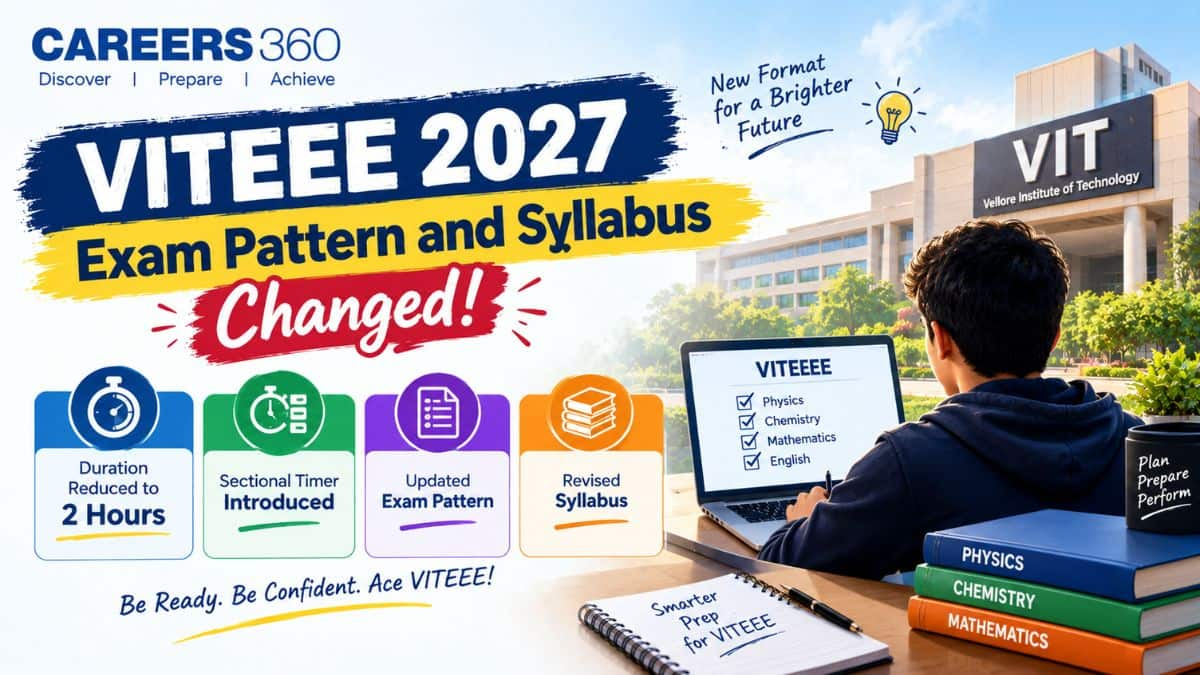
Candidates who passed the HSC/Class XII examination in 2024 or earlier are not eligible to appear for VITEEE 2027 or seek admission. The VITEEE 2027 examination will be conducted for a duration of 2 hours.
VITEEE 2027 Summary All the Changes
- VITEEE 2027 Eligibility Criteria: This year, there is no age limit.
- Revised Exam Pattern: The exam pattern has been revised to a total of 400 marks, consisting of 100 MCQs: Mathematics – 40 questions, Physics – 25 questions, Chemistry – 25 questions, English – 5 questions, and Aptitude – 5 questions.
- Revised Syllabus: The VITEEE 2027 syllabus has been revised, with new topics added to Physics and Mathematics and topics added and removed in Chemistry.
- New Exam Centres: The new VITEEE 2027 exam centres include Chirala, Ongole, Vijayawada, Mapusa, Bilaspur, and Cuttack.
Test City and Centre Allotment: VIT will allot the test city, centre, date, and time based on the candidate’s correspondence address and valid address proof. If the preferred location is unavailable or valid address proof is not submitted, VIT may cancel the application or allot an alternative test centre without any refund. - Admission Criteria: Qualifying for the examination and being called for counselling does not guarantee admission. Admission depends on the candidate’s rank and the availability of seats.
VITEEE 2027 New Eligibility Criteria
| Criteria | Eligibility Criteria |
|---|---|
Nationality | In the case of Resident Indian, NRI and OCI, it is required to have a residential address in India as mentioned in the text 2027. |
Qualifying Examination | The candidates must have passed the class XII examination in 2025/2026 or appear for VITEEE and class XII in 2027. Those who have passed out in or before 2024 are not eligible. |
English Subject | Candidates must have English as one of their subjects in the qualifying examination. |
Single Board Requirement | Candidates must complete all required subjects through one recognised examination board in a single academic year. |
Combining Board Marks | Candidates cannot combine subjects or marks from different boards or academic years to satisfy eligibility requirements. |
Multiple Board Examinations | Candidates who have appeared for multiple board examinations in the same academic year are ineligible. This restriction was also present in 2026, but is restated in 2027. |
Board Code | The candidates are required to choose the right board code from the list of Board code mentioned in the VITEEE 2027 prospectus. If a wrong/mismatch code is entered, the application may be rejected without notice. |
Subject Combination | The 2027 text explicitly defines PCM, PCB and PCMB according to the subjects listed on the Class XII/HSC marksheet. |
Community / Nativity Certificate | Candidates in the specified reserved categories and regions must produce the required certificate at counselling. The 2027 text additionally states that admission may be void ab initio if eligibility norms are not met. |
MPCEA / BPCEA Marks | The 2027 text explicitly states that PCM marks are considered for MPCEA candidates and PCB marks for BPCEA candidates when determining eligibility. |
VITEEE 2027 New Exam Pattern
| Particulars | Details |
|---|---|
Duration of exam | 2 hours |
Sections | Mathematics -40 - old Physics - 25 questions Chemistry - 25 questions Aptitude- 5 questions English - 5 questions |
VITEEE 2027 total questions | 100 |
400 |
Confused About College Admissions?
Get expert advice on college selection, admission chances, and career path in a personalized counselling session.
Book a Counselling Slot
Select Date
Pick a Slot
VITEEE 2027 Syllabus Changed
The authority has released the VITEEE syllabus 2027 on the official website. Candidates can refer to the new syllabus for VITEEE in the table below.
VITEEE 2027 Physics Syllabus New Topics
| Units | Topics |
|---|---|
SI units; dimensions and dimensional analysis; significant figures; least count and zero error; systematic and random errors; absolute, relative and percentage uncertainty; simple uncertainty calculation. Graphical interpretation. | |
Motion in one and two dimensions; displacement, velocity and acceleration; motion graphs; relative motion; projectile and circular motion. Newton’s laws; free-body diagrams; equilibrium; friction; inclined planes; connected bodies and ideal pulleys. Inertial and uniformly accelerating frames. | |
Work by constant and simple variable forces; kinetic and potential energy; power; conservative and dissipative forces; energy conservation. Impulse; momentum conservation; centre of mass; elastic and inelastic collisions in one and two dimensions; coefficient of restitution; simple potential-energy diagrams. | |
Angular motion; torque; angular momentum; rotational energy; moments of inertia of standard uniform bodies; parallel-axis and perpendicular-axis theorems. Static equilibrium, fixed-axis rotation and rolling without slipping. Gravitation; field and potential; variation of gravitational acceleration with altitude; Kepler’s laws; circular satellite orbits, orbital energy, geostationary satellites and escape velocity. | |
Mechanical Properties of Matter | Fluid pressure; Pascal’s principle; buoyancy and flotation, Surface tension, surface energy, and capillary effects. |
Oscillations and Mechanical Waves | Simple harmonic motion: phase, energy. Spring–mass systems, spring combinations and the simple pendulum damping, forced oscillations, resonance, travelling waves, superposition, standing waves, harmonics; beats; speed of sound, doppler effect |
Thermal Physics | Calorimetry, phase changes, conduction, convection, Newton's law of cooling, ideal gases, kinetic theory, RMS speed, equipartition of energy, P–V diagrams, heat engines, refrigerators, Carnot limits, entropy |
Uniform charge distributions, conductors in electrostatic equilibrium, electrostatic shielding, fixed-charge and fixed-voltage capacitor situations | |
Ohmic and non-Ohmic behaviour. Electrical energy and power; simple electrical networks | |
Circular and helical charged-particle motion; crossed-field applications. Magnetic fields due to long solenoids; magnetic dipoles; energy. dia-, para-, and ferro - magnetic materials. | |
Motional induction, magnetic energy. Elementary RC charging and discharging, peak and rms values; reactance, impedance, phase, electromagnetic-wave applications | |
Elementary microscopes and telescopes, single-slit diffraction;Malus’s and Brewster’s laws. | |
Modern Physics | Matter waves; de Broglie relation; Bohr’s model, hydrogen-like atom; energy levels and spectra, mass–energy equivalence; radioactive decay, half-life, mean life and activity; fission, fusion and reaction energy. |
Electronics | I-V characteristics of photodiode, solar cell and elementary logic gate (XNOR). |
VITEEE 2027 Chemistry Syllabus New Topics
| Units | Topics |
|---|---|
Physical Chemistry | Chemical bonding: ionic and covalent bonds, Bond parameters and Lewis structures, Polar character of covalent bonds and covalent character of ionic bonds, Valence Bond Theory Resonance, VSEPR Theory, Geometry of covalent molecules, Molecular Orbital Theory of homonuclear diatomic molecules, Hydrogen bonding, Zeroth Law of Thermodynamics, Third Law of Thermodynamics, Internal energy and enthalpy, Heat capacity and specific heat, Measurement of Δ?ΔU and Δ?ΔH, Hess’s law of constant heat summation, Enthalpy of bond dissociation, combustion, formation, Atomization, Sublimation, phase transition, Ionization, solution and dilution. |
Analytical Chemistry | Equilibrium in physical and chemical processes, Dynamic nature of equilibrium, Equilibrium constant, Ionic equilibrium, Ionization of acids and bases, Strong and weak electrolytes, Degree of ionization, Ionization of polybasic acids, Acid strength, Hydrolysis of salts, Henderson equation, Solubility product, Common ion effect. |
Inorganic Chemistry | Modern periodic law and present form of the periodic table, Periodic trends in atomic and ionic radii, Ionization enthalpy and electron gain enthalpy, Valence, oxidation states and chemical reactivity, General introduction to p-block elements (Groups 13–18), Unique behaviour of the first element in each group, Boron, borax, boric acids and boron hydrides, Aluminium and its reactions with acids and alkalies, Carbon catenation and allotropic forms, Silicon tetrachloride, silicones, silicates and zeolites, Ammonia and nitric acid, Oxides of nitrogen (structure only), Phosphine and phosphorus oxoacids, Dioxygen and ozone, Sulphur dioxide and sulphuric acid, Oxoacids of sulphur, Chlorine and hydrochloric acid, Oxoacids of halogens. |
Coordination and Material Chemistry | Crystal Field Theory (CFT) Colour and magnetic properties of coordination compounds Classification of solids based on binding forces Two-dimensional and three-dimensional lattices Calculation of unit-cell density Packing efficiency and voids Number of atoms per unit cell in a cubic unit cell Magnetic properties of solids Band theory of metals Conductors, semiconductors and insulators n-type and p-type semiconductors Colloidal state True solutions, colloids and suspensions Lyophilic, lyophobic, multimolecular and macromolecular colloids Tyndall effect Brownian movement Electrophoresis Coagulation Emulsions and their types |
Basic Principles of Organic Chemistry and Functionalized Organic Compounds | Aromaticity Electrophilic substitution Halogenation Friedel–Crafts alkylation and acylation Haloform reaction |
Carboxylic Acids, Organic Nitrogen Compounds, Biomolecules and Polymers | Vitamins: types and functions, Chemistry in Everyday Life, Chemicals in medicines: analgesics, tranquilizers, antiseptics, disinfectants, antimicrobials, antifertility drugs, antibiotics, antacids and antihistamines, Chemicals in food: preservatives and artificial sweetening agents, Elementary concepts of antioxidants Cleansing agents: soaps and detergents Cleansing action of soaps and detergents |
VITEEE 2027 Maths Syllabus New Topics
| Units | Topics |
|---|---|
Matrices and Applications | Solution of Linear Programming problem in two variables, Simple applications. - Theory of equations, Cubic, Biquadratic equations, and solutions. |
Differential Calculus | Rate of change of quantities |
Integral Calculus and its Applications | Indefinite integrals |
Ordinary Differential Equations | Bernoulli’s equations |
Probability and Statistics | Measures of central tendency, Dispersion – Grouped and ungrouped Data. |
Discrete Mathematics | Binary Operations and Types, Product rule, Permutations and Combinations, Contingency. |
VITEEE Conduct Exam
The test city, test centre, test date, and time will be allotted by VIT. The test centre will be allotted based on the candidate’s correspondence address. If you do not upload valid proof of your correspondence address, your application will be cancelled, and no refund will be provided. In the event that a test city or test centre is unavailable in the region corresponding to the candidate’s correspondence address, VIT reserves the right to allot an alternative test city and test centre, including the nearest available test city, as deemed appropriate by the Institute. The allotment of the test city and test centre will be at the sole discretion of VIT, and candidates will not be entitled to claim any particular test city or test centre.
VITEEE 2027 Exam Centres - New
| States | Cities |
|---|---|
Andhra Pradesh | Chirala |
Ongole | |
Vijayawada | |
Goa | Mapusa |
Himachal Pradesh | Bilaspur |
Odisha | Cuttack |
Frequently Asked Questions (FAQs)
Q: When will the VITEEE 2027 exam be held?
A:
Th VITEEE 2027 exam will be conducted from April 27 to May 2, 2027.
Q: What are the new eligibility criteria for VITEEE 2027?
A:
Candidates must meet the qualifying examination, nationality, English subject, and single-board requirements. They must also select the correct board code and submit the required certificates, wherever applicable.
Q: What is the exam pattern for VITEEE 2027?
A:
VITEEE 2027 will have 100 multiple-choice questions for a total of 400 marks, with a duration of 2 hours. The sections include Mathematics (40 questions), Physics (25), Chemistry (25), Aptitude (5), and English (5).
Articles
Related Stories
|
Upcoming Engineering Exams

Certifications By Top Providers
Explore Top Universities Across Globe
Popular Courses and Specializations
List of colleges accepting VITEEE
Browse Engineering Colleges by State
Questions related to VITEEE
On Question asked by student community
Have a question related to VITEEE ?
Your age is not a problem . For example, the VITEEE 2026 age criterion required candidates to be born on or after 1 July 2004, so your DOB (6 February 2007) is well within the acceptable range.
However, your Class 12 history may affect your eligibility .
VIT's admission guidelines
Hello Dear Student,
The official VITEEE 2027 syllabus will be released along with the admission brochure, which is usually published a few months before the application process begins. The syllabus is generally based on the Class 11 and Class 12 curriculum.
For preparation, NCERT textbooks should be your primary study
Hello Dear Student,
No, the VIT Engineering Entrance Examination (VITEEE) for the 2026 academic year is not available now
You can check, find and access more information here:
https://engineering.careers360.com/exams/viteee
Hope it helps!
Hello,
With a VITEEE rank of around 69,000 , you have a good chance of getting CSE (AI & ML) at VIT-AP . Based on recent admission trends, CSE AI & ML at VIT-AP has been available up to around the 60,000–80,000 rank range depending on the fee category and
Hello Dear Student,
With a 69k rank in VITEEE, you are eligible for Category 4 or 5 to secure CSE with a specialization in AI/ML at the VIT AP campus. Category 1 and 2 seats typically close much earlier for Computer Science branches.
You can check, find and access more
Popular VITEEE Questions
Arrange the following Cobalt complexes in the order of incresing Crystal Field Stabilization Energy (CFSE) value. Complexes :
Choose the correct option :
Option: 1
Option: 2
Option: 3
Option: 4
The type of hybridisation and magnetic property of the complex  , respectively, are :
Option: 1
Option: 2
Option: 3
Option: 4
Option: 5
Option: 6
Option: 7
Option: 8
Option: 9
Option: 10
Option: 11
Option: 12
Option: 13
Option: 14
Option: 15
Option: 16
Option: 1
Option: 2
Option: 3
Option: 4
Option: 5
Option: 6
Option: 7
Option: 8
Option: 9
Option: 10
Option: 11
Option: 12
Option: 13
Option: 14
Option: 15
Option: 16
The number of geometrical isomers found in the metal complexes
 respectively, are :
Option: 1
Option: 2
Option: 3
Option: 4
Option: 5
Option: 6
Option: 7
Option: 8
Option: 9
Option: 10
Option: 11
Option: 12
Option: 13
Option: 14
Option: 15
Option: 16
Option: 1
Option: 2
Option: 3
Option: 4
Option: 5
Option: 6
Option: 7
Option: 8
Option: 9
Option: 10
Option: 11
Option: 12
Option: 13
Option: 14
Option: 15
Option: 16
Spin only magnetic moment of an octahedral complex of  in the presence of a strong field ligand in BM is :
Option: 1 4.89
Option: 2 4.89
Option: 3 4.89
Option: 4 4.89
Option: 5 2.82
Option: 6 2.82
Option: 7 2.82
Option: 8 2.82
Option: 9 0
Option: 10
Option: 1 4.89
Option: 2 4.89
Option: 3 4.89
Option: 4 4.89
Option: 5 2.82
Option: 6 2.82
Option: 7 2.82
Option: 8 2.82
Option: 9 0
Option: 10
3 moles of metal complex with formula gives 3 moles of silver chloride on treatment with excess of silver nitrate. The secondary valency of CO in the complex is_______.
(Round off to the nearest integer)
The overall stability constant of the complex ion is
. The overall dissociation constant is
. Then
is ___________(Nearest integer)

Applications for Admissions are open.
Ranked #43 among Engineering colleges in India by NIRF | Get Upto 100% Scholarships
Woxsen University, Hyderabad
ApplyScholars’ Round Deadline: 14th Nov’26 | Earn upto 50% merit Scholarship + 10% for top performers | EFMD Accredited | AACSB (USA) & AMDISA Member | Highest CTC 28 LPA
SRM Institute of Science and Technology, Tiruchirappalli
ApplyApplication Free of Cost for Limited Time || NAAC A++ Accredited | Highest CTC 52 LPA | #11 in University Category by NIRF
Saveetha Engineering College, Chennai
ApplyAffiliated to Anna University | Highest CTC 44 LPA | Top Recruiters : JP Morgan Chase & Co, Nielson IQ, QUBE, META, GOOGLE, AMAZON & many more.
Dr Vishwanath Karad MIT World Peace University, Pune
ApplyHighest CTC 30 LPA | #9 in Management Category by Times B-School | Merit-Based Scholarship Upto - 50 Crores
ATLAS SkillTech University, Mumbai
ApplyCourses designed with CTOs, Data Scientists, and Cybersecurity experts | 50+ elective options
VITEEE Notifications
Explore Career Options
By IndustryNever miss VITEEE update
Get timely VITEEE updates directly to your inbox. Stay informed!