
Search Colleges, Exams, Schools & more


Login
An Interview with Jayaprakash Dirisala, BTech CSE AIML Student at MRIIRS Faridabad
Manav Rachna International Institute of Research and Studies (MRIIRS), Faridabad was established in 2008. MRIIRS Faridabad has received approval from the UGC. MRIIRS Faridabad is one of the educational institutions run by Manav Rachna. MRIIRS Faridabad was rated as 'A++' by the National Assessment and Accreditation Council (NAAC).
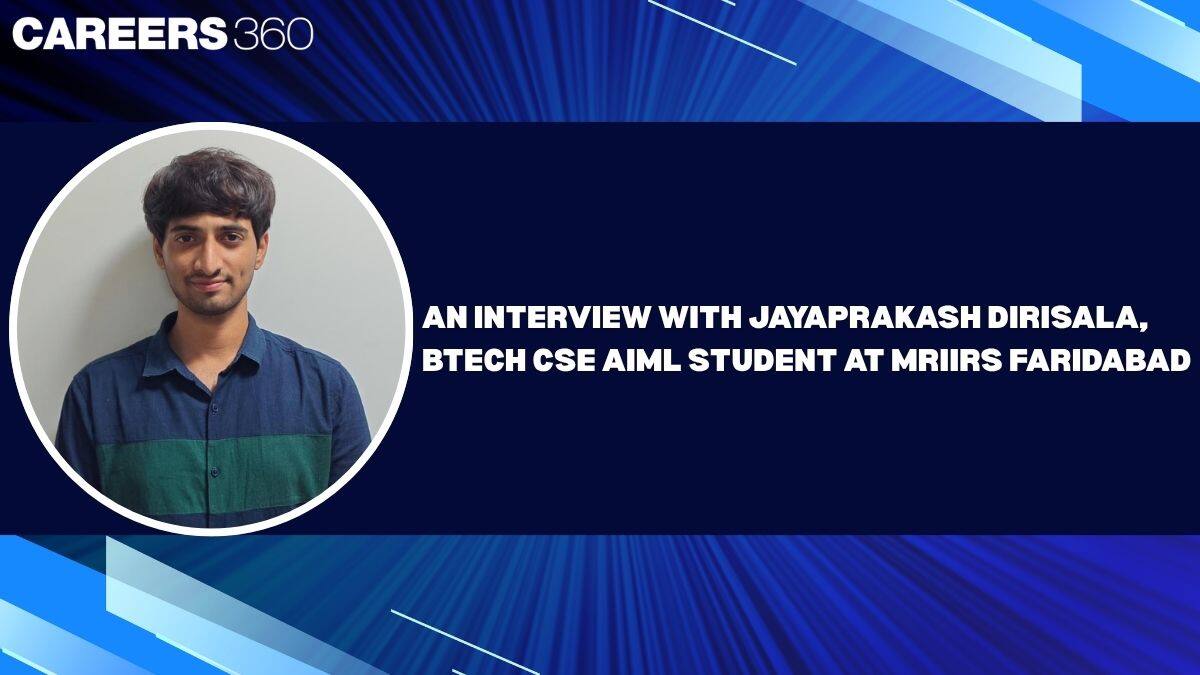
In this interview brought to you by Careers360, Jayaprakash talks about the unique facilities offered, campus life, daily routine, extra-curricular activities, events held, and more. Know more about MRIIRS Faridabad from a student's point of view in the article below.
Careers360: Tell us something about yourself. (a bit of the background, like graduation, place and any such thing)
Jayaprakash Dirisala: My name is Jayaprakash Dirisala, and I’m currently pursuing my Bachelor of Technology in Computer Science and Engineering at Manav Rachna International Institute of Research and Studies. I’m from Telangana.
I’ve always been interested in problem-solving and software development, which led me toward Computer Science. During my college journey, I developed a strong interest in backend engineering, distributed systems, and scalable application development. I enjoy building systems that are reliable, efficient, and capable of handling real-world scale.
Over time, I’ve worked with technologies like Java, Python, Spring Boot, REST APIs, PostgreSQL, Docker, and cloud-based tools through projects, internships, and continuous learning. Alongside academics, I actively practice competitive programming and problem solving on platforms like LeetCode and Codeforces, which has helped me improve my analytical and coding skills.
Also See: MRIIRS Admissions
Careers360: Tell us something about your College/University and what made you choose it
Jayaprakash Dirisala: I’m studying at Manav Rachna International Institute of Research and Studies. One of the main reasons I chose this university was because it provided a good balance between academics and practical learning opportunities.
I wanted a college environment where I could explore software development beyond classroom learning through projects, coding contests, internships, and technical communities. The university encouraged students to participate in hackathons, workshops, and industry-oriented activities, which helped me gain practical exposure.
Another factor was the flexibility to work on self-learning and internships alongside academics. This helped me focus deeply on backend development and problem solving while continuing my coursework.
Careers360: What is the course you are pursuing at your College/University and what made you choose this specialisation?
Jayaprakash Dirisala: I’m pursuing a Bachelor of Technology in Computer Science and Engineering. I chose this specialisation because I’ve always been fascinated by technology and how software systems solve real-world problems. Initially, I enjoyed programming and logical problem solving, and gradually I became more interested in system design, backend development, and scalable applications.
Computer Science gave me the opportunity to study subjects like Data Structures, Algorithms, Operating Systems, DBMS, and Computer Networks, which built a strong technical foundation. I also liked the fact that this field constantly evolves and provides opportunities to keep learning new technologies.
Through this specialisation, I was able to work on projects involving REST APIs, distributed systems, databases, and AI-powered applications, which strengthened my interest in software engineering even more.
Careers360: Is an internship mandatory at your University? If yes, where did you pursue it and what was the duration? What were the steps to get into it?
Jayaprakash Dirisala: Yes, internships are encouraged as part of the learning process at our university because they help students gain industry exposure and practical experience.
I pursued internships in backend engineering and machine learning-related domains, where I worked on scalable systems, APIs, and backend pipelines. The experience helped me understand how real-world engineering teams operate and how production-grade systems are built.
The steps that helped me secure these internships included:
Building strong fundamentals in Data Structures and Algorithms
Practicing coding regularly on competitive programming platforms
Working on real-world projects and improving my GitHub profile
Learning backend technologies like Java, Spring Boot, APIs, databases, and Docker
Applying consistently through portals, LinkedIn, and networking
Preparing for coding rounds and technical interviews
Consistency in learning and project building played a major role in helping me get shortlisted.
Careers360: Please give details on the assistance you received from the faculty, peers and placement office with regard to the internships?
Jayaprakash Dirisala: The faculty, peers, and placement office were supportive throughout the internship process.
The placement office regularly shared internship opportunities, company updates, and assessment details with students. They also conducted sessions related to resume building, aptitude preparation, and interview guidance.
Faculty members encouraged us to participate in technical activities, projects, and coding competitions, which helped strengthen our practical skills. Some professors also guided us during project development and motivated us to focus on industry-relevant technologies.
My peers also played an important role. We used to discuss interview experiences, solve coding problems together, share resources, and help each other prepare for assessments and interviews. Being in a collaborative environment helped me stay motivated and improve consistently.
Careers360: How was your experience with the internship? What are the key takeaways that you can look back on from it?
Jayaprakash Dirisala: My internship experience was very valuable because it gave me practical exposure to real-world software engineering and industry workflows.
I got the opportunity to work on backend systems, APIs, and scalable services, where I learned how production systems are designed and maintained. I also understood the importance of writing clean, maintainable, and efficient code.
Some of the major takeaways from the internship were:
Understanding real-world backend architecture and system scalability
Learning how teams collaborate in professional environments
Improving debugging, problem-solving, and communication skills
Gaining experience with APIs, databases, concurrency, and performance optimisation
Understanding the importance of reliability, testing, and monitoring in software systems
The experience also taught me how important continuous learning is in the tech industry. It gave me more confidence in my technical abilities and strengthened my interest in backend engineering and distributed systems.
Disclaimer: This article is published as a marketing initiative between MRIIRS Faridabad and Careers360.
Articles
Upcoming Engineering Exams
Certifications By Top Providers
Explore Top Universities Across Globe
List of Related colleges

Questions related to MRIIRS Faridabad
On Question asked by student community
Have a question related to MRIIRS Faridabad ?
Hi Aspirant,
Both the college are private and both of them offer BBA course but in the case of establishment DAV institute of management is old in comparative to satyug darshan. Satyug provide 1 course under BBA and they charge 1.32 lakh fees on the other hand DAV provide 4

Applications for Admissions are open.
Ranked #43 among Engineering colleges in India by NIRF | Get Upto 100% Scholarships
East Point College of Engineering & Tech. Admissions 2026
ApplyApply for B.E at East Point College of Engineering and Technology | Affiliated to VTU | AICTE Approved | NBA Accredited | Highest CTC 33 LPA
GMRIT Deemed to be University M.Tech Admissions 2026
Apply100+ Recruiters | 100+ Placements of 2026 Batch | NBA & NAAC Accredited | Highest CTC 37 LPA
KCCITM BTECH ADMISSIONS 2026
ApplyNBA Accredited | AICTE Approved | Affiliated to AKTU | Highest CTC 14.2 LPA | Accepts CUET Score
UPES M.Tech Admissions 2027
ApplyRanked #45 Among Universities in India by NIRF | 1950+ Students Placed 91% Placement, 800+ Recruiters
ICFAI University Hyderabad B.Tech Admissions 2026
ApplyMerit Scholarships | NAAC A+ Accredited | Top Recruiters : E&Y, CYENT, Nvidia, CISCO, Genpact, Amazon & many more
MRIIRS Faridabad Notifications
Latest updates
Explore Career Options
By Industry