School of Computer Science, UPES, Dehradun
Ranked #43 among Engineering colleges in India by NIRF | Get Upto 100% Scholarships


Integration is one of the most important topics in the JEE Main and JEE Advanced Mathematics syllabus. In JEE Main, questions based on substitution, integration by parts, partial fractions, and definite integrals are asked from this chapter. Solving JEE Main Integration Questions will make students familiar with the types of problems that can be expected in the JEE Main 2027 Exam and will also improve their speed of calculation. Integration JEE Main questions with solutions from JEE Main previous years' papers will help the students identify the most common concepts and the level of difficulty of the problems.
This Story also Contains

In this article, students can go through the important Integration JEE Main questions, topic-wise weightage, JEE previous 10 year questions, the difficulty level, and a few JEE preparation tips too.
The Integration JEE Main questions help you prepare effectively for the JEE Main exam. Solving integration JEE Main questions with solutions is one of the best ways to prepare for IIT JEE.
Question 1. Let e be the base of natural logarithm and let f:{1,2,3,4}1,e,e2,e3 and
g:1,e,e2,e31,12,13,14 be two bijective functions such that f is strictly decreasing and g is strictly increasing. If (x)=f-1g-112x, then the area of the region $\mathrm{R}=\left\{(\mathrm{x}, \mathrm{y}): \mathrm{x}^2 \leq \mathrm{y} \leq \phi(\mathrm{x})\right.$, 0x1} is :
1. 3-e(2)3e(2)
2. 13e(2)
3. 3+e(2)
4. 3+e(2)2+e(3)
Correct Answer: Option (1)
Solution:
$\begin{aligned} & f(x)=e^{x-1} \\ & g(x)=\frac{1}{\log _e x+1} \\ & f^{-1}\left(g^{-1}(1 / 2)\right)=f^{-1}(e)=2 \\ & \phi(x)=2^x \\ & \therefore \int_0^1\left(2^x-x^2\right) d x=\left(\frac{2^x}{\ln 2}-\frac{x^3}{3}\right)_0^1=\frac{1}{\ln 2}-\frac{1}{3} \\ & =\frac{3-\ln 2}{3 \ln 2}\end{aligned}$
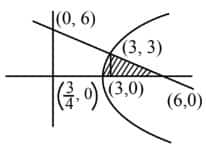
Question 2: The area of the region {(x,y):0y6-x, $\left.\mathrm{y}^2 \geq 4 \mathrm{x}-3, \mathrm{x} \geq 0\right\}$ is :
1. 8
2. 9
3. 12
4. 15
Correct Answer: Option (2)
Solution:
A=036-y-y2+34dy=9

Question 3: The value of the integral -44324x1+exdx is :
1. 4+2
2. 3+8
3. 3+4
4. 4+3
Correct Answer: Option (2)
Solution:
Apply (P-5)
I=-/4/43241+e-d
$\begin{aligned}
& \text { Add } 2 \mathrm{I}=\int_{-\pi / 4}^{\pi / 4} 32 \cos ^4 \theta \mathrm{~d} \theta=2 \int_0^{\pi / 4} 32 \cos ^4 \theta \mathrm{~d} \theta \\
& \mathrm{I}=32 \int_0^{\pi / 4} \cos ^4 \theta \mathrm{~d} \theta \\
& =8 \int_0^{\pi / 4}\left(2 \cos ^2 \theta\right)^2 \mathrm{~d} \theta=8 \int_0^{\pi / 4}(1+\cos 2 \theta)^2 \mathrm{~d} \theta \\
& =8 \int_0^{\pi / 4} 1+2 \cos 2 \theta+\cos ^2 2 \theta \mathrm{~d} \theta \\
& =8 \int_0^{\pi / 4} 1+2 \cos 2 \theta+\frac{1+\cos 4 \theta}{2} \mathrm{~d} \theta \\
& =8\left[\frac{3 \theta}{2}+\frac{2 \sin 2 \theta}{2}+\frac{\sin 4 \theta}{8}\right]_0^{\pi / 4} \\
& =8\left[\left(\frac{3 \pi}{8}+1+0\right)\right]=3 \pi+8
\end{aligned}$
Question 4: The value of the integral -11x3+|x|+1x2+2|x|+1dx is equal to
1. 3e2
2. 2e2
3. 5e3
4. 3e3
Correct Answer: Option (2)
Solution: $\begin{aligned} & I=\int_{-1}^1 \frac{x^3+|x|+1}{x^2+2|x|+1} \cdot d x \\ & I=\int_{-1}^1 \frac{x^3}{x^2+2|x|+1} \cdot d x+\int_{-1}^1 \frac{|x|+1}{x^2+2|x|+1} \cdot d x \\ & I=0+\int_{-1}^1 \frac{|x|+1}{|x|^2+2|x|+1} \cdot d x \\ & 2 \int_0^1 \frac{1}{x+1} \cdot d x \\ & I=2[\ln |x+1|]_0^1 \\ & I=2 \ln (2)\end{aligned}$
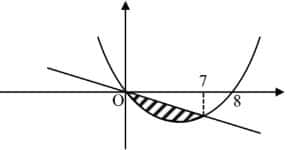
Question 5: The area of the region (x,y):x2-8xy-x is:
1. 3436
2. 6376
3. 4376
4. 5236
Correct Answer: Option (1)
Solution: $\begin{aligned} & \text { Required area }=\int_0^7\left(7 x-x^2\right) d x \\ & =\left[\frac{7 x^2}{2}-\frac{x^3}{3}\right]_0^7=\frac{343}{6}\end{aligned}$
Question 6: If /6/4x-3x+3+1dx=e(3-1), then 92 is equal to ____ .
1. 12
2. 13
3. 11
4. 14
Correct Answer: Option (1)
Solution:
$\begin{aligned} & \int_{\pi / 6}^{\pi / 4}\left(\left(\cot \left(\mathrm{x}-\frac{\pi}{3}\right) \cot \left(\mathrm{x}+\frac{\pi}{3}\right)+1\right) \mathrm{dx}\right. \\ & \text { using } \cot (\mathrm{A}-\mathrm{B})=\frac{\cot \mathrm{B} \cot \mathrm{A}+1}{\cot \mathrm{~B}-\cot \mathrm{A}} \\ & \Rightarrow \int_{\pi / 6}^{\pi / 4}-\frac{1}{\sqrt{3}}\left[\cot \left(\mathrm{x}-\frac{\pi}{3}\right)-\cot \left(\mathrm{x}+\frac{\pi}{3}\right)\right] \mathrm{dx} \\ & \Rightarrow \frac{-1}{\sqrt{3}}\left[\ln \left|\frac{\sin \left(\mathrm{x}-\frac{\pi}{3}\right)}{\sin \left(\mathrm{x}+\frac{\pi}{3}\right)}\right|\right]_{\frac{\pi}{6}}^{\frac{\pi}{4}}\end{aligned}$
$\begin{aligned} & =\frac{-1}{\sqrt{3}}\left[\ln \left|\left(\frac{\sin 15^{\circ}}{\left.\sin 105^{\circ}\right)}\right)\right|-\ell \mathrm{n}\left|\frac{\sin 30^{\circ}}{\sin 90^{\circ}}\right|\right] \\ & =\frac{-1}{\sqrt{3}}\left[\ln \left(\tan 15^{\circ}\right)-\ell \mathrm{n}\left(\frac{1}{2}\right)\right. \\ & =\frac{-1}{\sqrt{3}}[\ln (2-\sqrt{3})+\ell \mathrm{n} 2] \\ & \Rightarrow \frac{-1}{\sqrt{3}} \ln (4-2 \sqrt{3})=\frac{-2}{\sqrt{3}} \ln (\sqrt{3}-1) \\ & \therefore \alpha=\frac{-2}{\sqrt{3}} \therefore 9 \alpha^2=12\end{aligned}$
Question 7: Let $f(x)=\left\{\begin{array}{lll}\frac{1}{3} & , & x \leq \pi / 2 \\ \frac{b(1-\sin x)}{(\pi-2 x)^2} & , & x>\pi / 2\end{array}\right.$, If f is continuous at x=/2, then the value of 03~b-6x2+2x-3dx is :
1. 5
2. 2
3. 3
4. 4
Correct Answer: Option (4)
Solution:
x2b1-2-x42-x2=13b=83
02x2+2x-3dx=02|(x+3)(x-1)|dx
put x-1=t
-11|(t+4)t|dt=-10-t2-4tdt+01t2+4tdt
-t33-2t2-10+t33+2t201=4
Question 8: The value of the integral
02xx2+x+1(x+1)x4+x2+1dx is equal to :
1. 13e(3-22)
2. 23e(4+2)
3. 23e(3+22)
4. 13e(1+62)
Correct Answer: Option (3)
Solution: $\begin{aligned} & I=\int_0^2 \sqrt{\frac{x\left(x^2+x+1\right)}{(x+1)\left(x^2-x+1\right)\left(x^2+x+1\right)} d x} \\ & =\int_0^2 \sqrt{\frac{x}{x^3+1}} d x \\ & \left(x^{3 / 2}=t \Rightarrow \frac{3}{2} x^{1 / 2} d x=d t\right) \\ & =\frac{2}{3} \int_0^{2^{3 / 2}} \frac{d t}{\sqrt{t^2+1}} \\ & =\frac{2}{3}\left(\ln \left(t+\sqrt{t^2+1}\right)\right)_0^{2^{3 / 2}} \\ & =\frac{2}{3} \ln \left(2^{3 / 2}+3\right)\end{aligned}$
Question 9: The value of the integral 0e(x)x2+4dx is:
1. e(2)2
2. e(2)4
3. 1+e(2)
4. 2+e(2)
Correct Answer: Option (2)
Solution:
Put x=2tdx=2dt
$\begin{aligned}
& \mathrm{I}=\int_0^{\infty} \frac{\ell \mathrm{n} 2 \mathrm{t}}{4 \mathrm{t}^2+4}(2 \mathrm{dt})=\frac{1}{2} \int_0^{\infty} \frac{\ell \mathrm{n} 2+\ell \mathrm{nt}}{\mathrm{t}^2+1} \mathrm{dt} \\
& =\frac{1}{2} \int_0^{\infty} \frac{\ell \mathrm{n} 2}{\mathrm{t}^2+1} \mathrm{dt}+\frac{1}{2} \int_0^{\infty} \frac{\ell \mathrm{nt}}{\mathrm{t}^2+1} \mathrm{dt} \\
& {\left[\frac{\ln 2}{2} \mathrm{tan}^{-1} \mathrm{t}\right]_0^{\infty}+\mathrm{I}_1} \\
& =\frac{\ell \mathrm{n} 2}{2} \cdot \frac{\pi}{2}+\mathrm{I}_1 \\
& \mathrm{I}_2=\frac{1}{2} \int_0^{\infty} \frac{\ell \mathrm{nt}}{\mathrm{t}^2+1} \mathrm{dt} \quad \mathrm{t}=\frac{1}{\mathrm{u}} \Rightarrow \mathrm{dt}=-\frac{\mathrm{du}}{\mathrm{u}^2} \\
& =\frac{1}{2} \int_{\infty}^0 \frac{\ell \mathrm{n}(1 / \mathrm{u})}{\frac{1}{\mathrm{u}^2}+1}\left(-\frac{\mathrm{du}}{\mathrm{u}^2}\right)
\end{aligned}$
Add I1=0
$\mathrm{I}=\frac{\pi \ell \mathrm{n} 2}{4}$
Question 10: The integral 01-11+x+x2dx is equal to :
1. 2-12+12e54+2
2. 2-12+12e54-2
3. 2-12-12e54+2
4. 2-12-12e54-2
Correct Answer: Option (4)
Solution: $\begin{aligned}= & \int_0^1 \tan ^{-1}\left(\frac{1}{1+x+x^2}\right) d x \\ = & \int_0^1 \tan ^{-1}\left(\frac{(x+1)-x}{1+x(x+1)}\right) d x \\ = & \int_0^1\left(\tan ^{-1}(x+1)-\tan ^{-1} x\right) d x \\ = & \left(x \tan ^{-1}(x+1)-\frac{1}{2} \ell \mathrm{n}\left|1+(1+x)^2\right|+\tan ^{-1}(x+1)\right)_0^1 \\ & -\left(x \tan ^{-1} x-\frac{1}{2} \ell \mathrm{n}\left|1+x^2\right|\right)_0^1 \\ = & \left(2 \tan ^{-1} 2-\frac{\pi}{4}-\frac{1}{2} \ell \mathrm{n} \frac{5}{2}\right)-\left(\frac{\pi}{4}-\frac{1}{2} \ell \mathrm{n} 2\right) \\ = & 2 \tan ^{-1} 2-\frac{1}{2} \ell \mathrm{n}\left(\frac{5}{4}\right)-\frac{\pi}{2}\end{aligned}$
Question 11: Let -22(|x|+[xx])dx=2(3-2)+, where [•] is the greatest integer function. Then 2 equals.
1. 1
2. 2
3. 4
4. 8
Correct Answer: Option (2)
Solution: $\begin{aligned} & \int_{-2}^2(|\sin x|+[x \sin x]) d x \\ & \Rightarrow 2 \int_0^2(|\sin x|+[x \sin x]) d x \\ & \Rightarrow 2\left[\int_0^2 \sin x d x+\int_0^2[x \sin x] d x\right] \\ & 2\left([-\cos x]_0^2+\int_0^\alpha 0 d x+\int_\alpha^2 2 d x\right) \\ & 2(3-\cos 2-2-\alpha) \\ & 2(3-\cos 2)-2 \alpha \\ & \text { where } \alpha \text { is Root of } x \sin x=1 \\ & \text { Now } \operatorname{comparing} \beta=-2 \alpha \\ & \alpha=-\frac{\beta}{2} \\ & -\frac{\beta}{2} \sin \left(\frac{-\beta}{2}\right)=1 \\ & \beta \sin \left(\frac{\beta}{2}\right)=2\end{aligned}$
Question 12: The value of 0204x+4xdx is equal to:
1. 152
2. 25
3. 15
4. 252
Correct Answer: Option (3)
Solution: $\begin{aligned} & I=\int_0^{20 \pi}\left(1-2 \sin ^2 x \cos ^2 x\right) \cdot d x \\ & =20 \pi-\frac{1}{2} \int_0^{20 \pi} \sin ^2 2 x d x \\ & 20 \pi-\frac{1}{2}(40) \int_0^{\frac{\pi}{2}} \sin ^2 2 x \\ & 20 \pi-\frac{20}{2}\left(x-\frac{\sin 2 x}{2}\right)_0^{\frac{\pi}{2}} \\ & 20 \pi-10\left(\frac{\pi}{2}\right)=15 \pi\end{aligned}$
Question 13: Let f(x)=dxx23+2x12 be such that f(0)=-26+24e(2). If f(1)=a+be(3), where a,bz, then a+b is equal to:
1. -18
2. -11
3. -5
4. -26
Correct Answer: Option (2)
Solution:
f(x)=dxx2/3+2x1/2
Put x=t6dx=6t5dt
$\begin{aligned}
& =\int \frac{6 t^5 d t}{t^4+2 t^3}=6 \int \frac{\left(t^2-4\right)+4}{t+2} d t \\
& =6\left[\int(t-2) d t+4 \int \frac{1}{t+2} d t\right] \\
& =6\left[\frac{\mathrm{t}^2}{2}-2 \mathrm{t}+4 \ln (\mathrm{t}+2)\right]+\mathrm{C} \\
& =3 \mathrm{x}^{1 / 3}-12 \mathrm{x}^{1 / 6}+24\left(\mathrm{n}\left(\mathrm{x}^{16}+2\right)+\mathrm{C}\right. \\
& \mathrm{f}(0)=24(\mathrm{n} 2+\mathrm{C}=-26+24(\mathrm{n} 2 \text { (given) } \\
& \Rightarrow \mathrm{C}=-26
\end{aligned}$
Now
$\begin{aligned}
& f(1)=-35+24(n 3=A+B(n 3 \text { (as given in ques.) } \\
& \Rightarrow A=-35 \& B=24 \\
& \Rightarrow A+B=-11
\end{aligned}$
Hence, the correct answer is option (2).
Question 14: The value of r=1200rx|x|dx is ____
1. 210
2. 110
3. 112
4. 230
Correct Answer: Option (1)
Solution:
$\begin{aligned} & I_r=\int_0^r x|\sin \pi x| d x \\ & \text { King's Rule }=\int_0^r(r-x)|\sin \pi x| d x \\ & 2 I_r=\int_0^r r|\sin \pi x| d x \\ & I_r=\frac{r}{2} \int_0^r|\sin \pi x| d x \\ & I_1=\frac{1}{2} \int_0^1|\sin \pi x| d x=\frac{1}{2 \pi} \int_0^\pi|\sin t| d t=\frac{1}{2 \pi} \cdot 2 \\ & I_2=\frac{2}{2} \int_0^2|\sin \pi x| d x=\frac{2}{2 \pi} \int_0^{2 \pi}|\sin t| d t=\frac{2}{2 \pi} .4\end{aligned}$
$\begin{aligned} & \therefore S=\sqrt{\pi \cdot \frac{1}{2 \pi} \cdot 2}+\sqrt{\pi \cdot \frac{2}{2 \pi} \cdot 4}+\sqrt{\pi \cdot \frac{3}{2 \pi} \cdot 6 \ldots \ldots \ldots .+\sqrt{\pi \cdot \frac{20}{2 \pi} \cdot 2(20)}} \\ & =1+2+3+\ldots \ldots .20=\frac{20 \times 21}{2}=210\end{aligned}$
Hence, the correct answer is 210.
Question 15: If 1-52x5x2xdx=f(x)+C, where C is the constant of integration, then f6-f4 is equal to
1. 13(26-3)
2. 23(4+6)
3. 43(8-6)
4. 13(26+3)
Correct Answer: Option (3)
Solution:
$\begin{aligned} & \int \frac{1-5 \cos ^2 x}{\sin ^2 x \cos ^2 x} d x \\ & \int \frac{\sec ^2 x d x}{\sin ^5 x}-\int \frac{5}{\sin ^5 x} d x \\ & \int \frac{1}{\sin ^5 x} \tan x-\int \frac{-5}{\sin ^6 x} \cos x \cdot \tan x d x-\int \frac{5}{\sin ^6 x} d x=\frac{\tan x}{\sin ^5 x}=f(x) \\ & f\left(\frac{\pi}{6}\right)-f\left(\frac{\pi}{4}\right)=\frac{32}{\sqrt{3}}-\frac{1}{\left(\frac{1}{\sqrt{2}}\right)^5}=\frac{32}{\sqrt{3}}-4 \sqrt{2}=\frac{4}{\sqrt{3}}(8-\sqrt{6})\end{aligned}$
Hence, the correct answer is option 3.
Question 16: If 1-52x5x2xdx=f(x)+C, where C is the constant of integration, then f6-f4 is equal to
1. 13(26-3)
2. 23(4+6)
3. 43(8-6)
4. 13(26+3)
Correct Answer: Option (3)
Solution: $\begin{aligned} & \int \frac{1-5 \cos ^2 x}{\sin ^2 x \cos ^2 x} d x \\ & \int \frac{\sec ^2 x d x}{\sin ^5 x}-\int \frac{5}{\sin ^5 x} d x \\ & \int \frac{1}{\sin ^5 x} \tan x-\int \frac{-5}{\sin ^6 x} \cos x \cdot \tan x d x-\int \frac{5}{\sin ^6 x} d x=\frac{\tan x}{\sin ^5 x}=f(x) \\ & f\left(\frac{\pi}{6}\right)-f\left(\frac{\pi}{4}\right)=\frac{32}{\sqrt{3}}-\frac{1}{\left(\frac{1}{\sqrt{2}}\right)^5}=\frac{32}{\sqrt{3}}-4 \sqrt{2}=\frac{4}{\sqrt{3}}(8-\sqrt{6})\end{aligned}$
Hence, the correct answer is option 3.
Question 17: Let $f(t)=\int\left(\frac{\left(1-\sin \left(\log _e t\right)\right.}{1-\cos \left(\log _e t\right)}\right) d t, t>1$. if. fe/2=-e/2 and fe/4=e/4 then equals:
1. -1-22
2. -1+2
3. -1-2
4. 1+2
Correct Answer: Option (3)
Solution:
Let t=xt=exdt=exdx
$\begin{aligned} & G . I=\int \frac{1-\sin x}{2 \sin ^2 \frac{x}{2}} e^x d x=\frac{1}{2} \int\left(\cos e^2 \frac{x}{2}-2 \cot \frac{x}{2}\right) e^x d x=\frac{1}{2} e^x\left(-2 \cot \frac{x}{2}\right)+c \\ &\Rightarrow-t \cot \left(\frac{\operatorname{los} t}{2}\right)+c \\ & f\left(e^{-\pi / 2}\right)=-e^{\pi / 2} \quad \Rightarrow c=0 \\ & \therefore d\left(e^{\pi / 4}\right)=-e^{-\pi / 4}(\sqrt{2}+1) \\ & \therefore \alpha=-(\sqrt{2}+1)\end{aligned}$
Hence, the correct answer is option (3).
Question 18: Let I(x)=3dx(4x+6)4x2+8x+3 and I(0)=34+20.
If I12=a2b+c, where $a, b, c, \in N, \operatorname{gcd}(a, b)=1$, then a+b+c is equal to:
1. 26
2. 23
3. 25
4. 24
Correct Answer: Option (1)
Solution:
I(x)=32dx(2x+3)(2x+3)(2x+1)=32dx(2x+3)3/2(2x+1)1/2
$\begin{aligned} & =\frac{3}{2} \int \frac{d x}{\left(\frac{2 x+3}{2 x+1}\right)^{3 / 2}(2 x+1)^2}\left(t=\frac{2 x+3}{2 x+1} \Rightarrow d t=\frac{-4}{(2 x+1)^2} d x\right) \\ & =\frac{3}{2} \int\left(\frac{2 x+3}{2 x+1}\right)^{-\frac{3}{2}} \frac{d x}{(2 x+1)^2}=\frac{-3}{8} \frac{\left(\frac{2 x+3}{2 x+1}\right)^{\frac{-3}{2}+1}}{\frac{-3}{2}+1}+C=\frac{3}{4}\left(\frac{2 x+1}{2 x+3}\right)^{\frac{1}{2}}+C \\ & I(0)=20+\frac{\sqrt{3}}{4} \Rightarrow c=20 \\ & I\left(\frac{1}{2}\right)=\frac{3 \sqrt{2}}{8}+20 \\ & a+b+c=3+8+20=26\end{aligned}$
Hence the correct answer is option (1).
Question 19: The value of the integral 24524~dx1+32x is:
1. 18
2. 6
3. 3
4. 12
Correct Answer: Option (4)
Solution:
Let the given integral be I :
$
I=\int_{\frac{\pi}{2 \pi}}^{\frac{5 \pi}{3 \pi}} \frac{d x}{1+\sqrt{\tan 2 x}}
$
The sum of the limits is a+b=24+524=624=4.
Using the property abf(x)dx=abf(a+b-x)dx, replace x with 4-x :
$
\begin{aligned}
& I=\int_{\frac{\pi}{2 \pi}}^{\frac{\sin }{2 \pi}} \frac{d x}{1+\sqrt[3]{\tan 2\left(\frac{\pi}{4}-x\right)}} \\
& I=\int_{\frac{\pi}{2 \pi}}^{\frac{\sin }{2 \pi}} \frac{d x}{1+\sqrt[3]{\tan \left(\frac{\pi}{2}-2 x\right)}}
\end{aligned}
$
Since 2-= :
$
\begin{aligned}
& I=\int_{\frac{\pi}{2 \pi}}^{\frac{\frac{\pi}{2 \pi}}{2 \pi}} \frac{d x}{1+\sqrt[3]{\cot 2 x}} \\
& I=\int_{\frac{\pi}{2 \pi}}^{\frac{\pi}{2 \pi}} \frac{d x}{1+\frac{1}{\sqrt[3]{\tan 2 x}}} \\
& I=\int_{\frac{\pi}{2 \pi}}^{\frac{\pi}{2 \pi}} \frac{\sqrt[3]{\tan 2 x}}{1+\sqrt{\tan 2 x}} d x
\end{aligned}
$
Now, add the two expressions for I :
$
\begin{aligned}
& 2 I=\int \frac{\frac{\pi}{\pi}}{\frac{\pi}{2 \pi}}\left(\frac{1}{1+\sqrt[3]{\tan 2 x}}+\frac{\sqrt[3]{\tan 2 x}}{1+\sqrt[3]{\tan 2 x}}\right) d x \\
& 2 I=\int \frac{\frac{\pi}{2}}{\frac{1+\sqrt[3]{\tan 2 x}}{1+\sqrt[3]{\tan 2 x}} d x} \\
& 2 I=\int \frac{\frac{\pi}{2 \pi}}{\frac{\pi}{24}} 1 d x \\
& 2 I=[x] \frac{\frac{\pi x}{\pi}}{24} \\
& 2 I=\frac{5 \pi}{24}-\frac{\pi}{24}=\frac{4 \pi}{24}=\frac{\pi}{6} \\
& I=\frac{\pi}{12}
\end{aligned}
$
Hence, the correct answer is option (4).
Question 20: The value of -221[x]+4dx, where [.] denotes the greatest integer function, is:
1. 160(-7)
2. 760(3-1)
3. 760(-3)
4. 160(21-1)
Correct Answer: Option (2)
Solution:
I=-2-11-2+4dx+-101-1+4dx+0110+4dx+1211+4dx
$ I=\frac{1}{2}\left(-1+\frac{\pi}{2}\right)+\frac{1}{3}(0-(-1))+\frac{1}{4}(1-0)+\frac{1}{5}\left(\frac{\pi}{2}-1\right)$
$ I=\frac{\pi}{4}-\frac{1}{2}+\frac{1}{3}+\frac{1}{4}+\frac{\pi}{10}-\frac{1}{5} $
$ I=\frac{7 \pi}{20}-\frac{7}{60}$
I=760(3-1)
Hence, the correct answer is option (2).
Question 21: If 014-11-2x+4x2dx=a-1(2)-be(5), where abN, then (2a+b) is equal to...
1. 9
2. 5
3. 6
4. 4
Correct Answer: Option (1)
Solution:
$\begin{aligned}
& 4 \int_0^1 \operatorname{Tan}^{-1}\left(\frac{1}{1-2 x+4 x^2}\right) d x \\
& 4 \int_0^1 \operatorname{Tan}^{-1}\left(\frac{2 x-(2 x-1)}{1+2 x+(2 x-1)}\right) d x \\
& I=4 \int_0^1 \operatorname{Tan}^{-1} 2 x . d x-4 \int_0^1 \operatorname{Tan}^{-1}(2 x-1) d x \ldots \ldots .(i) \\
& 4 \int_0^1 \operatorname{Tan}^{-1} 2 x . d x-4 \int_0^1 \operatorname{Tan}^{-1}(2(1-x)-1) d x \\
& I=4 \int_0^1 \operatorname{Tan}^{-1} 2 x . d x+4 \int_0^1 \operatorname{Tan}^{-1}(2 x-1) d x \ldots . .(i i) \\
& \text { (i) }+ \text { (ii) } 2 I=8 \int_0^1 \operatorname{Tan}^{-1} 2 x . d x
\end{aligned}$
By integration by parts $I=4 \operatorname{Tan}^1 2-\log 5$
$\therefore 2 a+b=8+1=9$
Hence, the correct answer is 9.
Question 22: 60|(3x+2x+x)|dx is equal to:
1. 17
2. 21
3. 24
4. 26
Correct Answer: Option (1)
Solution:
$\begin{aligned}
& \text { Sol: } 6 \int_0^\pi|\sin 3 x+\sin 2 x+\sin x| d x \\
& =6 \int_0^\pi|\sin 2 x+2 \sin 2 x \cos x| d x=6 \int_0^\pi|\sin 2 x(1+2 \cos x)| d x \\
& =6 \int_0^\pi|2 \cos x(1+2 \cos x)| \sin x d x \quad \cos x=t \\
& =12 \int_1^{-1}|t(1+2 t)|-d t \quad-\sin x \cdot d x=d t
\end{aligned}$
$\begin{aligned}
& =12 \int_{-1}^1|t(1+2 t)| d t=12\left[\int_{-1}^{-1 / 2}\left(t+2 t^2\right) d t-\int_{-1 / 2}^0\left(t+2 t^2\right) d t+\int_0^1\left(t+2 t^2\right) d t\right] \\
= & 12\left[\left(\frac{t^2}{2}+\frac{2 t^3}{3}\right)_{-1}^{-1 / 2}-\left(\frac{t^2}{2}+\frac{2 t^3}{3}\right)_{-1 / 2}+\left(\frac{t^2}{2}+\frac{2 t^3}{3}\right)\right] \\
= & 12\left[\left(\frac{1}{8}-\frac{1}{12}\right)-\left(\frac{1}{2}-\frac{2}{3}\right)+\left(\frac{1}{8}-\frac{1}{12}\right)+\left(\frac{1}{2}+\frac{2}{3}\right)\right] \\
= & 12\left[\frac{2}{8}-\frac{2}{12}+\frac{4}{3}\right]=12\left[\frac{1}{4}-\frac{1}{6}+\frac{4}{3}\right]=3-2+16=17
\end{aligned}$
OR,
$\begin{aligned}
& 6 \int_0^\pi|2 \sin 2 x \cos x+\sin 2 x| d x \\
& 6 \int_0^\pi\left|4 \sin x \cos ^2 x+2 \sin \cos x\right| d x
\end{aligned}$
$I=12 \int_0^\pi \sin x\left|2 \cos ^2 x+\cos x\right| d x \quad \text { Put } \cos x=t,-\sin x d x=d t$
Hence, the correct answer is 17.
Question 23: If a function f(x) satisfies a condition f(x)=x+0/2xyf(y) dy, then f4 is equal to:
1. 1322+2-
2. 4-32
3. 2-22
4. 126-4-
Correct Answer: Option (4)
Solution:
Let, f(x)=x+kx
where k=0/2yf(y)dy
$
\begin{aligned}
& \Rightarrow k=\int_0^{\pi / 2}\left(\sin y \cdot \cos y+k \sin ^2 y\right) d y=-\frac{\cos 2 y}{4}+\left.\frac{k}{2}\left(y-\frac{\sin 2 y}{2}\right)\right|_0 ^{\pi / 2} \\
& \Rightarrow k=\frac{1}{2}+\frac{k \pi}{4} \Rightarrow k=\frac{2}{4-\pi}
\end{aligned}
$
Hence f(x)=x+24-x
Question 24: Evaluate x2x+x-1dx
1. -121+2x2+c
2. 121+3x2+c
3. -121+2 x2+c
4. 121+3x2+c
Correct Answer: Option (3)
Solution:
$\begin{aligned}
& I=\int \frac{\sec x d x}{2 \tan x+\sec x-1} \\
& =\int \frac{d x}{2 \sin x+1-\cos x}=\int \frac{d x}{4 \sin \frac{x}{2} \cos \frac{x}{2}+2 \sin ^2 \frac{x}{2}} \\
& =\frac{1}{2} \int \frac{\operatorname{cosec}^2 \frac{x}{2} d x}{2 \cot \frac{x}{2}+1}
\end{aligned}$
Let $2 \cot \frac{\mathrm{x}}{2}=\mathrm{t} \Rightarrow-\operatorname{cosec}^2 \frac{\mathrm{x}}{2} \mathrm{dx}=\mathrm{dt}$
Hence I=-12dtt+1=-12|1+t|+ constant
$=-\frac{1}{2} \ln \left|1+2 \cot \frac{x}{2}\right|+\text { c }$
Hence, the correct answer is option (3).
Question 25: 40113+x2+1+x2dx-3e(3) is equal to:
1. 2+2+e(1+2)
2. 2-2-e(1+2)
3. 2+2-e(1+2)
4. 2-2+e(1+2)
Correct Answer: Option (2)
Solution:
Given the expression:
40113+x2+1+x2dx-3e(3)
First, rationalize the denominator inside the integral by multiplying numerator and denominator by
3+x2-1+x2
This gives:
013+x2-1+x2(3+x2)2-(1+x2)2dx
Since
(3+x2)2-(1+x2)2=(3+x2)-(1+x2)=2
the integral becomes
013+x2-1+x22dx=12013+x2-1+x2dx
Therefore, the original expression is
412013+x2-1+x2dx-3e(3)=2013+x2-1+x2dx-32e3
Split the integral:
2013+x2dx-011+x2dx-32e3
Recall the integral formula
x2+cdx=x2x2+c+c2x+x2+c+C
Apply for c=3:
013+x2dx=x2x2+3+32x+x2+301
Evaluate at limits:
=124+32(1+2)-0+323=1+323-343=1+343
Similarly for c=1:
011+x2dx=x2x2+1+12x+x2+101
Evaluate at limits:
=122+12(1+2)-0=22+12(1+2)
Substitute back:
21+343-22-12(1+2)-323
Simplify:
=2-2+323-(1+2)-323=2-2-(1+2)
Hence, the value of the original expression is
2-2-(1+2)=2-2-e(1+2)
Hence, the correct answer is option (2).
Get expert advice on college selection, admission chances, and career path in a personalized counselling session.
JEE Main Integration questions over the last 10 years have covered various topics. The table below shows the most asked JEE Main and JEE Advanced integration question topics.
Topic Name | No. of Questions |
Area Bounded by Two Curves | 79 |
Definite Integration | 49 |
Area Bounded by Curve and Axes | 34 |
Piecewise Definite Integration | 29 |
Integration Using Substitution | 25 |
Properties of the Definite Integral (Part 2) - King's Property | 24 |
Area Bounded by Curves When Intersecting at More Than One Point | 21 |
Newton-Leibniz's Formula | 19 |
Definite integral as the limit of a sum | 17 |
Integration by Parts | 17 |
Evaluation of Definite Integrals by Substitution | 16 |
Application of Even- Odd Properties in Definite Integration | 12 |
Application of Periodic Properties in Definite Integration | 12 |
Integration as Reverse Process of Differentiation | 10 |
Properties of the Definite Integral (Part 1) | 9 |
Application of Inequality in Definite Integration | 5 |
Fundamental Formulae of Indefinite Integration (Trigonometric Functions) | 5 |
Integration Using Partial Fraction | 5 |
Reduction Formula (Part 1) | 5 |
Trigonometric Integrals (Part 1) | 5 |
Fundamental Formulae of Indefinite Integration (Inverse Trigonometric Functions) | 4 |
Also Check: JEE Main 2027 Important Formulas
The important formulas to solve Integration JEE Main questions are provided below; students must learn them:
Power Rule of Integration
xn,dx=xn+1n+1+C,n-1
Logarithmic Integration Formula
1x,dx=|x|+C
Exponential Function Formula
ex,dx=ex+C
General Exponential Formula
ax,dx=axa+C
Integration of Sine Function
x,dx=-x+C
Integration of Cosine Function
x,dx=x+C
Integration of Secant Square
2x,dx=x+C
Standard Inverse Tangent Formula
11+x2,dx=-1x+C
Standard Inverse Sine Formula
11-x2,dx=-1x+C
Integration by Parts Formula
u,dv=uv-v,du
Ranked #43 among Engineering colleges in India by NIRF | Get Upto 100% Scholarships
Scholars’ Round Deadline: 14th Nov’26 | Earn upto 50% merit Scholarship + 10% for top performers | EFMD Accredited | AACSB (USA) & AMDISA Member | Highest CTC 28 LPA
While preparing for IIT JEE, it is very important to follow the best books because they help properly cover all the concepts. Refer to the books given below for solving Integration JEE Main questions and answers.
|
|
|
|
|
Frequently Asked Questions (FAQs)
Some of the topics that may form the Integration JEE Main questions include indefinite and definite integration, integration formulae, integration using substitution, integration by parts, and properties of definite integrals, etc.
Yes, integration is one of the important topics in the JEE Main Mathematics syllabus. It is very necessary that students have knowledge of the basic formulae and can solve different types of questions.
First, you need to study the basics of integration formulas. Secondly, you should work out chapter-wise questions and previous years' questions of JEE Main.
PYQs are a great resource for knowing about the type of questions that can be asked from integration in JEE Main. But students must also solve some more questions to develop conceptual clarity.

On Question asked by student community
Dear Student,
You can access JEE Main Mathematics previous-year questions on Careers360. Practising previous-year questions will help you understand the exam pattern and question types.
Hello Student,
You can check the resources provided below:
Hope this helps!
Hello, since you are in Intermediate 2nd year with the MPC group and preparing for JEE Main, focus on completing the syllabus, revising important concepts and solving previous years’ JEE Main question papers. Take regular mock tests and analyse your mistakes to improve your score. Keep a realistic study schedule
Dear Student
Please specify whether you want Physics, Chemistry, or Mathematics, and which JEE Main/Advanced exam.
Hi Ansh Chauhan
Check the link below for the high-weightage Physics chapters for JEE Main 2027 based on recent exam trends. Students can use these chapters to prioritise their preparation and focus more on topics that have appeared frequently in previous papers.
https://engineering.careers360.com/articles/most-weightage-chapters-for-jee-main-physics-2027

Ranked #43 among Engineering colleges in India by NIRF | Get Upto 100% Scholarships
Scholars’ Round Deadline: 14th Nov’26 | Earn upto 50% merit Scholarship + 10% for top performers | EFMD Accredited | AACSB (USA) & AMDISA Member | Highest CTC 28 LPA
Application Free of Cost for Limited Time || NAAC A++ Accredited | Highest CTC 52 LPA | #11 in University Category by NIRF
Affiliated to Anna University | Highest CTC 44 LPA | Top Recruiters : JP Morgan Chase & Co, Nielson IQ, QUBE, META, GOOGLE, AMAZON & many more.
Highest CTC 30 LPA | #9 in Management Category by Times B-School | Merit-Based Scholarship Upto - 50 Crores
Courses designed with CTOs, Data Scientists, and Cybersecurity experts | 50+ elective options