
Search Colleges, Exams, Schools & more


Login
What RTI Data Shows About Electrical Engineering Placements
#B.E /B.Tech
Electrical Engineering is often considered as a reliable branch of engineering when it comes to placements, but the truth is that the placement outcomes are often misinterpreted. Reason being, that headlines often focus on a few high salaries and ignore key factors such as intake size, participation and average salaries.
This Story also Contains
- Why This Data Matters
- Electrical Engineering Placements in IITs
- Electrical Engineering Placements in NITs
- Electrical Engg v/s CSE
- Takeaway for Aspirants and Parents
In this article, we have compiled RTI data from 11 IITs and 5 NITs, which will help students and parents determine the actual placement outcome based on all the important factors.
Why This Data Matters
The data examines the key steps in a student’s placement journey: student intake, how many students registered for placements, and how many accepted the offer.
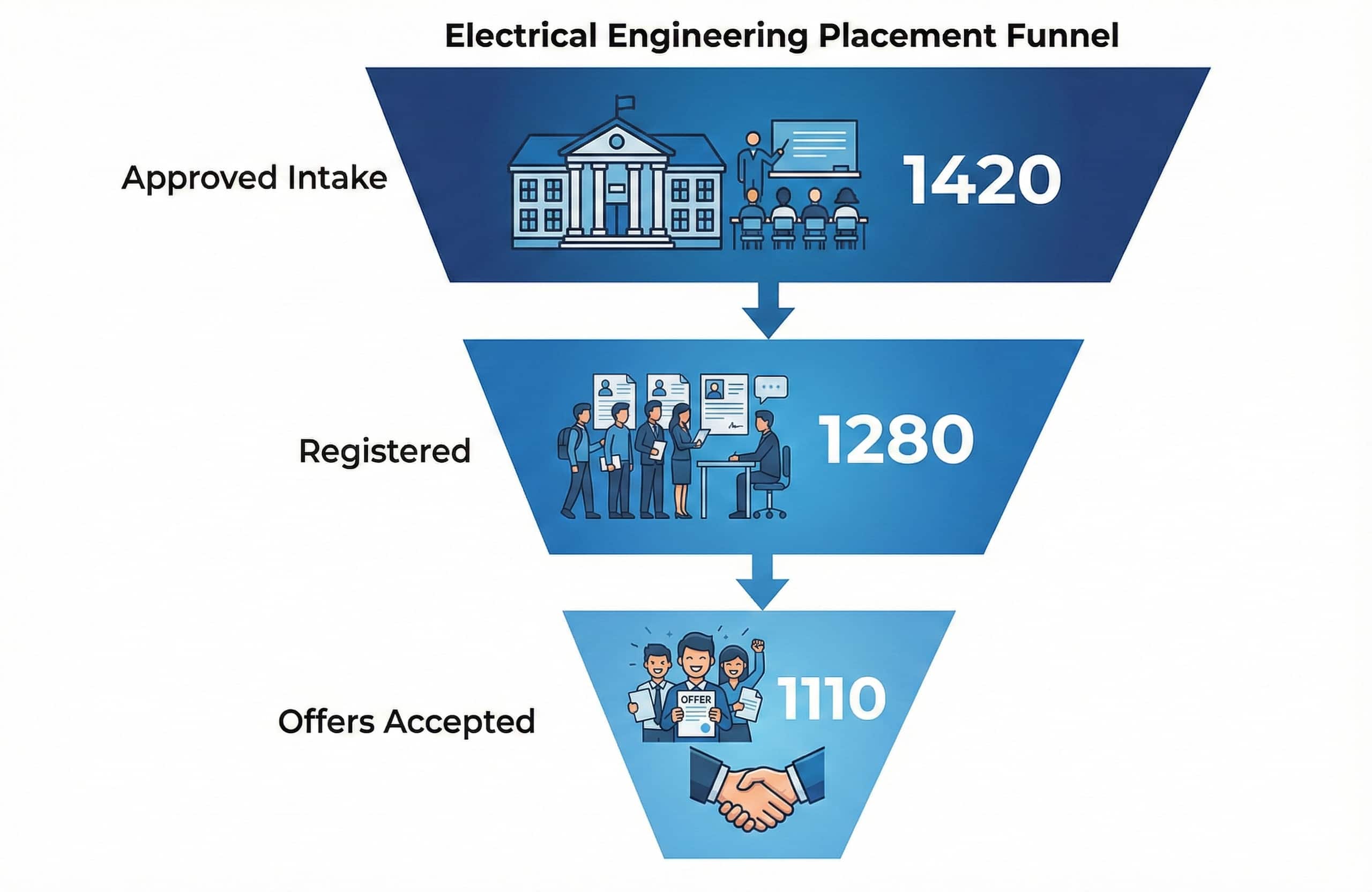
When we consider these stages together, it gives us a clearer picture of the placement situation in a particular institute. Consequently, this helps students and parents to avoid considering only the highest CTCs, as they are often mentioned for marketing purposes. This gives a more well-rounded final placement picture.
Confused About College Admissions?
Get expert advice on college selection, admission chances, and career path in a personalized counselling session.
Book a Counselling Slot
Select Date
Pick a Slot
Electrical Engineering Placements in IITs
Placement outcomes for electrical engineering across IITs differ across campuses. This difference can be due to batch size and participation. Newer IITs display increased volatility, and on the other hand, legacy IITs have steady placement outcomes.
One also needs to keep in mind that a significant number of electrical engineering students opt out of campus placements to pursue roles in PSUs, or higher studies. These factors might not portray realistic placement statistics.
| Institute | Intake 2021-22 | Students Registered for Placements 2024-25 | Placement Offer Accepted by Students 2024-25 | Placement % (Intake) | Placement % (Registered) | Max CTC | Average CTC |
|---|---|---|---|---|---|---|---|
62 | 59 | 54 | 87.10% | 91.53% | - | - | |
153 | 154 | 142 | 92.81% | 92.21% | - | 34.60 | |
39 | 32 | 25 | 64.10% | 78.13% | 52.00 | 16.65 | |
72 | 77 | 63 | 87.50% | 81.82% | - | - | |
37 | 35 | 29 | 78.38% | 82.86% | - | 23.13 | |
34 | 27 | 20 | 58.82% | 74.07% | - | - | |
40 | 34 | 27 | 67.50% | 79.41% | - | 12.77 | |
78 | 67 | 59 | 75.64% | 88.06% | 53.00 | 15.98 | |
114 | 102 | 87 | 76.32% | 85.29% | 52.30 | 20.07 | |
150 | 143 | 137 | 91.33% | 95.80% | - | - | |
50 | 41 | 38 | 76.00% | 92.68% | 38.85 | 17.14 |
Observation: IITs such as IIT Goa, Pallakkad, Gandhinagar, and Tirupati have a greater percentage difference due to small batch size. On the other hand, IITs such as IIT Kanpur and IIT Roorkee have stable placement outcomes even though the batch size is large. Even though there are some placement outcomes on average, an electrical engineering graduate earns between Rs. 15 LPA - Rs. 20 LPA. A single high package should not be indicative of the entire batch.
Electrical Engineering Placements in NITs
Batch size for electrical engineering is larger than the ones at IITs. This also changes how placement percentage should be calculated. Against here too, the participation behaviour has a more important role than the highest salary numbers.
Institute | Intake 2021-22 | Students Registered for Placements 2024-25 | Placement Offer Accepted by Students 2024-25 | Placement % (Intake) | Placement % (Registered ) | Max CTC | Average CTC |
100 | 81 | 68 | 68.00% | 83.95% | 36.40 | 11.00 | |
134 | 127 | 102 | 76.12% | 80.31% | 46.38 | 14.82 | |
125 | 98 | 96 | 76.80% | 97.96% | 30.00 | 7.91 | |
117 | 106 | 80 | 68.38% | 75.47% | 51.00 | 14.73 | |
115 | 94 | 87 | 75.65% | 92.55% | 51.52 | 9.99 |
Observation: High registered-placement percentages often hide lower participation levels, hence do not show the picture of the entire batch but only of those who have registered for the placements. If we look at the average salaries, they are lower than at IITs. There are also some other reasons why the placement outcome is different than the one at IITs.
Electrical Engg v/s CSE
Parameter | CSE | Electrical Engineering |
No. of Institutes | 23 | 16 |
Approved Intake (2021–22) | 2332 | 1420 |
Students Registered for Placements (2024–25) | 2188 | 1277 |
Placement Offers Accepted (2024–25) | 1892 | 1114 |
Placement % (Registered) | 86.47% | 87.24% |
Placement % (Intake) | 81.13% | 78.45% |
Average CTC | 20.35 | 16.57 |
Across instittues electrical engineering has registered placement percentages that nearly match Computer Science Engineering, even though average salaries are lower. The reason being in CSE placements are limited to a limited number of high-paying software roles, due to which the average salaries increase, making the outcome uneven. Electrical engineering, on the other hand, has a wider variety of roles in core engineering, electronics, energy, analytics, and interdisciplinary positions. Due to this, the placement outcomes are more consistent.
What students need to understand is that electrical engineering is a long-term career choice. Growth depends on skills and role progression rather than securing a high starting salary. Students need to understand that electrical engineering is not fall back branch; it has quite a distinct career path from a high-paying branch such as CSE.
Takeaway for Aspirants and Parents
Electrical engineering provides reliable placement outcomes if the data is read carefully and interpreted in the proper context.
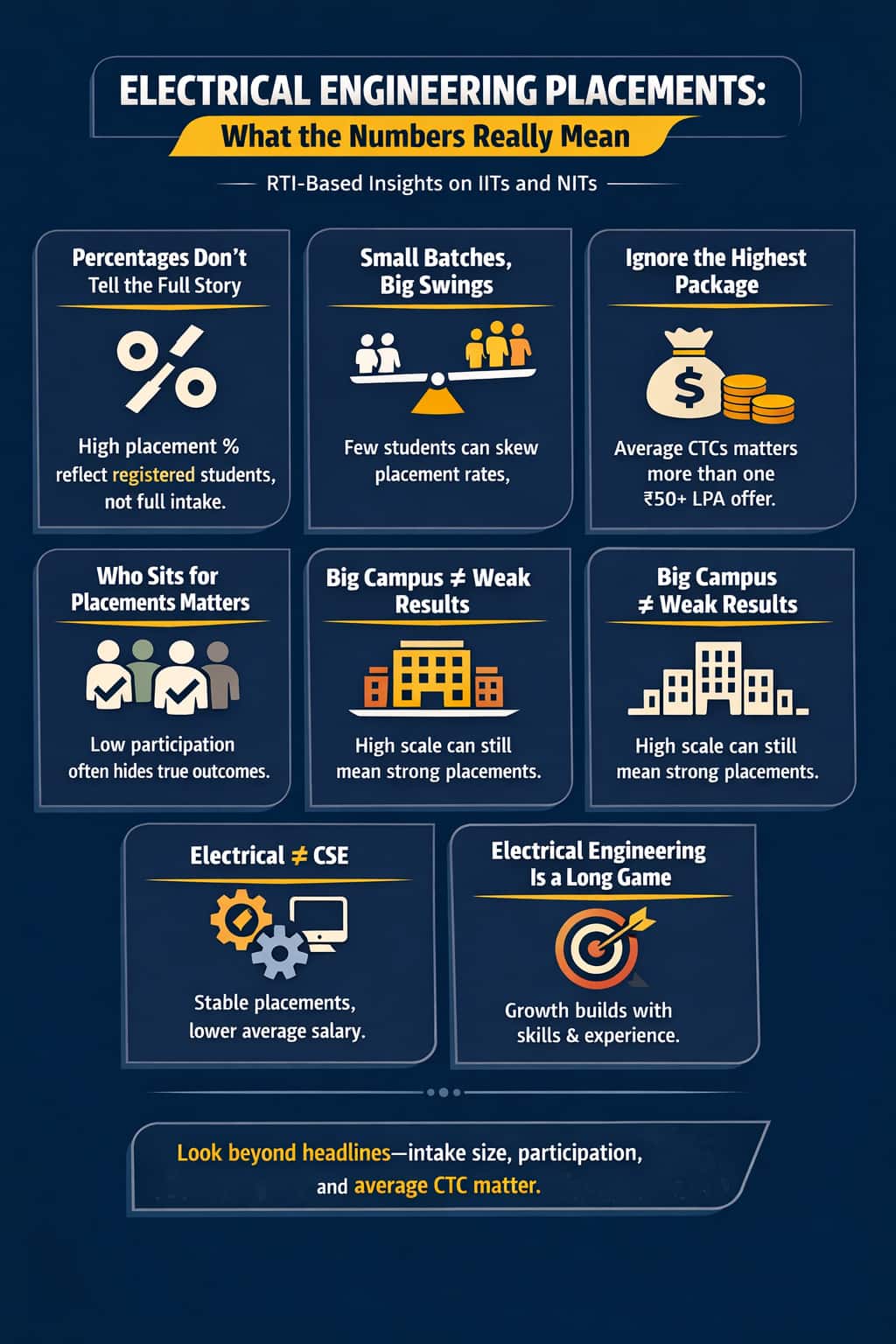
Comparing the intake with placed students, placement registration, and land, looking at average CTC rather than just high CTC will give a clearer picture than marketing-driven placement numbers.
Articles
Upcoming Engineering Exams

Certifications By Top Providers
Explore Top Universities Across Globe
Popular Courses and Specializations
Popular Degrees
Popular Branches
Popular Courses
- BTech Production Engineering: Course, Eligibility, Admission, Syllabus, Fees, Jobs, Scope
- B.Tech in Telecommunication Engineering: Course, Admission, Fees, Scope, Salary
- B.Tech in Power System Engineering: Courses, Fees, Jobs, Scope
- B.Tech in Silk Technology: Course, Eligibility, Fees, Scope, Salary
- B.Tech in Thermal Engineering - Course, Eligibility, Fees, Scope, Salary
List of B.E /B.Tech colleges
Browse Engineering Colleges by State
Questions related to B.E /B.Tech
On Question asked by student community
Have a question related to B.E /B.Tech ?
Hello, pursuing an M.Tech in Artificial Intelligence and Machine Learning after B.E. in AI and ML can help you gain advanced knowledge and specialise in the field. You can explore M.Tech AI and ML colleges and fees details here: https://engineering.careers360.com/colleges/list-of-artificial-intelligence-and-machine-learning-colleges-in-india?degree=6&stream=1&branch=588
You can pursue B.Tech in Robotics, Automation or Mechatronics after Class 12 with PCM. Admission depends on the university and may be through JEE Main or merit.
For example, Galgotias University offers B.Tech in Robotics and Mechatronics, so these can be good options to explore if you're interested in automation
Hi,
Yes, you can still join BE/BTech through KCET counselling. Since you officially discontinued your B.Sc Agriculture seat, submitted the discontinuation letter, and got your TC/documents back without penalty, you are generally eligible to participate in KCET counselling again.
KEA mainly creates issues when students block seats and do not
If you're specifically looking for B.E./ B. Tech in Aerospace Engineering (not Aeronautical Engineering) , it's worth considering LPU as well. Aerospace Engineering is a broader field that covers the design, development, testing, and maintenance of both aircraft and spacecraft , including satellites, rockets, and space exploration systems, whereas Aeronautical
Hello
If you are looking for the BE/B.Tech in Aerospace Engineering in Karnataka or Tamil Nadu States. There are some reputed colleges which offer this course with good academics and the best placement records.
Here are some colleges that offer BE/B.Tech in Aerospace Engineering -
- Madras Institute of Technology (MIT)

Applications for Admissions are open.
Among top 100 Universities Globally in the Times Higher Education (THE) Interdisciplinary Science Rankings 2026
Amity University Noida-B.Tech Admissions 2026
ApplyAmong top 100 Universities Globally in the Times Higher Education (THE) Interdisciplinary Science Rankings 2026
Manav Rachna University M.Tech Admissions 2026
ApplyRecognized as Category-1 Deemed to be University by UGC | 41,000 + Alumni Imprints Globally | Students from over 20+ countries
Manav Rachna-B.Tech Admissions 2026
ApplyNAAC A++ Grade | Recognized as Category-1 Deemed to be University by UGC | 41,000 + Alumni Imprints Globally
GMRIT Deemed to be University B.Tech Admissions 2026
Apply100+ Recruiters | 1200+ Placements of 2026 Batch | NBA & NAAC Accredited | Highest CTC 37 LPA
Integral University B.Tech Admissions 2026
ApplyNAAC A+ Accredited | Highest CTC 45 LPA | Scholarships Available
News and Notifications
Explore Career Options
By Industry