Careers360 Logo
ask-icon
share
    Inverse Trigonometry JEE Advanced Questions: Weightage, PYQs, and Preparation Tips

    Inverse Trigonometry JEE Advanced Questions: Weightage, PYQs, and Preparation Tips

    Shivani PooniaUpdated on 06 Aug 2026, 03:52 PM IST

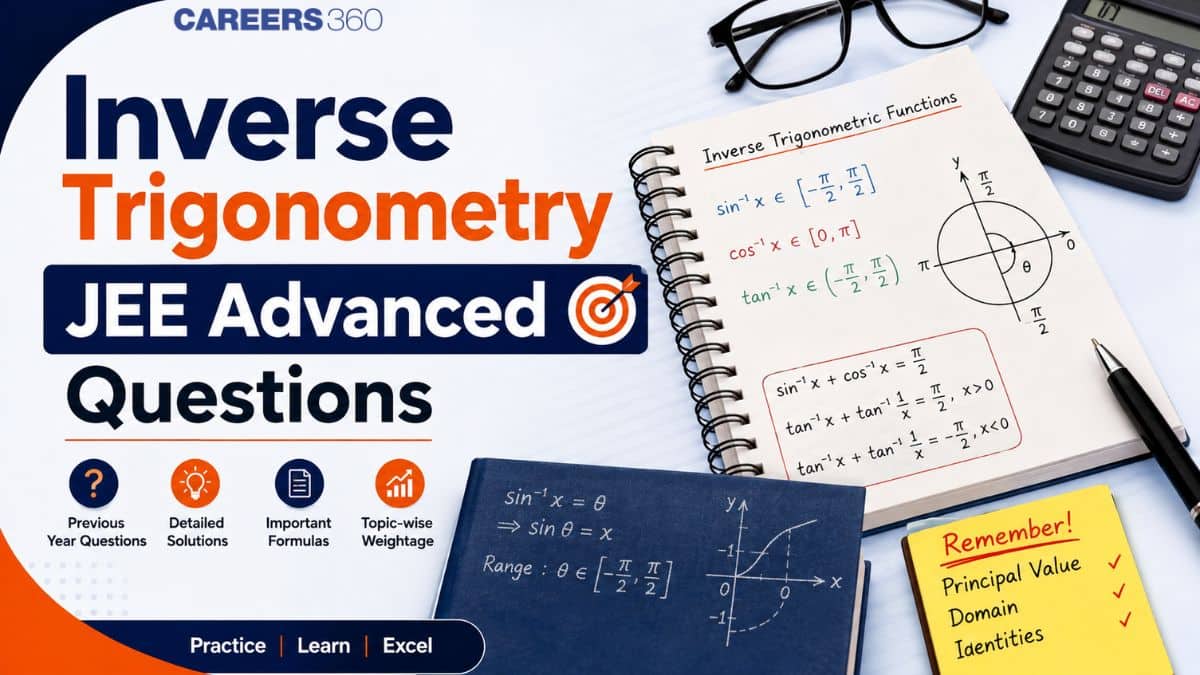
    Inverse trigonometry is the part of maths that helps you find out the angles when the value of some trigonometric functions are given. Inverse Trigonometry is one of the most important chapters in JEE Advanced. Every year, around 1 to 2 questions are asked from this unit. Practising Inverse Trigonometry JEE Advanced Questions helps students understand the exam pattern, the types of questions asked, and the difficulty level of these questions. In this article, we have provided topic -wise weightage, important formulas, JEE Advanced and JEE Main inverse trigonometry questions, JEE 2027 preparation tips, and Inverse Trigonometry IIT questions PDF.
    Practice using JEE Main & Advanced Trigonometry Previous Year Questions -Free PDF

    This Story also Contains

    1. Inverse Trigonometry JEE Advanced Last 10 Years Most Asked Topics
    2. JEE Main and JEE Advanced Inverse Trigonometric Functions Weightage
    3. Important Inverse Trigonometry Formulas and Identities
    4. Important Topics from Inverse Trigonometry
    5. Inverse Trigonometry JEE Advanced Previous Year Questions
    6. Best Books for Inverse Trigonometric JEE Main Questions
    Inverse Trigonometry JEE Advanced Questions: Weightage, PYQs, and Preparation Tips
    Inverse Trigonometry JEE Advanced Questions & PYQs

    Inverse Trigonometry JEE Advanced Last 10 Years Most Asked Topics

    Inverse Trigonometry JEE Advanced Questions asked in the last 10 years include different topics. The table below is prepared based on JEE Main 2026 exam analysis, which shows the most asked JEE Advanced inverse trigonometry question topics.

    Topic

    No. of Questions Asked

    Principal and Standard Values

    2

    Properties of Inverse Trigonometric Functions

    1

    Domain and Range

    2

    Simplification with the help of Identities

    2

    Sum and Difference of Inverse Trigonometric Functions

    1

    Inverse Trigonometric Identities

    2

    Inequalities

    1

    Graphs of Inverse Trigonometric Functions

    1

    Substitution

    1

    Integration

    1

    Functional Equations

    1

    Total

    15

    Confused About College Admissions?

    Get expert advice on college selection, admission chances, and career path in a personalized counselling session.

    Book a Counselling Slot
    Select Date
    Pick a Slot

    JEE Main and JEE Advanced Inverse Trigonometric Functions Weightage

    The JEE Main previous year trends and analysis show that the number of questions asked from Inverse trigonometry varies year to year. The table given below is prepared based on JEE Main 2026 exam analysis.

    Exam

    Difficulty Level

    No. of Questions Asked

    JEE Main

    Moderate

    6-8

    JEE Advanced

    Moderate to Difficult

    1-2

    Important Inverse Trigonometry Formulas and Identities

    To score good marks in JEE Advanced Maths, it is really important to revise formulas regularly. Below are some of the most important inverse-trigonometric formulas, which usually come up:

    1. Range of Inverse Trigonometric functions

    • $\sin ^{-1} x \in[-\pi / 2, \pi / 2]$

    • $\cos ^{-1} \mathrm{x} \in[0, \pi]$

    • $\tan ^{-1} \mathrm{x} \in(-\pi / 2, \pi / 2)$

    2. Basic inverse trigonometric function identities

    • $\sin ^{-1} x+\cos ^{-1} x=\pi / 2$

    • $\tan ^{-1} x+\tan ^{-1}(1 / x)=\pi / 2(x>0)$

    • $\tan ^{-1} x+\tan ^{-1}(1 / x)=-\pi / 2(x<0)$

    UPES B.Tech Admissions 2026

    Ranked #43 among Engineering colleges in India by NIRF | Get Upto 100% Scholarships | Spot Admissions via CUET

    Amity University Noida-B.Tech Admissions 2026

    Among top 100 Universities Globally in the Times Higher Education (THE) Interdisciplinary Science Rankings 2026

    3. $\tan ^{-1} \mathrm{a}+\tan ^{-1} \mathrm{~b}=\tan ^{-1}[(\mathrm{a}+\mathrm{b}) /(1-\mathrm{ab})]$

    4. Values of inverse Trigonometric functions

    Inverse Function

    Value

    $\sin ^{-1}(0)$

    0

    $\sin ^{-1}(1 / 2)$

    $\pi / 6$

    $\sin ^{-1}(1)$

    $\pi / 2$

    $\cos ^{-1}(1)$

    0

    $\cos ^{-1}(0)$

    $\pi / 2$

    $\cos ^{-1}(-1)$

    $\Pi$

    $\tan ^{-1}(1)$

    $\pi / 4$

    $\tan ^{-1}(\sqrt{ } 3)$

    $\pi / 3$

    $\tan ^{-1}(0)$

    0

    Also Check: JEE 2027 Important Formulas

    Important Topics from Inverse Trigonometry

    Inverse Trigonometric function is the most asked chapter in JEE Advanced. Most questions from this chapter are asked from the topics given below:

    1. Domain and Range

    2. Principal Value

    3. Inverse trigonometry functions graphs

    4. Inverse trigonometric functions identities

    5. Identities, their sum and differences

    6. Applications of inverse trigonometric functions

    7. Logarithmic transformations

    Also Check: JEE Main 2027 Study Guide Complete Notes, Important Concepts, Formulae and Practice Questions

    Inverse Trigonometry JEE Advanced Previous Year Questions

    JEE Advanced inverse trigonometry questions are the best way to prepare for JEE Advanced 2027. The questions below will help you understand the exam pattern, the key topics, and also the general level of difficulty.

    Question 1: The total number of real solutions of the equation

    $\theta=\tan ^{-1}(2 \tan \theta)-\frac{1}{2} \sin ^{-1}\left(\frac{6 \tan \theta}{9+\tan ^2 \theta}\right)$ is

    (Here, the inverse trigonometric functions $\sin ^{-1} x$ and $\tan ^{-1} x$ assume values in $\left[-\frac{\pi}{2}, \frac{\pi}{2}\right]$ and $\left(-\frac{\pi}{2}, \frac{\pi}{2}\right)$, respectively).

    (1) 1

    (2) 2

    (3) 3

    (4) 5

    Solution: Option (3)

    Given , $\theta=\tan ^{-1}(2 \tan \theta)-\frac{1}{2} \sin ^{-1}\left(\frac{6 \tan \theta}{9+\tan ^2 \theta}\right)$

    Let $x=\tan \theta$.

    The equation becomes $\theta=\tan ^{-1}(2 x)-\frac{1}{2} \sin ^{-1}\left(\frac{6 x}{9+x^2}\right)$.

    Let us first find the value of $\frac{6 x}{9+x^2}$

    $
    \frac{6 x}{9+x^2}=\frac{2(3 x)}{9+x^2}=\frac{2\left(\frac{x}{3}\right)}{1+\left(\frac{x}{3}\right)^2}
    $
    Let $y=\frac{x}{3}$.
    Then $\frac{6 x}{9+x^2}=\frac{2 y}{1+y^2}=\sin \left(2 \tan ^{-1}(y)\right)=\sin \left(2 \tan ^{-1}\left(\frac{x}{3}\right)\right)$ [$\sin (2 \theta)=\frac{2 \tan (\theta)}{1+\tan ^2(\theta)}$]

    The equation becomes $\theta=\tan ^{-1}(2 x)-\frac{1}{2} \sin ^{-1}\left(\sin \left(2 \tan ^{-1}\left(\frac{x}{3}\right)\right)\right)$.

    $
    \theta=\tan ^{-1}(2 x)-\tan ^{-1}\left(\frac{x}{3}\right)
    $

    Apply the tangent function to both sides

    $
    \begin{aligned}
    & \tan (\theta)=\tan \left(\tan ^{-1}(2 x)-\tan ^{-1}\left(\frac{x}{3}\right)\right) . \\
    & \tan (\theta)=\frac{2 x-\frac{x}{3}}{1+2 x \frac{x}{3}}=\frac{\frac{5 x}{3}}{1+\frac{2 x^2}{3}}=\frac{5 x}{3+2 x^2} .
    \end{aligned}
    $
    Since $x=\tan (\theta)$, we have $x=\frac{5 x}{3+2 x^2}$.

    Solve for $x$

    $
    \begin{aligned}
    & x\left(3+2 x^2\right)=5 x . \\
    & 3 x+2 x^3=5 x . \\
    & 2 x^3-2 x=0 . \\
    & 2 x\left(x^2-1\right)=0 . \\
    & 2 x(x-1)(x+1)=0 . \\
    & x=0,1,-1 .
    \end{aligned}
    $

    Find the values of $\theta$

    $
    \begin{aligned}
    & \tan (\theta)=0 \Longrightarrow \theta=0 \\
    & \tan (\theta)=1 \Longrightarrow \theta=\frac{\pi}{4} \\
    & \tan (\theta)=-1 \Longrightarrow \theta=-\frac{\pi}{4}
    \end{aligned}
    $

    Therefore, the total number of real solutions is: 3.

    Question 2: $

    \mathrm{f}_1(\mathrm{x})=\cot ^{-1}\left(\tan \left(\sin ^2 \mathrm{x}\right)\right), \mathrm{f}_2(\mathrm{x})=\tan ^{-1}\left(\cot \left(\cos ^2 \mathrm{x}\right)\right), \mathrm{f}_3(\mathrm{x})=\cot ^{-1}\left(\operatorname { t a n } \left(\cos ^2 \mathrm{x}\right.\right.

    $

    and $f_4(x)=\tan ^{-1}\left(\cot \left(\sin ^2 x\right)\right)$, then correct option are

    (1)$\mathrm{f}_{1}(\mathrm{x})+\mathrm{f}_{2}(\mathrm{x})+\mathrm{f}_{3}(\mathrm{x})+\mathrm{f}_{4}(\mathrm{x})=2(\pi-1)$

    (2)$\mathrm{f}_{1}(\mathrm{x})-\mathrm{f}_{2}(\mathrm{x})+\mathrm{f}_{3}(\mathrm{x})-\mathrm{f}_{4}(\mathrm{x})=0$

    (3)$\mathrm{f}_{1}(\mathrm{x})-\mathrm{f}_{2}(\mathrm{x})+\mathrm{f}_{3}(\mathrm{x})-\mathrm{f}_{4}(\mathrm{x})=2 \pi$

    (4) $\mathrm{f}_{4}(\mathrm{x})>\mathrm{f}_{3}(\mathrm{x}) \Rightarrow \cos 2 \mathrm{x}>0$

    Solution: Option (1), (2), (4)

    $\mathrm{f}_{1}(\mathrm{x})=\frac{\pi}{2}-\sin ^{2} \mathrm{x}, \mathrm{f}_{2}(\mathrm{x})=\frac{\pi}{2}-\cos ^{2} \mathrm{x}\\\\ \mathrm{f}_{3}(\mathrm{x})-\frac{\pi}{2}-\cos ^{2} \mathrm{x}, \mathrm{f}_{4}(\mathrm{x})=\frac{\pi}{2}-\sin ^{2} \mathrm{x}$

    Hence, the answer is Option (1,2,4)


    Question 3: Let $\mathrm{f}(\mathrm{x})=\operatorname{cosec}^{-1}\left(\left[\cos ^2 \mathrm{x}+2 \sin ^2 \mathrm{x}\right]\right)$. Then set of points, where $f(x)$ is not continuous is (where [.] denotes greatest integer function)

    (1) $\left\{(2 n-1) \frac{\pi}{2}, n \in z\right\}$

    (2) $\left\{\frac{\mathrm{n} \pi}{2}, \mathrm{n} \in \mathrm{z}\right\}$

    (3) $\left\{(2 n+1) \frac{\pi}{2}, n \in z\right\}$

    (4) none of these

    Solution: Option (1)

    $
    f(x)=\operatorname{cosec}-1\left(\left[\cos ^2 x+2 \sin ^2 x\right]\right)=\operatorname{cosec}^{-1}\left(\left[1+\sin ^2 x\right]\right)
    $

    when

    $
    \begin{aligned}
    & \sin x= \pm 1, f(x)=\operatorname{cosec} \\
    & -1(2)=\frac{\pi}{6} \\
    & \sin x \neq \pm 1, f(x)=\operatorname{cosec}^{-1}(1)=\operatorname{cosec} \\
    & \text { when }
    \end{aligned}{ }^{-1}(1)=\frac{\pi}{2} .
    $

    Hence $f(x)$ is not continuous at odd multiple of $\frac{\pi}{2}$


    Question 4: Find the value of $\left.2 \tan ^{-1}(\operatorname{cosec} \theta)+\tan ^{-1}\left(2 \sin \theta \sec ^2 \theta\right)\right)$ if $\sin \theta$ is the only real root of $\mathrm{x}^3+\mathrm{px}^2+\mathrm{qx}+1=0,(\mathrm{p}<\mathrm{q})$ is

    (1) $\pi$

    (2) $\frac{\pi}{2}$

    (3) $-\frac{\pi}{2}$

    (4) $- \pi$

    Solution: Option (4)

    $\begin{aligned} & f(x)=x^3+p x^2+q x+1 \\ & f(0)=1 \Rightarrow \quad f(0)>0 \\ & f(-1)=p-q \Rightarrow \quad f(-1)<0 \\ & \text { Hence } \sin \theta \in(-1,0) \Rightarrow \theta \in\left(-\frac{\pi}{2}, 0\right) \\ & \quad \text { So, } \quad 2 \tan ^{-1}(\operatorname{cosec} \theta)+\tan ^{-1}\left(2 \sin \theta \sec ^2 \theta\right) \\ & =2 \tan ^{-1}\left(\frac{1}{\sin \theta}\right)+\tan ^{-1}\left(\frac{2 \sin \theta}{1-\sin ^2 \theta}\right) \\ & =2 \tan ^{-1}\left(\frac{1}{\sin \theta}\right)+\tan ^{-1}\left(\tan \left(2 \tan ^{-1}(\sin \theta)\right)\right) \\ & =2\left[\tan ^{-1}\left(\frac{1}{\sin \theta}\right)+\tan ^{-1}(\sin \theta)\right] \\ & =2\left[\frac{-\pi}{2}\right]=-\pi \\ & \text { (as } \sin \theta<0)\end{aligned}$


    Question 5: If the equation $\sin ^{-1}(\cos x)+\left|x^2-\lambda\right|=\frac{\pi}{2}$ is inconsistent, then value of $\lambda$ can be

    (1) $\frac{-1}{2}$

    (2) $\frac{-1}{3}$

    (3) $\frac{1}{2}$

    (4) $\frac{1}{3}$

    Solution: Option (1), (2)

    $\begin{aligned} & \sin ^{-1}(\cos x)+\left|x^2-\lambda\right|=\frac{\pi}{2} \\ & \frac{\pi}{2}-\sin ^{-1}(\cos x)=\left|x^2-\lambda\right| \\ & \cos ^{-1}(\cos x)=\left|x^2-\lambda\right|\end{aligned}$

    1786010456777

    For no point of intersection, $\lambda<0$ and $x^2-\lambda=x$ have no solution

    $
    x^2-x-\lambda=0
    $
    $
    \mathrm{D}<0
    $
    $
    1+4 \lambda<0 \quad \Rightarrow \quad \lambda<-\frac{1}{4}
    $


    Question 6: If $f(x)=\sin ^{-1}|\sin x|$ and $g(x)=\left(\sin ^{-1}|\sin x|\right)^2$ when, $x \in[0,2 \pi]$, then area between $f(x)$ and $g(x)$ is

    (1) $\frac{4}{3}+\frac{\pi^{2}(\pi-1)}{6} \\$

    (2) $\frac{1}{6}+\frac{\pi^{3}}{8} \\$

    (3) $\frac{3}{4}+\frac{\pi^{2}(\pi-2)}{6} \\$

    (4) $\frac{4}{3}+\frac{\pi^{2}(\pi-3)}{6}$

    Solution: Option (4)

    $\begin{aligned} & \text { Area }=4\left[\int_0^1\left(x-x^2\right)+\int_1^{\pi / 2}\left(x^2-x\right) d x\right] \\ & =4\left[\frac{x^2}{2}-\left.\frac{x^3}{3}\right|_0 ^1+\frac{x^3}{3}-\left.\frac{x^2}{2}\right|_1 ^{\pi / 2}\right] \\ & =\frac{4}{3}+\frac{\pi^2(\pi-3)}{6}\end{aligned}$


    Question 7: The area enclosed between $f(x)$ and $\{\mathrm{x}\}$-axis, when $f(x)=\min \left\{\cos ^{-1}(\cos x), \cot ^{-1}(\cot x)\right\}$ and $x \in(\pi, 2 \pi)$ is

    (1) $\frac{\pi^{2}}{2} \\$

    (2) $\pi^{2} \\$

    (3) $\frac{\pi^{2}}{4} \\$

    (4) $\frac{\pi^{2}}{3}$

    Solution: Option (3)

    1786010456839

    $Area =\frac{1}{2} \times \pi \times \frac{\pi}{2}=\frac{\pi^{2}}{4}$


    Question 8: Which of the following is a rational number

    (1) $\tan \left(\frac{1}{2} \cos ^{-1} \frac{\sqrt{5}}{3}\right)$

    (2) $\log _{2}\left(\sin \left(\frac{1}{4} \sin ^{-1} \frac{\sqrt{63}}{8}\right)\right)$

    (3) $\cos \left(\frac{\pi}{2}-\sin ^{-1}\left(\frac{4}{5}\right)\right)$

    (4) $\cos \left(\cot ^{-1} \frac{1}{3}+\cot ^{-1} 3\right)$

    Solution: Option (2), (3), (4)

    $
    \begin{aligned}
    & \cos ^{-1} \frac{\sqrt{5}}{3}=\theta \Rightarrow \cos \theta=\frac{\sqrt{5}}{3} \Rightarrow \tan \theta=\frac{2}{\sqrt{5}} \\
    & \tan \theta=\frac{2 \tan \frac{\theta}{2}}{1-\tan ^2 \frac{\theta}{2}} \Rightarrow \tan \frac{\theta}{2}=\frac{3-\sqrt{5}}{2}
    \end{aligned}
    $

    B $
    \sin ^{-1} \frac{\sqrt{63}}{8}=\theta \Rightarrow \sin \theta=\frac{\sqrt{63}}{8}, \cos \theta=\frac{1}{8}
    $

    As $\cos \frac{\theta}{2}=\sqrt{\frac{1+\cos \theta}{2}}=\frac{3}{4}$
    And $\sin \frac{\theta}{4}=\sqrt{\frac{1-\cos \frac{\theta}{2}}{2}}=\frac{1}{2 \sqrt{2}}$
    Now, $\log _2 \sin \left(\frac{1}{4} \sin ^{-1} \frac{\sqrt{63}}{8}\right)=\log _2 \frac{1}{2 \sqrt{2}}=-\frac{3}{2}$

    C $\cos \left(\frac{\pi}{2}-\sin ^{-1} \frac{4}{5}\right)=\cos \left(\cos ^{-1} \frac{4}{5}\right)=\frac{4}{5}$

    D $\cos \left(\cot ^{-1} \frac{1}{3}+\cot ^{-1} 3\right)=\cos \left(\tan ^{-1} 3+\cot ^{-1} 3\right)=\cos \left(\frac{\pi}{2}\right)=0$

    Question 9: Match the column


    Column-I


    Column-II

    (p)

    If smallest positive integral value of x for which $x^2-x-\sin ^{-1}(\sin 2)<0$ is $\lambda$, then $3+\lambda$ is equal to

    (1)

    4

    (q)

    Number of solution(s) of $2[x]=x+2\{x\}$ is, (where [.] is GIF and \{.\} is fractional part function)

    (2)

    1

    (r)

    If $x^2+y^2=1$ and maximum value of $x+y$ is $\frac{\sqrt{2}}{3} \lambda$, then $\lambda$ is

    (3)

    2

    (s)

    $f\left(x+\frac{1}{2}\right)+f\left(x-\frac{1}{2}\right)=f(x)$ for all $x \in R$, then period of $f(x)$ is

    (4)

    3

    (1) $p-1, q-4, r-4, s-4$

    (2) $p –1, q –4, r-3, s-2$

    (3) $p –1, q –3, r-4, s-2$

    (4) $p –1, q –2, r-3, s-4$

    Solution: Option (1)

    $
    \begin{aligned}
    & x^2-x-\pi+2<0 \\
    & x=\frac{1 \pm \sqrt{4 \pi-7}}{2} \\
    & \therefore \frac{1-\sqrt{4 \pi-7}}{2}<\mathrm{x}<\frac{1+\sqrt{4 \pi-7}}{2} \quad \therefore \lambda=1 \\
    & 2[\mathrm{x}]=\mathrm{x}+2\{\mathrm{x}\}
    \end{aligned}
    $

    (i) If x is an integer, then the equation becomes $2 x=x+0$
    i.e. $x=0$ is a solution
    (ii) If $x \neq 1$ the equation becomes

    $
    \begin{aligned}
    & 2[\mathrm{x}]=[\mathrm{x}]+\{\mathrm{x}\}+2\{\mathrm{x}\} \text { i.e. } \quad\{\mathrm{x}\}=\frac{1}{3}[\mathrm{x}] \\
    & 0<\frac{[\mathrm{x}]}{3}<1 \Rightarrow 0<[\mathrm{x}]<3
    \end{aligned}
    $

    Possible values of $[x]$ are 1,2
    If $[x]=1$, then $\{x\}=\frac{1}{3} \quad \therefore \quad x=1+\frac{1}{3}=\frac{4}{3}$
    If $[\mathrm{x}]=2$, then $\{\mathrm{x}\}=\frac{2}{3} \quad \therefore \quad \mathrm{x}=\frac{8}{3}$
    There are 3 solutions

    $
    \begin{gathered}
    \text { Let } x=\cos \theta, y=\sin \theta \\
    \therefore x+y=\cos \theta+\sin \theta \\
    \therefore \quad \text { maximum value of } x+y \text { is } \sqrt{2} \\
    \mathrm{f}\left(\mathrm{x}+\frac{1}{2}\right)+\mathrm{f}\left(\mathrm{x}-\frac{1}{2}\right)=\mathrm{f}(\mathrm{x}) \\
    \mathrm{f}(\mathrm{x}+1)+\mathrm{f}(\mathrm{x})=\mathrm{f}\left(\mathrm{x}+\frac{1}{2}\right) \Rightarrow \mathrm{f}(\mathrm{x}+1)+\mathrm{f}\left(\mathrm{x}-\frac{1}{2}\right)=0 \\
    \mathrm{f}\left(\mathrm{x}+\frac{3}{2}\right)=-\mathrm{f}(\mathrm{x}) \Rightarrow \mathrm{f}(\mathrm{x}+3)=-\mathrm{f}\left(\mathrm{x}+\frac{3}{2}\right)=\mathrm{f}(\mathrm{x})
    \end{gathered}
    $

    $f(x)$ is periodic with period 3

    Question 10: Match the column


    Column-I


    Column-II

    (A)

    Difference of greatest and least value of $\sqrt{2}(\sin x+\cos x)$

    (p)

    4

    (B)

    Difference of greatest and least value of $x^2-4 x+3, x \in[1,3]$ is

    (q)

    1

    (C)

    Greatest value of

    $
    \tan ^{-1}\left(\frac{1-x}{1+x}\right), x \in[0,1]
    $

    (r)

    0

    (D)

    Difference of greatest and least value of $\cos ^{-1} \mathrm{x}^2, \mathrm{x} \in\left[\frac{-1}{\sqrt{2}}, \frac{1}{\sqrt{2}}\right]$ is

    (s)

    $\frac{\pi}{6}$


    (t)

    $\frac{\pi}{4}$

    (1) $A-r, B-q, C-s, D-t$

    (2) $A –p, B –q, C-t, D-s$

    (3) $A –p, B –q, C-s, D-t$

    (4) $A –r, B-p, C-t, D-s$

    Solution: Option (2)

    A. The difference $=2-(-2)=4$
    B. Let $\mathrm{f}(\mathrm{x})=\mathrm{x}^2-4 \mathrm{x}+3$

    $\begin{aligned}
    & \mathrm{f}^{\prime}(\mathrm{x})=2 \mathrm{x}-4=0 \quad \Rightarrow \mathrm{x}=2 \\
    & \mathrm{f}(1)=0, \mathrm{f}(2)=-1, \mathrm{f}(3)=0
    \end{aligned}$

    $\therefore \mid$ greatest value-least value $\mid=1$
    C.

    $\tan ^{-1} \frac{1-x}{1+x}=\tan ^{-1} 1-\tan ^{-1} x$

    $\therefore \text { greatest value }=\frac{\pi}{4}$

    D.

    $\therefore \text { greatest value }=\frac{\pi}{2}, \text { least value }=\frac{\pi}{3}$

    Question 11. If sum of the series $\cot ^{-1}\left(2 \cdot 1^2\right)+\cot ^{-1}\left(2 \cdot 2^2\right)+\cot ^{-1}\left(2 \cdot 3^2\right) \ldots \ldots \infty$ is equal to $k \pi$ then find the value of $[k]$, while $[\cdot]$ denotes GIF

    (1) 0

    (2) 1

    (3) 2

    (4) 3

    Solution: Option (1)

    $\begin{aligned} \mathrm{s} & =\sum_{\mathrm{r}=1}^{\infty} \cot ^{-1}\left(2 \cdot \mathrm{r}^2\right)=\sum_{\mathrm{r}=1}^{\infty} \tan ^{-1} \frac{1}{2 \mathrm{r}^2} \\ & =\sum_{\mathrm{r}=0}^{\infty} \tan ^{-1}\left(\frac{(2 \mathrm{r}+1)-(2 \mathrm{r}-1)}{1+(2 \mathrm{r}+1)(2 \mathrm{r}-1)}\right) \\ & =\sum_{\mathrm{r}=1}^{\infty} \tan ^{-1}(2 \mathrm{r}+1)-\tan ^{-1}(2 \mathrm{r}-1) \\ & =\left(\tan ^{-1} 3-\tan ^{-1} 1\right)+\left(\tan ^{-1} 5-\tan ^{-1} 3\right)+\left(\tan ^{-1} 7-\tan ^{-1} 5\right)+\ldots \ldots \tan ^{-1} \infty \\ & =-\tan ^{-1} 1+\tan ^{-1} \infty \\ & =-\frac{\pi}{4}+\frac{\pi}{2}=\frac{\pi}{4} \Rightarrow \mathrm{k}=\frac{1}{4}\end{aligned}$

    Question 12. $\begin{aligned} & \cot ^{-1}\left(\frac{5+3 \cos 2 \mathrm{x}}{3 \sin 2 \mathrm{x}}\right)+\cot ^{-1}\left(\frac{4}{\tan \mathrm{x}}\right)=\lambda \mathrm{x} \text {, then find the value of } \lambda \text { where } \\ & x \in\left(\frac{-\pi}{2}, \frac{\pi}{2}\right)\end{aligned}$

    (1) 1

    (2) 2

    (3) 3

    (4) 4

    Solution: Option (1)

    $\begin{aligned} & \Rightarrow \cot ^{-1}\left(\frac{5+3 \cos 2 \mathrm{x}}{3 \sin 2 \mathrm{x}}\right)+\cot ^{-1}\left(\frac{4}{\tan \mathrm{x}}\right) \\ & \Rightarrow \tan ^{-1}\left(\frac{3 \sin 2 \mathrm{x}}{5+3 \cos 2 \mathrm{x}}\right)+\tan ^{-1}\left(\frac{\tan \mathrm{x}}{4}\right) \\ & \Rightarrow \tan ^{-1}\left(\frac{6 \tan \mathrm{x}}{8+2 \tan ^2 \mathrm{x}}\right)+\tan ^{-1}\left(\frac{\tan \mathrm{x}}{4}\right) \\ & \Rightarrow \tan ^{-1}\left(\frac{\frac{3 \tan x}{4+\tan ^2 x}+\frac{\tan x}{4}}{1-\frac{3 \tan ^2 x}{16+4 \tan ^2 x}}\right) \\ & \Rightarrow \tan ^{-1}(\tan x) \\ & =x\end{aligned}$

    Question 13. $\mathrm{S}=\cot ^{-1}\left(\frac{1}{8}\right)+\cot ^{-1}\left(\frac{1}{2}\right)+\cot ^{-1}\left(\frac{9}{8}\right)+\cot ^{-1}(2)+\cot ^{-1}\left(\frac{25}{8}\right)+\ldots$

    $ \text { If } \lim _{n \rightarrow \infty} \mathrm{S}=\frac{\mathrm{a}}{\mathrm{b}} \pi$

    then the correct option is/are

    (1) $a+b=9$

    (2) $a-b=5$

    (3) $a-b=3$

    (4) $a+b=11$

    Solution: Options (3) and (4)

    $\begin{aligned} & \mathrm{T}_{\mathrm{n}}=\cot ^{-1}\left(\frac{\mathrm{n}^2}{8}\right) \\ & =\tan ^{-1}\left(\frac{8}{\mathrm{n}^2}\right)=\tan ^{-1}\left(\frac{2}{1+\frac{\mathrm{n}^2}{4}-1}\right) \\ & =\tan ^{-1}\left(\frac{\mathrm{n}}{2}+1\right)-\tan ^{-1}\left(\frac{\mathrm{n}}{2}-1\right) \\ & \sum_{\mathrm{n}=1}^{\infty} \mathrm{T}_{\mathrm{n}}=\frac{7 \pi}{4}\end{aligned}$

    Question 14: Let $0<\alpha<1, \beta=\frac{1}{3 \alpha}$ and $\tan ^{-1}(1-\alpha)+\tan ^{-1}(1-\beta) =\frac{\pi}{4}$. Then $6(\alpha+\beta)$ is equal to:

    (1) 6

    (2) 7

    (3) 8

    (4) 9

    Solution: Option (2)

    $\begin{aligned} & \beta=\frac{1}{3 \alpha}, \tan ^{-1}(1-\alpha)+\tan ^{-1}(1-\beta)=\frac{\pi}{4} \\ & \Rightarrow \tan \left(\tan ^{-1}(1-\alpha)+\tan ^{-1}(1-\beta)\right)=1 \\ & \Rightarrow \frac{1-\alpha+1-\beta}{1-(1-\alpha)(1-\beta)}=1 \\ & \Rightarrow 2-\alpha-\beta=1-(1-\alpha-\beta+\alpha \beta) \\ & \Rightarrow 2-\alpha-\beta=\alpha+\beta-\alpha \beta \\ & \Rightarrow 2(\alpha+\beta)=2+\alpha \beta \\ & \Rightarrow 2(\alpha+\beta)=2+\frac{1}{3}=\frac{7}{3} \\ & \alpha+\beta=\frac{7}{6} \\ & 6(\alpha+\beta)=7\end{aligned}$

    Question 15: If $\sin \left(\tan ^{-1}(x \sqrt{2})\right)=\cot \left(\sin ^{-1} \sqrt{1-x^2}\right), x \in(0,1)$, then the value of $x$ is:

    (1) $\frac{1}{2}$

    (2) $\frac{1}{3}$

    (3) $\frac{2}{3}$

    (4) $\frac{5}{8}$

    Solution: Option (1)

    $\begin{aligned} & \frac{x \sqrt{2}}{\sqrt{2 x^2+1}}=\frac{1}{\sqrt{1-x^2}} \\ & 2\left(1-x^2\right)=\left(2 x^2+1\right) \\ & 2-2 x^2=2 x^2+1 \\ & x^2=\frac{1}{4} \\ & x=\frac{1}{2}\end{aligned}$

    Also check: JEE Mains 2027: Maths Set of 5 Sample Paper with Solution

    Best Books for Inverse Trigonometric JEE Main Questions

    Refer to the books given below for solving JEE Advanced inverse trigonometry questions. While preparing for IIT JEE, it is very important to follow the Best Books for JEE Main 2027 because they help properly cover all the concepts.

    Sr. No

    Book Names

    1

    Class 11 and 12 NCERT

    2

    IIT Mathematics by M.L. Khanna

    3

    RD Sharma

    4

    Problems Plus in IIT Mathematics by A. Das Gupta

    Frequently Asked Questions (FAQs)

    Q: How many questions are asked from Inverse Trigonometry in JEE Advanced?
    A:

    Usually, about one question comes up each year. Sometimes Inverse Trigonometry IIT questions can be mixed together with another chapter. 

    Q: Is inverse trigonometry important for JEE Advanced 2027?
    A:

    Yes, Inverse Trigonometry JEE Advanced Questions are high-scoring because the syllabus is smaller than many others. 

    Q: Which are the most important inverse trigonometry.
    A:

    Topics like principal values, domains, and ranges, plus identities, graphs, and composite functions are most asked. 

    Articles
    |
    Upcoming Engineering Exams
    Certifications By Top Providers
    Data Analytics with Python
    Via Indian Institute of Technology Roorkee
    Online Certificate Course on Cyber Laws
    Via Indian Law Institute, New Delhi
    Basic Programming using Python
    Via Indian Institute of Technology Bombay
    Biomechanics of Joints and Orthopaedic Implants
    Via Indian Institute of Technology Kharagpur
    Biomedical Nanotechnology
    Via Indian Institute of Technology Roorkee
    Material Science
    Via Indira Gandhi National Open University, New Delhi
    Explore Top Universities Across Globe

    Questions related to JEE Advanced

    On Question asked by student community

    Have a question related to JEE Advanced ?

    Hey there,

    Yes, you can pursue Class 12 with PCM through NIOS after passing PCB in 2025, but your eligibility for entrance exams depends on the exam rules. For JEE Main , NIOS is accepted, but JEE Advanced eligibility is generally based on the year you first passed Class 12,

    With this rank, some good options include:

    1. CBIT (unlikely)

    2. VNR VJIET (unlikely)

    3. Gokaraju Rangaraju Institute of Engineering and Technology (possible in later rounds for some branches)

    4. CMR Technical Campus

    5. Malla Reddy Engineering Colleges

    6. CVR College of Engineering (depending on category/branch)

    7. Vardhaman College of

    Hello Dear Student,
    To shortlist courses and colleges on Careers360 for CSAB using your ranks (JEE Main 38k, JEE Advanced 18,814, KCET 1,049), use the JEE Main College Predictor, filter by your category and home state, and review past NIT/IIIT/GFTI vacancy trends.

    You can check, find and access more information

    Hello Dear Student,
    With 190 marks in JEE Advanced, getting a Computer Science and Engineering (CSE) branch in top or older IITs is generally not possible for general category students, but you may get CSE in some newer or lower-generation IITs (like IIT Ropar or similar newer peers) or good

    Hello Aspirant,

    Admission to the IIT Preparatory Course depends on several factors such as category-wise seat availability, number of candidates opting for the preparatory programme and counselling trends for the particular year. With an SC Preparatory Rank of 4721, securing a seat may be difficult in highly preferred IITs, but