VIT Bhopal University | M.Tech Admissions 2026
M.Tech admissions open @ VIT Bhopal University | Highest CTC 70 LPA | Apply now


GATE Syllabus 2027 - IIT Madras will upload the GATE 2027 syllabus PDF online on the official website. The syllabus of GATE 2027 includes the important topics chapter-wise on which the GATE question paper will be based. GATE exam syllabus 2027 covers topics for Aptitude, Engineering Mathematics, and core papers. Candidates must follow the GATE syllabus while preparing for the GATE exam. The authority will conduct GATE 2027 exam in February 2027. The direct GATE exam syllabus 2027 download link for 30 papers is given below.
Direct link to download the GATE syllabus PDF
This Story also Contains

The authority will soon announce the GATE exam dates for all the subject papers on the official website. Candidates must be aware of all the topics of the GATE syllabus 2027. Candidates are also advised to look for the GATE 2027 exam pattern, marking scheme, types of questions, duration, and other details. In addition to understanding the exam pattern, candidates should also practice the GATE question papers. Candidates can also check the detailed syllabus along with topic-wise weightage for some of the important GATE 2027 papers.
Check: GATE Application form | GATE 2027 Notification
Participial | Details |
Exam | GATE 2027 |
Organizing Authority | IIT Madras |
GATE 2027 syllabus release date | To be Released in July 2026 |
GATE official website | To be updated |
Sections in GATE 2027 syllabus |
|
Total no of questions | 30 |
Indian Institute of Technology Madras will release the GATE M.Tech syllabus PDF 2027 on the official website. Candidates must ensure they are aware of all the topics included in the GATE syllabus 2027 before starting the preparation. After downloading the GATE 2027 syllabus, candidates should thoroughly review the topics and chapters. To ensure sufficient revision time, aspirants must cover each topic of the GATE syllabus at least a month before the exam. The link for the GATE exam syllabus 2027, weightage-wise for all 30 papers, is provided below. The syllabus of the optional papers is also mentioned here.
Papers | GATE Syllabus PDF Download |
Data Science & Artificial Intelligence | |
Naval Architecture and Marine Engineering (NM) | |
Computer Science (CS) and Information Technology (IT) | |
Chemistry (CY) | |
Ecology and Evolution (EY) | |
Geology and Geophysics (GG) | |
Mathematics (MA) | |
Physics (PH) | |
Statistics (ST) | |
Biomedical Engineering (BM) | |
Engineering Sciences Syllabus (XE) | |
Life Sciences (XL) | |
Humanities and Social Sciences | |
Environmental Science and Engineering | |
Geomatics Engineering (GE) | |
Reasoning and Comprehension (XH-B1) | |
Engineering Mathematics (XE-A) | |
Biochemistry (XL-Q) | |
Material science (XE-C) | |
Philosophy (XH-C4) | |
Thermodynamics (XE-E) | |
Fluid Mechanics (XE-B) | |
Linguistics (XH-C3) | |
Psychology (XH-C5) | |
Botany (XL-R) | |
Economics (XH-C1) | |
Microbiology (XL-S) | |
Solid Mechanics (XE-D) | |
Sociology (XH-C6) |
Also Read: GATE Question Paper
The general aptitude section is compulsory in the exam. The total marks of this section are 15. General Aptitude is the primary and shared section among all. The GATE General Aptitude syllabus includes Verbal Aptitude, Quantitative Aptitude, Analytical Aptitude, and Spatial Aptitude. Candidates must practice the GATE general aptitude as it is a section that can fetch full marks with proper practice.
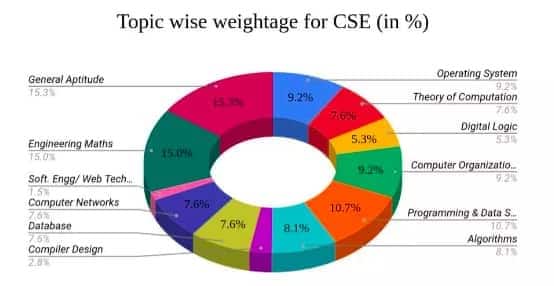
Candidates can check the topic-wise weightage for the GATE Computer Science syllabus here. The GATE 2027 syllabus for CSE comprises important topics for the exam. Accordingly, candidates can start the preparation for the test based on the GATE exam syllabus weightage. Below is the GATE syllabus for CSE 2027. Candidates can also find the weightage in marks below. While all the topics are important for the GATE exam, candidates can use the high-weightage topics as a starting point for the GATE preparation. Candidates can download the GATE 2027 syllabus CSE PDF download link in the table below..
Chapters | Topics |
Engineering Mathematics | Discrete Mathematics: Propositional and first-order logic. Sets, relations, functions, partial orders, and lattices. Monoids, Groups. Graphs: connectivity, matching, colouring. Combinatorics: counting, recurrence relations, generating functions. Linear Algebra: Matrices, determinants, systems of linear equations, eigenvalues and eigenvectors, LU decomposition. Calculus: Limits, continuity and differentiability, Maxima and minima, Mean value theorem, Integration. Probability and Statistics: Random variables, Uniform, normal, exponential, Poisson and binomial distributions. Mean, median, mode and standard deviation. Conditional probability and Bayes theorem. |
Digital Logic | Boolean algebra. Combinational and sequential circuits. Minimization. Number representations and computer arithmetic (fixed and floating point). |
Computer Organization and Architecture | Machine instructions and addressing modes. ALU, data path and control unit. Instruction pipelining, pipeline hazards. Memory hierarchy: cache, main memory and secondary storage; I/O interface (interrupt and DMA mode). |
Programming and Data Structures | Programming in C. Recursion. Arrays, stacks, queues, linked lists, trees, binary search trees, binary heaps, graphs. |
Algorithms | Searching, sorting, hashing. Asymptotic worst case time and space complexity. Algorithm design techniques: greedy, dynamic programming and divide‐and‐conquer. Graph traversals, minimum spanning trees, shortest paths. |
Theory of Computation | Regular expressions and finite automata. Context-free grammars and push-down automata. Regular and context-free languages, pumping lemma. Turing machines and undecidability |
Compiler Design | Lexical analysis, parsing, syntax-directed translation. Runtime environments. Intermediate code generation. Local optimisation, Data flow analyses: constant propagation, liveness analysis, common sub expression elimination |
Operating System | System calls, processes, threads, inter‐process communication, concurrency and synchronization. Deadlock. CPU and I/O scheduling. Memory management and virtual memory. File systems. |
Databases | ER‐model. Relational model: relational algebra, tuple calculus, SQL. Integrity constraints, normal forms. File organization, indexing (e.g., B and B+ trees). Transactions and concurrency control. |
Computer Networks | Concept of layering: OSI and TCP/IP Protocol Stacks; Basics of packet, circuit and virtual circuit switching; Data link layer: framing, error detection, Medium Access Control, Ethernet bridging; Routing protocols: shortest path, flooding, distance vector and link state routing; Fragmentation and IP addressing, IPv4, CIDR notation, Basics of IP support protocols (ARP, DHCP, ICMP), Network Address Translation (NAT); Transport layer: flow control and congestion control, UDP, TCP, sockets; Application layer protocols: DNS, SMTP, HTTP, FTP, Email |
GATE Topics | Expected Weightage in Marks |
Engineering Maths | 14.75 |
Database | 7.5 |
Theory of Computation | 7.5 |
Compiler Design | 2.75 |
Computer Organization & Architecture | 9 |
Programming & Data Structures | 10.5 |
Algorithms | 8 |
Digital Logic | 5.25 |
Operating System | 9 |
General Aptitude | 15 |
Computer Networks | 7.5 |
Soft. Engg/ Web Technology | 1.5 |
The authorities will release the GATE syllabus for mechanical engineering online. Candidates can check the GATE 2027 ME syllabus to know the important topics for exam preparation. Moreover, the GATE ME syllabus weightage is provided below, using which candidates can focus on the important topics. However, candidates should cover all topics in the GATE ME syllabus 2027 to gain top marks. The complete ME syllabus for GATE 2027 can also be found on the official website.
GATE Syllabus 2027 Mechanical Engineering
Subjects | Topics |
GATE ME Engineering Mathematics Syllabus |
|
Applied Mechanics and Design syllabus for GATE ME |
|
GATE 2027 ME Fluid Mechanics and Thermal Sciences syllabus |
|
Materials, Manufacturing and Industrial Engineering syllabus for GATE ME |
|
Topic | Expected Weightage in Marks |
General Aptitude | 15 |
Industrial Engineering | 8 |
Engineering Maths | 12.25 |
Manufacturing Engineering | 14.25 |
Engineering Mechanics | 2.5 |
Strength of materials | 7.75 |
Heat Transfer | 6 |
Machine Design | 3.75 |
Fluid Mechanics | 7.5 |
Theory of Mechanics | 9 |
Thermodynamics | 12.75 |
Refrigeration & Air Conditioning | 1.25 |
IIT Madras will release the GATE Electrical syllabus 2027 PDF on the official website. Check the GATE 2027 electrical syllabus with weightage below. Candidates can use the high-weightage topics to start their GATE 2027 preparation.
Name | Topics Included in GATE EE Syllabus |
Engineering Mathematics syllabus for GATE EE | Linear Algebra: Matrix Algebra, Systems of linear equations, Eigen values, Eigen vectors. Calculus: Mean value theorems, Theorems of integral calculus, Evaluation of definite and improper integrals, Partial Derivatives, Maxima and minima, Multiple integrals, Fourier series, Vector identities, Directional derivatives, Line integral, Surface integral, Volume integral, Stokes’s theorem, Gauss’s theorem, Divergence theorem, Green’s theorem. Differential Equations: First order equations (linear and nonlinear), Higher-order linear differential equations with constant coefficients, Method of variation of parameters, Cauchy’s equation, Euler’s equation, Initial and boundary value problems, Partial Differential Equations, Method of separation of variables. Complex Variables: Analytic functions, Cauchy’s integral theorem, Cauchy’s integral formula, Taylor series, Laurent series, Residue theorem, Solution integrals. Probability and Statistics: Sampling theorems, Conditional probability, Mean, Median, Mode, Standard Deviation, Random variables, Discrete and Continuous distributions, Poisson distribution, Normal distribution, Binomial distribution, Correlation analysis, Regression analysis. |
GATE EE syllabus for Electromagnetic Fields | Coulomb's Law, Electric Field Intensity, Electric Flux Density, Gauss's Law, Divergence, Electric field and potential due to point, line, plane and spherical charge distributions, Effect of dielectric medium, Capacitance of simple configurations, Biot‐Savart’s law, Ampere’s law, Curl, Faraday’s law, Lorentz force, Inductance, Magnetomotive force, Reluctance, Magnetic circuits, Self and Mutual inductance of simple configurations. |
GATE EE syllabus for Electric Circuits | Network elements: ideal voltage and current sources, dependent sources, R, L, C, M elements; Network solution methods: KCL, KVL, Node, and Mesh analysis; Network Theorems: Thevenin’s, Norton’s, Superposition and Maximum Power Transfer theorem; Transient response of dc and ac networks, sinusoidal steady-state analysis, resonance, two-port networks, balanced three-phase circuits, star-delta transformation, complex power and power factor in ac circuits. |
GATE EE syllabus for Analog and Digital Electronics | Simple diode circuits: clipping, clamping, rectifiers; Amplifiers: biasing, equivalent circuit, and frequency response; oscillators and feedback amplifiers; operational amplifiers: characteristics and applications; single stage active filters, Sallen Key, Butterworth, VCOs and timers, combinatorial and sequential logic circuits, multiplexers, demultiplexers, Schmitt triggers, sample and hold circuits, A/D and D/A converters. |
GATE EE syllabus for Electrical Machines | Single-phase transformer: equivalent circuit, phasor diagram, open circuit, and short circuit tests, regulation and efficiency; Three-phase transformers: connections, vector groups, parallel operation; Auto-transformer, Electromechanical energy conversion principles; DC machines: separately excited, series and shunt, motoring and generating mode of operation and their characteristics, speed control of dc motors; Three-phase induction machines: the principle of operation, types, performance, torque-speed characteristics, no-load and blocked-rotor tests, equivalent circuit, starting and speed control; Operating principle of single-phase induction motors; Synchronous machines: cylindrical and salient pole machines, performance and characteristics, regulation and parallel operation of generators, starting of synchronous motors; Types of losses and efficiency calculations of electric machines |
GATE EE syllabus for Signals and Systems | Representation of continuous and discrete time signals, shifting and scaling properties, linear time-invariant and causal systems, Fourier series representation of continuous and discrete time periodic signals, sampling theorem, Applications of the Fourier Transform for continuous and discrete-time signals, Laplace Transform and Z transform |
GATE EE syllabus for Power Systems | Basic concepts of electrical power generation, ac and dc transmission concepts, Models and performance of transmission lines and cables, Series and shunt compensation, Electric field distribution and insulators, Distribution systems, Per‐unit quantities, Bus admittance matrix, Gauss-Seidel and Newton-Raphson load flow methods, Voltage and Frequency control, Power factor correction, Symmetrical components, Symmetrical and unsymmetrical fault analysis, Principles of over‐current, differential, directional and distance protection; Circuit breakers, System stability concepts, Equal area criterion, Economic Load Dispatch (with and without considering transmission losses). |
GATE EE syllabus for Power Electronics | Static V-I characteristics and firing/gating circuits for Thyristor, MOSFET, IGBT; DC to DC conversion: Buck, Boost and Buck-Boost Converters; Single and three-phase configuration of uncontrolled rectifiers; Voltage and Current commutated Thyristor based converters; Bidirectional ac to dc voltage source converters; Magnitude and Phase of line current harmonics for uncontrolled and thyristor based converters; Power factor and Distortion Factor of ac to dc converters; Single-phase and three-phase voltage and current source inverters, sinusoidal pulse width modulation. |
GATE EE syllabus for Control Systems | Mathematical modelling and representation of systems, Feedback principle, transfer function, Block diagrams and Signal flow graphs, Transient and Steady‐state analysis of linear time-invariant systems, Stability analysis using Routh-Hurwitz and Nyquist criteria, Bode plots, Root loci, Lag, Lead and Lead‐Lag compensators; P, PI and PID controllers; State-space model, Solution of state equations of LTI systems, R.M.S. value, average value calculation for any general periodic waveform. |
GATE EE syllabus for Electrical and Electronic Measurements | Bridges and Potentiometers, Measurement of voltage, current, power, energy, and power factor; Instrument transformers, Digital voltmeters, and multimeters, Phase, Time, and Frequency measurement; Oscilloscopes, Error analysis |
GATE Topics | Expected Weightage in Marks |
Engineering Maths | 11.75 |
Power Electronics | 7.5 |
Network Theory | 11.75 |
Signal & System | 8.5 |
Control Systems | 9 |
Power Systems | 9.75 |
Electrical machines | 8.25 |
Electrical & Electronics Measurements | 4.5 |
Analog & Digital Electronics | 11.25 |
EMT | 2.75 |
General Aptitude | 15 |
Candidates can check the topic-wise GATE instrumentation engineering syllabus from the table below. The GATE 2027 IN syllabus includes various topics such as engineering mathematics, control systems, Electrical Circuits and Machines, Electricity and Magnetism, and more.
Section Name | GATE 2027 IN Syllabus |
GATE IN syllabus for Engineering Mathematics | Linear Algebra: Matrix algebra, systems of linear equations, consistency and rank, Eigenvalue and Eigenvectors. Calculus: Mean value theorems, theorems of integral calculus, partial derivatives, maxima and minima, multiple integrals, Fourier series, vector identities, line, surface and volume integrals, Stokes, Gauss and Green’s theorems. Differential Equations: First-order equations (linear and nonlinear), second-order linear differential equations with constant coefficients, method of variation of parameters, Cauchy’s and Euler’s equations, initial and boundary value problems, solution of partial differential equations: variable separable method. Analysis of Complex Variables: Analytic functions, Cauchy’s integral theorem and integral formula, Taylor’s and Laurent’s series, residue theorem, solution of integrals. Probability and Statistics: Sampling theorems, conditional probability, mean, median, mode, standard deviation, and variance; random variables: discrete and continuous distributions: normal, Poisson and binomial distributions. Numerical Methods: Matrix inversion, solutions of non-linear algebraic equations, iterative methods for solving differential equations, numerical integration, regression and correlation analysis. |
GATE IN Syllabus for Electricity and Magnetism | Coulomb's Law, Electric Field Intensity, Electric Flux Density, Gauss's Law, Divergence, Electric field and potential due to point, line, plane, and spherical charge distributions, Effect of the dielectric medium, Capacitance of simple configurations, Biot‐Savart’s law, Ampere’s law, Curl, Faraday’s law, Lorentz force, Inductance, Magnetomotive force, Reluctance, Magnetic circuits, Self and Mutual inductance of simple configurations. |
GATE IN Syllabus for Electrical Circuits and Machines | Voltage and current sources: independent, dependent, ideal and practical; v-i relationships of resistor, inductor, mutual inductance and capacitor; transient analysis of RLC circuits with dc excitation. Kirchoff’s laws, mesh and nodal analysis, superposition, Thevenin, Norton, maximum power transfer and reciprocity theorems. Peak-, average- and rms values of ac quantities; apparent-, active-, and reactive powers; phasor analysis, impedance and admittance; series and parallel resonance, locus diagrams, realization of basic filters with R, L and C elements; transient analysis of RLC circuits with ac excitation. One-port and two-port networks, driving point impedance and admittance, open-, and short circuit parameters. Single-phase transformer: equivalent circuit, phasor diagram, open circuit and short circuit tests, regulation and efficiency; Three-phase induction motors: principle of operation, types, performance, torque-speed characteristics, no-load and blocked rotor tests, equivalent circuit, starting and speed control; Types of losses and efficiency calculations of electric machines |
GATE IN Syllabus for Signals and Systems | Periodic, aperiodic and impulse signals; Laplace, Fourier and z-transforms; transfer function, frequency response of first and second-order linear time-invariant systems, impulse response of systems; convolution, correlation. Discrete-time system: impulse response, frequency response, pulse transfer function; DFT and FFT; basics of IIR and FIR filters. |
GATE IN Syllabus for Control Systems | Feedback principles, signal flow graphs, transient response, steady-state-errors, Bode plot, phase and gain margins, Routh and Nyquist criteria, root loci, design of lead, lag and lead-lag compensators, state-space representation of systems; time-delay systems; mechanical, hydraulic and pneumatic system components, synchro pair, servo and stepper motors, servo valves; on-off, P, PI, PID, cascade, feedforward, and ratio controllers, tuning of PID controllers and sizing of control valves. |
GATE IN Syllabus for Analog Electronics | Characteristics and applications of diode, Zener diode, BJT and MOSFET; small-signal analysis of transistor circuits, feedback amplifiers. Characteristics of ideal and practical operational amplifiers; applications of opamps: adder, subtractor, integrator, differentiator, difference amplifier, instrumentation amplifier, precision rectifier, active filters, oscillators, signal generators, voltage-controlled oscillators and phase-locked loop, sources and effects of noise and interference in electronic circuits. |
GATE IN Syllabus for Digital Electronics | Combinational logic circuits, minimization of Boolean functions. IC families: TTL and CMOS. Arithmetic circuits, comparators, Schmitt trigger, multi-vibrators, sequential circuits, flipflops, shift registers, timers and counters; sample-and-hold circuit, multiplexer, analogue-to-digital (successive approximation, integrating, flash and sigma-delta) and digital-to-analogue converters (weighted R, R-2R ladder and current steering logic). Characteristics of ADC and DAC (resolution, quantization, significant bits, conversion/settling time); basics of number systems, Embedded Systems: Microprocessor and microcontroller applications, memory and input-output interfacing; basics of data acquisition systems, basics of distributed control systems (DCS) and programmable logic controllers (PLC). |
GATE IN Syllabus for Measurements | SI units, standards (R, L, C, voltage, current and frequency), systematic and random errors in measurement, expression of uncertainty - accuracy and precision, propagation of errors, linear and weighted regression. Bridges: Wheatstone, Kelvin, Megohm, Maxwell, Anderson, Schering and Wien for measurement of R, L, Cand frequency, Q-meter. Measurement of voltage, current and power in single and three-phase circuits; AC and DC probes; true rms meters, voltage and current scaling, instrument transformers, timer/counter, time, phase frequency measurements, digital voltmeter, digital multimeter; oscilloscope, shielding and grounding. |
GATE IN Syllabus for Sensors and Industrial Instrumentation | Resistive-, capacitive-, inductive-, piezoelectric-, Hall effect sensors and associated signal conditioning circuits; transducers for industrial instrumentation: displacement (linear and angular), velocity, acceleration, force, torque, vibration, shock, pressure (including low pressure), flow (variable head, variable area, electromagnetic, ultrasonic, turbine, and open channel flow meters) temperature (thermocouple, bolometer, RTD (3/4 wire), thermistor, pyrometer, and semiconductor); liquid level, pH, conductivity and viscosity measurement. 4-20 mA two-wire transmitter. |
GATE IN Syllabus for Communication and Optical Instrumentation | Amplitude- and frequency modulation and demodulation; Shannon's sampling theorem, pulse code modulation; frequency and time division multiplexing, amplitude-, phase-, frequency-, quadrature amplitude, pulse shift keying for digital modulation; optical sources and detectors: LED, laser, photo-diode, light-dependent resistor,square-law detectors, and their characteristics; interferometer: applications in metrology; basics of fiber optic sensing. UV-VIS Spectrophotometers, Mass spectrometer. |
Topic | Expected Weightage |
Process Controls | 1.5 |
Analog circuits | 11.75 |
Measurements | 6.25 |
Communications | 1.5 |
Control System | 10.75 |
Digital Circuits | 7 |
Analytical Biomedical & Optical Instrumentation | 4.25 |
Circuits & Networks | 10.25 |
General Aptitude | 15 |
Signals and Systems | 7.75 |
Transducers | 12.25 |
Engg Maths | 11.75 |
IIT Madras will release GATE exam syllabus for civil engineering 2027 online on the official website. The GATE 2027 syllabus for Civil Engineering pdf download link will be available online. Candidates must prepare all the GATE CE syllabus topics mentioned below.
Sections | Topics |
GATE CE Engineering Mathematics syllabus | Linear Algebra: Matrix algebra; Systems of linear equations; eigen values and eigen vectors. Calculus: Functions of single variable; Limit, continuity and differentiability; Mean value theorems, local maxima and minima; Taylor series; Evaluation of definite and indefinite integrals, application of definite integral to obtaining area and volume; Partial derivatives; Total derivative; Gradient, Divergence and Curl, Vector identities; Directional derivatives; Line, Surface and Volume integrals. Ordinary Differential Equation (ODE): First order (linear and non-linear) equations; higher order linear equations with constant coefficients; Euler-Cauchy equations; initial and boundary value problems. Partial Differential Equation (PDE): Fourier series; Separation of variables; solutions of onedimensional diffusion equation; first and second order one-dimensional wave equation and two-dimensional Laplace equation. Probability and Statistics: Sampling theorems; Conditional probability; Descriptive statistics – Mean, median, mode and standard deviation; Random Variables – Discrete and Continuous, Poisson and Normal Distribution; Linear regression. Numerical Methods: Error analysis. Numerical solutions of linear and non-linear algebraic equations; Newton’s and Lagrange polynomials; numerical differentiation; Integration by trapezoidal and Simpson’s rule; Single and multi-step methods for first order differential equations. |
GATE CE Structural Engineering syllabus | Engineering Mechanics: System of forces, free-body diagrams, equilibrium equations; Internal forces in structures; Frictions and its applications; Centre of mass; Free Vibrations of undamped SDOF system. Solid Mechanics: Bending moment and shear force in statically determinate beams; Simple stress and strain relationships; Simple bending theory, flexural and shear stresses, shear centre; Uniform torsion, Transformation of stress; buckling of column, combined and direct bending stresses. Structural Analysis: Statically determinate and indeterminate structures by force/ energy methods; Method of superposition; Analysis of trusses, arches, beams, cables and frames; Displacement methods: Slope deflection and moment distribution methods; Influence lines; Stiffness and flexibility methods of structural analysis. Construction Materials and Management: Construction Materials: Structural Steel – Composition, material properties and behaviour; Concrete - Constituents, mix design, short-term and long-term properties. Construction Management: Types of construction projects; Project planning and network analysis - PERT and CPM; Cost estimation. Concrete Structures: Working stress and Limit state design concepts; Design of beams, slabs, columns; Bond and development length; Prestressed concrete beams. Steel Structures: Working stress and Limit state design concepts; Design of tension and compression members, beams and beam- columns, column bases; Connections - simple and eccentric, beam-column connections, plate girders and trusses; Concept of plastic analysis -beams and frames. |
GATE CE syllabus for Geotechnical Engineering | Soil Mechanics: Three-phase system and phase relationships, index properties; Unified and Indian standard soil classification system; Permeability - one dimensional flow, Seepage through soils – two - dimensional flow, flow nets, uplift pressure, piping, capillarity, seepage force; Principle of effective stress and quicksand condition; Compaction of soils; One- dimensional consolidation, time rate of consolidation; Shear Strength, Mohr’s circle, effective and total shear strength parameters, Stress-Strain characteristics of clays and sand; Stress paths. Foundation Engineering: Sub-surface investigations - Drilling bore holes, sampling, plate load test, standard penetration and cone penetration tests; Earth pressure theories - Rankine and Coulomb; Stability of slopes – Finite and infinite slopes, Bishop’s method; Stress distribution in soils – Boussinesq’s theory; Pressure bulbs, Shallow foundations – Terzaghi’s and Meyerhoff’s bearing capacity theories, effect of water table; Combined footing and raft foundation; Contact pressure; Settlement analysis in sands and clays; Deep foundations – dynamic and static formulae, Axial load capacity of piles in sands and clays, pile load test, pile under lateral loading, pile group efficiency, negative skin friction. |
GATE CE syllabus for Water Resources Engineering | Fluid Mechanics: Properties of fluids, fluid statics; Continuity, momentum and energy equations and their applications; Potential flow, Laminar and turbulent flow; Flow in pipes, pipe networks; Concept of boundary layer and its growth; Concept of lift and drag. Hydraulics: Forces on immersed bodies; Flow measurement in channels and pipes; Dimensional analysis and hydraulic similitude; Channel Hydraulics - Energy-depth relationships, specific energy, critical flow, hydraulic jump, uniform flow, gradually varied flow and water surface profiles. Hydrology: Hydrologic cycle, precipitation, evaporation, evapo-transpiration, watershed, infiltration, unit hydrographs, hydrograph analysis, reservoir capacity, flood estimation and routing, surface run-off models, ground water hydrology - steady state well hydraulics and aquifers; Application of Darcy’s Law. Irrigation: Types of irrigation systems and methods; Crop water requirements - Duty, delta, evapotranspiration; Gravity Dams and Spillways; Lined and unlined canals, Design of weirs on permeable foundation; cross drainage structures. |
GATE CE syllabus for Environmental Engineering | Water and Waste Water Quality and Treatment: Basics of water quality standards – Physical, chemical and biological parameters; Water quality index; Unit processes and operations; Water requirement; Water distribution system; Drinking water treatment. Sewerage system design, quantity of domestic wastewater, primary and secondary treatment. Effluent discharge standards; Sludge disposal; Reuse of treated sewage for different applications. Air Pollution: Types of pollutants, their sources and impacts, air pollution control, air quality standards, Air quality Index and limits. Municipal Solid Wastes: Characteristics, generation, collection and transportation of solid wastes, engineered systems for solid waste management (reuse/ recycle, energy recovery, treatment and disposal). |
GATE CE Transportation Engineering Syllabus | Transportation Infrastructure: Geometric design of highways - cross-sectional elements, sight distances, horizontal and vertical alignments. Geometric design of railway Track – Speed and Cant. Concept of airport runway length, calculations and corrections; taxiway and exit taxiway design. Highway Pavements: Highway materials - desirable properties and tests; Desirable properties of bituminous paving mixes; Design factors for flexible and rigid pavements; Design of flexible and rigid pavement using IRC codes. Traffic Engineering: Traffic studies on flow and speed, peak hour factor, accident study, statistical analysis of traffic data; Microscopic and macroscopic parameters of traffic flow, fundamental relationships; Traffic signs; Signal design by Webster’s method; Types of intersections; Highway capacity. |
GATE CE syllabus for Geomatics Engineering | Principles of surveying; Errors and their adjustment; Maps - scale, coordinate system; Distance and angle measurement - Levelling and trigonometric levelling; Traversing and triangulation survey; Total station; Horizontal and vertical curves. Photogrammetry and Remote Sensing - Scale, flying height; Basics of remote sensing and GIS |
Topic | Weightage | Topic | Weightage |
Geo-Technical | 15.25 | Environment Engg | 9 |
SOM | 7.75 | Design of Steel Structures | 4.25 |
Structural Analysis | 3.5 | Highway & Surveying | 12 |
FM and Hydraulic machine | 6.75 | Engineering Mathematics | 12.25 |
Irrigation & Hydrology | 7.75 | General Aptitude | 15 |
RCC and Prestressed concrete | 6.5 |
Below is the GATE ECE syllabus with weightage. Candidates have to prepare all the topics mentioned in the GATE syllabus for ECE. There are 8 topics under the GATE ECE syllabus.
GATE 2027 syllabus for Electronics and Communications Engineering
Sections | Topics |
GATE ECE syllabus for Engineering Mathematics | Linear Algebra: Vector space, basis, linear dependence and independence, matrix algebra, eigen values and eigen vectors, rank, solution of linear equations - existence and uniqueness. Calculus: Mean value theorems, theorems of integral calculus, evaluation of definite and improper integrals, partial derivatives, maxima and minima, multiple integrals, line, surface and volume integrals, Taylor series. Differential Equations: First-order equations (linear and nonlinear), higher-order linear differential equations, Cauchy's and Euler's equations, methods of solution using variation of parameters, complementary function and particular integral, partial differential equations, variable separable method, initial and boundary value problems. Vector Analysis: Vectors in plane and space, vector operations, gradient, divergence and curl, Gauss's, Green's and Stokes’ theorems. Complex Analysis: Analytic functions, Cauchy’s integral theorem, Cauchy’s integral formula, sequences, series, convergence tests, Taylor and Laurent series, residue theorem. Probability and Statistics: Mean, median, mode, standard deviation, combinatorial probability, probability distributions, binomial distribution, Poisson distribution, exponential distribution, normal distribution, joint and conditional probability |
GATE ECE Syllabus Networks, Signals and Systems | Circuit Analysis: Node and mesh analysis, superposition, Thevenin's theorem, Norton’s theorem, reciprocity. Sinusoidal steady state analysis: phasors, complex power, maximum power transfer. Time and frequency domain analysis of linear circuits: RL, RC and RLC circuits, solution of network equations using Laplace transform. Linear 2-port network parameters, wye-delta transformation. Continuous-time Signals: Fourier series and Fourier transform, sampling theorem and applications. Discrete-time Signals: DTFT, DFT, z-transform, discrete-time processing of continuous-time signals. LTI systems: definition and properties, causality, stability, impulse response, convolution, poles and zeroes, frequency response, group delay, phase delay |
GATE ECE Electronic Devices syllabus | Energy bands in intrinsic and extrinsic semiconductors, equilibrium carrier concentration, direct and indirect band-gap semiconductors. Carrier Transport: Diffusion current, drift current, mobility and resistivity, generation and recombination of carriers, Poisson and continuity equations. P-N junction, Zener diode, BJT, MOS capacitor, MOSFET, LED, photo diode and solar cell. |
GATE ECE syllabus Analog Circuits | Diode Circuits: Clipping, clamping and rectifiers. BJT and MOSFET Amplifiers: Biasing, AC coupling, small signal analysis, frequency response. Current mirrors and differential amplifiers. Op-amp Circuits: Amplifiers, summers, differentiators, integrators, active filters, Schmitt triggers and oscillators. |
Digital Circuits GATE ECE syllabus | Number Representations: Binary, integer, and floating-point numbers. Combinatorial circuits: Boolean algebra, minimization of functions using Boolean identities and Karnaugh map, logic gates and their static CMOS implementations, arithmetic circuits, code converters, multiplexers, decoders. Sequential Circuits: Latches and flip-flops, counters, shift-registers, finite state machines, propagation delay, setup and hold time, critical path delay. Data Converters: Sample and hold circuits, ADCs and DACs. Semiconductor Memories: ROM, SRAM, DRAM. Computer Organization: Machine instructions and addressing modes, ALU, data-path and control unit, instruction pipelining. |
GATE ECE syllabus Control Systems | Basic control system components; Feedback principle; Transfer function; Block diagram representation; Signal flow graph; Transient and steady-state analysis of LTI systems; Frequency response; Routh-Hurwitz and Nyquist stability criteria; Bode and root-locus plots; Lag, lead and lag-lead compensation; State variable model and solution of state equation of LTI systems. |
GATE ECE syllabus for Communications | Random Processes: Auto correlation and power spectral density, properties of white noise, filtering of random signals through LTI systems. Analog Communications: Amplitude modulation and demodulation, angle modulation and demodulation, spectra of AM and FM, superheterodyne receivers. Information Theory: Entropy, mutual information and channel capacity theorem. Digital Communications: PCM, DPCM, digital modulation schemes (ASK, PSK, FSK, QAM), bandwidth, inter-symbol interference, MAP, ML detection, matched filter receiver, SNR, and BER. Fundamentals of error correction, Hamming codes, CRC. |
GATE ECE syllabus for Electromagnetics | Maxwell's Equations: Differential and integral forms and their interpretation, boundary conditions, wave equation, Poynting vector. Plane Waves and Properties: Reflection and refraction, polarization, phase and group velocity, propagation through various media, skin depth. Transmission Lines: Equations, characteristic impedance, impedance matching, impedance transformation, S-parameters, Smith chart. Rectangular and circular waveguides, light propagation in optical fibers, dipole and monopole antennas, and linear antenna arrays. |
GATE ECE 2027 Syllabus with Weightage
Topic | Weightage | Topic | Weightage |
Network Theory | 11.25 | Communication Systems | 10.75 |
Electronics Devices & Circuits | 7.25 | EMT | 9.5 |
Digital Circuits | 6 | Engineering Maths | 10.5 |
Signal & Systems | 9 | General Aptitude | 15 |
Analog Circuits | 11.75 | Micro Processors | 1.5 |
Control Systems | 9 | - | - |
GATE Syllabus for Geology and Geophysics
Candidates can check the GATE Geology and Geophysics syllabus below. The GATE Geology and Geophysics syllabus is divided into 3 sections: common, Geology and Geophysics.
GATE 2027 syllabus for Geology and Geophysics
Subject | Topics |
Part (A) Common section |
|
Part-B (B1): Geology |
|
Part-B (B2): Geophysics |
|
GATE Syllabus for Engineering Science
The authority will release the GATE 2027 Engineering Science syllabus online. Last year, a new optional paper, Energy Science, was introduced. The GATE engineering science paper includes the syllabus for other optional papers such as fluid mechanics, economics, psychology, zoology, philosophy, and more. Candidates can check the topics-wise syllabus for GATE engineering sciences from the following table. Candidates who wish to appear for the GATE 2027 engineering sciences paper have to choose any two optional sections from the list below. The engineering mathematics section will be common for the GATE 2027 engineering sciences paper.
GATE 2027 syllabus for Engineering Science
Subject | Topics |
Fluid Mechanics |
|
Thermodynamics |
|
Materials Science |
|
Polymer Science and Engineering |
|
Solid Mechanics |
|
Atmospheric and Oceanic Sciences |
|
Food Technology |
|
Energy Science |
|
GATE Humanities and Social Sciences Syllabus
The GATE 2027 Humanities and Social Sciences syllabus will be available on the official website. The GATE Humanities and social sciences syllabus includes topics from Economics, Linguistics, Psychology, Sociology, and other GATE papers. The reasoning and comprehension section is common for all GATE Humanities and social sciences papers.
GATE 2027 syllabus for Humanities and Social Sciences
Subject | Topics |
Economics |
|
Linguistics |
|
English |
|
Psychology |
|
Sociology |
|
Philosophy |
|
GATE Syllabus Life Sciences
Check the GATE Life Sciences syllabus for Botany, Biochemistry, Microbiology, Zoology, and Food Technology below.
GATE syllabus 2027 Life Sciences
Subject | Topics |
Botany |
|
Zoology |
|
Microbiology |
|
Food Technology |
|
Biochemistry |
|
GATE DA syllabus
The syllabus of GATE Data Science and Artificial Intelligence (DA) comprises topics based on the General Aptitude and the test paper syllabus. Below is the detailed GATE DA syllabus.
Subject | Topics |
General Aptitude |
|
Data Science and Artificial Intelligence (DA) |
|
How to Download GATE 2027 Syllabus PDF
Visit the GATE 2027 syllabus official website
Click on the syllabus option in the menu
Select your paper/ branch.
Download the syllabus PDF for free.
M.Tech admissions open @ VIT Bhopal University | Highest CTC 70 LPA | Apply now
Interdisciplinary, innovative, impactful & viable solutions to real business problems | Industry-Ready | International Immersion | Applications closing on 10th May’26
IITM GATE 2027 Exam Pattern
Along with the GATE exam syllabus 2027, candidates need to be aware of the paper pattern. The authority has released the GATE exam pattern in online mode. Candidates must prepare for the GATE exam with the exam pattern in mind for more efficient preparation. The exam paper pattern comprises details such as the mode of the exam, the number of questions, the marking scheme, and more.
GATE Exam Pattern
Particulars | Details |
Marking Scheme | All of the questions will be worth 1 or 2 marks |
Total Marks | 100 Marks |
Examination Mode | Computer-Based Test (Online) |
Duration | 3 Hours |
Number of Papers in GATE | 30 Papers |
Section |
|
Type of Questions |
|
Design of Questions | The questions are designed to test the listed abilities
|
Number of Questions | 65 Questions (including 10 questions from General Aptitude) |
Distribution of Questions in all Papers except AR, CY, EY, GG, MA, PH, and XL | Engineering Mathematics - 13 Marks Subject Questions - 72 Marks General Aptitude - 15 Marks |
Distribution of Questions in AR, CY, EY, GG, MA, PH, XH, and XL | Questions from Subject Concerned - 85 Marks General Aptitude - 15 Marks |
Marking Scheme | Questions carry 1 mark or 2 marks |
Negative Marking | For a wrong answer chosen in an MCQ, there will be a negative marking. For a 1-mark MCQ, a 1/3 mark will be deducted for a wrong answer. For a 2-mark MCQ, a 2/3 mark will be deducted for a wrong answer. There is no negative marking for wrong answer(s) to MSQ or NAT questions. There is no partial marking in MSQ. |
GATE Previous Year Question Papers
Knowledge of the GATE syllabus, along with the weightage of topics, is crucial for effective exam preparation. This helps candidates focus on important topics and save a considerable amount of time for revision.
There are a total of 30 GATE Papers.
Solving the GATE previous years' question papers will boost the confidence of students to solve the exam paper.
Candidates can access the previous year GATE Question Paper PDF download from 2024, 2023, 2022, 2021, and so on.
GATE Question Paper includes a total of 65 multiple-choice questions (MCQs), multiple select questions (MCQs), and Numerical Answer Types (NATs).
Best Books for GATE Preparation 2027
Here is the list of GATE exam preparation books for CSE, CE, EE, ME, and EC.
Frequently Asked Questions (FAQs)
GATE syllabus includes three sections- General Aptitude, Engineering Mathematics. Candidates can find the GATE Syllabus 2026 for every subject such as CSE, ECE, Electrical Engineering, Mechanical Engineering and Civil Engineering on the official website.
The GATE 2027 syllabus will be released by IIT Madras.
Candidates can appear for one or two GATE 2027 exam papers subject to meeting the eligibility criteria. However, 2 papers are only allowed according to the preset 2 -paper combinations set by the conducting authority.
There are a total of 30 subjects in the GATE exam 2027.
Below is the list of books for GATE CSE
For Algorithms - Introduction to Algorithms by Cormen
Engineering Mathematics - Advanced Engineering Mathematics by Erwin Kreyszig
Computer Networks - Computer Networks by Peterson & Davie
The GATE syllabus includes three major sections: General Aptitude, Engineering Mathematics, and Core Engineering subjects at the graduation level.
To get the GATE 2027 syllabus for CSE in PDF format, visit to the official website.
You should ideally start preparing for the GATE exam in the second year of your bachelor's program, as many of the technical subjects tested are covered in the third or fourth semester of undergraduate studies. This timing allows sufficient preparation to grasp fundamental concepts and practice extensively for the exam.
IIT Madras will prepare the GATE 2027 question paper.
GATE syllabus typically remains consistent from year to year with minor updates.

On Question asked by student community
Hello Dear Student,
With a GATE CSE score of 503 (OBC-NCL) , admission to M.Tech Computer Science & Engineering (CSE) at Malaviya National Institute of Technology Jaipur is likely to be difficult, as recent OBC cutoff trends for CSE have generally been higher than 500. Careers360's expected 2026 cutoff places
Hello Dear Student,
With a GATE score of 381, OBC-NCL rank of 776, and GATE marks of 42.67, admission to IIT Kharagpur for M.Tech is likely to be difficult for highly competitive branches. Recent IIT Kharagpur cutoffs for OBC candidates in popular programmes have generally been much higher than a
Hello Ankam,
Here are the links to the 14th February TS GATE Question paper.
You can also check the analysis from the link below.
Hello Ankam,
Here are the links to the TS GATE Electrical Engineering Question paper 2026.
Analysis of the exam has been added in the link below.
Hello Dear Student,
Getting M.Tech admission at National Institute of Technology Sikkim with a GATE score of 240 and 5.5 CGPA is very difficult because:

Among top 100 Universities Globally in the Times Higher Education (THE) Interdisciplinary Science Rankings 2026
Campuses in Ropar, Agartala, Aizawl, Ajmer, Aurangabad, Calicut, Imphal, Itanagar, Kohima, Gorakhpur, Patna & Srinagar
NAAC A+ Accredited | Highest CTC 45 LPA | Scholarships Available
AICTE Approved | NAAC A++ | Category 1 University by MHRD | Highest CTC 1.4 Cr LPA from Amazon | Application Deadline: 26th Jun'26
100+ Recruiters | 100+ Placements of 2026 Batch | NBA & NAAC Accredited | Highest CTC 37 LPA
Highest CTC 60 LPA | 46000+ Alumni Network | 500+ Global Recruiters