University Institute of Engineering, Chandigarh University, Chandigarh
Among top 1% Universities in India (QS World University Rankings 2027)


Permutation and Combination JEE Main Questions - If you have solved JEE Main papers, you have probably noticed that the permutation and combination question is asked almost every single year. It is a relatively small topic in the JEE Main Mathematics syllabus compared with chapters such as Calculus and Coordinate Geometry, but this topic is manageable with regular practice. It has few formulas and more concepts, and once you understand the patterns of the questions, the JEE Main 2027 questions become easy.
This Story also Contains
In this article, we will provide you with how much weightage it carries in the exam every year, important formulas, and permutation and combination JEE Main questions with solutions to know the pattern of questions, along with a permutation and combination JEE questions PDF to download.
Also Read:
The analysis of JEE Main 2026 shows that the permutation and combination chapter is the highest-scoring chapter in the JEE Main Maths exam․ The analysis of the questions on this chapter from the January and April 2026 sessions shows that it was frequently asked․
Session | Total Questions Asked | Marks | Weightage |
January 2026 | 12 | 48 | 4.80% |
April 2026 | 9 | 36 | 3.60% |
Overall 2026 | 21 | 84 | 4.20% |
Get the actual JEE Main previous year question papers with detailed solutions here
Question 1: If the number of seven-digit numbers, such that the sum of their digits is even, is $m \cdot n \cdot 10^n$; $m, n \in\{1,2,3, \ldots, 9\}$, then $m+n$ is equal to________.
1) 14
2) 16
3) 20
4) 9
Correct answer: (1)
Solution:
Total number of 7-digit numbers is:
$
9 \times 10^6 = 9,000,000
$
Since half of these numbers have the sum of digits even, the count is:
$
\frac{9 \times 10^6}{2} = 4,500,000 = 9 \times 5 \times 10^5
$
Here, $m = 9$ and $n = 5$, so
$
m + n = 14
$
Hence, the answer is $14$.
Question 2: From all the English alphabet, five letters are chosen and are arranged in alphabetical order. The total number of ways in which the middle letter is ' M ' is :
1) 14950
2) 6084
3) 4356
4) 5148
Correct answer: (4)
Solution:
We must choose 5 letters:
Let them be $A_1<A_2<A_3<A_4<A_5$
Given $A_3=$ 'M'
So now:
We must choose 2 letters before $\mathbf{M}$ (i.e., from $\mathbf{A}$ to $\mathbf{L}=12$ letters)
And 2 letters after $M$ (i.e., from $N$ to $Z=13$ letters)
So:
Choose 2 letters from A to L (i.e., from 12 letters) $\rightarrow{ }^{12} C_2$
Choose 2 letters from N to Z (i.e., from 13 letters) $\rightarrow{ }^{13} \mathrm{C}_2$
Total ways = ${ }^{12} C_2 \times{ }^{13} C_2$
$=66 \times 78$
$=5148$
Hence, the correct answer is option (4).
Question 3: In a group of 3 girls and 4 boys, there are two boys, $B_1$ and $B_2$. The number of ways in which these girls and boys can stand in a queue such that all the girls stand together, all the boys stand together, but $B_1$ and $B_2$ are not adjacent to each other, is :
1) 144
2) 72
3) 96
4) 120
Correct answer: (1)
Solution:
There are two blocks because all girls must stand together and all boys must stand together. The two blocks can be arranged in:
2 ways (i.e., girls first then boys, or boys first then girls).
The girls can be arranged among themselves in:
$3!=6$ ways.
For the boys ( 4 in total), they must be arranged such that the specific boys $B_1$ and $B_2$ are not adjacent.
First, calculate the total number of arrangements of 4 boys:
$4!=24$.
Next, count the arrangements where $B_1$ and $B_2$ are adjacent. Think of $B_1$ and $B_2$ as a single unit. This unit can be arranged in:
$2!=2$ ways (since $B_1$ and $B_2$ can swap positions).
Now, with this new unit, we have 3 units in total (the $B_1 B_2$ unit and the other 2 boys), which can be arranged in:
$3!=6$ ways.
So, the number of arrangements where $B_1$ and $B_2$ are adjacent is:
$2!\times 3!=2 \times 6=12$
Therefore, the number of valid arrangements for the boys where $B_1$ and $B_2$ are not adjacent is:
$24-12=12$
Total ways $=2 \times 6 \times 12=144$
Hence, the correct answer is option (1).
Question 4: The number of ways, 5 boys and 4 girls can sit in a row so that either all the boys sit together or no two boys sit together, is__________.
1) 17280
2) -
3) -
4) -
Correct answer: (1)
Solution:
Case 1: All 5 boys sit together
Treat all 5 boys as a single block. So, total units to arrange = 1 block of boys + 4 girls = 5 units
$
5!
$
Number of ways to arrange boys within the block:
$
5!
$
Total arrangements in this case:
$
5! \times 5! = 120 \times 120 = 14400
$
Case 2: No two boys sit together
First arrange 4 girls:
$
4! = 24
$
Girls create 5 available gaps: _ G _ G _ G _ G _
Choose 5 out of 5 gaps to place boys:
$
\binom{5}{5} = 1
$
Arrange 5 boys in those positions:
$
5! = 120
$
Total arrangements in this case:
$
4! \times \binom{5}{5} \times 5! = 24 \times 1 \times 120 = 2880
$
$
14400 + 2880 = 17280
$
Hence, the answer is 17280.
Question 5: Group A consists of 7 boys and 3 girls, while Group B consists of 6 boys and 5 girls. The number of ways 4 boys and 4 girls can be invited for a picnic if 5 of them must be from group A and the remaining 3 from group B, is equal to:
1) 8575
2) 9100
3) 8925
4) 8750
Correct answer: (3)
Solution:
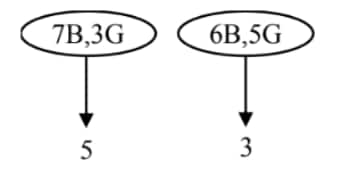
We are given two groups:
$
\text{Group A: } 7 \text{ boys}, 3 \text{ girls}
$
$
\text{Group B: } 6 \text{ boys}, 5 \text{ girls}
$
We need to invite 4 boys and 4 girls for a picnic such that 5 people are from Group A and 3 people are from Group B.
Step 1: Define variables
Let the number of boys chosen from Group A be \(x\), and the number of girls from Group A be \(y\).
Since total invited from Group A is 5, we have
$
x + y = 5.
$
From total boys invited:
$
x + \text{boys from B} = 4,
$
and from total girls invited:
$
y + \text{girls from B} = 4.
$
Step 2: Find possible distributions
We want integer solutions for:
$
\begin{cases}
x + y = 5 \\
(x) + (\text{boys from B}) = 4 \\
(y) + (\text{girls from B}) = 4
\end{cases}
$
Since total boys invited = 4, and total girls invited = 4.
Therefore, the number of boys from Group B is \(4 - x\), and the number of girls from Group B is \(4 - y\).
Since the total invited from Group B is 3, we have:
$
(4 - x) + (4 - y) = 3 \Rightarrow 8 - (x + y) = 3 \Rightarrow 8 - 5 = 3,
$
which is true. So the total invited from Group B is consistent.
Step 3: Possible values of \(x\) and \(y\)
Since \(x + y = 5\), possible pairs \((x,y)\) with \(x, y \geq 0\) are:
\(x = 2, y = 3\)
\(x = 3, y = 2\)
\(x = 4, y = 1\)
(Choosing \(x = 1, y = 4\) or \(x=0, y=5\) is impossible since Group A has only 3 girls.)
Step 4: Calculate number of ways for each case
Case I: \(x = 2\) boys, \(y = 3\) girls from Group A
- Boys from Group A: choose 2 out of 7: \({}^7C_2\)
- Girls from Group A: choose 3 out of 3: \({}^3C_3\)
- Boys from Group B: \(4 - 2 = 2\), choose 2 out of 6: \({}^6C_2\)
- Girls from Group B: \(4 - 3 = 1\), choose 1 out of 5: \({}^5C_1\)
Number of ways:
$
\text{C-I} = {}^7C_2 \times {}^3C_3 \times {}^6C_2 \times {}^5C_1
$
Case II: \(x = 3\) boys, \(y = 2\) girls from Group A
- Boys from Group A: \({}^7C_3\)
- Girls from Group A: \({}^3C_2\)
- Boys from Group B: \(4 - 3 = 1\), \({}^6C_1\)
- Girls from Group B: \(4 - 2 = 2\), \({}^5C_2\)
Number of ways:
$
\text{C-II} = {}^7C_3 \times {}^3C_2 \times {}^6C_1 \times {}^5C_2
$
Case III: \(x = 4\) boys, \(y = 1\) girl from Group A
- Boys from Group A: \({}^7C_4\)
- Girls from Group A: \({}^3C_1\)
- Boys from Group B: \(4 - 4 = 0\), \({}^6C_0\)
- Girls from Group B: \(4 - 1 = 3\), \({}^5C_3\)
Number of ways:
$
\text{C-III} = {}^7C_4 \times {}^3C_1 \times {}^6C_0 \times {}^5C_3
$
Step 5: Total number of ways
$
\text{Total} = \text{C-I} + \text{C-II} + \text{C-III}
$
Substitute values:
$
= {}^7C_2 \cdot {}^3C_3 \cdot {}^6C_2 \cdot {}^5C_1 + {}^7C_3 \cdot {}^3C_2 \cdot {}^6C_1 \cdot {}^5C_2 + {}^7C_4 \cdot {}^3C_1 \cdot {}^6C_0 \cdot {}^5C_3
$
Calculating each term:
- \({}^7C_2 = 21\)
- \({}^3C_3 = 1\)
- \({}^6C_2 = 15\)
- \({}^5C_1 = 5\)
So,
$
21 \times 1 \times 15 \times 5 = 1575
$
- \({}^7C_3 = 35\)
- \({}^3C_2 = 3\)
- \({}^6C_1 = 6\)
- \({}^5C_2 = 10\)
So,
$
35 \times 3 \times 6 \times 10 = 6300
$
- \({}^7C_4 = 35\)
- \({}^3C_1 = 3\)
- \({}^6C_0 = 1\)
- \({}^5C_3 = 10\)
So,
$
35 \times 3 \times 1 \times 10 = 1050
$
Adding all:
$
1575 + 6300 + 1050 = 8925
$
Hence, the correct answer is option (3).
Question 6: Group A consists of 7 boys and 3 girls, while Group B consists of 6 boys and 5 girls. The number of ways 4 boys and 4 girls can be invited for a picnic if 5 of them must be from group A and the remaining 3 from group B, is equal to:
1) 8575
2) 9100
3) 8925
4) 8750
Correct answer: (3)
Solution:
We are given two groups:
$
\text{Group A: } 7 \text{ boys}, 3 \text{ girls}
$
$
\text{Group B: } 6 \text{ boys}, 5 \text{ girls}
$
We need to invite 4 boys and 4 girls for a picnic such that 5 people are from Group A and 3 people are from Group B.
Step 1: Define variables
Let the number of boys chosen from Group A be \(x\), and the number of girls from Group A be \(y\).
Since total invited from Group A is 5, we have
$
x + y = 5.
$
From total boys invited:
$
x + \text{boys from B} = 4,
$
and from total girls invited:
$
y + \text{girls from B} = 4.
$
Step 2: Find possible distributions
We want integer solutions for:
$
\begin{cases}
x + y = 5 \\
(x) + (\text{boys from B}) = 4 \\
(y) + (\text{girls from B}) = 4
\end{cases}
$
Since total boys invited = 4, and total girls invited = 4.
Therefore, the number of boys from Group B is \(4 - x\), and the number of girls from Group B is \(4 - y\).
Since the total invited from Group B is 3, we have:
$
(4 - x) + (4 - y) = 3 \Rightarrow 8 - (x + y) = 3 \Rightarrow 8 - 5 = 3,
$
which is true. So the total invited from Group B is consistent.
Step 3: Possible values of \(x\) and \(y\)
Since \(x + y = 5\), possible pairs \((x,y)\) with \(x, y \geq 0\) are:
- \(x = 2, y = 3\)
- \(x = 3, y = 2\)
- \(x = 4, y = 1\)
(Choosing \(x = 1, y = 4\) or \(x=0, y=5\) is impossible since Group A has only 3 girls.)
Step 4: Calculate number of ways for each case
Case I: \(x = 2\) boys, \(y = 3\) girls from Group A
- Boys from Group A: choose 2 out of 7: \({}^7C_2\)
- Girls from Group A: choose 3 out of 3: \({}^3C_3\)
- Boys from Group B: \(4 - 2 = 2\), choose 2 out of 6: \({}^6C_2\)
- Girls from Group B: \(4 - 3 = 1\), choose 1 out of 5: \({}^5C_1\)
Number of ways:
$
\text{C-I} = {}^7C_2 \times {}^3C_3 \times {}^6C_2 \times {}^5C_1
$
Case II: \(x = 3\) boys, \(y = 2\) girls from Group A
- Boys from Group A: \({}^7C_3\)
- Girls from Group A: \({}^3C_2\)
- Boys from Group B: \(4 - 3 = 1\), \({}^6C_1\)
- Girls from Group B: \(4 - 2 = 2\), \({}^5C_2\)
Number of ways:
$
\text{C-II} = {}^7C_3 \times {}^3C_2 \times {}^6C_1 \times {}^5C_2
$
Case III: \(x = 4\) boys, \(y = 1\) girl from Group A
- Boys from Group A: \({}^7C_4\)
- Girls from Group A: \({}^3C_1\)
- Boys from Group B: \(4 - 4 = 0\), \({}^6C_0\)
- Girls from Group B: \(4 - 1 = 3\), \({}^5C_3\)
Number of ways:
$
\text{C-III} = {}^7C_4 \times {}^3C_1 \times {}^6C_0 \times {}^5C_3
$
Step 5: Total number of ways
$
\text{Total} = \text{C-I} + \text{C-II} + \text{C-III}
$
Substitute values:
$
= {}^7C_2 \cdot {}^3C_3 \cdot {}^6C_2 \cdot {}^5C_1 + {}^7C_3 \cdot {}^3C_2 \cdot {}^6C_1 \cdot {}^5C_2 + {}^7C_4 \cdot {}^3C_1 \cdot {}^6C_0 \cdot {}^5C_3
$
Calculating each term:
- \({}^7C_2 = 21\)
- \({}^3C_3 = 1\)
- \({}^6C_2 = 15\)
- \({}^5C_1 = 5\)
So,
$
21 \times 1 \times 15 \times 5 = 1575
$
- \({}^7C_3 = 35\)
- \({}^3C_2 = 3\)
- \({}^6C_1 = 6\)
- \({}^5C_2 = 10\)
So,
$
35 \times 3 \times 6 \times 10 = 6300
$
- \({}^7C_4 = 35\)
- \({}^3C_1 = 3\)
- \({}^6C_0 = 1\)
- \({}^5C_3 = 10\)
So,
$
35 \times 3 \times 1 \times 10 = 1050
$
Adding all:
$
1575 + 6300 + 1050 = 8925
$
Hence, the correct answer is option (3).
Question 7: The number of natural numbers, between 212 and 999, such that the sum of their digits is 15, is_______________.
1) 64
2) -
3) -
4) -
Correct answer: (1)
Solution:
We are given the range of natural numbers from 212 to 999 and are asked to find how many of these numbers have a digit sum equal to 15.
Let a 3-digit number be represented as $ xyz $, where:
$ x \in \{2, 3, ..., 9\} $ (since the number must be greater than 212)
$ y, z \in \{0, 1, ..., 9\} $
The digit sum condition is $ x + y + z = 15 $
We analyze this by fixing values of $ x $ from 2 to 9 and counting the number of integer solutions to $ y + z = 15 - x $, under the constraint $ 0 \leq y, z \leq 9 $.
Let’s compute valid $ (y, z) $ pairs for each $ x $:
$ x = 2 \Rightarrow y + z = 13 \Rightarrow \text{valid pairs: } (4,9), (5,8), (6,7), (7,6), (8,5), (9,4) \Rightarrow 6 \text{ solutions} $
$ x = 3 \Rightarrow y + z = 12 \Rightarrow \text{pairs: } (3,9), (4,8), ..., (9,3) \Rightarrow 7 \text{ solutions} $
$ x = 4 \Rightarrow y + z = 11 \Rightarrow \text{pairs: } (2,9), (3,8), ..., (9,2) \Rightarrow 8 \text{ solutions} $
$ x = 5 \Rightarrow y + z = 10 \Rightarrow \text{pairs: } (1,9), (2,8), ..., (9,1) \Rightarrow 9 \text{ solutions} $
$ x = 6 \Rightarrow y + z = 9 \Rightarrow \text{pairs: } (0,9), (1,8), ..., (9,0) \Rightarrow 10 \text{ solutions} $
$ x = 7 \Rightarrow y + z = 8 \Rightarrow \text{pairs: } (0,8), (1,7), ..., (8,0) \Rightarrow 9 \text{ solutions} $
$ x = 8 \Rightarrow y + z = 7 \Rightarrow \text{pairs: } (0,7), (1,6), ..., (7,0) \Rightarrow 8 \text{ solutions} $
$ x = 9 \Rightarrow y + z = 6 \Rightarrow \text{pairs: } (0,6), (1,5), ..., (6,0) \Rightarrow 7 \text{ solutions} $
Now summing the valid cases:
$
6 + 7 + 8 + 9 + 10 + 9 + 8 + 7 = 64
$
Hence, the correct answer is $64$.
Question 8: Let P be the set of seven-digit numbers with the sum of their digits equal to 11. If the numbers in P are formed by using the digits 1,2 and 3 only, then the number of elements in the set P is:
1) 158
2) 173
3) 164
4) 161
Correct answer: (4)
Solution:
We are given:
Seven-digit numbers.
Digits used: only $1, 2, 3$.
Sum of digits = 11.
Let the digits of such a number be $d_1, d_2, \dots, d_7 \in \{1,2,3\}$, with:
$
d_1 + d_2 + \cdots + d_7 = 11
$
We are to count how many such seven-digit numbers can be formed (order matters), such that their digits sum to 11.
Try all valid combinations of digits adding to 11
We look for non-negative integer solutions to:
$
x_1 + 2x_2 + 3x_3 = 11 \quad \text{and} \quad x_1 + x_2 + x_3 = 7
$
Where:
- $x_1$ = number of 1s,
- $x_2$ = number of 2s,
- $x_3$ = number of 3s.
From the second equation:
$
x_1 = 7 - x_2 - x_3
$
Substitute into the first:
$
(7 - x_2 - x_3) + 2x_2 + 3x_3 = 11
\Rightarrow 7 - x_2 - x_3 + 2x_2 + 3x_3 = 11
\Rightarrow 7 + x_2 + 2x_3 = 11
\Rightarrow x_2 + 2x_3 = 4
$
Now, find integer solutions to:
$
x_2 + 2x_3 = 4
$
Try values of $x_3$ from 0 to 2:
- $x_3 = 0 \Rightarrow x_2 = 4 \Rightarrow x_1 = 3$
- $x_3 = 1 \Rightarrow x_2 = 2 \Rightarrow x_1 = 4$
- $x_3 = 2 \Rightarrow x_2 = 0 \Rightarrow x_1 = 5$
For each valid (x₁, x₂, x₃), compute permutations
Case (i): $x_1=5, x_2=0, x_3=2$
Digits: 1,1,1,1,1,3,3
Total permutations:
$
\frac{7!}{5!2!} = 21
$
Case (ii): $x_1=4, x_2=2, x_3=1$
Digits: 1,1,1,1,2,2,3
Total permutations:
$
\frac{7!}{4!2!1!} = 105
$
Case (iii): $x_1=3, x_2=4, x_3=0$
Digits: 1,1,1,2,2,2,2
Total permutations:
$
\frac{7!}{3!4!} = 35
$
Add up all valid permutations
$
\text{Total} = 21 + 105 + 35 = 161
$
Hence, the correct answer is option (4).
Question 9: The number of different 5-digit numbers greater than 50000 that can be formed using the digits 0,1,2,3,4,5,6,7, such that the sum of their first and last digits should not be more than 8 is:
1) 4608
2) 5720
3) 5719
4) 4607
Correct answer: (4)
Solution:
We are given the digits: 0, 1, 2, 3, 4, 5, 6, 7 — total 8 digits.
We want to form 5-digit numbers greater than 50000 using these digits, such that:
- The first digit (ten-thousands place) must be ≥ 5.
- The sum of the first and last digits must be ≤ 8.
- Digits can be repeated.
Step 1: First digit (A)
To ensure the number is greater than 50000, the first digit (denoted as A) must be 5, 6, or 7.
So, possible values of A: {5, 6, 7}
Step 2: Last digit (E)
Let the number be represented as A B C D E.
We now select the last digit (E) such that:
$
A + E \leq 8
$
We’ll go case by case based on allowed values of A:
- If A = 5 ⇒ E ≤ 3 → E can be {0,1,2,3} ⇒ 4 choices
- If A = 6 ⇒ E ≤ 2 → E can be {0,1,2} ⇒ 3 choices
- If A = 7 ⇒ E ≤ 1 → E can be {0,1} ⇒ 2 choices
So total valid (A,E) pairs:
$
(5,0), (5,1), (5,2), (5,3) \quad \Rightarrow 4 \text{ pairs} \\
(6,0), (6,1), (6,2) \quad \Rightarrow 3 \text{ pairs} \\
(7,0), (7,1) \quad \Rightarrow 2 \text{ pairs}
$
Total valid (A,E) pairs = 4 + 3 + 2 = 9
Step 3: Digits B, C, D (middle three digits)
Each of B, C, and D can be any of the 8 digits (including 0–7), with repetition allowed.
So, number of choices = $8 \times 8 \times 8 = 512$
Step 4: Total valid numbers
$
\text{Total} = 9 \times 512 = 4608
$
But the number 50000 is included in this count (A=5, E=0, B=C=D=0), and we want numbers strictly greater than 50000.
So we subtract 1:
$
\text{Final Answer} = 4608 - 1 = 4607
$
Hence, the correct answer is option (4).
Question 10: The largest $\mathrm{n} \in \mathrm{N}$ such that $3^{\mathrm{n}}$ divides 50 ! is:
1) 21
2) 22
3) 20
4) 23
Correct answer: (2)
Solution:
We are asked to find the largest $n \in \mathbb{N}$ such that $3^n \mid 50!$
Let us use this formula to find the exponent of $3$ in $50!$
$
n = \left\lfloor \frac{50}{3^1} \right\rfloor + \left\lfloor \frac{50}{3^2} \right\rfloor + \left\lfloor \frac{50}{3^3} \right\rfloor + \left\lfloor \frac{50}{3^4} \right\rfloor + \cdots
$
$
n = \left\lfloor \frac{50}{3} \right\rfloor + \left\lfloor \frac{50}{9} \right\rfloor + \left\lfloor \frac{50}{27} \right\rfloor + \left\lfloor \frac{50}{81} \right\rfloor + \cdots
$
$
n = \left\lfloor 16.66 \right\rfloor + \left\lfloor 5.55 \right\rfloor + \left\lfloor 1.85 \right\rfloor + \left\lfloor 0.62 \right\rfloor + \cdots
$
$
n = 16 + 5 + 1 + 0$
$\quad= 22
$
Therefore, the largest $n$ such that $3^n \mid 50!$ is 22.
Hence, the correct answer is option (2).
Question 11: The number of sequences of ten terms, whose terms are either 0 or 1 or 2 , that contain exactly five 1s and exactly three 2s , is equal to
1) 360
2) 45
3) 2520
4) 1820
Correct answer: (3)
Solution:
Total positions $=10$
Given:
5 positions $\rightarrow 1$
3 positions $\rightarrow 2$
Remaining 2 positions $\rightarrow 0$
We need to count the number of ways to arrange these:
This is a permutation of the multiset problem, so:
Number of such sequences $=\frac{10!}{5!\cdot 3!\cdot 2!}$
$=\frac{10!}{5!\cdot 3!\cdot 2!}$
$=\frac{3628800}{120 \cdot 6 \cdot 2}$
$=\frac{3628800}{1440}$
$=2520$
Hence, the correct answer is option (3).
Question 12: From a group of 7 batsmen and 6 bowlers, 10 players are to be chosen for a team, which should include at least 4 batsmen and at least 4 bowlers. One batsman and one bowler who are the captain and vice-captain, respectively, of the team should be included. Then the total number of ways such a selection can be made is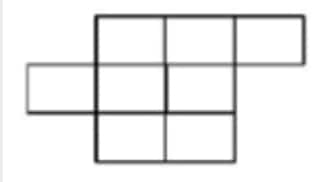
1) 165
2) 155
3) 145
4) 135
Correct answer: (2)
Solution:
7 Batsmen & 6 Bowlers
To select 10 players, including at least
4 Batsmen & 4 Bowlers
Captain & vice-captain have already been selected
No. of ways $={ }^6 \mathrm{C}_5 \times{ }^5 \mathrm{C}_3+{ }^6 \mathrm{C}_4 \times{ }^5 \mathrm{C}_4+{ }^6 \mathrm{C}_3 \times{ }^5 \mathrm{C}_5$
$\begin{aligned}
& =6 \times 10+15 \times 5+20 \times 1 \\
& =60+75+20=155
\end{aligned}$
Hence, the answer is option (2).
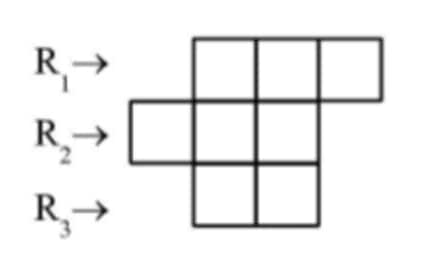
Question 13: The number of ways, in which the letters $\mathrm{A}, \mathrm{B}, \mathrm{C}$, $D$, $E$ can be placed in the 8 boxes of the figure below so that no row remains empty and at most one letter can be placed in a box, is :
1) 5880
2) 960
3) 840
4) 5760
Correct answer: (4)
Solution:
Given the row-wise availability:
R₁: 3 1 2 2 1
R₂: 1 3 2 1 2
R₃: 1 1 1 2 2
Required number of ways:
$\left(
^{3}C_{3} .^{3}C_{1} .^{2}C_{1}
+
^{3}C_{1} .^{3}C_{3} .^{2}C_{1}
+
^{3}C_{2} .^{3}C_{2}. ^{2}C_{1}
+
^{3}C_{2}. ^{3}C_{1}.^{3}C_{2}
+
^{3}C_{1} .^{3}C_{2}. ^{2}C_{2}
\right) \times 5!$
$= (12 + 18 + 9 + 9) \times 120 = 48 \times 120 = 5760$
The number of ways$=5760$
Hence, the answer is option (4).
Question 14: The number of words, which can be formed using all the letters of the word "DAUGHTER", so that all the vowels never come together, is
1) 34000
2) 37000
3) 36000
4) 35000
Correct answer: (3)
Solution:
We have the word: DAUGHTER
Total words $=8$!
Total words in which vowels are together $=6!\times 3!$
Total words in which all vowels are not together
$
\begin{aligned}
& =8!-6!\times 3! \\
& =6![56-6] \\
& =720 \times 50 \\
& =36000
\end{aligned}
$
Hence, the answer is option (3).
Question 15: The number of 6-letter words, with or without meaning, that can be formed using the letters of the word MATHS such that any letter that appears in the word must appear at least twice, is __________.
1) 1405
2) 1800
3) 1120
4) 1609
Correct answer: (1)
Solution:
We need to find the number of 6-letter words formed using the letters of the word MATHS such that any letter that appears in the word appears at least twice.
The letters available are: $ \{M, A, T, H, S\} $.
Case 1: Using only one letter
Since each letter must appear at least twice, and the word length is 6, only letters that can be repeated 6 times are considered. Each single letter can form one word: e.g., "MMMMMM".
Number of such words:
$
5 \quad (\text{one for each letter})
$
Case 2: Using exactly two distinct letters
Let the two letters be chosen in $ \binom{5}{2} = 10 $ ways.
Possible distributions of letters in the 6-letter word such that each letter appears at least twice are:
- One letter appears 2 times, the other 4 times
- Both letters appear 3 times each
Number of words for each distribution:
- For 2 and 4:
$
\frac{6!}{2!4!} = 15 \quad \text{arrangements}
$
Since the two letters can be swapped (which letter appears 2 times or 4 times), multiply by 2:
$
15 \times 2 = 30
$
- For 3 and 3:
$
\frac{6!}{3!3!} = 20 \quad \text{arrangements}
$
Total words for two distinct letters:
$
10 \times (30 + 20) = 10 \times 50 = 500
$
Case 3: Using exactly three distinct letters
Since each letter appears at least twice, the only possibility is that each letter appears exactly twice (because $2 + 2 + 2 = 6$).
Number of ways to choose 3 letters:
$
\binom{5}{3} = 10
$
Number of arrangements of 6 letters with each letter appearing twice:
$
\frac{6!}{2!2!2!} = 90
$
Total words for three distinct letters:
$
10 \times 90 = 900
$
Total number of words:
$
5 + 500 + 900 = 1405
$
Hence, the answer is 1405.
Question 16: For $\mathrm{n} \geq 2$, let $S_n$ denote the set of all subsets of $\{1,2 \ldots \ldots, n\}$ with no two consecutive numbers. For example $\{1,3,5\} \in \mathrm{S}_6$, but $\{1,2,4\} \notin \mathrm{S}_6$. Then $n\left(\mathrm{~S}_5\right)$ is equal to _____.
1) 13
2) 10
3) 21
4) 28
Correct answer: (1)
Solution:
$
\mathrm{A}=\{1,2,3,4,5 \ldots . \mathrm{n}\}
$
No. of subsets having relements such that no two are consecutive is $={ }^{n-r+1} C_r$
$
\text { for } \mathrm{n}=5, \text { no. of ways }={ }^{6-\mathrm{r}} \mathrm{C}_{\mathrm{r}}
$
Subsets having no element $=1$
$
\begin{aligned}
& \text { Subsets having exactly } 1 \text { element }={ }^5 \mathrm{C}_1=5 \\
& \text { Subsets having exactly } 2 \text { element }={ }^4 \mathrm{C}_2=6 \\
& \text { Subsets having exactly } 3 \text { element }={ }^3 \mathrm{C}_3=1 \\
& \Rightarrow 5+6+1+1=13
\end{aligned}
$
Hence, the answer is 13.
Question 17: The number of 3-digit numbers that are divisible by 2 and 3 , but not divisible by 4 and 9, is
1) 125
2) 111
3) 101
4) 167
Correct answer: (1)
Solution:
We are given the task to find how many 3-digit numbers are divisible by both $2$ and $3$, but not divisible by both $4$ and $9$.
First, compute the total number of 3-digit numbers. The smallest 3-digit number is $100$, and the largest is $999$, so:
$
999 - 99 = 900
$
Now, numbers divisible by both $2$ and $3$ are divisible by their LCM:
$
\text{LCM}(2, 3) = 6
$
So, the number of 3-digit numbers divisible by $6$ is:
$
\frac{900}{6} = 150
$
Next, consider numbers divisible by both $4$ and $9$. Their LCM is:
$
\text{LCM}(4, 9) = 36
$
So, the number of 3-digit numbers divisible by $36$ is:
$
\frac{900}{36} = 25
$
Hence, the number of 3-digit numbers divisible by $2$ and $3$ but not by $4$ and $9$ is:
$
150 - 25 = 125
$
Hence the answer is 125.
Question 18: There are 12 points in a plane, no three of which are in the same straight line, except 5 collinear points. Then the total number of triangles that can be formed with the vertices at any three of these 12 points is
1) 230
2) 220
3) 200
4) 210
Correct answer: (4)
Solution:
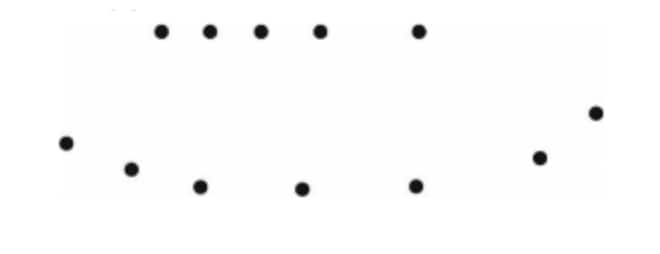
Total number of triangles formed from 12 points (choosing any 3):
$^{12}C_{3} = \frac{12 \cdot 11 \cdot 10}{6} = 220$
Number of collinear triangles (which are not valid triangles):
From the 5 collinear points, the number of ways to choose 3 points:
$^{5}C_{3} = 10$
These 10 are not valid triangles (as all 3 points lie on the same line).
Subtract invalid triangles from total:
$220−10=210$
Hence, the answer is option (4).
Question 19: $r$-sided polygons are formed by joining the vertices of an $n$-sided polygon. If the number of polygons that can be formed, none of whose sides coincide with those of the $n$-sided polygon, is$\frac{n(n-r-p)!}{r!(n-q r)!}$, then $p+q=$
1) 3
2) 9
3) 8
4) 1
Correct answer: (1)
Solution:
One vertex of the polygon can be fixed in $n$ ways. The rest of the ( $r-1$ ) vertices are fixed in such a way that no two selected vertices are adjacent ones as we go along the n -sided polygon. It amounts to dividing the rest of the vertices into r groups (for an r -sided polygon) with $\mathrm{x}_{\mathrm{i}}$ elements such that
$x_1+x_2+\ldots \ldots \ldots+x_r=n-r \quad x_i>0 .$
Number of ways of such a selection is ${ }^{n-r-1} C_{r-1}$
⇒ Total number of polygons $=n^{n-r-1} C_{r-1}$.
In this counting, each of the polygons has been counted r times.
Hence total number of possible $r-$ sided polygons $=\frac{n^{n-r-1} C_{r-1}}{r}=\frac{n(n-r-1)!}{r!(n-2 r)!}$.
Hence, the answer is 3.
Question 20: If all the words with or without meaning made using all the letters of the word “KANPUR” are arranged as in a dictionary, then the word at $440^{\text {th }}$ position in this arrangement is:
1) PRNAKU
2) PRKANU
3) PRKAUN
4) PRNAUK
Correct answer: (3)
Solution:
All permutations of the word KANPUR are arranged in dictionary order.
Total letters $=6$
Alphabetical order:
$A<K<N<P<R<U$
Total permutations:
$6!=720$
Each starting letter has
$5!=120$ permutations
Cumulative blocks:
$A$: $1$–$120$
$K$: $121$–$240$
$N$: $241$–$360$
$P$: $361$–$480$
$440$ lies in the block starting with $P$.
Position within $P$ block:
$440-360=80$
Remaining letters: $A,K,N,R,U$
Each second-letter block has
$4!=24$ permutations
Cumulative:
$A$: $1$–$24$
$K$: $25$–$48$
$N$: $49$–$72$
$R$: $73$–$96$
$80$ lies in the $R$ block.
Position within this block:
$80-72=8$
Remaining letters: $A,K,N,U$
Each third-letter block has
$3!=6$ permutations
Cumulative:
$A$: $1$–$6$
$K$: $7$–$12$
$8$ lies in the $K$ block.
Remaining letters: $A,N,U$
Each fourth-letter block has
$2!=2$ permutations
Cumulative:
$A$: $1$–$2$
Position $2$ corresponds to $A$.
Remaining letters: $N,U$
Order:
$NU$
$UN$
Position $2$ gives $UN$.
Word at position $440$: $\text{PRKAUN}$
Hence, the correct answer is PRKAUN.
Question 21: Several functions $f:\{1,2, \ldots, 100\} \rightarrow\{0,1\}$, that assign 1 to exactly one of the positive integers less than or equal to 98, are equal to___________.
1) 392
2) 123
3) 134
4) 145
Correct answer: (1)
Solution:
Given:
$ f: \{1, 2, \ldots, 100\} \to \{0,1\} $
$ f(i) = 1 $ for exactly one $ i \in \{1, 2, \ldots, 98\} $
For all other $ j \neq i $ in $\{1, \ldots, 98\}$, $ f(j) = 0 $
No restriction on $ f(99) $ and $ f(100) $, they can be 0 or 1 independently.
Step 1: Choose the unique position for 1 among first 98 integers
Number of ways:
$\binom{98}{1} = 98$
Step 2: Values for $ f(99) $ and $ f(100) $
Each can be either 0 or 1, independently:
$
2 \times 2 = 4 \text{ ways}.
$
Step 3: Total number of such functions
$
98 \times 4 = 392.
$
Hence, the answer is 392.
Question 22: Line $L_1$ of slope 2 and line $L_2$ of slope $\frac{1}{2}$ intersect at the origin O . In the first quadrant, $\mathrm{P}_1, \mathrm{P}_2, \ldots . \mathrm{P}_{12}$ are 12 points on line $L_1$ and $Q_1, Q_2, \ldots . . Q_9$ are 9 points on line $\mathrm{L}_2$. Then the total number of triangles that can be formed having vertices at three of the 22 points $\mathrm{O}, \mathrm{P}_1, \mathrm{P}_2, \ldots \mathrm{P}_{12}$, $\mathrm{Q}_1, \mathrm{Q}_2, \ldots \mathrm{Q}_9$, is:
1) 1080
2) 1134
3) 1026
4) 1188
Correct answer: (2)
Solution:
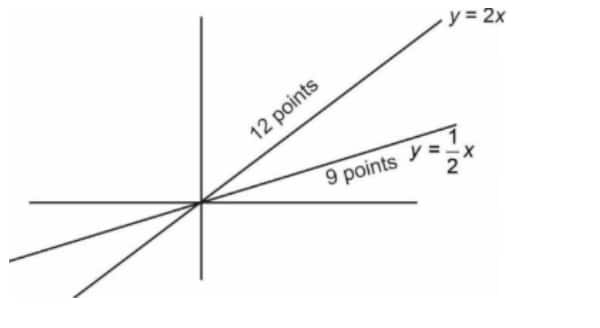
Total number of points = $12$ (on $L_1$) $+ 9$ (on $L_2$) $+ 1$ (origin $O$) = $22$
Total number of triangles that can be formed from 22 points:
$
^{22}C_3 = \dfrac{22 \times 21 \times 20}{6} = 1540
$
However, any 3 collinear points do not form a triangle. So, we must subtract the number of such degenerate triangles:
Line $L_1$ has $13$ collinear points: $O, P_1, \ldots, P_{12}$
Collinear triples on $L_1 = ^{13}C_3 = \dfrac{13 \times 12 \times 11}{6} = 286$
Line $L_2$ has $10$ collinear points: $O, Q_1, \ldots, Q_9$
Collinear triples on $L_2 = ^{10}C_3 = \dfrac{10 \times 9 \times 8}{6} = 120$
No other 3 points are collinear, since $L_1$ and $L_2$ intersect only at $O$.
Therefore, the number of triangles that can be formed is:
$
^{22}C_3 - ^{13}C_3 - ^{10}C_3 = 1540 - 286 - 120 = 1134
$
Hence, the correct answer is option (2).
Question 23: Let S be the set of all the words that can be formed by arranging all the letters of GARDEN. From the set S, one word is selected at random. The probability that the selected word will NOT have vowels in alphabetical order is:
1) $\frac{1}{4}$
2) $\frac{2}{3}$
3) $\frac{1}{3}$
4) $\frac{1}{2}$
Correct answer: (4)
Solution:
We are given the word "GARDEN" which consists of 6 distinct letters: G, A, R, D, E, N.
The total number of words that can be formed by arranging all these letters is:
$
\text{Total number of arrangements} = 6! = 720
$
We are interested in finding the probability that the selected word does NOT have vowels in alphabetical order.
The vowels in "GARDEN" are A and E.
We define "vowels in alphabetical order" to mean A appears before E in the arrangement.
Let’s calculate the number of arrangements where A comes before E.
Since all letters are distinct, and exactly two of them are vowels (A and E), in half of the total arrangements A will come before E, and in the other half E will come before A.
So, number of arrangements where A comes before E:
$
\frac{720}{2} = 360
$
Thus, number of arrangements where vowels are not in alphabetical order (i.e., E before A) is:
$
720 - 360 = 360
$
Hence, the required probability is:
$
\frac{\text{Number of unfavorable cases}}{\text{Total cases}} = \frac{360}{720} = \frac{1}{2}
$
Hence, the correct answer is option (4).
Question 24: All five-letter words are made using all the letters A, B, C, D, E and arranged as in an English dictionary with serial numbers. Let the word at serial number $n$ be denoted by $W_n$. Let the probability $\mathrm{P}\left(\mathrm{W}_{\mathrm{n}}\right)$ of choosing the word $\mathrm{W}_{\mathrm{n}}$ satisfy $\mathrm{P}\left(\mathrm{~W}_{\mathrm{n}}\right)=2 \mathrm{P}\left(\mathrm{~W}_{\mathrm{n}-1}\right), \mathrm{n}>1 .$ If $\mathrm{P}(\mathrm{CDBEA})=\frac{2^\alpha}{2^\beta-1}, \alpha, \beta \in \mathbb{N}$, then $\alpha+\beta$ is equal to : $\qquad$
1) 183
2) 178
3) 231
4) 132
Correct answer: (1)
Solution:
Let $\mathrm{P}\left(\mathrm{W}_1\right)=\mathrm{x}$
Use summation,
$\begin{aligned}
& \sum_{i=1}^{120} P\left(W_i\right)=1 \\
& x+2 x+2^2 x+2^3 x+\ldots+2^{119} x=1 \\
& \frac{x\left(2^{120}-1\right)}{(2-1)}=1 \Rightarrow x=\frac{1}{2^{120}-1}------(i)
\end{aligned}$
Rank of CDBEA
$\begin{aligned}
& A_{\ldots}=\lfloor 4=24 \\
& B_{\ldots}=\lfloor{4}=24 \\
& \mathrm{CA}_{\ldots-\ldots}=\lfloor 3=6 \\
& \text { C B}_\ldots=\lfloor {3}=6 \\
& \mathrm{CDA}_{-\ldots}=\lfloor 2=2 \\
& \mathrm{CDBAE}=1 \\
& \text { CDBEA=1 }
\end{aligned}$
$\begin{aligned} & \text { So, } \mathrm{P}\left(\mathrm{W}_{64}\right)=2 \mathrm{P}\left(\mathrm{W}_{63}\right)=\ldots=2^{63} \mathrm{P}\left(\mathrm{W}_1\right) \\ & =\frac{2^{63}}{2^{120}-1} \\ & \alpha+\beta=63+120=183\end{aligned}$
Hence, the answer is $183$.
The table below shows the distribution of questions asked from the chapter permutation and combination in the January and April JEE Main 2026 exams․ The table will help students to have an idea about the topics important from the point of view of the exam and on which they should focus․
Topic | January Session | April Session | Total Questions |
6 | 0 | 6 | |
0 | 3 | 3 | |
Applications of Selections-I | 3 | 3 | 6 |
Distribution of Distinct Objects into Distinct Places | 0 | 1 | 1 |
Distribution of Distinct Objects into Identical Places | 1 | 0 | 1 |
Finding Number of Solutions of Equations | 0 | 1 | 1 |
Permutation of Objects When Few Are Identical | 0 | 1 | 1 |
Permutation as an Arrangement | 1 | 0 | 1 |
1 | 0 | 1 | |
Total | 12 | 9 | 21 |
The following table shows the topic-wise distribution of the number of questions from the topic of permutation and combination asked per year over the last 10 years of the JEE Main exam. Candidates can use this to identify high-weightage topics and plan their preparation strategy effectively․
Also Read: Last 10 Years JEE Main Question Paper
Topic | Total Questions Asked |
Applications of Selections-I | 50 |
Application of Permutation-I | 47 |
35 | |
Permutation as an Arrangement | 28 |
Applications of Selections-II | 21 |
Application of Permutation-II | 15 |
Fundamental Principle of Counting | 15 |
Permutation of Objects When Few Are Identical | 15 |
Rank of a Word in a Dictionary | 10 |
Application of Permutation-III | 8 |
Application of Permutation-IV | 6 |
Some of the useful formulas of Permutation and combination are given below, which help in your quick revision before solving the question.
Concept | Formula |
Factorial | $n!=n \times(n-1) \times(n-2) \times \ldots \times 2 \times 1$ |
Factorial of 0 | 0! = 1 |
Permutation of n objects taken r at a time | $\text { nPr = n! / (n - r)! }$ |
Combination of n objects taken r at a time | $\mathrm{nCr}=\mathrm{n}!/[\mathrm{r}!\times(\mathrm{n}-\mathrm{r})!]$ |
Relation between permutation and combination | $\mathrm{nPr}=\mathrm{nCr} \times \mathrm{r}!$ |
Symmetry property | $\mathrm{nCr}=\mathrm{nC}(\mathrm{n}-\mathrm{r})$ |
Sum of all combinations | $n C 0+n C 1+\ldots+n C n=2 n$ |
Circular permutation | (n − 1)! |
Circular permutation when clockwise and anticlockwise arrangements are identical | (n − 1)! / 2 |
Permutations with repeated objects | $n!/(p!\times q!\times r!)$ |
Arrangements when repetition is allowed | $\mathrm{n}^{\mathrm{r}}$ |
Selection with repetition allowed | $(n+r-1) C r$ |
Fundamental Principle of Counting | If one task has m ways and another has n ways, both can be done in m × n ways |
Addition Principle | If a task can be done in m ways or n mutually exclusive ways, total ways = m + n |
Identity | Formula |
Basic combination | $^nC_0 = ^nC_n = 1$ |
Selection of one object | $^nC_1 = ^nC_{n-1} = n$ |
Pascal's identity | $^nC_r + ^nC_{r-1} = ^{n+1}C_r$ |
Useful identity | $r \times ^nC_r = n \times ^{n-1}C_{r-1}$ |
Ratio of consecutive combinations | $\frac{^nC_r}{^nC_{r-1}} = \frac{n-r+1}{r}$ |
Alternating sum | $^nC_0 - ^nC_1 + ^nC_2 - \cdots + (-1)^n{}^nC_n = 0$ |

On Question asked by student community
Hello Sunny,
Here are the requested links. Hope they help!
Hello Devendra,
The National Testing Agency (NTA) primarily provides the official JEE Main syllabus, previous-year question papers, answer keys and mock tests rather than complete chapter-wise preparation notes. You can access these resources through the official JEE Main website.
Hello student!
JEE Main 2027 will be conducted in two sessions by the National Testing Agency (NTA). The January session is scheduled for January 20, 21, 22, 23, 24 and 28, 2027, while the April session will be held from April 2 to 7, 2027.
You can check the complete
Hello Gunjan
Kindly provide the details of the resource from which you are trying to download the PDF so that we can assist you further.
Hello!
Check the below resources to access the JEE Main, NDA Physics Sample Papers:
https://engineering.careers360.com/download/ebooks/jee-mains-physics-sample-paper
https://engineering.careers360.com/articles/jee-main-2027-physics-sample-paper
https://competition.careers360.com/download/nda-sample-papers-previous-years
Hope it helps!

Ranked #43 among Engineering colleges in India by NIRF | Get Upto 100% Scholarships
60+ Years of Education Legacy | UGC & AICTE Approved | Prestigious Scholarship Worth 6 Crores
Highest CTC 24.80 LPA | Average CTC 6.56 LPA
Scholars’ Round Deadline: 14th Nov’26 | Earn upto 50% merit Scholarship + 10% for top performers | EFMD Accredited | AACSB (USA) & AMDISA Member | Highest CTC 28 LPA
Diploma (17 Specializations), B.Tech / B.Tech (Hons.) / IE-B.Tech - 4 years - 25+ specializations | M. Tech - 14+ specializations | Highest CTC – 60 LPA
Special Scholarship for Students from Goa (Get an exclusive scholarship of ₹20,000 if you're a Goa-based student) | Bringing Parul Education Trust's 30-year Education Legacy to Goa