Amity University Noida-B.Tech Admissions 2026
Among top 100 Universities Globally in the Times Higher Education (THE) Interdisciplinary Science Rankings 2026


JEE Main 2025 Question Answer Coloured Button Meaning - Aspirants of the JEE Mains exam must check this article to know the meaning of the JEE Main question answer coloured button. NTA will conduct the JEE Main 2025 exam for session 1 from January 22 to 31 and for session 2 from April 1 to 8. If you are someone who is attempting the online JEE Main mock tests and is confused about the JEE Main question answer coloured button meaning, then read the article.
This Story also Contains
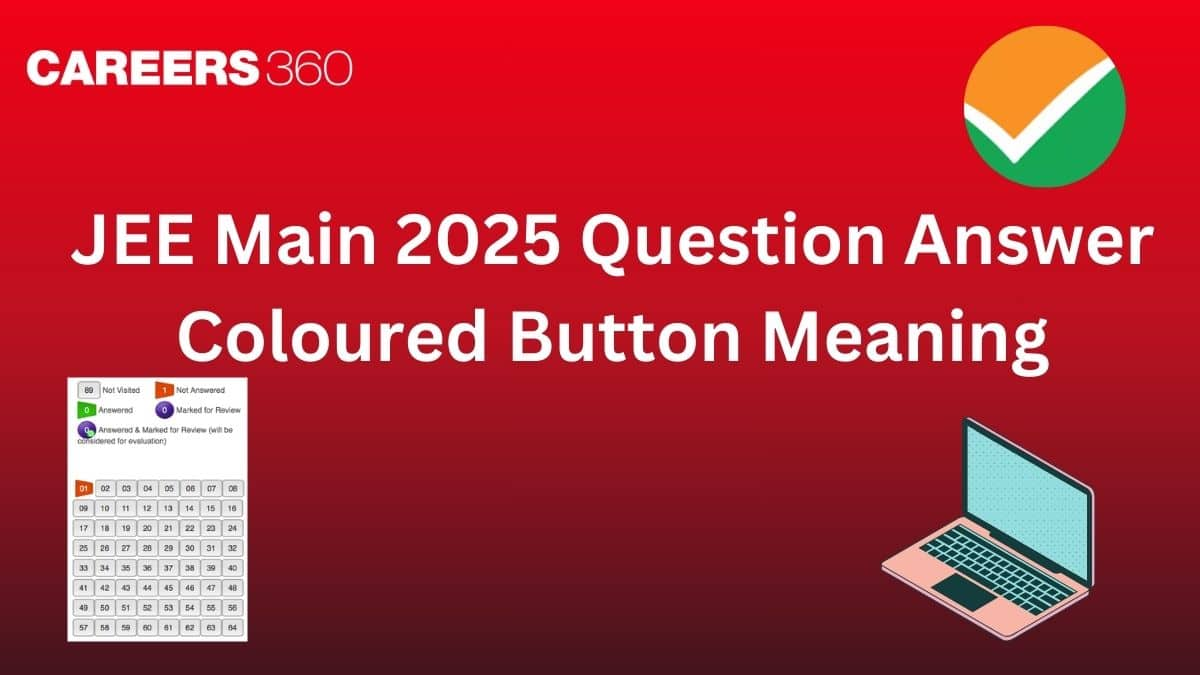
The JEE Mains exam will be conducted in online mode at test centres. During the exam, the authority will display a question palette on the screens. Candidates must be aware of the JEE Main question answer coloured button meaning 2025 before appearing for the test.
Also read - 100 marks in JEE Main percentile | 99 percentile in JEE Mains means how many marks
Since the Joint Entrance Exam (Main) is conducted in online mode, candidates have to understand how to navigate through questions. A question palette will be displayed on the screens to provide an overview of the questions using different colours. Each coloured button has some meaning that provides a quick overview of the questions attempted/unattempted and others in the JEE Main question paper. Based on the interactions, the coloured button will change automatically.
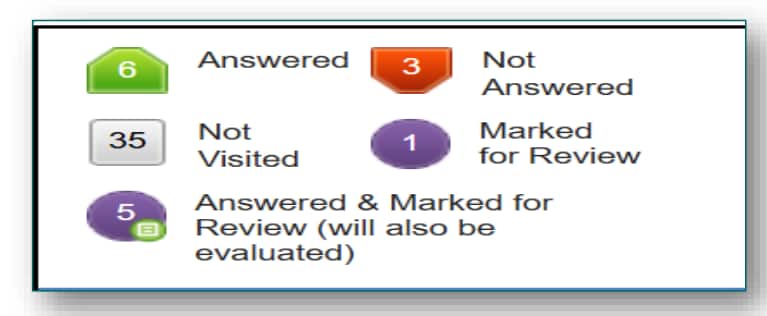
Meaning of the white box in JEE Mains 2025 - The white box indicates that the candidates have not visited the question. This means that the student has not taken a look at the question. It is the default mode at the start of the test. Students can use this to track all the questions they have not visited yet.
Meaning of the orange box in JEE Mains 2025 - The orange box in JEE Mains means the candidate has visited the question but has not answered it. This acts as a reminder for candidates to know that they have yet to answer the particular question.
Meaning of the green box in JEE Main 2025 - If you answer a question, then the colour is changed to green. This means that the candidate has saved his/her response to the question asked.
Meaning of the purple circle in JEE Main 2025 - The purple coloured circle over the question indicates that the question has not been answered but is marked for review. Students can visit the question again and mark the answer to it to change the colour.
Meaning of the purple circle with a green dot in JEE Mains 2025 - An extended version of the review questions. A purple circle with a dot in the JEE Main 2025 question answer coloured button indicates that the question has been answered and marked for review. It is important to note that the answer marked will be considered for evaluation. This means that the JEE marking scheme will apply to the answer marked. However, students have marked this for review before the final submission.
Get expert advice on college selection, admission chances, and career path in a personalized counselling session.
The question palette for JEE Mains 2025 will be displayed on the right side of the screen. Candidates can check the status of each question. Along with the JEE Main question palette, candidates can also check the countdown timer on the top right corner of the screen. The timer will display the remaining time available to complete the examination. When the timer reaches zero, the examination will end by itself.
Frequently Asked Questions (FAQs)
A green button indicates that the candidate has answered that particular question and it will be counted for evaluation.
A white button indicates that the candidates have not visited those questions.
The JEE Main 2025 coloured buttons will be available on the top right-side corner throughout the exam.
The question palette in JEE Mains has coloured buttons to indicate students the status of each question.

On Question asked by student community
Hello Student,
JEE main CRL rank of around 6,99,050, admission to NITs, IIITs and most GFTIs through JOSSA counselling is likely to be difficult under the general category. However you may still have opportunity in some State Government engineering Colleges, particularly through state level counselling processes, depend on your category,
Hello Student,
With JEE mains rank of 1,09,447 and belonging to SEBC category along with ex- servicemen quota, you may receive additional reservation benefit during the counselling process. However, whether you can get CSE will depend on factor such as Institute you are applying to, seat availability, category wise cut-off,
Hello Student,
With JEE main rank of around 1,37,000 OBC category and Jharkhand home state quota getting CSE at BITS sindhari maybe difficult based on previous year closing is one of the most sought-after branches. ECE may be also competitive, but you may have better chance compared to CSE specially
Hello Student,
To check your JEE CUP (JEE Combined Entrance Examination Committee Uttar Pradesh) result, follow these steps:
1. Visit the official JEE CUP/JEECUP website.
2. Click on the "JEECUP Result" or "Rank Card" link available on the homepage.
3. Enter your Application Number, Password/Date of Birth, and the required
Hello Student,
With 86.2% in class 12th (JKBOSE) and 93.88% in JEE mains you have decent chance of getting admission to several good engineering College based on previous year trend you may explore option in GFTIs, IIITs and state engineering College, while admission to top NITs in popular branches maybe

Among top 100 Universities Globally in the Times Higher Education (THE) Interdisciplinary Science Rankings 2026
Last Date to Apply: 30th June | Ranked #43 among Engineering colleges in India by NIRF | Highest Package 1.3 CR , 100% Placements
40 LPA Highest Package | Up to 100% Scholarship worth 24 Crore via GUTS exam
Awarded A Grade by RTU, Kota | Top Recruiters-Google, Microsoft, Adobe, IBM, TCS, LTI and many more
3000+ Successful Placements | 100+ Leading Recruiters
Mark presence in the Modern Architectural field with Bachelor of Architecture | Highest CTC : 70 LPA | Accepts NATA Score