Amity University Noida-B.Tech Admissions 2026
Among top 100 Universities Globally in the Times Higher Education (THE) Interdisciplinary Science Rankings 2026


The timetable to study 16 hours a day is not easy. This kind of a schedule is strictly meant for students who are repeaters, drop year students or high score aimers like 99+ percentile. One very important thing to note here is that in the 16 hours study schedule, the ‘16’ hours should be focused, planned student time and not just passive sitting. You must also understand that a 16 hour study timetable for the JEE Main 2026 exam requires discipline as well as physical endurance and mental stability. You have to be healthy and have mental endurance as well in order to be able to follow the 16 hour study schedule for JEE Main.
This Story also Contains
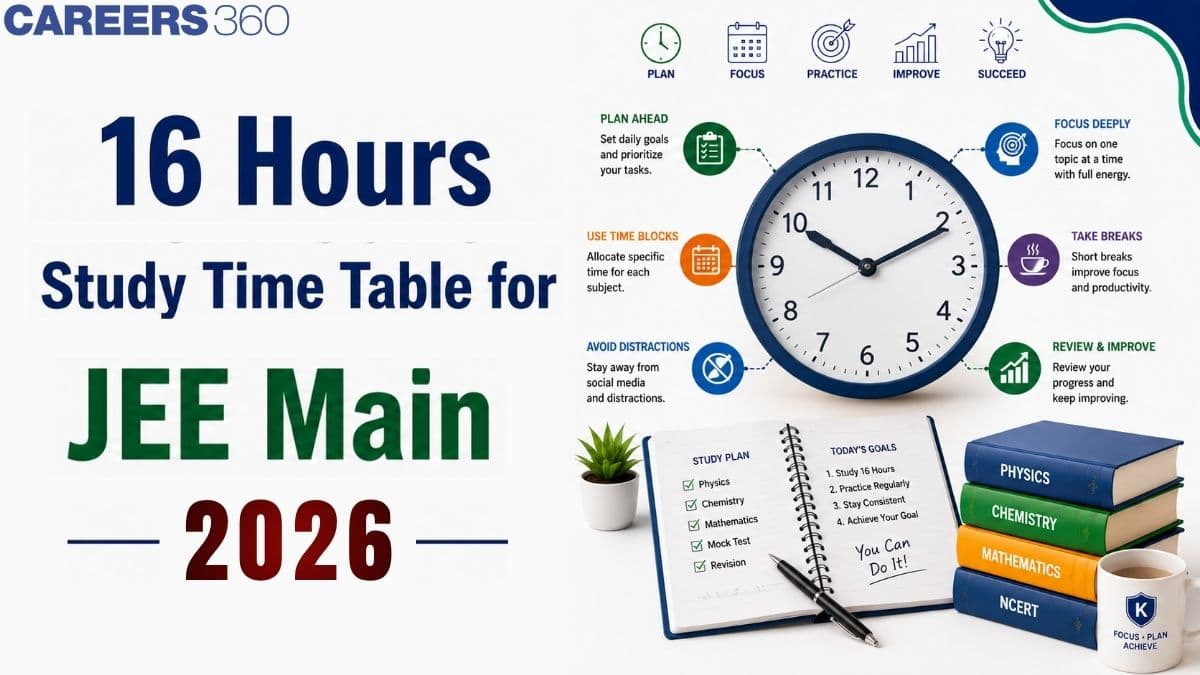
In this section of the 16 hour timetable for JEE, let's understand why this kind of high-intensity study block is even important. The reason is simple. JEE Main is a highly competitive exam taken by nationwide candidates. It’s every aspiring engineer's dream to clear JEE Main exam with flying colours and take admission in the top institutes through it. The JEE Main syllabus is vast, but you can also try to explore JEE Main High Scoring Chapters and Topics. Covering the syllabus is a tiring job, plus balancing revision along with it adds up even more. Over long months, candidates first take every other topic and study the foundation, followed by advanced problem-solving, and then put that chapter in the JEE Main revision plan 2026. These are some of the reasons that you need to know before starting a 16 hours study timetable for JEE Main.
As discussed earlier, in the need to even have a timetable 2026, let’s understand how it should be distributed among the months. A table has been given below for a 6-month plan with a 16 hour study schedule for 2026 to cover the syllabus and have a solid JEE Main 2026 preparation strategy. Your strategy must also include JEE Main high-scoring topics, so make sure to go through it as well. You must also go through JEE Main Latest Syllabus 2026, so you don't waste time on deleted topics.
Phase | Focus Area | Daily Priority |
First 3 Months | Syllabus completion | Theory + basic problems |
Next 2 Months | Strengthening weak areas | Mixed problem sets |
Final Phase | Revision & testing | Give full mock tests and do analysis |
Get expert advice on college selection, admission chances, and career path in a personalized counselling session.
A 16 hours study schedule has to be tight, focused and with minimal breaks for the JEE Main 2026 Study Plan. But that does not mean one should avoid taking any breaks, as it can wear you out and prevent you from putting your absolute best into the JEE Main preparation timetable 2026. Therefore, we have curated a mock schedule for you. You can follow it as it is or make changes according to your own needs. Below is the 16 hours study timetable PDF that you can save and follow thoroughly.
Time Slot | Activity Focus |
5:00 – 6:30 AM | Revision of previously studied concepts |
6:30 – 8:30 AM | |
8:30 – 9:00 AM | Breakfast + short break |
9:00 – 11:00 AM | Numerical practice (high-weight chapters) |
11:00 – 11:30 AM | Break |
11:30 – 1:30 PM | Chemistry theory + examples |
1:30 – 2:15 PM | Lunch + rest |
2:15 – 4:15 PM | Problem-solving session |
4:15 – 4:45 PM | Break |
4:45 – 6:45 PM | Mock test / sectional test |
6:45 – 7:30 PM | Dinner + relaxation |
7:30 – 9:30 PM | Analysis of mock / error log |
9:30 – 11:00 PM | Light revision + formula notes |
Let’s now understand how to divide your 16 hours study schedule ideally. The table below will give you an idea to start it off. Strategising for each subject is important. You can take help of JEE Main Chapter-Wise Weightage to strategise and prepare accordingly. If you plan a particular subject that requires more time, you can edit it accordingly.
Subject | Approx Daily Hours |
Physics | 5 Hours |
Mathematics | 5 Hours |
Chemistry | 4 Hours |
Revision & Analysis | 2 Hours |
The timetable to study 16 hours a day is significantly huge. In this kind of schedule, you must know how to take breaks and plan them properly. Therefore, we have given a break routine for 16 hours study timetable below:
Break Type | Duration | Purpose |
Short Break | 5–10 min | Mental reset |
Medium Break | 30–45 min | Meals & rest |
Night Wind-down | 30 min | Stress release |
If you have made up your mind to follow a 16 hours study timetable for JEE Mains and are now wondering how to get there, then you should go through the following pointers:
Gradual increase strategy ($10 \rightarrow 12 \rightarrow 14 \rightarrow 16$ hours).
Learn to train the mind for long concentration spans.
Keep one book you can revise daily, and prepare short notes for important formulas and memorize them.
Don't go for low-value study habits.
Discipline is more important than motivation.
If you feel you are weak in a particular chapter, then you can go through JEE Main Chapter-Wise PYQs to strengthen your preparation over that chapter.
While 16 hours is still manageable, 18 hours becomes too hectic. You will risk sleep deprivation. There will be both short-term and long-term effects on your body. If there is absolutely no way out and you feel it is the immediate need of the hour, then you might consider following the 18 hours study timetable for JEE Main, but it is not recommendable.
Here in this section, we will understand the key differences between a 16 and 18 hours study timetable for JEE Main. This will help you understand the different factors that you need to keep in mind when you are choosing your study schedule.
Factor | 16 Hours | 18 Hours |
Sustainability | High | Very Low |
Sleep Quality | Moderate | Poor |
Burnout Risk | Medium | Very High |
Recommended Duration | Months | A few days only |
Frequently Asked Questions (FAQs)
One full-length mock per week during preparation. Two per week in the final 6–8 weeks. The test itself isn't the point — the analysis after is. If you're taking mocks and not reviewing every wrong answer, you're just measuring your mistakes, not fixing them.
No. Eighteen hours of studying leaves six hours for sleep, meals, and everything else. That's not a schedule; it's a countdown to crashing. Students who attempt it rarely last more than a few weeks before either the quality collapses or they stop entirely. Short pushes before specific tests are fine. As a sustained daily routine, it doesn't work.
There's no single answer, but students who get there tend to share a few things: they use fewer sources and know them deeply, they take mocks seriously and review them thoroughly, and they revise often enough that nothing gets cold. A 10-hour day built around those habits will.
Enough isn't really the right question. The question is whether those 16 hours are producing output — problems solved correctly, concepts that stick, mock scores improving. Students who hit 99 percentile aren't necessarily studying more hours than students who don't. They're usually studying better: tighter revision cycles, more mock tests, fewer sources. If you can genuinely sustain 16 focused hours without quality dropping, it's a strong schedule. Most people can't, and the ones who push it anyway tend to burn out around month three.
Yes, with the right structure. Hours without direction don't translate to rank. The schedule needs subject rotation, daily revision, and regular mock tests — not just reading time. Check every two weeks whether your mock scores are actually moving. If they're not, the problem is usually method, not hours.
Six to eight hours. Most consistent toppers sleep around 7. Less than 6 hours sustained over months leads to compounding fatigue that shows up as careless errors, slower solving speed, and difficulty with new concepts. It's not noticeable week to week — it catches up quietly.
Realistically, no. Between school, commute, meals, and homework, most school-going students have 8–10 hours left for self-study on a good day. A structured 8-hour self-study block is more achievable and more sustainable. Don't plan 16 hours and consistently deliver 6 — plan 8 and actually do it.
They have the time for it, but time and output aren't the same thing. The dropout rate from ambitious schedules is high because burnout is gradual and easy to miss. Track output weekly — problems attempted, topics covered, mock scores — not just hours sat at the desk. If the numbers aren't moving, scale back and fix the method.
Depends on your gaps, but Mathematics generally demands the most raw practice time. Most Maths problems require multi-step solving, and that only gets faster through repetition. Chemistry is often the most efficient — it rewards systematic memorisation and has a higher return per hour for most students. Physics sits in between: you need conceptual clarity first, then problem practice.
Daily, weekly, monthly. Not as a checklist — as a system. Review that day's material before sleeping. Cover the week's topics on Sunday. Do a full sweep before each mock. Without this, whatever you studied in month one will be largely gone by month four when it matters.

On Question asked by student community
Hello Dear Student,
With an 81 percentile in MHT CET and 71 percentile in JEE Main as a Female VJNT candidate, securing Computer Engineering, CSE, or IT in top-tier colleges (like VJTI or COEP) is difficult through CAP rounds. However, your category benefits and All India Rank provide strong prospects
Hello,
For JEE Advanced Physics preparation, focus on building strong conceptual understanding along with regular problem-solving. Important topics include:
Mechanics
Electrostatics and Current Electricity
Magnetism
Electromagnetic Induction
Optics
Modern Physics
Thermodynamics
Waves and Oscillations
Rotational Motion
Fluid Mechanics
You can prepare using NCERT, H.C. Verma, D.C. Pandey, and previous years'
Hello, if you entered the wrong JEE percentile but uploaded the correct JEE scorecard, your application may still be considered during document verification. However, the final decision will depend on BBAU's verification process. It is advisable to contact the university admission office and inform them about the mistake as soon
Hello Aspirant,
With JEE main rank of 8,19,756 General (Delhi) Category and 68% in class 12 getting CSC or it in top IPU colleges like BPIT, VIPS, BVCOE, Akhilesh Das, or HMRITM is unlikely through the regular counselling rounds.
However, you should still participate in all IPU counselling rounds including
Hello! Thank you for your question.
Admission to NFSU Delhi Campus depends on several factors, including your JEE Main rank, category, home state status, preferred B.Tech programme, seat availability, and the counselling cut-offs for each round. Please share your JEE Main CRL rank, EWS rank, home state, and preferred B.Tech

Among top 100 Universities Globally in the Times Higher Education (THE) Interdisciplinary Science Rankings 2026
Last Date to Apply: 31st July | Ranked #43 among Engineering colleges in India by NIRF | Get Upto 100% Scholarships | Spot Admissions via CUET
100+ Recruiters | 1200+ Placements of 2026 Batch | NBA & NAAC Accredited | Highest CTC 37 LPA
NAAC A+ Grade | Ranked 503 Globally (QS World University Rankings 2026)
40 LPA Highest Package | Up to 100% Scholarship worth 24 Crore via GUTS exam
UGC Approved | Highest Package: ₹1.2 Crore Offered | 20,000+ Placements | 1,800+ Recruiting Partners | Avail Upto 100% Scholarship