University Institute of Engineering, Chandigarh University, Chandigarh
Among top 1% Universities in India (QS World University Rankings 2027)


On a typical Sunday evening, a college student might finish an assignment, join a group call to plan a presentation, search for a lost set of notes, pay an electricity bill and set a reminder for tomorrow’s early class, all from one phone. Each of these tasks takes a few taps, so it’s easy to assume the technology behind them is simple, or that it only matters to the people who build it. Many students think of computer science as nothing more than writing code for a job, and they rarely connect it with the everyday tools they already depend on. Yet every one of those tools exists because someone looked at an ordinary problem and worked out how a computer could handle it more reliably than a person could. This blog looks at five such problems, how computing ideas help with them, and what a b.tech computer science programme teaches that makes this kind of thinking possible.
This Story also Contains
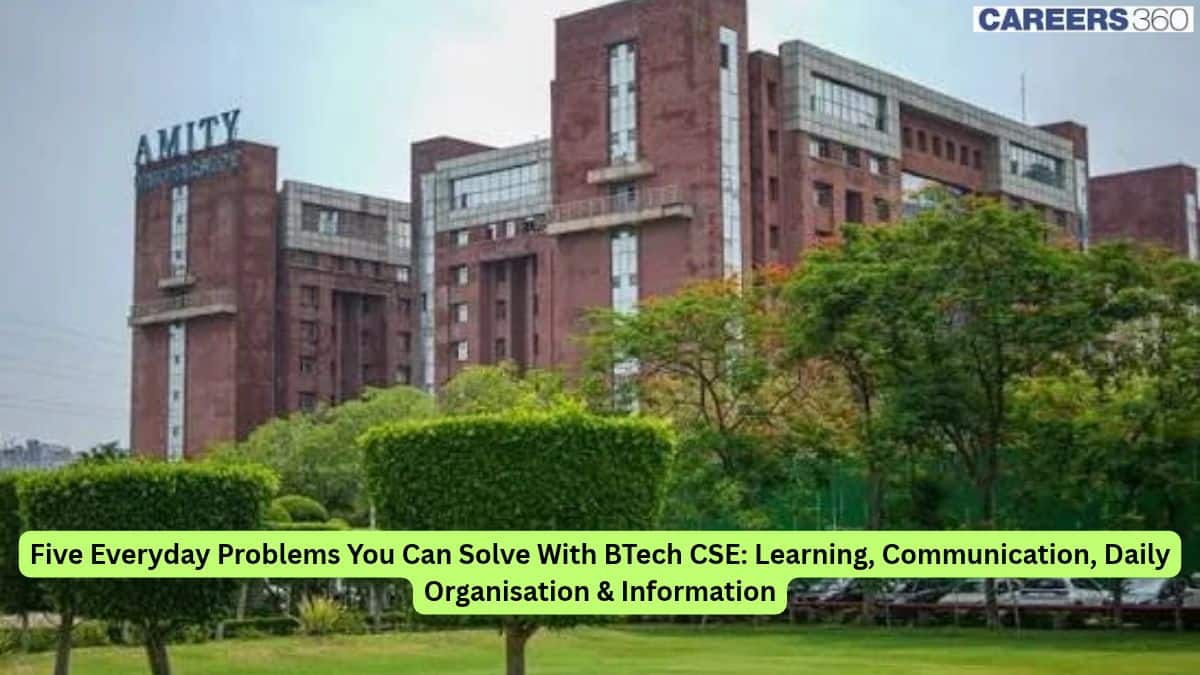
The applications of computer science reach into almost every part of daily life, and the five areas below show how ordinary problems turn into design questions that students can learn to answer.
Also Read: Amity University Noida Admissions
A student with five subjects, scattered notes and several approaching deadlines can use a learning platform that keeps material in one place, a study app that builds a revision plan from the syllabus, and reminders that arrive before each submission date. Behind such a tool, a database stores the notes and records, an algorithm decides which topics need revision first, and a simple interface keeps the whole thing quick enough that students actually use it. Without that last part, even a well-built tool tends to be abandoned within a week.
Messaging apps, video calls, translation tools and shared documents have changed how people study, work and keep in touch. Networking carries data between devices in small packets, data processing compresses audio and video so that a call still works on a weak connection, and software development ties these pieces into an app that behaves the same way on different phones. Collaborative applications go a step further by letting several people edit one document at the same time without overwriting each other, which depends on careful logic about how changes are merged.
Calendar apps, task managers and budgeting tools all aim to take small, repeated decisions off a person’s mind. An expense app that sorts spending into categories and warns when one of them crosses its monthly limit follows a short set of rules that a student could write in a few lines of code. Programming logic such as conditions and loops is what makes this possible, and automation extends the idea to recurring work like monthly bill reminders, weekly backups or attendance summaries that would otherwise be done by hand.
Search engines, recommendation systems and information management tools help people reach relevant material among enormous amounts of content. Data structures such as indexes work a little like the index at the back of a book, because they allow a program to jump to the right place without reading everything. Algorithms then rank the results, databases store the underlying records, and recommendation systems look at patterns in past behaviour to suggest what a person might want to read or watch next.
Mobile apps now let people pay bills, book appointments and check exam results without standing in a queue, and that only helps if the service is easy to use for everyone. Accessible interfaces with larger text, screen reader support, regional language options and designs that work on slow connections make a real difference to people who might otherwise be left out. User-centred design, which means testing a product with real users and changing it based on what they find difficult, is as much a part of software development as the code itself.
Also see: Amity University Noida Courses
Problem solving in computer science follows a fairly consistent path, whatever the size of the problem. It begins with identifying what is actually going wrong, then breaking it into smaller tasks, working out a logical approach, writing the code, testing the result and improving it. Take a timetable clash that causes students to miss classes. The problem can be split into collecting timetable data, detecting overlapping slots and displaying the result clearly, and each of those parts is easier to solve than the whole.
This way of thinking is usually called computational thinking, and it rests on a few habits: decomposing a problem, spotting patterns, ignoring details that don’t matter and describing the steps precisely enough for a machine to follow them. Testing is just as important as writing the code, because most programs fail the first time in ways their authors didn’t expect, and fixing those failures one by one is how the solution gradually becomes reliable. The habit of working this way tends to stay with students long after they’ve stopped writing code, since it applies to any task that can be broken into steps.
The BTech Computer Science course runs for four years, with the early semesters focusing on mathematics, physics and programming basics, and the later ones moving into more specialised areas. The table below shows how the main BTech Computer Science subjects connect with the everyday problems discussed above.
| Subject | What it covers | Everyday use |
|---|---|---|
Programming | Writing and debugging code | Building apps and automation scripts |
Data structures and algorithms | Organising data and designing efficient steps | Fast searching, sorting and ranking |
Database management | Storing, retrieving and updating records | Records behind apps, schools and shops |
Computer networks | How devices exchange data | Messaging, calls and web access |
Operating systems | Memory, processes and file handling | Letting devices run many tasks smoothly |
Software engineering | Planning, designing and testing software | Building reliable applications |
Artificial intelligence | Learning from data and making predictions | Recommendations, translation and assistants |
Subject names and their order differ between colleges, so applicants should look at the detailed syllabus instead of relying on the programme title. Laboratory sessions matter as much as lectures, because writing and debugging code is a skill that only develops through practice, and a programme that gives students regular lab time will usually prepare them better than one that stays mostly theoretical.
Computer science projects are where classroom concepts meet real use, and some of the most useful ones start from a problem the student actually has:
A student timetable application that detects clashes and sends reminders
A personal expense tracker that sorts spending and warns about limits
A smart reminder system that adjusts alerts based on deadlines
An online learning portal that keeps notes, assignments and progress in one place
An information search tool that finds relevant material quickly in a large collection of documents
Among top 1% Universities in India (QS World University Rankings 2027)
India’s only private university to be ranked for Graduate Employability | 6000+ Placements | 800+ Recruiters | 75 LPA-Highest Salary
Working on projects like these helps students apply what they’ve learned in class, because a database or an algorithm makes far more sense once it has to work inside a program that someone else will use. It also gives them a chance to test ideas, find out what fails and improve the design, which builds the kind of problem-solving ability that employers tend to look for. A few finished projects also give applicants something concrete to show during internship and job interviews.
Also see: Amity University Noida Facilities
Applicants who want to study these ideas in a structured way can look at the B.Tech Computer Science & Engineering programme at Amity University Noida. The programme is listed as a four-year, full-time undergraduate course offered through the university’s engineering school, and it gives students a chance to build computing knowledge and technical skills that apply to the kinds of everyday problems discussed above.
Eligibility is listed as a 10+2 qualification with English, physics, mathematics and either chemistry or computer science, with a minimum of about 60 per cent marks. Admission is listed as based on a national-level engineering entrance score or the university’s own entrance test, though the exact steps can change from one admission cycle to another. It’s also worth asking how much of the programme is project-based, how often students get laboratory time, and what internship support is available, since those details show how practical the learning will be. Fee figures differ across sources, so the fee structure is best confirmed directly with the university. For current dates and requirements, applicants can visit the official B.Tech Computer Science & Engineering programme page.
Disclaimer: This article has been published as a part of a marketing collaboration between Careers360 and Amity University.
Frequently Asked Questions (FAQs)
The course usually covers programming, data structures, algorithms, database management, computer networks, operating systems, software engineering and artificial intelligence, along with mathematics in the early semesters. Subject names and order vary between colleges.
Computer science helps by turning a repeated or confusing task into a set of clear steps that software can carry out. Scheduling, messaging, searching for information and accessing services online all rely on algorithms, databases and well-designed interfaces.
Students can build a timetable application, an expense tracker, a reminder system, an online learning portal or a simple search tool. Each project uses programming, databases and testing, and each solves a problem the builder actually has.
Logical reasoning, the ability to break a problem into smaller parts, comfort with mathematics, programming, careful testing and patience with debugging all matter. Clear communication also helps, since solutions have to be explained to the people who will use them.
Graduates can work as software developers, data analysts, web and mobile developers, systems engineers, cybersecurity analysts and AI or machine learning engineers. Some also move into product roles, research or start their own ventures.

On Question asked by student community
Hello Student,
For Amity Institute of Biotechnology, Noida, PCB students can be eligible for BTech programmes with the specified eligibility. Careers360 lists 60% aggregate in Class 12 with PCB/PCM for non-sponsored candidates and 55% for sponsored candidates. However, eligibility can differ for BTech CSE at different Amity campuses. Therefore, check
Hello Student, both Amity Noida and Amity Gurugram can be considered for MCA, but the better choice for you depends on factors such as fees, placements, campus environment, location, curriculum, internships and your career goals. If your priority is a larger campus and broader exposure, Noida may be worth considering.
Hello,
Sorry, we are currently not covering Amity University Lucknow
BDes
sample questions/papers. You can check the official Amity website for sample paper questions.
Agar aap UP Board se Class 12 PCB kar rahe ho aur B. Tech CSE karna chahte ho, to Mathematics ki eligibility requirement complete karna important hai. NIOS se additional Mathematics lene ka option useful ho sakta hai, lekin admission se pehle apne UP Board + NIOS subject combination ki
Minor mismatches in your Aadhaar card and Class 10 marksheet don't automatically make you ineligible for admission. Universities usually consider your academic documents, but you'll likely be asked to provide supporting documents or get the discrepancy corrected. It's best to contact the admissions office and explain the situation before completing

India’s only private university to be ranked for Graduate Employability | 6000+ Placements | 800+ Recruiters | 75 LPA-Highest Salary
Ranked #43 among Engineering colleges in India by NIRF | Get Upto 100% Scholarships
First private university in Delhi-NCR to be awarded the prestigious NAAC ‘A++’ Accreditation | Recognized as Category-1 Deemed to be University by UGC
Diploma (17 Specializations), B.Tech / B.Tech (Hons.) / IE-B.Tech - 4 years - 25+ specializations | M. Tech - 14+ specializations | Highest CTC – 60 LPA
60+ Years of Education Legacy | UGC & AICTE Approved | Prestigious Scholarship Worth 6 Crores
Highest CTC 24.80 LPA | Average CTC 6.56 LPA