Integral University B.Tech Admissions 2026
NAAC A+ Accredited | Highest CTC 45 LPA | Scholarships Available


JEE Main Preparation Tips 2027: Candidates who wish to clear the entrance exam and secure a BTech seat at a good college must check the JEE Main 2027 preparation tips. JEE Main exam preparation involves creating a proper study plan, identifying good books and study material, regular practice, especially with JEE Main previous year papers, thorough revision and effective time management. Aspirants can check this page to know how to prepare for JEE Mains at home. Being one of the crucial tests, JEE Main 2027 has a huge competition. Everyone has similar study methods. Hence, to achieve an upper hand, one must be aware of the preparation tips for JEE Main 2027.
This Story also Contains
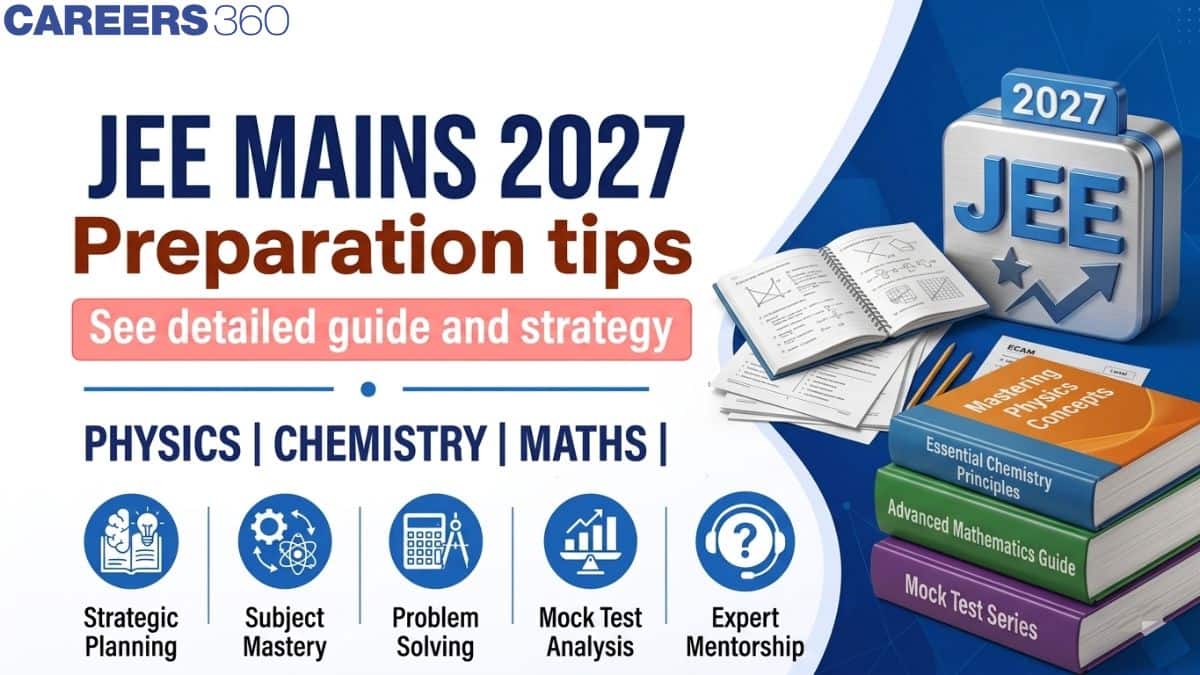
Students need to work towards grasping the concepts of Physics, Chemistry and Mathematics, instead of just learning the topics. Practising and taking mock tests can also enhance speed and accuracy. In this article, students can go through the best JEE Main preparation tips 2027 along with other strategies.
Here are some of the preparation tips for JEE Main 2027 for those who are either looking to start fresh or have dropped a year.
Get expert advice on college selection, admission chances, and career path in a personalized counselling session.
We have provided the JEE Main Session 1 study plan to start preparing for the exam. It will help you plan a daily study schedule properly. Check it below:
Time | Activity | Purpose |
6:00 AM – 7:00 AM | Light revision/formula review | Quick recall of important notes or formulas to start the day fresh |
7:00 AM – 8:30 AM | Focused study session 1 | Practice problems or concept reinforcement |
8:30 AM – 9:00 AM | Break | Relax, have breakfast, and take a short walk |
9:00 AM – 10:30 AM | Focused study session 2 | Solve previous year questions or sectional exercises |
10:30 AM – 11:00 AM | Short break | Tea/refreshment |
11:00 AM – 12:30 PM | Focused study session 3 | Practice mock test section or numerical questions |
12:30 PM – 1:30 PM | Lunch / Rest | Take a complete break |
1:30 PM – 3:00 PM | Revision / Notes | Revise formulas, short notes, and key mistakes from previous tests |
3:00 PM – 3:30 PM | Break | Tea/snack and relax |
3:30 PM – 5:00 PM | Mock test / Practice set | Take timed mini-tests or a full section of previous papers |
5:00 PM – 5:30 PM | Break | Short walk or refresh |
5:30 PM – 7:00 PM | Problem-solving / Weak area focus | Work on mistakes or difficult questions |
7:00 PM – 7:30 PM | Break | Dinner prep / light activity |
7:30 PM – 9:00 PM | Revision / Formula notebook | Recap what was studied today and update the error notebook |
9:00 PM – 9:30 PM | Light reading / Relax | Optional: motivational reading, mental relaxation |
10:00 PM | Sleep | Ensure proper rest for memory consolidation |
Also Check- JEE Main 100 Days Study Plan 2027
The First Step- Create a Study Plan. An effective study plan is a must for all aspirants. They must follow that plan diligently. JEE Main preparation tips PDF can be downloaded online. Here are some tips for those who wish to know how to crack JEE Mains in first attempt.
1. JEE Main Syllabus
Students should refer to the JEE Main latest syllabus 2027 to start the preparation and be aware of what is to be covered during the preparation strategy for the JEE Main 2027 exam.
2. Maintain Notes
Notes are one of the most essential aspects to follow for effective preparation for the JEE Main 2027 exam. They are useful during revisions as well as enhance memorisation of the concepts that are to be recalled when taking the test or the exam.
3. Focus on the NCERT Textbook
An efficient preparation strategy for JEE Main 2027 would also entail focusing on the NCERT textbook 2027, especially for the subject of chemistry for JEE Main 2027 preparation. Every successful candidate and coaching guru recommends that the NCERT is the pillar of the JEE Main exam, but it is advisable to utilise it correctly.
4. Dividing your study smartly
Divide your study time so that you spend an equal amount of time studying each subject. Time division is important to prevent over-focusing on one topic and to maintain daily consistency. If you study 10 hours daily for your preparation, then split your time as outlined in the table
Subject | Time |
3 hours | |
2.5 hours | |
3 hours | |
Mock Test + Analysis | 1.5 hours |
Wondering how to crack JEE Mains in first attempt? A planned strategy for revision is very necessary. The first step in an effective revision plan, especially for those who are looking to know how to prepare for JEE Main at home, is to divide your preparation into systematic phases. Start with a concept revision phase; here, revise your class notes, NCERTs (greatest for concepts but not fully sufficient), important formulas 2027 & important theory again so that you strengthen your basics. Then comes the Practice and PYQ Phase, where you start your topic-wise questions and previous year question papers from 2016 to 2025.
Organizing And Planning Your Study
Make a study timetable (monthly and a day‐by‐day plan) since candidates want to prepare for JEE Mains by self study. Aspirants can check the daily routine of JEE Main toppers for reference. Deciding and allotting a particular time frame for preparation, learning, practising, revising and attempting mock tests is very necessary. According to your structure, studying will allow sufficient time for learning and relieve anxiety that usually increases with time if not prepared properly.
Be Conceptual, Not Just Memorising
Try to build a strong understanding of Physics, Chemistry, and Maths. Solve application problems regularly to understand what a formula really means—do not memorise formulas just to apply them. It will help to remember them in the future. Conceptual learning improves your understanding of both the questions and the application.
Practice the Last 10 Years of JEE Main Papers
Although topic-wise questions and numerical problems should be solved daily, you should not forget to practice the last 10 years of JEE Main papers. Practising and familiar with JEE Main papers will greatly improve your speed, accuracy, and confidence in the exam.
Take Practice Tests Regularly and Maintain an Error Notebook
Try to take a weekly full-length JEE Main sample papers and mock tests as if it were actual exam conditions. Set aside an hour for error review, take notes on all your mistakes, and then circle the topics that were the most difficult to fix as topics to review right after you test. Keep studying and reviewing the subjects at all times.
Revision and Time Management
Have short notes and the formula handy for quick review prior to taking the test. Make it a practice to review these materials regularly. Particularly in the last weeks of prep, practice solving questions within the test allotted time, then practice more questions, providing an hour less than the allotted time.
1. Accept That This Year Is Different — And Plan Accordingly.
You've already sat for the exam once. That means you know what the paper feels like, where you froze, and which topics cost you marks. Most freshers don't have that. Use it. Your preparation this year should not be a repeat of last year — it should be a direct response to what went wrong.
2. The First Month Is for Honest Assessment, Not Blind Revision.
Before you open a single book, sit down and figure out exactly where you stood in your last attempt. Which chapters were weak? Where did you lose time in the paper? What was your accuracy in each subject? This data should drive your entire study plan — not a generic timetable you found online.
3. NCERT Is Still Non-Negotiable.
Some droppers make the mistake of thinking they're past NCERT. They're not. Go through it again — especially Chemistry. You'll catch things you missed or half-understood the first time. Skipping this step and jumping to advanced material is one of the most common dropper mistakes.
4. Fix Your Weak Subjects Early — Not in the Last Two Months.
Whatever subject pulled your score down last year needs attention from day one. If it's Maths, start Maths today. Don't leave it for later because later never comes with the focus it needs. The first three to four months of your drop year are the most valuable — don't spend them on comfortable subjects.
5. Build a Realistic Daily Schedule and Stick to It.
Eight hours sounds good on paper. If you can genuinely do eight focused hours, great. If you can't, plan for six and actually do them. An honest six-hour day beats a dishonest ten-hour day every single time. Pick your study hours, keep them fixed, and protect them.
6. Don't Ignore the Psychological Side of Dropping.
This is the part nobody talks about enough. Dropping a year is hard. Friends have moved on to college, there's pressure from home, and some days, motivation completely disappears. That's normal — but it can derail preparation if you don't manage it. Build small daily wins into your routine. Don't compare your timeline to anyone else's.
7. Solve PYQs Chapter-Wise First, Then Full Papers.
Don't start with full mock tests in the first month. Go chapter-wise through the last 10 years of PYQs first. Understand how NTA frames questions, topic by topic. Once you have that base, move to full-length mocks — ideally from the third month onward.
8. Take Mock Tests Every Week Without Exception.
From the third month, one full JEE Main mock test per week minimum. Time yourself strictly. Sit in exam conditions no phone, no breaks beyond what the actual exam allows. After every mock, spend as much time reviewing it as you spent taking it. The review is where the real learning happens.
9. Keep an Error Log and Use It.
Every mistake you make — in practice, in mocks, in chapter exercises goes into one notebook. Write the question, what you did wrong, and what the right approach is. Revisit this notebook weekly. By the time January arrives, this notebook is worth more than any test series.
10. Don't Chase New Material in the Final Two Months.
After October, stop adding new books or new resources. Whatever you've been studying revise it, test yourself on it, strengthen it. Students who keep introducing new material in November and December end up scattered. Depth beats breadth in the final stretch.
11. Sort Out Your Resources Early and Don't Keep Switching.
One book per subject is enough if you use it properly. HC Verma and DC Pandey for Physics, MS Chauhan and NCERT for Chemistry, RD Sharma or Cengage for Maths — pick your set and go deep. Switching books mid-year because someone recommended something new is a time drain.
12. Chemistry Can Rescue Your Score Don't Underestimate It.
If your Physics and Maths are average, Chemistry can still push your percentile significantly. It's the most straightforward of the three subjects in terms of scoring — a lot of questions are direct if you know the theory. Droppers who neglect Chemistry because it feels "less important" are leaving easy marks on the table.
13. Sleep, Eat, and Take Breaks Seriously.
This is not optional advice. A tired brain retains nothing. Six hours of focused study after proper sleep beats ten hours of exhausted studying every time. Your drop year is a long haul — you can't sprint it. Protect your health or your preparation will suffer for it.
14. Have One Person Who Holds You Accountable.
A friend who's also preparing, a parent, a mentor — someone who checks in on whether you actually did what you planned. Self-accountability is hard over a full year. One external check-in per week makes a real difference.
Before starting the preparation, it is important to know the exam pattern of JEE Main. Here you can check it:
Particulars | Details |
Exam Name | Joint Entrance Examination (JEE) Main 2027 |
Conducting Body | National Testing Agency (NTA) |
Exam Level | National Level |
Exam Mode | Online (Computer-Based Test) |
Paper | Paper 1 – B.E./B.Tech |
Subjects | Physics, Chemistry, and Mathematics |
Type of Questions | Multiple Choice Questions (MCQs) and Numerical Value Type (NVT) Questions |
Questions to Attempt | 75 (25 per subject), - Section A: MCQs (20 questions) - Section B: NVT (5 questions) |
Duration | 3 hours (180 minutes) |
Total Marks | 300 marks |
Marking Scheme | MCQs: +4 / −1; Numerical: +4 / 0 (no negative marking) |
Number of Sessions | Twice a year (Expected: January & April) |
Language of Exam | English, Hindi, and other regional languages (as per NTA guidelines) |
Eligibility Criteria | Passed/appearing in Class 12 (with Physics, Chemistry, and Mathematics) |
Official Website | https://jeemain.nta.ac.in |
Here, we have provided a list of the best books for JEE Main 2027. You can refer to it and start preparing accordingly.
Subject | Books | Purpose / Notes |
Physics | Concepts of Physics (Vol. 1 & 2) – H.C. Verma Problems in Physics – S.S. Krotov | Build strong fundamentals and problem-solving skills Practice challenging and analytical problems |
Chemistry (Organic) | Organic Chemistry – O.P. Tandon Organic Chemistry – Morrison & Boyd | Clear concepts and essential practice Understand reaction mechanisms and advanced concepts |
Chemistry (Physical) | Problems in Physical Chemistry – Narendra Awasthi Concepts of Physical Chemistry – P. Bahadur | Practice numerical and problem-solving skills Comprehensive coverage for all topics |
Chemistry (Inorganic) | Concise Inorganic Chemistry – J.D. Lee NCERT Chemistry Class 11 & 12 | Structured content for easy understanding Foundation and core concept clarity |
Mathematics | Higher Algebra – Hall & Knight IIT Mathematics – M.L. Khanna Problems in Calculus of One Variable – I.A. Maron Trigonometry – S.L. Loney | Strong algebra practice and techniques Comprehensive problem practice Master calculus concepts and applications Deep understanding of trigonometry |
Practising JEE Main previous year question papers is one of the most effective ways to understand the latest exam pattern, question types, and difficulty level. Candidates should solve both the January and April session papers to identify important topics, improve time management, and evaluate their preparation level before the exam.
Sr No | Paper Name |
1 | |
2 | |
3 | |
4 | |
5 | |
6 | |
7 | |
8 | |
9 | |
10 | |
11 | |
12 | |
13 | |
14 | |
15 | JEE Main 2020 September Session Question Paper with Solution |
16 | |
17 | |
18 | |
19 | |
20 | |
21 | |
22 | |
23 |
Frequently Asked Questions (FAQs)
Yes. It is definitely possible by doing NCERT, PYQs, mocks and self-study. Aspirants who wish to know how to prepare for JEE Mains by self study can go through this article.
Candidates can crack the JEE Main 2027 with a proper preparation strategy, practice, complete revision, and practice mock tests. The JEE Main preparation tips pdf come in handy.
NCERT can get you marks for chemistry and the basics of physics and maths, but it needs to be supplemented. One has to get best books for JEE Main 2027 for physics, chemistry and maths, study and practice regularly.
JEE Main exam has 75 questions, 25 each from Physics, Chemistry and Mathematics. Out of 25 questions, 20 will be MCQ and 5 will be questions with numerical value answers.
At least 30-50 mock tests of the whole paper should be taken.
If a student studies for 6–10 hours daily consistently and revises on a routine basis, he is most likely to be able to clear the exam.

On Question asked by student community
Hi, three months can still be used productively, but right now you should avoid trying to complete everything at once. First, divide the syllabus into high-priority chapters, moderate-priority chapters and low-priority chapters. Focus on concepts and PYQs for the high-priority areas, take regular timed tests and keep a separate list
Hello!
Given below are the links to access the JEE Main Question Papers (Hindi Medium):
https://engineering.careers360.com/hi/articles/jee-main-question-paper-hindi-medium
https://engineering.careers360.com/hi/articles/jee-main-question-paper
Dear Student,
You can access the JEE Main Last Five Years' Analysis (2026–2022) on Careers360. It provides insights into previous-year trends, difficulty levels, and important topics to help with exam preparation.
Dear Student,
You can access JEE Main Previous 10 Years Question Papers with Detailed Solutions on Careers360. These papers are useful for understanding the exam pattern, important topics and question types, and for practising Physics, Chemistry and Mathematics.
JEE Main Previous 10 Years Question Papers with Detailed Solutions
You can
Dear Student,
Can you clarify what do you want to know about the JEE Main exam . Are you looking for the JEE Main syllabus, eligibility criteria, or preparation strategy.

100+ Recruiters | 1200+ Placements of 2026 Batch | NBA & NAAC Accredited | Highest CTC 37 LPA
NAAC A++ Grade | Recognized as Category-1 Deemed to be University by UGC | 41,000 + Alumni Imprints Globally
Apply for B.E at East Point College of Engineering and Technology | Affiliated to VTU | AICTE Approved | NBA Accredited | Highest CTC 33 LPA
NAAC A+ Accredited | Highest CTC 45 LPA | Scholarships Available
Admission Against Cancellation/Lapsed Seats | Pay 500 Application Fee instead of ₹1500 | NIRF Ranked 87 | NAAC A+ Grade | Upto 100% scholarship
10000+ Alumni across the globe | Scholarships available