IITs- A Complete Guide
Dive into everything you need to know about IITs—from eligibility and cutoffs to fees and placements.


Preparing for IIT-JEE has always involved more than simply completing a syllabus. Students have to build concepts, solve enough problems to understand how those concepts work in practice, identify their weak areas, and revise them repeatedly. In the past few years, the number of tools available to support that process has also changed dramatically. Alongside textbooks, coaching material, and JEE Main previous-year questions, students now have access to digital learning platforms and AI tools that can explain a concept, work through a problem, or create practice questions within seconds.
This Story also Contains
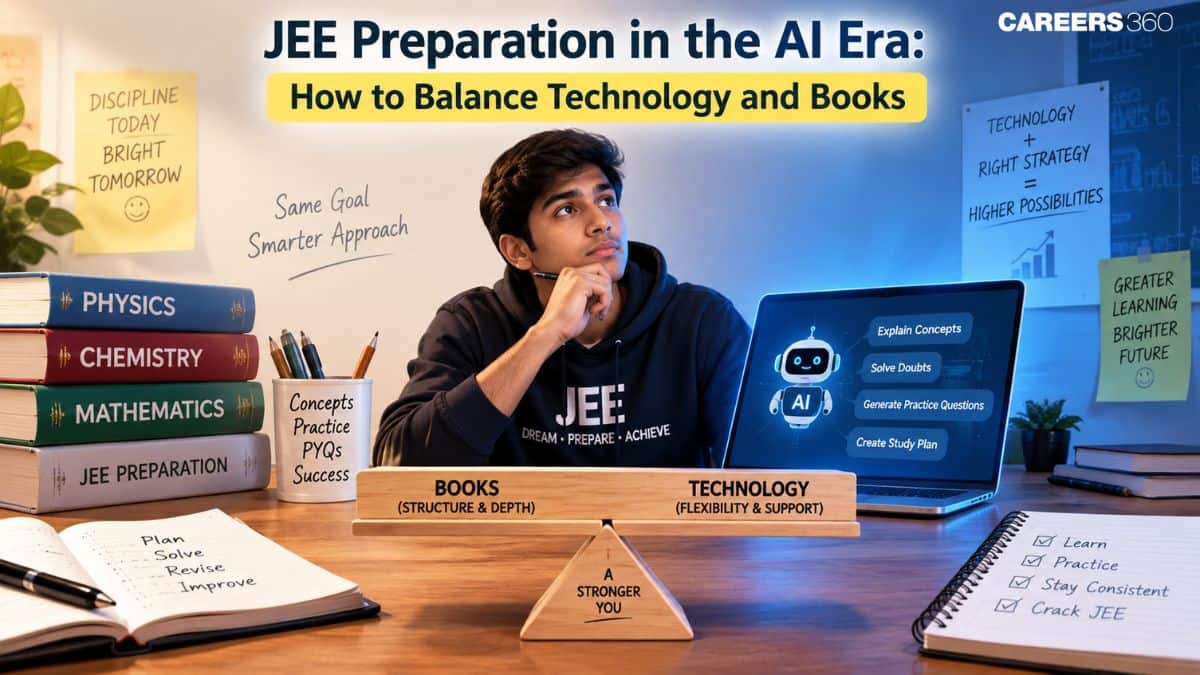
The convenience is undeniable, but it also raises a more important question for JEE aspirants: how much of preparation should be driven by technology, and where does a structured resource such as a book continue to matter? For JEE Main, JEE Advanced, and other engineering entrance examinations, the answer is increasingly about finding the right balance rather than choosing one over the other.
A student preparing for an examination as broad and demanding as JEE Main needs a clear learning path. A good preparation book provides one. Concepts are covered first, followed by examples, practice questions, previous-year questions and revision, so students can simply work through the chapter instead of wasting time figuring out what to pick up next.
With the use of AI, the same process can become more flexible. If a Physics concept is difficult to follow, AI can explain it in simpler language. Similarly, for a Mathematics problem, AI can show a different way of solving it, or give students more questions to practise when they need them. It can also come in handy when an aspirant is stuck on a problem or needs to go over a concept again because it did not make sense the first time.
The distinction matters because AI generally responds to the question a student asks, while a well-designed book also covers concepts and problems they may not know they need. That is particularly relevant to JEE Main preparation, where students may not always recognise gaps in their own understanding. A structured resource takes them through the JEE syllabus, introduces different applications of a concept, and ensures that preparation is not limited to whatever a student happens to search for.
The depth required for IIT-JEE also makes sustained problem-solving important. Students need to spend time working through difficult Physics problems, attempting increasingly complex mathematics questions, and applying Chemistry concepts across different types of questions. An immediate explanation can help when a student is stuck, but working through the problem independently, making mistakes and returning to the concept develops the concentration and problem-solving stamina that competitive examinations demand.
For students, the two therefore serve different but complementary purposes. A book provides the structure and breadth needed to keep preparation on course, while AI can offer additional explanation and practice when an individual student needs it. The value lies in using the flexibility of technology without losing the discipline and progression that serious JEE preparation requires.
Get expert advice on college selection, admission chances, and career path in a personalized counselling session.
Printed books remain particularly useful during revision because they allow students to build a record of their own preparation. JEE Main Important formulas can be underlined, difficult questions marked, mistakes noted, and problems that need another attempt easily identified. After months of preparation, those annotations can turn a book into a personalised revision guide that reflects the student's own areas of difficulty.
Printed books also mean students are not looking at a screen for every part of their preparation. Online classes, lectures, JEE mock tests, and study material already take up a good part of the day, so having some preparation that happens away from a device can be useful.Sitting down with a book removes notifications and the temptation to move between different platforms, allowing students to concentrate on a chapter or a set of problems for a sustained period.
Previous-year questions are equally important. For JEE aspirants, PYQs offer something that generic practice cannot: a direct record of how concepts have appeared in the actual examination. Organised properly, they help students understand recurring concepts, question patterns, and levels of difficulty. AI can explain a PYQ, analyse a solution or create questions based on it, but students still need to attempt the original questions themselves.
Reliability is also important, which is why established JEE preparation material is reviewed by subject experts, aligned with the prescribed syllabus, and regularly updated to reflect changes in the examination pattern.. AI-generated explanations can be useful, but students should still verify the information they receive rather than treating every response as authoritative. In a high-stakes examination, a small error in a formula, interpretation, or solution can lead a student in the wrong direction.
Also Read:
The case for books today cannot simply be that they have always worked. Students' expectations have changed, and educational publishing has to respond to the way learning now takes place.
Modern preparation material can connect the structure of a printed book with digital assessments, QR-enabled resources, mock tests, performance tracking, video explanations and technology-supported learning. The objective is to retain the depth and reliability of curated preparation material while giving students additional ways to practise, assess their progress and seek help when they need it.
For students preparing for IIT-JEE and other engineering entrance exams, the key is simply knowing what to use, and when. A book can provide the syllabus-led structure, concepts, curated practice, and previous-year questions that keep preparation on course, while digital tools can help students assess their performance, and AI can offer quicker explanations, resolve doubts, and provide targeted practice. The technology does not have to replace the discipline of preparation; it can strengthen it by giving students additional support around a structured learning process. AI may change how students access information and practise certain topics, but reliable content, systematic study, sustained problem-solving, and thoughtful revision remain central to doing well in IIT-JEE.
Avinash Agarwal is the director of Disha Publication and also a well-known name in India’s education ecosystem. He has spent over two decades now in academic publishing and student engagement. He holds an MBA in marketing from the Management Development Institute and a B.Tech in computer science. In practice, he has helped a lot with creating learning resources for the school and competitive exams, like JEE, NEET and UPSC, for students.
Through more than 100 workshops and seminars, he’s been directly meeting thousands of students. The conversations usually circle study skills, discipline, and learning strategies that actually work. And outside all this professional stuff, he’s a national-level basketball player too, plus he enjoys travelling whenever he gets the chance.
Frequently Asked Questions (FAQs)
No, AI tools can not replace books and notes, but they are good resources that can be used to support the JEE Main Preparation.
You can use AI as a personal guide, like:
AI can make learning more personalised, help in making a timetable, personalised study plan according to your class time. AI can create quizzes as per you instruction can create mock tests also. Basically, you can use AI as a personal guide.

On Question asked by student community
Dear Student,
You can access JEE Main Mathematics previous-year questions on Careers360. Practising previous-year questions will help you understand the exam pattern and question types.
Dear Student
Please specify whether you want Physics, Chemistry, or Mathematics, and which JEE Main/Advanced exam.
Hi Ansh Chauhan
Check the link below for the high-weightage Physics chapters for JEE Main 2027 based on recent exam trends. Students can use these chapters to prioritise their preparation and focus more on topics that have appeared frequently in previous papers.
https://engineering.careers360.com/articles/most-weightage-chapters-for-jee-main-physics-2027
Hi, three months can still be used productively, but right now you should avoid trying to complete everything at once. First, divide the syllabus into high-priority chapters, moderate-priority chapters and low-priority chapters. Focus on concepts and PYQs for the high-priority areas, take regular timed tests and keep a separate list
Hello!
Given below are the links to access the JEE Main Question Papers (Hindi Medium):
https://engineering.careers360.com/hi/articles/jee-main-question-paper-hindi-medium
https://engineering.careers360.com/hi/articles/jee-main-question-paper

100+ Recruiters | 1200+ Placements of 2026 Batch | NBA & NAAC Accredited | Highest CTC 37 LPA
Apply for B.E at East Point College of Engineering and Technology | Affiliated to VTU | AICTE Approved | NBA Accredited | Highest CTC 33 LPA
Last Date to Apply: 17th August | QS I-Gauge Diamond Rated | NAAC A+ Accredited | 621 Recruitment Partners | INR 40 LPA Highest CTC | 4482 Job offers
Merit Scholarships | NAAC A+ Accredited | Top Recruiters : E&Y, CYENT, Nvidia, CISCO, Genpact, Amazon & many more
60+ Years of Education Legacy | UGC & AICTE Approved | Scholarship Worth 6 Crores | H-CTC 35 LPA
Application Free of Cost for Limited Time || NAAC A++ Accredited | Highest CTC 52 LPA | #11 in University Category by NIRF