
Search Colleges, Exams, Schools & more


Login
8 Best CSE Branches For Future in AI in 2025 - Artificial Intelligence Career Options, Salary
Best CSE Specializations For A Future in AI: Artificial Intelligence (AI) Artificial Intelligence is a branch of computer science that focuses on making machines capable of performing tasks that usually require human intelligence. If you want to get admission in Computer Science Engineering (CSE) in this fast growing industry, then pchoosing a specialization in AI-related fields is a smart option. CCSE is a broad field that includes areas like Artificial Intelligence, data analytics, robotics, and more. So, it is important to choose your specialisation carefully, as it can shape your future career.So, you need to be good in selecting CSE specialisations which will set you up for a good career.
This Story also Contains
- 8 Best CSE Specializations For Future in AI
- Which is better CSE or AI and Data Science salary
- BTech CSE Data Science and Artificial Intelligence Salary
- Skills Acquired for BTech CSE Data Science and Artificial Intelligence
- Career Opportunities for BTech CSE Data Science and Artificial Intelligence
- How to Choose Which CSE Specialisation is Correct for You?
Related links:
8 Best CSE Specializations For Future in AI
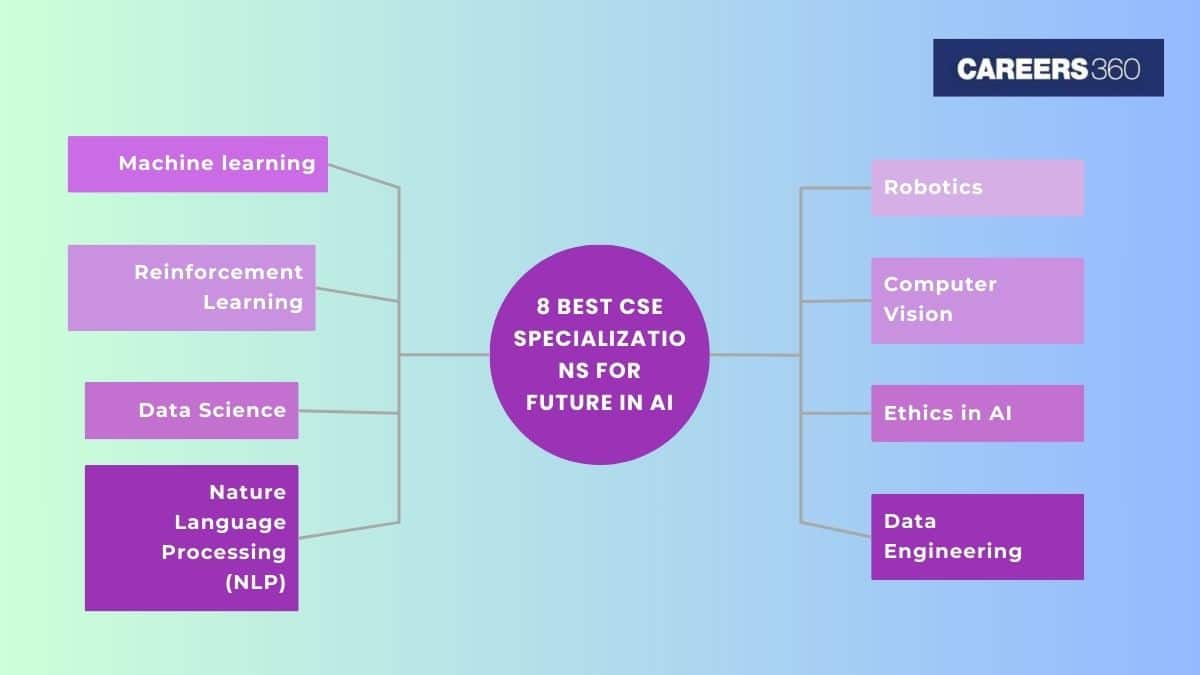
Here are some of the top computer science fields for AI careers that are shaping the future of technology: CSE specialisations for artificial intelligence, including machine learning. Reinforcement learning, Data Science, Robotics, Computer Vision, Ethics in AI, Data Engineering.
Machine learning: It teaches us to develop algorithms that make machines learn from data.
Reinforcement Learning: Machine learning is an advanced subset of Machine Learning where agents learn to make decisions through trial and error, mainly used in robotics/gaming/automation.
Data Science: It is about processing and analysing large datasets to be used in building predictive models and driving AI solutions.
Nature Language Processing (NLP): It tackles the problem of allowing computers to understand, interpret, and generate human language — essential for chatbots, voice assistants and language translation tools.
Robotics: Turns AI into hardware that enables intelligent robots to complete tasks on its own. Robotic applications, driven by AI, exist in manufacturing, healthcare, and automation industries.
Computer Vision: An area of AI working towards teaching machines to interpret and process visual information, and changing autonomous vehicles, medical imaging, and other innovations.
Ethics in AI: Ethics, especially bias, privacy, and accountability become increasingly critical as AI technology evolves.
Data Engineering: It covers how to build, and manage, the infrastructure which runs the AI models, including the data pipelines, the databases, and the big data architectures.
Confused About College Admissions?
Get expert advice on college selection, admission chances, and career path in a personalized counselling session.
Book a Counselling Slot
Select Date
Pick a Slot
Which is better CSE or AI and Data Science salary
Fresher Salary | 4-5 LPA |
Average Salary | 6-10 LPA |
Experienced Salary | 12-25 LPA |
Average Fee | 50,000- 1,50000 yearly |
Artificial Intelligence and Data Science Job Opportunities | Domain Expert, UX designer, Social Scientist, Data Product Manager, Information Security Analyst, Software Engineer, System Analyst, Expert Analyst, Statistician, Decision-Maker, Data Analyst, Machine Learning Engineer, Data Science Leader, Product Analyst, Machine Learning Architect, Analytics Manager, Qualitative Expert, Artificial Intelligence Engineer |
Artificial Intelligence and Data Science Syllabus | Programming, Data Structures, database management systems, warehousing, machine learning Probability, statistics, linear algebra, algorithms, and Artificial intelligence |
BTech CSE Data Science and Artificial Intelligence Salary
Salaries of B.Tech graduates in the sphere of CSE Data Science and Artificial Intelligence: Experience-wise, company size, location, and industry demand have significantly varying salaries. As these fields relate to cutting-edge technological advances, professionals working in this field have comparatively attractive pay. The following table outlines the range of salary for CSE Data Science and AI engineers based on their experience; the actual figures in companies and regions might vary.
Experience Level | Data Scientist (in INR) | AI Engineer (in INR) |
Beginner (1-2 years) | 6-7 LPA | 5-7 LPA |
Mid-Senior (5-8 years) | 10-12 LPA | 8-10 LPA |
Expert (10-15 years) | 20+ LPA | 20+ LPA |
Skills Acquired for BTech CSE Data Science and Artificial Intelligence
CSE: It offers basic skills for software development, system design, database management and coding. Graduates are equipped with a wide software skills portfolio that has a wide IT application potential.
CSE (AIML): Through practice with general CSE skills, students learn AI and ML in depth, from data analysis, algorithm design and implementing AI based solutions. It prepares graduates for work in specialised AI technologies.
JEE Main Syllabus: Subjects & Chapters
Select your preferred subject to view the chapters
Career Opportunities for BTech CSE Data Science and Artificial Intelligence
CSE: Graduates can all go on to work as a software developer, network engineer, database administrator, IT consultant or systems analyst. The degree is a generalist degree which means there are a range of tech roles it’ll open.
CSE (AIML): The programme allows graduates to function as AI engineers, data scientists, machine learning engineers or AI researchers. Right now, these roles are in big demand in sectors dealing with automation, data science, and AI innovation.
How to Choose Which CSE Specialisation is Correct for You?
Most of the Computer Science and Engineering specialisations are similar and have same foundation. The CSE programs have around 70% of the same curriculum like programming, data structures, algorithms, operating systems, and databases. The real difference comes in the last years of the program when students start focusing on a specific area.
If a candidate like mathematics, especially topics like probability, statistics, and logical reasoning, then Artificial Intelligence and Machine Learning (AI/ML) or Data Science are good choices to be made. But if a candidate enjoy working with images, videos, or visual information, then Computer Vision is a better fit as it deals with visuals. And at last of a student is more interested in language, communication, or chatbots, then Natural Language Processing (NLP) should be the preferred choice.
Frequently Asked Questions (FAQs)
Q: Which is better, CSE or CSE with specialisation in AI and ML?
A:
A specialisation may limit future options but you have more choices when you choose CSE – you can choose a specialisation like AI and ML or explore more specialisations. If you have a general CSE degree then you can still study AI and ML concepts, upskilling yourself, yet not closing your career options.
Q: How do CSE specialisations in AI differ from traditional CSE programs?
A:
CSE specialisations in AI focus on artificial intelligence and machine learning with customised coursework and applied settings, whereas traditional CSE programs provide a more general foundation in general computer science concepts.
Q: What are the top specialisations in Computer Science Engineering (CSE) for a career in AI?
A:
The specialisations in CSE, toward a future in AI, are restricted to Machine Learning, Data Science, Natural Language Processing (NLP), Computer Vision, and Robotics.
Articles
Related Stories
|
Upcoming Engineering Exams

Certifications By Top Providers
Explore Top Universities Across Globe
Popular Courses and Specializations
List of colleges accepting JEE Main
Browse Engineering Colleges by State
Questions related to JEE Main
On Question asked by student community
Have a question related to JEE Main ?
Dear Student,
You can access JEE Main Mathematics previous-year questions on Careers360. Practising previous-year questions will help you understand the exam pattern and question types.
Hello Student,
You can check the resources provided below:
Hope this helps!
Hello, since you are in Intermediate 2nd year with the MPC group and preparing for JEE Main, focus on completing the syllabus, revising important concepts and solving previous years’ JEE Main question papers. Take regular mock tests and analyse your mistakes to improve your score. Keep a realistic study schedule
Dear Student
Please specify whether you want Physics, Chemistry, or Mathematics, and which JEE Main/Advanced exam.
Hi Ansh Chauhan
Check the link below for the high-weightage Physics chapters for JEE Main 2027 based on recent exam trends. Students can use these chapters to prioritise their preparation and focus more on topics that have appeared frequently in previous papers.
https://engineering.careers360.com/articles/most-weightage-chapters-for-jee-main-physics-2027

Study Resources, Applications and Opportunities
Ranked #43 among Engineering colleges in India by NIRF | Get Upto 100% Scholarships
East Point College of Engineering & Tech. Admissions 2026
ApplyApply for B.E at East Point College of Engineering and Technology | Affiliated to VTU | AICTE Approved | NBA Accredited | Highest CTC 33 LPA
ICFAI University Hyderabad B.Tech Admissions 2026
ApplyMerit Scholarships | NAAC A+ Accredited | Top Recruiters : E&Y, CYENT, Nvidia, CISCO, Genpact, Amazon & many more
SRM University Trichy B.Tech 2026
ApplyApplication Free of Cost for Limited Time || NAAC A++ Accredited | Highest CTC 52 LPA | #11 in University Category by NIRF
Woxsen University B.Tech Admissions 2027
ApplyIIRF Top Private Engineering College 2026: All India Rank #13 | H-CTC 18 LPA | Merit-Based Scholarships
IITs- A Complete Guide
Get nowDive into everything you need to know about IITs—from eligibility and cutoffs to fees and placements.
JEE Main Notifications
Explore Career Options
By IndustryNever miss JEE Main update
Get timely JEE Main updates directly to your inbox. Stay informed!