
Search Colleges, Exams, Schools & more


Login
Current Electricity JEE Mains Questions 2027 - Most Asked Questions With Solutions

Current Electricity JEE Main Questions - Current Electricity is one of the important topics in Physics for JEE Main preparation. Practising Current Electricity JEE Main Questions helps students understand the frequently asked topics like Ohm’s law, resistance, resistivity, Kirchhoff’s laws, electric power, and the way resistors get combined. Doing previous years' questions (PYQs) is also useful because it helps in knowing the exam pattern, identifying which concepts are asked again and again, and boosting your problem-solving speed. In this article, students can practise important Current Electricity questions with solutions and prepare effectively for the JEE Main exam.
Live | Nov 3, 2026 | 7:18 PM IST
This Story also Contains
- Weightage of Current Electricity in JEE Main 2027
- Current Electricity JEE Main Questions 2027 with Solutions
- Topic-Wise Weightage and Number of Current Electricity JEE Main Questions
- Last 10 Years' Weightage of Current Electricity in JEE Main
- Important Formulas of Current Electricity for JEE Main 2027
Weightage of Current Electricity in JEE Main 2027
The analysis of JEE Main 2026 shows that the Current Electricity chapter is an important chapter in the JEE Main Maths exam․ The table below shows the session-wise number of questions, marks, and weightage of the chapter.
Session | Total Questions Asked | Marks | Weightage |
January 2026 | 16 | 64 | 6.40% |
April 2026 | 8 | 32 | 3.70% |
Overall 2026 | 24 | 96 | 5.05% |
Confused About College Admissions?
Get expert advice on college selection, admission chances, and career path in a personalized counselling session.
Book a Counselling Slot
Select Date
Pick a Slot
Current Electricity JEE Main Questions 2027 with Solutions
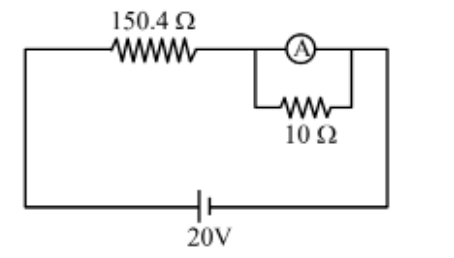
Question 1: In the figure shown below, a resistance of 150.4 is connected in series to an ammeter A of resistance 240. A shunt resistance of 10 is connected in parallel with the ammeter. The reading of the ammeter is ______ mA.
1) 5
2) 9
3) 19
4) 1
Correct answer: (1)
Solution:
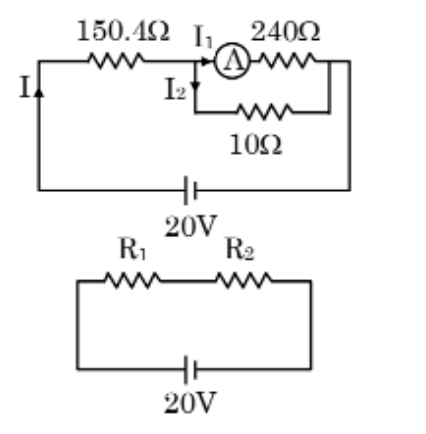
$\begin{aligned} & \mathrm{R}_{\mathrm{eq}}=\mathrm{R}_1+\mathrm{R}_2 \\ & \mathrm{R}_{\mathrm{eq}}=150.4+\frac{240 \times 10}{250} \\ & =150.4+9.6=160 \Omega \\ & \mathrm{I}_1=\frac{\mathrm{IR}_2}{240} \\ & \mathrm{I}_1=\frac{\mathrm{I} \times 9.6}{240} \\ & =\frac{20}{160} \times \frac{9.6}{2400}=\frac{1}{200}=5 \times 10^{-3} \mathrm{~A}=5 \mathrm{~mA}\end{aligned}$
Hence, the answer is 5.
Question 2: Using a battery, a 100 pF capacitor is charged to 60 V, and then the battery is removed. After that, a second uncharged capacitor is connected to the first capacitor in parallel. If the final voltage across the second capacitor is 20 V, its capacitance is : (in pF )
1) 600
2) 200
3) 400
4) 100
Correct answer: (2)
Solution:
i.e. $Q=60 \times 100 p C$
When new capacitance $C^{\prime}$ is connected
Then $Q=\left(C+C^{\prime}\right) V$
$60 \times 100 = (100 + C') \times 20 \quad \Rightarrow \quad C' = 200$
Hence, the answer is option (2)
Question 3: A motor operating on 100 V draws a current of 1 A. If the efficiency of the motor is $91.6 \%$, then the loss of power in units of cal/s is
1) 4
2) 8.4
3) 2
4) 6.2
Correct answer: (3)
Solution:
$\begin{aligned} & P_0=100 \times 1=100 \mathrm{~W} \\ & \text { Loss }=(1-\eta) P_0=\frac{8.4}{100} \times 100=8.4 \mathrm{~J} \\ & \text { Loss }=\frac{8.4}{4.2} \mathrm{cal}=2\end{aligned}$
Hence, the answer is option (3)
Question 4: There are n number of identical electric bulbs, each is designed to draw a power p independently from the mains supply. They are now joined in series across the mains supply. The total power drawn by the combination is
1) $p$
2) $n p$
3) $\frac{p}{n}$
4) $\frac{p}{n^2}$
Correct answer: (3)
Solution:
$\frac{v^2}{R}=P$
$\begin{aligned} & R_{e q}=n R \\ & P^{\prime}=\frac{v^2}{R_{e q}}=\frac{v^2}{n R} = \frac{P}{n}\end{aligned}$
Hence, the answer is option (3).
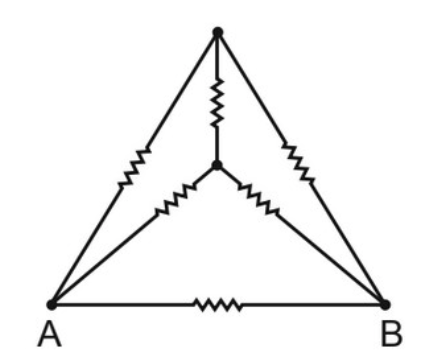
Question 5: A wire of resistance R is bent into a triangular pyramid as shown in the figure, with each segment having the same length. The resistance between points A and B is R/n. The value of n is :
1) 16
2) 14
3) 10
4) 12
Correct answer: (4)
Solution:
As $r=\frac{R}{6}$
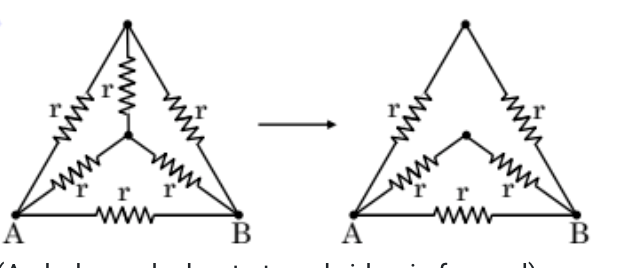
(As a balanced Wheatstone bridge is formed)
Now, Equivalent resistance between A and B can be written as
$\frac{1}{R_{AB}}=\frac{1}{2r}+\frac{1}{2r}+\frac{1}{r}=\frac{2}{r}\quad \Rightarrow \quad R_{AB}=\frac{r}{2}$
Hence, the answer is option (4).
Question 6: A wire of resistance 9 is bent to form an equilateral triangle. Then the equivalent resistance across any two vertices will be ____ ohm.
1) 2
2) 8
3) 19
4) 45
Correct answer: (1)
Solution:
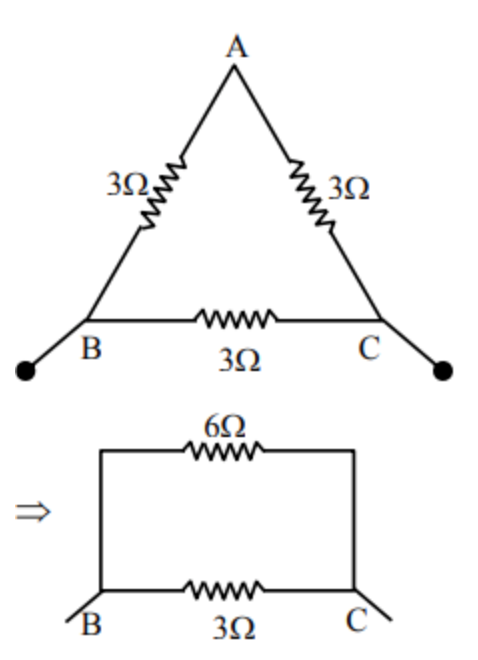
9 is the resistance of the whole wire
$\therefore$ Resistance of each wire =3.
$\therefore$ Equivalent resistance $=\frac{3 \times(3+3)}{3+(3+3)}=2 \Omega$
Hence, the answer is 2.
Question 7:
Two cells of emf 1 V and 2 V and internal resistance 2 and 1, respectively, are connected in series with an external resistance of 6. The total current in the circuit is I1. Now the same two cells in parallel configuration are connected to the same external resistance. In this case, the total current drawn is $I_2$. The value of $\left(\frac{I_1}{I_2}\right)$ is $\frac{x}{3}$. The value of $x$ is ____.
1) 4
2) 9
3) 8
4) 7
Correct answer: (1)
Solution:
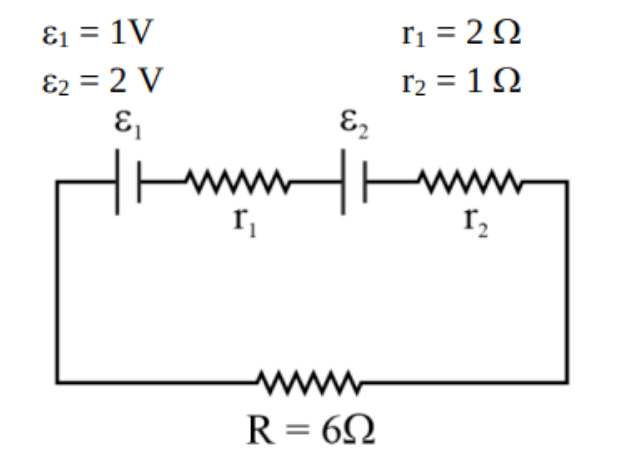
In series $I=\frac{E_{\text {net }}}{R_{\text {eq }}}=\frac{\varepsilon_1+\varepsilon_2}{r_1+r_2+R}$
$\begin{aligned} & \mathrm{I}_1=\frac{1+2}{2+1+6}=\frac{3}{9}=\frac{1}{3} \mathrm{Amp} \\ & \text { In parallel } \mathrm{E}_{\mathrm{eq}}=\frac{\frac{\varepsilon_1}{\mathrm{r}_1}+\frac{\varepsilon_2}{\mathrm{r}_2}}{\frac{1}{\mathrm{r}_1}+\frac{1}{\mathrm{r}_2}}=\frac{\frac{1}{2}+\frac{2}{1}}{\frac{1}{2}+1}=\frac{5}{3} \\ & \text { Current in parallel } \mathrm{I}_2=\frac{\mathrm{E}_{\mathrm{eq}}}{\mathrm{r}_{\mathrm{eq}}+\mathrm{R}}=\frac{\frac{5}{3}}{\frac{\mathrm{r}_1 \mathrm{r}_2}{\mathrm{r}_1+\mathrm{r}_2}+\mathrm{R}}=\frac{\frac{5}{3}}{\frac{2}{3}+6} \\ & \frac{\frac{5}{3}}{\frac{20}{3}}=\frac{1}{4} \\ & \frac{\mathrm{I}_1}{\mathrm{I}_2}=\frac{\frac{1}{3}}{\frac{1}{4}}=\frac{4}{3} \\ & \text { comparing } \mathrm{x}=4\end{aligned}$
Hence, the answer is 4.
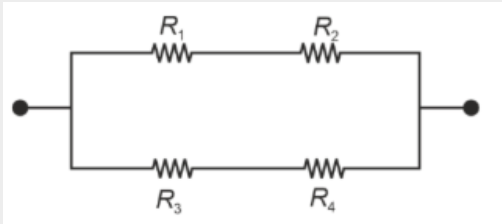
Question 8: From the combination of resistors with resistance values R1=R2=R3=5 and R4=10, which of the following combinations is the best circuit to get an equivalent resistance of 6 ?
1)
2)
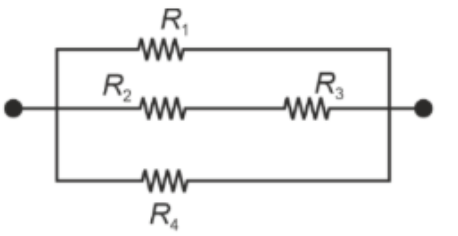
3)
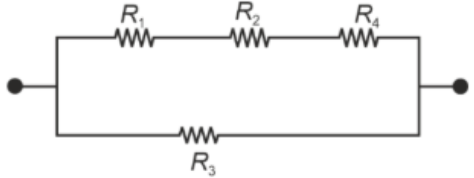
4)
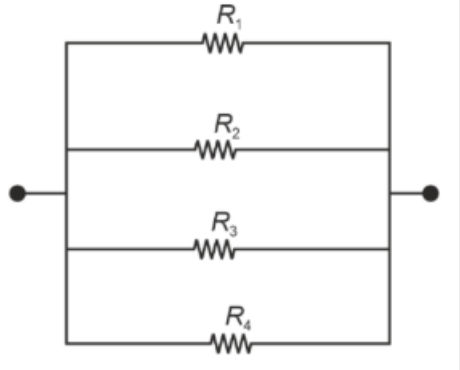
Correct answer: (1)
Solution:
$R_1=R_2=R_3=5 \Omega$ and $R_4=10 \Omega$
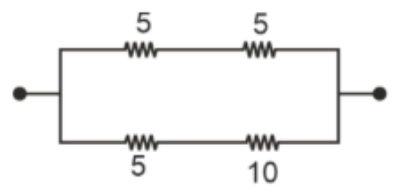
$R_{e q}=\frac{15 \times 10}{250}=6 \Omega$
Hence, the answer is option (1).
Question 9: A wire of resistance R is bent into an equilateral triangle and an identical wire is bent into a square. The ratio of resistance between the two endpoints of an edge of the triangle to that of the square is
1) 9/8
2) 8/9
3) 27/32
4) $32 / 27$
Correct answer: (4)
Solution:
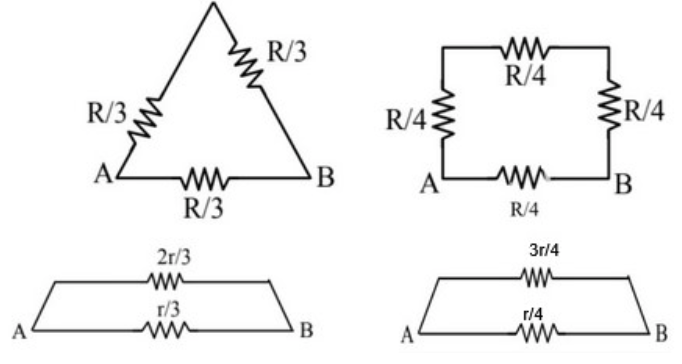
$\mathrm{R}=\frac{\rho \ell}{\mathrm{A}}$
So, $R \propto \ell$
The side length of the triangle is 1/3 of the total length.
$\begin{aligned} & \left(R_{e q}\right)_1=\frac{2 r / 3 \times r / 3}{2 r / 3+r / 3}=2 r / 9 \\ & \left(R_{e q}\right)_2=\frac{3 r / 4 \times r / 4}{3 r / 4+r / 4}=3 r / 16 \\ & \frac{\left(R_{e q}\right)_1}{\left(R_{e q}\right)_2}=\frac{2 r / 9}{3 r / 16}=\frac{32}{27}\end{aligned}$
Hence, the answer is option (4).
Question 10:
A parallel plate capacitor of area A=16~cm2 and separation between the plates 10 cm is charged by a DDC. Consider a hypothetical plane surface of area A0=3.2~cm2 inside the capacitor and parallel to the plates. At an instant, the current through the circuit is 6 A. At the same instant, the displacement current through A0 is __________ mA.
Correct answer: (1)
Solution:
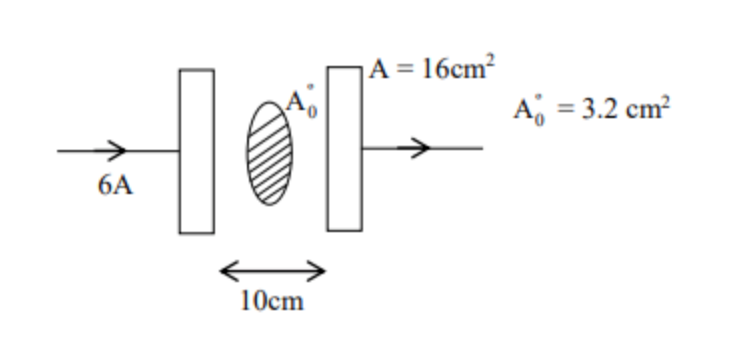
$\begin{aligned} & \text { displacement current }=\frac{\mathrm{d}(\mathrm{Q})}{\mathrm{dt}} \\ & \epsilon_0 \cdot \frac{\mathrm{~d} \phi}{\mathrm{dt}} \\ & (\phi \propto \text { area }) \\ & \mathrm{i} \propto \text { area } \\ & \frac{\mathrm{i}}{6}=\frac{3.2 \mathrm{~cm}^2}{16 \mathrm{~cm}^2}, \quad \mathrm{i}=\frac{32 \times 6}{10 \times 16} \\ & =\frac{12}{10}=1.2 \mathrm{~A}=1200 \mathrm{mA}\end{aligned}$
Hence, the answer is 1200.
Question 11:
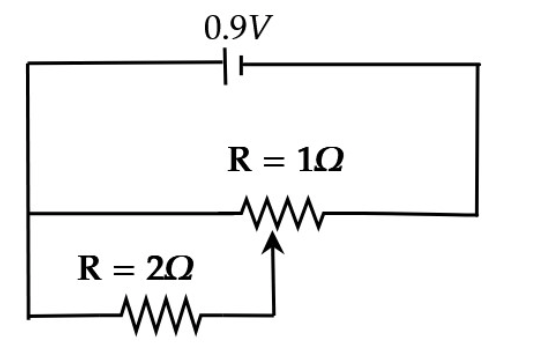
The sliding contact of a potentiometer is in the middle of the potentiometer wire having resistance Rp= 1 as shown in the figure. An external resistance of Re=2 is connected via the sliding contact. The current through the circuit is
1) 0.3 A
2) 1.35 A
3) 1.0 A
4) 0.9 A
Correct answer: (3)
Solution:
The circuit can be considered as
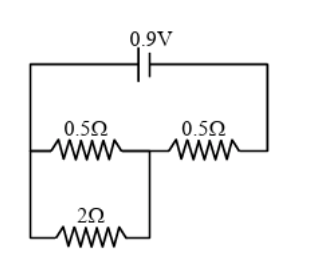
Therefore, the equivalent resistance is:
$\begin{aligned}
& \operatorname{Req}=0.5+(0.5 \times 2) /(2+0.5) \\
& =0.5+1 / 2.5 \\
& =0.5+0.4 \\
& =0.9 \Omega
\end{aligned}$
Therefore, current $(\mathrm{i})=0.9 / 0.9=1 \mathrm{~A}$.
Hence, the answer is option (3).
Question 12:
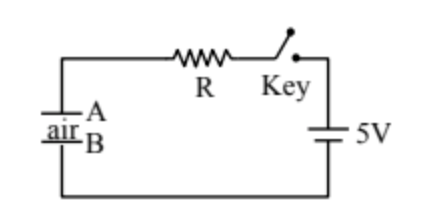
Identify the valid statements relevant to the given circuit at the instant when the key is closed. A. There will be no current through resistor R.
B. There will be maximum current in the connecting wires.
C. The potential difference between the capacitor plates A and B is minimum.
D. Charge on the capacitor plates is minimum. Choose the correct answer from the options given below
1) C, D only
2) B, C, D only
3) A, C only
4) A, B, D only
Correct answer: (2)
Solution:
The capacitor acts as a plain wire when S is closed, so we achieve maximum current.
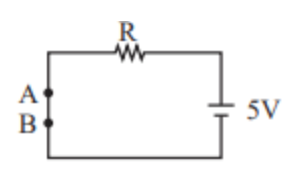
The charge on the capacitor will be zero.
The potential difference across the capacitor will be zero.
Hence, the answer is option (2).
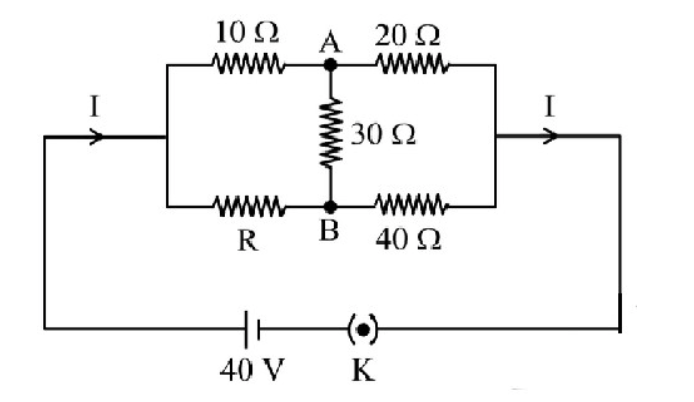
Question 13: The value of the current I in the electrical circuit, as given below, when the potential at A is equal to the potential at B, will be _________ A.
1) 2
2) 9
3) 7
4) 6
Correct answer: (1)
Solution:
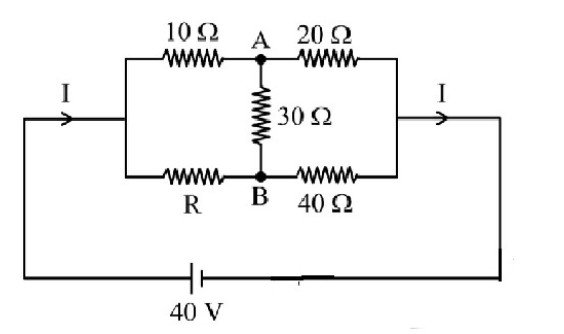
Since $V_A=V_B$, the bridge is balanced.
Therefore,
$\begin{aligned}
& 10 / R=20 / 40 \\
& R=20 \Omega
\end{aligned}$
The net resistance is:
Rnet $=(60 \times 30) /(60+30)$
$\begin{aligned}
& =1800 / 90 \\
& =20 \Omega
\end{aligned}$
Therefore, the current is:
$\text { I= 40/20 = } 2 \text { A }$
Hence, the answer is 2.
Question 14: Find the equivalent resistance between two ends of the following circuit. 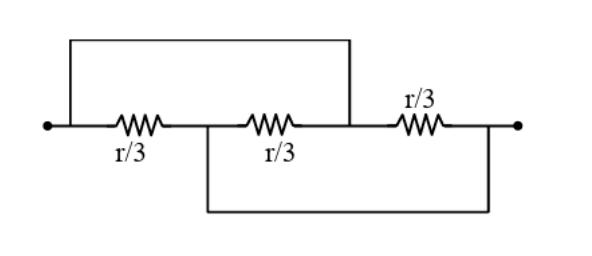
1) r
2) $\frac{r}{6}$
3) $\frac{r}{9}$
4) $\frac{r}{3}$
Correct answer: (3)
Solution:
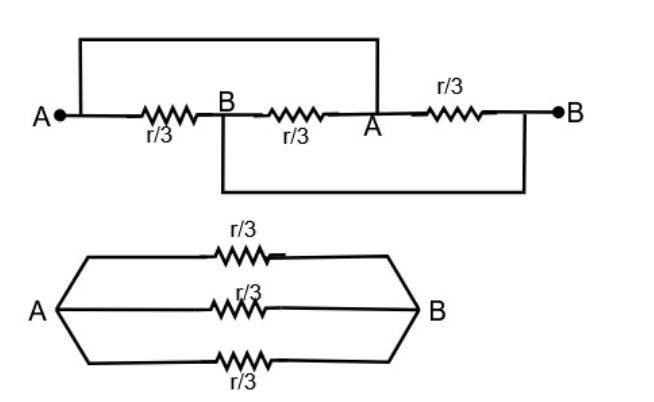
All are in parallel
$R_{e q}=\frac{r / 3}{3}=r / 9$
Hence, the answer is option (3).
Question 15: The battery of a mobile phone is rated as 4.2 V, 5800 mAh. How much energy is stored in it when fully charged?
1) 43.8 kJ
2) 48.7 kJ
3) 87.7 kJ
4) 24.4 kJ
Correct answer: (3)
Solution:
Convert mAh to Ah:
The battery capacity is given as 5800 mAh. Since
$1 \text { Ah = } 1000 \text { mAh }$
We have,
$5800 \mathrm{mAh}=5.8 \mathrm{Ah}$
Calculate energy in watt-hours (Wh):
Energy = Voltage × Capacity
$\begin{aligned}
& =4.2 \times 5.8 \\
& =24.36 \mathrm{~Wh}
\end{aligned}$
Convert watt-hours to joules (J):
Since $1 \mathrm{~Wh}=3600 \mathrm{~J}$,
Energy $=24.36 \times 3600$
$\begin{aligned}
& =87,696 \mathrm{~J} \\
& \approx 87.7 \mathrm{~kJ}
\end{aligned}$
Thus, the energy stored in the battery when fully charged is about 87.7 kJ.
Hence, the answer is option (3)
Question 16: Current passing through a wire as a function of time is given as $I(t)=0.02 t+0.01 \sim A$. The charge that will flow through the wire from $t=1 \sim s$ to $t=2 \sim s$ is :
1) 0.06 C
2) 0.02 C
3) 0.07 C
4) 0.04 C
Correct answer: (4)
Solution:
$\begin{aligned} \mathrm{q}&=\int \mathrm{idt} \\ &= \int_1^2(0.02 \mathrm{t}+0.01) \mathrm{dt} \\ \mathrm{q}&=\left[0.02 \frac{\mathrm{t}^2}{2}+0.01 \mathrm{t}\right]_1^2 \\ & =0.01(3)+0.01(1)=0.04 \mathrm{C}\end{aligned}$
Hence, the answer is option (4).
Question 17: A wire of length 25 m and cross-sectional area $5 \sim \mathrm{~mm}^2$ having resistivity of $2 \times 10^{-6} \Omega \sim m$ is bent into a complete circle. The resistance between diametrically opposite points will be
1) 12.5
2) 50
3) 100
4) 25
Correct answer: (4)
Solution:
$\begin{aligned} & L=25 \sim m, \sim A=5 \sim m m^2=5 \times 10^{-6} \sim m^2 \\ & \rho=2 \times 10^{-6} \Omega \sim m\end{aligned}$
$\mathrm{R}_{\text {wire }}=\frac{\rho \mathrm{L}}{\mathrm{A}}=\frac{2 \times 10^{-6} \times 25}{5 \times 10^{-6}}=10$
$R_{e q}=\frac{R}{4}=\frac{10}{4}=2.5 \Omega$
Hence, the answer is option (4)
Question 18: The net current flowing in the given circuit is _________A.
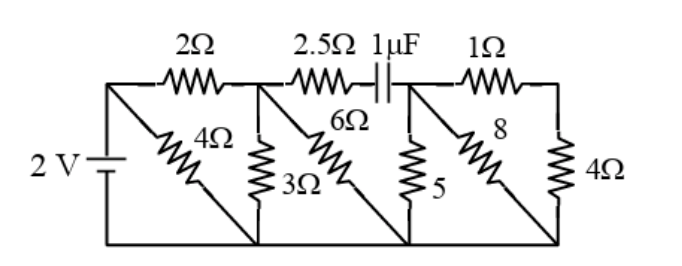
Correct answer: (1)
Solution:
After a long time, the capacitor behaves like infinite resistance.
So, the effective circuit will look as shown in the figure.
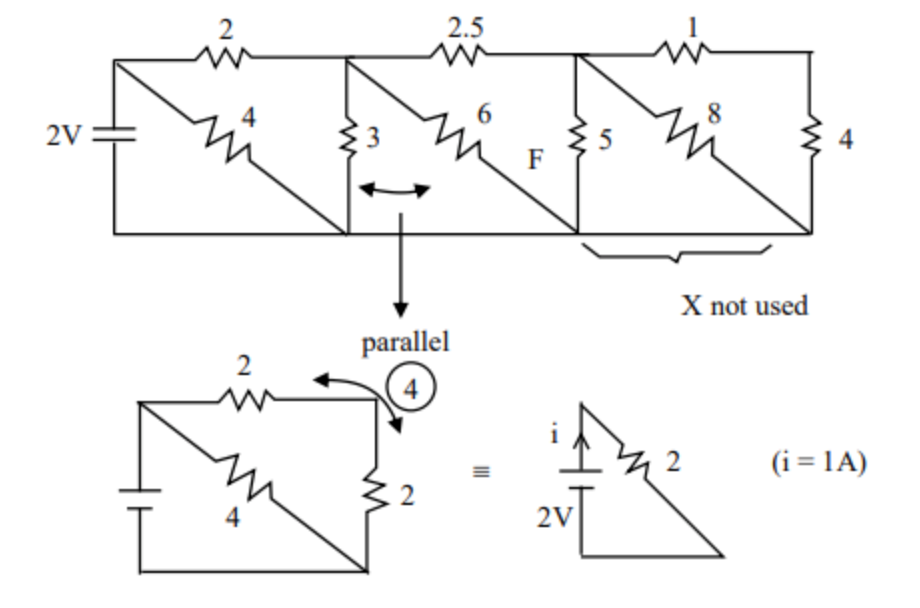
The net equivalent resistance is,
$\frac{1}{R_{eq}} = \frac{1}{4} + \frac{1}{2 + 2} $
$R_{e q}=2 \Omega$
Given, $V=2 \sim V$
$\therefore I = \frac{V}{R} = \frac{2}{2} = 1 \mathrm{~A}$
Hence, the answer is 1.
Question 19: An alternating current is given by $I=I_A \sin \omega t+I_B \cos \omega t$.
The r.m.s. current will be:
1) $\sqrt{I_A^2+I_B^2}$
2) $\frac{\sqrt{I_A^2+I_B^2}}{2}$
3) $\sqrt{\frac{I_A^2+I_B^2}{2}}$
4) ${\sqrt{2}}$
Correct answer: (3)
Solution:
Given,
$\mathrm{I}=\mathrm{I}_{\mathrm{a}} \sin (\omega \mathrm{t})+\mathrm{I}_\beta \cos (\omega \mathrm{t})$
Squaring both sides,
$\mathrm{I}^2=\mathrm{I}_{\mathrm{a}}^2 \sin ^2(\omega \mathrm{t})+\mathrm{I}_\beta^2 \cos ^2(\omega \mathrm{t})+2 \mathrm{I}_{\mathrm{a}} \mathrm{I}_\beta \sin (\omega \mathrm{t}) \cos (\omega \mathrm{t})$
Using the identity $2 \sin (\omega \mathrm{t}) \cos (\omega \mathrm{t})=\sin (2 \omega \mathrm{t})$,
$I^2=I_a^2 \sin ^2(\omega t)+I_\beta^2 \cos ^2(\omega t)+I_a I_\beta \sin (2 \omega t)$
Taking the mean square value,
$\mathrm{I}_{\mathrm{rms}}^2=\mathrm{I}_{\mathrm{a}}^2 \times\left\langle\sin ^2(\omega \mathrm{t})\right\rangle+\mathrm{I}_\beta^2 \times\left\langle\cos ^2(\omega \mathrm{t})\right\rangle+\mathrm{I}_{\mathrm{a}} \mathrm{I}_\beta \times\langle\sin (2 \omega \mathrm{t})\rangle$
We know that,
$\begin{aligned}
& \left\langle\sin ^2(\omega \mathrm{t})\right\rangle=1 / 2 \\
& \left\langle\cos ^2(\omega \mathrm{t})\right\rangle=1 / 2 \\
& \langle\sin (2 \omega \mathrm{t})\rangle=0
\end{aligned}$
Therefore,
$\begin{aligned}
& \mathrm{I}_{\mathrm{rms}}{ }^2=\left(\mathrm{I}_{\mathrm{a}}{ }^2 / 2\right)+\left(\mathrm{I}_\beta{ }^2 / 2\right) \\
& \mathrm{I}_{\mathrm{rms}}=\sqrt{ }\left[\left(\mathrm{I}_{\mathrm{a}}{ }^2+\mathrm{I}_\beta{ }^2\right) / 2\right]
\end{aligned}$
Hence, the answer is option (3).
Question 20: For the given circuit, the reading of the voltmeter is $\frac{2 P}{3}$, here $P$ is:
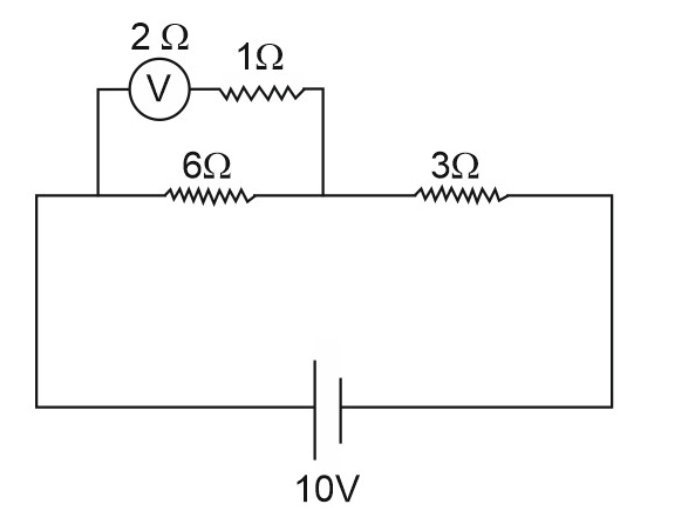
1) 4
2) 19
3) 3
4) 9
Correct answer: (1)
Solution:
$\begin{aligned} & 4 V=I(2)+I(1) \\ & I=\frac{4}{3} \\ & \text { Reading of voltmeter }=I \times 2=\frac{8}{3}\end{aligned}$
Hence, the answer is 4.
Question 21: Which of the following resistivity ( ) v/s temperature (T) curves is most suitable to be used in wire-wound standard resistors?
1)
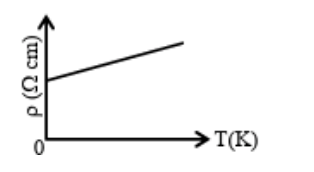
2)
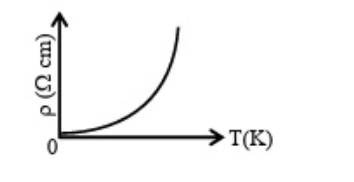
3)
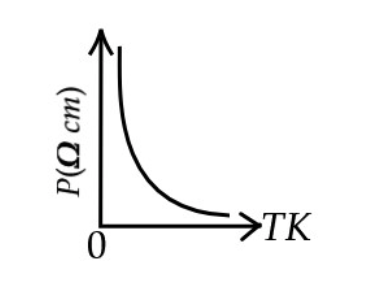
4)
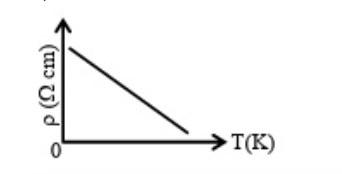
Correct answer: (1)
Solution:
The change in for standard wires should be very small wrt temp. Curve 1 shows the least variation of resistivity with temperature change. This makes it the ideal one to use.
Hence, the answer is option (1).
Question 22: Given below are two statements: Statement I: The equivalent emf of two non-ideal batteries connected in parallel is smaller than either of the two emfs. Statement II: The equivalent internal resistance of two non-ideal batteries connected in parallel is smaller than the internal resistance of either of the two batteries. In light of the above statements, choose the correct answer from the options given below.
1) Statement-I is true, but Statement-II is false
2) Both Statement-I and Statement-II are false
3) Both Statement-I and Statement-II are true
4) Statement-I is false,e but Statement-II is true
Correct answer: (4)
Solution:
$\varepsilon_{\mathrm{e}} \mathrm{q}=\left(\varepsilon_1 \mathrm{r}_2+\varepsilon_2 \mathrm{r}_1\right) /\left(\mathrm{r}_1+\mathrm{r}_2\right)$
check for $r_1=r_2 \Rightarrow \varepsilon_{e q}=\frac{\varepsilon_1+\varepsilon_2}{2}$
So S1 is false
$S 2: r_{e q}=\frac{r_1 r_2}{r_1+r_2}<r_1$ or $r_2$
S 2 is true
Hence, the answer is option (4).
Question 23: A galvanometer having a coil of resistance 30 needs 20 mA of current for full-scale deflection. If a maximum current of 3 A is to be measured using this galvanometer, the resistance of the shunt to be added to the galvanometer should be 30X, where X is
1) 447
2) 298
3) 149
4) 596
Correct answer: (3)
Solution:
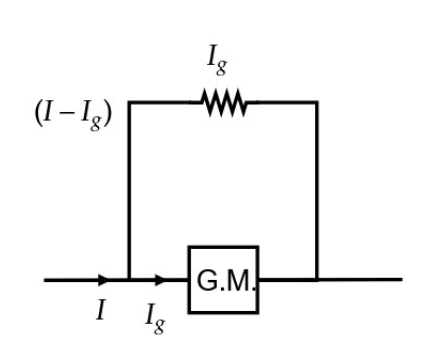
$\begin{aligned} & \mathrm{I}_{\mathrm{g}} \mathrm{R}_{\mathrm{g}}=\left(I-\mathrm{I}_{\mathrm{g}}\right) \mathrm{r} \\ & 20 \times 10^{-3} \times 30=(3-0.02) \times \mathrm{r}_{\mathrm{s}} \\ & \mathrm{r}_{\mathrm{s}}=\left(\frac{6}{2.98}\right)=\frac{30}{\mathrm{x}} \\ & \mathrm{x}=\left(\frac{2.98 \times 30}{0.6}\right)=149\end{aligned}$
Hence, the answer is option (3).
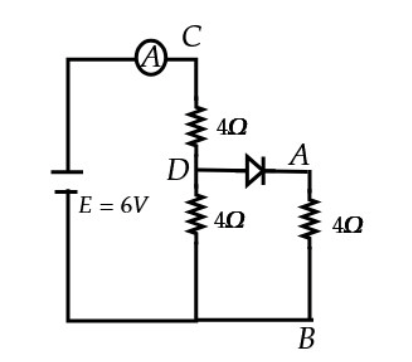
Question 24: Refer to the circuit diagram given in the figure. Which of the following observations are correct?
A. The total resistance of the circuit is 6.
B. The current in the ammeter is 1 A
C. The potential across AB is 4 volts.
D. Potential across CD is 4 volts:
E. The total resistance of the circuit is 8.
Choose the correct answer from the options given below:
1) A, B and D only
2) A, C and D only
3) B, C and E only
4) A, B and C only
Correct answer: (1)
Solution:
$\begin{aligned} & \text { Req }=4+\frac{4 \times 4}{4+4} \\ & =6 \Omega \\ & i=\frac{6}{6} \\ & =1 \mathrm{~A} \\ & V_{A B}=\frac{i}{2} \times R \\ & =\frac{1}{2} \times 4 \quad=2 \mathrm{~V}\end{aligned}$
$\begin{aligned} & V_{C D}=i R \\ & =1 \times 4 \\ & =4 \mathrm{~V}\end{aligned}$
Hence, the answer is option (1).
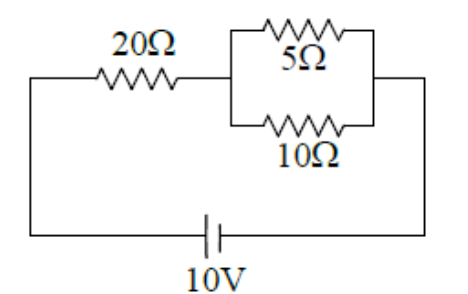
Question 25: The ratio of heat dissipated per second through the resistances $5 \Omega$ and $10 \Omega$ in the circuit given below is :
1) 1:2
2) 2:1
3) 4:1
4) 1:1
Correct answer: (2)
Solution:
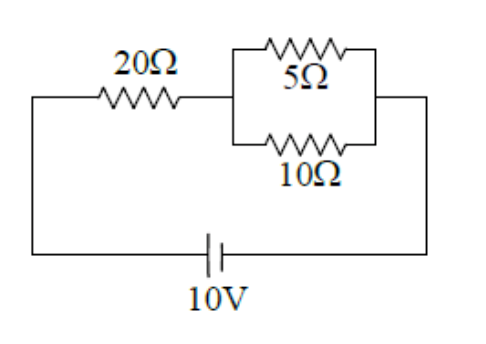
$ \frac{\mathrm{i}_1}{\mathrm{i}_2}=\frac{10}{5}=\frac{2}{1} $
$ \frac{\mathrm{P}_1}{\mathrm{P}_2}=\frac{\mathrm{i}_1^2 \mathrm{R}_1}{\mathrm{i}_2^2 \mathrm{R}_2}=\left(\frac{2}{1}\right)^2 \times \frac{5}{10}=\frac{2}{1}$
Hence, the answer is option (2).
Topic-Wise Weightage and Number of Current Electricity JEE Main Questions
The table below shows the distribution of questions asked from the chapter Current Electricity in the January and April JEE Main 2026 exams. The table will help students get an idea about the topics important from the point of view of the exam and on which they should focus․
Topic | January Session | April Session | Total Questions |
1 | 0 | 1 | |
1 | 0 | 1 | |
3 | 2 | 5 | |
3 | 0 | 3 | |
1 | 0 | 1 | |
Parallel Grouping of Resistance | 4 | 0 | 4 |
1 | 0 | 1 | |
1 | 1 | 2 | |
1 | 0 | 1 | |
0 | 1 | 1 | |
Internal Resistance | 0 | 1 | 1 |
0 | 1 | 1 | |
Series and Parallel Grouping of Cells | 0 | 2 | 2 |
Total | 16 | 8 | 24 |
JEE Main Syllabus: Subjects & Chapters
Select your preferred subject to view the chapters
Last 10 Years' Weightage of Current Electricity in JEE Main
The last 10 years’ weightage of Current Electricity in JEE Main helps students understand the chapter’s importance and identify frequently asked topics. The table below highlights the topic-wise question distribution to help you prioritise your preparation and focus on high-weightage areas of the past ten years.
Also Read: Last 10 Years JEE Main Question Paper
Topic | Number of Questions |
Parallel Grouping of Resistance | 71 |
Resistance and Resistivity | 41 |
Heat and Power Developed in a Resistor | 39 |
Meter Bridge | 39 |
Voltmeter | 37 |
Kirchhoff's Second Law | 36 |
Series and Parallel Grouping of Cells | 33 |
Wheatstone's Bridge | 31 |
Charging of Capacitor and Inductor | 25 |
Series Grouping of Resistance | 24 |
21 |
Important Formulas of Current Electricity for JEE Main 2027
1. Electric Current: $I=\frac{Q}{t}$
2. Current (instantaneous): $I=\frac{d Q}{d t}$
3. Ohm’s Law: $V=I R$
4. Resistance: $R=\rho \frac{L}{A}$
5. Resistivity: $\rho=\frac{R A}{L}$
6. Conductivity: $\sigma=\frac{1}{\rho}$
7. Current Density: $J=\frac{I}{A}$
8. Drift Velocity: $v_d=\frac{I}{neA}$
9. Current in Terms of Drift Velocity: $I=neAv_d$
10. Mobility: $\mu=\frac{v_d}{E}$
11. Resistance in Series: $R_s=R_1+R_2+R_3+\cdots$
12. Resistance in Parallel: $\frac{1}{R_p}=\frac{1}{R_1}+\frac{1}{R_2}+\frac{1}{R_3}+\cdots$
13. Electric Power: $P=VI=I^2R=\frac{V^2}{R}$
14. Electrical Energy: $W=VIt=I^2Rt=\frac{V^2t}{R}$
15. Joule’s Law of Heating: $H=I^2Rt$
16. Temperature Dependence of Resistance: $R_T=R_0[1+\alpha(T-T_0)]$
17. EMF of a Cell: $E=V+Ir$
18. Terminal Voltage: $V=E-Ir$
19. Current Through a Cell: $I=\frac{E}{R+r}$
20. Identical Cells in Series: $E_{\text{eq}}=nE,\quad r_{\text{eq}}=nr$
21. Identical Cells in Parallel: $E_{\text{eq}}=E,\quad r_{\text{eq}}=\frac{r}{n}$
22. Kirchhoff’s Junction Rule: $\sum I_{\text{in}}=\sum I_{\text{out}}$
23. Kirchhoff’s Loop Rule: $\sum \Delta V=0$
24. Wheatstone Bridge (Balanced Condition): $\frac{P}{Q}=\frac{R}{S}$
25. Meter Bridge: $\frac{X}{R}=\frac{l}{100-l}$
26. Potentiometer (Comparison of EMFs): $\frac{E_1}{E_2}=\frac{l_1}{l_2}$
27. Maximum Power Transfer Condition: $R=r$
28. Maximum Power Delivered to Load: $P_{\max}=\frac{E^2}{4r}$
Frequently Asked Questions (FAQs)
Q: What was the weightage of Current Electricity in the JEE Main 2026 Physics paper?
A:
Overall, 24 questions were asked on current electricity in JEE Main 2026. So, the weightage was 5.05% in both sessions.
Q: Which sub-topics are most frequently asked in the JEE Main exam?
A:
The frequently asked topics in current electricity are Ohm’s Law, Combination of Resistors & Cells, Kirchhoff’s Laws, Galvanometer, Meter Bridge, and Potentiometer, and Heating Effects of Current.
Q: How many questions from Current Electricity appeared in JEE Main 2026?
A:
In JEE Main 2026, 24 questions were asked from current electricity in both the sessions.
Articles
Related Stories
|
Upcoming Engineering Exams

Certifications By Top Providers
Explore Top Universities Across Globe
Popular Courses and Specializations
List of colleges accepting JEE Main
Browse Engineering Colleges by State
Questions related to JEE Main
On Question asked by student community
Have a question related to JEE Main ?
Hello Student,
You can check the relevant resources provided below.
https://engineering.careers360.com/hi/articles/jee-main-sample-papers
Hope it helps!
Hello Student,
You can check the relevant resources provided below.
Hope it helps!
Hi aspirant,
Yes, there are three new exam centres for JEE Main 2027. They are Kalahandi and Sundergarh in Odisha and Sahibzada Ajit Singh Nagar in Punjab.
You can also check this page for more details: https://engineering.careers360.com/articles/jee-main-2027-new-centres
Hello
You can check out the Hindi Medium sample paper of JEE Main 2027 from the section below:
https://engineering.careers360.com/hi/articles/jee-main-question-paper
https://engineering.careers360.com/hi/articles/jee-main-question-paper-hindi-medium
https://engineering.careers360.com/hi/articles/jee-main-sample-papers
You can also use filter option and find other practice resources for JEE Main 2027 below:
https://www.careers360.com/download/ebooks-and-sample-papers
Hello Student,
You can check the relevant JEE Main 2027 preparation resources using the link given below.
https://engineering.careers360.com/articles/jee-main-sample-papers
Hope it helps!

Applications for Admissions are open.
Ranked #43 among Engineering colleges in India by NIRF | Get Upto 100% Scholarships
Dayananda Sagar University, Bangalore
Apply60+ Years of Education Legacy | UGC & AICTE Approved | Prestigious Scholarship Worth 6 Crores
Woxsen University, Hyderabad
ApplyScholars’ Round Deadline: 14th Nov’26 | Earn upto 50% merit Scholarship + 10% for top performers | EFMD Accredited | AACSB (USA) & AMDISA Member | Highest CTC 28 LPA
Amity Institute of Aerospace Engineering, Noida
Apply#1 ranked University for Computer Science (Times Higher Education Rankings 2025) | 20+ Future-Ready Specializations
Parul Institute of Technology, Vadodara
ApplyDiploma (17 Specializations), B.Tech / B.Tech (Hons.) / IE-B.Tech - 4 years - 25+ specializations | M. Tech - 14+ specializations | Highest CTC – 60 LPA
Parul University, Goa
ApplySpecial Scholarship for Students from Goa (Get an exclusive scholarship of ₹20,000 if you're a Goa-based student) | Bringing Parul Education Trust's 30-year Education Legacy to Goa
JEE Main Notifications
Explore Career Options
By IndustryNever miss JEE Main update
Get timely JEE Main updates directly to your inbox. Stay informed!