
Search Colleges, Exams, Schools & more


Login
Explain parametric equation of a circle. - Practice Questions & MCQ
Edited By admin | Updated on Sep 18, 2023 18:34 AM | #JEE Main
Quick Facts
-

23 Questions around this concept.
Solve by difficulty
 EASY
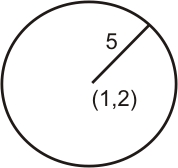
EASYWrite the equation of the circle in the following diagram :
The parametric equation of the circle $x^{2}+y^{2}+2x-4y+1= 0$ is
Concepts Covered - 1
Parametric Form of circle and Concentric Circle.
Parametric Form
To represent any point on a curve in terms of a single variable (parameter), we use parametric form of that curve.
1. Parametric Form for $x^2+y^2=r^2$
$P(x, y)$ is a point on the circle $x^2+y^2=r^2$ with centre $O(0,0)$. And $O P$ makes an angle $\theta$ with the positive direction of $X$-axis, then $x=r \cdot \cos \theta, y=r \cdot \sin \theta$ called the parametric equation of the circle.
Here as $\theta$ varies, the point on the circle also changes, and thus $\theta$ is called the parameter. Here $0 \leq \theta<2 \pi$.
So any arbitrary point on this circle can be assumed as (r. $\cos \theta, r \cdot \sin \theta)$

2. Parametric Form for $(x-h)^2+(y-k)^2=r^2$
Centre of the circle here is $(h, k)$
Parametric point on it is $(\mathrm{h}+\mathrm{r} \cdot \cos \theta, \mathrm{k}+\mathrm{r} \cdot \sin \theta)$
Concentric Circles
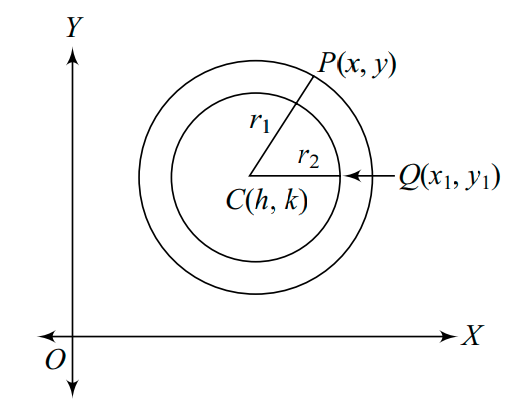
Two circles having common centre $\mathrm{C}(\mathrm{h}, \mathrm{k})$ but different radii $r_1$ and $\mathrm{r}_2$ are called concentric circles
$
\begin{aligned}
& S_1=(x-h)^2+(y-k)^2=r_1^2 \\
& S_2=(x-h)^2+(y-k)^2=r_2^2 \\
& r_1 \neq r_2 \\
& \mathrm{~S}_1 \text { and } \mathrm{S}_2 \text { are concentric circle }
\end{aligned}
$
Study it with Videos
"Stay in the loop. Receive exam news, study resources, and expert advice!"
Books
Reference Books
Clear your Basics with NCERT
E-books & Sample Papers
Get Answer to all your questions

B.Tech/B.Arch Admissions OPEN
Among top 100 Universities Globally in the Times Higher Education (THE) Interdisciplinary Science Rankings 2026
UPES B.Tech Admissions 2026
ApplyLast Date to Apply Extended till Today, 30th April | Ranked #43 among Engineering colleges in India by NIRF | Highest Package 1.3 CR , 100% Placements
Amrita University B.Tech 2026
ApplyRecognized as Institute of Eminence by Govt. of India | NAAC ‘A++’ Grade | Upto 75% Scholarships
MAHE, Manipal - B.Tech Admissions 2026
ApplyExtended Application Deadline: 30th April | NAAC A++ Accredited | NIRF Rank #3
Reva University B.Tech Admissions 2026
ApplyQS I-Gauge Diamond Rated | NAAC A+ Accredited | 621 Recruitment Partners | INR 40 LPA Highest CTC | 4482 Job offers
Manav Rachna-B.Tech Admissions 2026
ApplyNAAC A++ Grade | Recognized as Category-1 Deemed to be University by UGC | 41,000 + Alumni Imprints Globally