University Institute of Engineering, Chandigarh University, Chandigarh
Among top 1% Universities in India (QS World University Rankings 2027)


Getting a good rank in the West Bengal Joint Entrance Examination (WBJEE) is a big achievement for engineering and technology aspirants who want to take in admission to government and private colleges in West Bengal. But the most common myth is that people think that WBJEE exam preparation without coaching is not possible. In this article, we will break down the step by step to prepare for WBJEE without coaching.
This Story also Contains
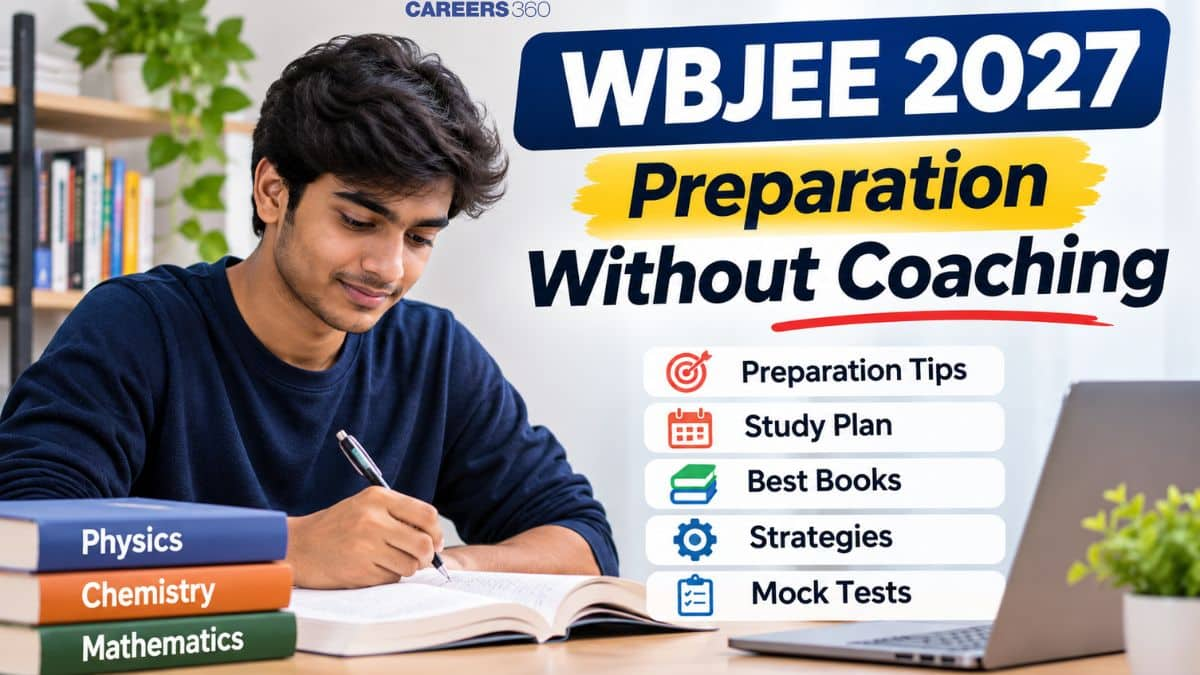
Yes, you can definitely prepare for the WBJEE exam without coaching. Students prefer studying on their own because they can study at their own pace. You can take the help of reference books, question papers, sample papers, study material, and practice tests for your preparation for WBJEE exam. However, self-study requires discipline. You have to make plans and achieve your goals on time. In case of any doubt regarding WBJEE preparation without coaching, you have to first go through the WBJEE exam pattern and syllabus. Next, break the syllabus and prepare a study schedule.
Get expert advice on college selection, admission chances, and career path in a personalized counselling session.
Before starting your preparation, instead of ready books and study material, aspirants need to do a few steps which help to understand about the WBJEE exam. The steps to follow before starting preparation are given below:
Before jumping into preparation, students must check the subjects, no of questions asked, and marking scheme.
Particulars | Details |
Mode of Examination | Offline (OMR-Based Examination) |
Exam Duration | 4 hours — 2 hours for Mathematics and 2 hours for Physics & Chemistry |
Papers | Paper I – Mathematics; Paper II – Physics and Chemistry |
Type of Questions | Multiple Choice Questions (Objective) |
Total Questions | 155 Questions |
Mathematics | 75 Questions |
Physics | 40 Questions |
Chemistry | 40 Questions |
Total Marks | 200 Marks |
Mathematics Category-wise Distribution | Category 1: 50 questions; Category 2: 15 questions; Category 3: 10 questions |
Physics & Chemistry Category-wise Distribution | Category 1: 30 questions; Category 2: 5 questions; Category 3: 5 questions |
Mode of Answering | Candidates have to darken the appropriate circle completely using a blue/black ballpoint pen |
Category 1 Marking | 1 mark for each correct answer |
Category 2 Marking | 2 marks for each correct answer |
Category 3 Marking | 2 marks for each correct answer |
Category 1 Negative Marking | ¼ mark deducted for each incorrect answer |
Category 2 Negative Marking | ½ mark deducted for each incorrect answer |
Category 3 Negative Marking | No negative marking |
WBJEE syllabus includes three subjects: Maths, Physics, Chemistry. The syllabus of all three is given below in the table:
Subject | WBJEE Syllabus Topics |
Physics | Physical World, Measurements, Units & Dimensions; Kinematics; Laws of Motion; Centre of Mass, Friction; Gravitation; Bulk Properties of Matter; Viscosity; Thermodynamics; Kinetic Theory of Gases; Oscillations & Waves; Electrostatics; Current Electricity; Magnetic Effect of Current; Magnetics; Electromagnetic Induction & Alternating Current; Electromagnetic Waves; Ray Optics; Wave Optics; Particle Nature of Light & Wave-Particle Dualism; Atomic Physics; Nuclear Physics; Electronics |
Chemistry | Atomic Structure; Radioactivity & Nuclear Chemistry; Periodic Table & Chemical Families; Chemical Bonding & Molecular Structure; Coordination Compounds; Solid State; Liquid State; Gaseous State; Chemical Energetics & Chemical Dynamics; Physical Chemistry of Solutions; Ionic & Redox Equilibria; Hydrogen; Chemistry of Non-Metallic Elements & Their Compounds; Chemistry of Metals; Chemistry in Industry; Polymers; Surface Chemistry; Environmental Chemistry; Chemistry of Carbon Compounds; Haloalkanes & Haloarenes; Alcohol; Aromatic Compounds; Application-Oriented Chemistry; Introduction to Biomolecules; Principles of Qualitative Analysis |
Mathematics | Algebra, Arithmetic Progression, G.P., H.P.; Sets, Relations & Mappings; Logarithms; Complex Numbers; Permutation & Combination; Polynomial Equations; Mathematical Induction; Matrices; Binomial Theorem; Statistics & Probability; Equivalence Relations. Trigonometry, Coordinate Geometry, Calculus, Vector Algebra and applications |
Analysing previous year question papers is very important because it will give an idea of the level of the exam and the difficulty of the questions, so that you can prepare yourself mentally whether you can prepare by self-study or you will need coaching for this. Previous year question papers and sample papers are given below in the table:
Students preparing for WBJEE without coaching should follow a structured approach that balances concept building, regular practice, revision, and mock tests.
Strategy | How to Follow It |
Follow a 4-Phase Plan | Divide preparation into Foundation, Practice, Mock Test and Final Revision phases. |
Strengthen Concepts First | Use NCERT/board books and free video lectures to build strong fundamentals. |
Prioritise Mathematics | Practise Mathematics daily, especially Calculus, Coordinate Geometry, Algebra and Probability. |
Practise After Each Chapter | Solve around 50–100 MCQs or numerical problems after completing a chapter. |
Use Free Resources | Make use of YouTube lectures, DPPs, question banks, mock tests and AI doubt-solving tools. |
Revise Regularly | Maintain short notes for formulas, reactions, exceptions and important concepts. |
Solve PYQs | Practise previous years' questions to understand the exam pattern and question trends. |
Take Mock Tests | Start with one mock test per week and increase to 2–3 tests per week closer to the exam. |
Analyse Mistakes | Review every mock to identify conceptual, calculation, silly and time-management errors. |
Focus on Revision | In the final month, revise short notes, PYQs and mock-test mistakes instead of starting new resources. |
Also Read: WBJEE 2027 Sample Paper PDF: Practice Questions with Solutions
Below are some subject-wise tips that will help students in WBJEE 2027 Preparation Without Coaching:
Physics:
Always start with the basics and formulas of Physics. After learning a particular concept, attempt numericals. It is better if you understand the use of the formula and not memorise it blindly. Practice is key since this would help improve your speed and accuracy.
Chemistry:
Revision is extremely important in chemistry. Make sure that you always take notes of all the important formulas, chemical reactions, and other relevant things. Keep revising the chapters daily and practice questions every day from each topic.
Maths:
Maths is really about question practice. First you learn the formula and the whole approach, then you do practice questions, plus PYQs too. After that, it kind of clicks.
Also Read: WBJEE 2027 Chapter Wise Weightage
Try to follow a timetable so there’s enough bandwidth for Mathematics, Physics, and Chemistry, plus some steady recap, PYQ practice too, and also mock tests at the right times.
Time | Task |
6:30 AM – 7:00 AM | Revise formulas, reactions and notes from the previous day. |
7:00 AM – 9:00 AM | Mathematics: Concepts + problem-solving |
9:00 AM – 10:00 AM | Breakfast/Break |
10:00 AM – 12:00 PM | Physics: Concepts + numerical practice |
12:00 PM – 1:00 PM | Break |
1:00 PM – 2:30 PM | Chemistry: Theory + MCQs |
2:30 PM – 4:00 PM | Lunch/Rest |
4:00 PM – 6:00 PM | Mathematics: MCQs/PYQs and weak topics |
6:00 PM – 7:00 PM | Break |
7:00 PM – 8:30 PM | Physics/Chemistry: Practice questions |
8:30 PM – 9:30 PM | Dinner/Break |
9:30 PM – 10:00 PM | Review mistakes and plan the next day |
Note: This timetable is only a suggested schedule. Students can adjust the study hours and subject-wise time allocation according to their school/board schedule, preparation level, and personal routine.
Self-study can be challenging, and students may lose motivation or struggle to stay consistent along the way. Students should avoid such mistakes; it will affect their preparation. Some of the common mistakes are given below student should avoid them.
Students should not use too many resources to study
Ignoring previous year questions
Not doing proper revision is the biggest mistake aspirants make
Only watching lectures and not clearing doubts.
Frequently Asked Questions (FAQs)
Yes, WBJEE can be qualified with self-study. But it needs constant study, practice, mock tests, and motivation.
WBJEE is usually considered a moderate exam conducted for students who want to take admission in government and private colleges in West Bengal.
120 marks or above can be considered the safe score for WBJEE; the exact scenario depends on the difficulty level of the exam.

On Question asked by student community
Hello Student, I can help you find the entrance examinations whose application forms are currently open or expected to open soon. The relevant exams will depend on your Class 12 stream, course and preferred state. For example, students from PCM may consider JEE and other engineering entrance exams, while PCB
Hi Kajal Pandey
If you are asking about the WBBSE Class 10 Semester 3 Maths Question Paper then you can refer to the available West Bengal Madhyamik Maths Question Papers.
https://school.careers360.com/boards/wbbse/west-bengal-madhyamik-question-papers
If you mean WBCHSE Class 12 Semester 3 Maths, the question paper is available here:
https://school.careers360.com/download/ebooks/wb-hs-3rd-sem-maths-question-paper-2025-26
Hello Student,
For Heritage Institute of Technology, Kolkata, the 2025 WBJEE cutoff for Electronics and Communication Engineering should be checked on a round-wise and category-wise basis, as opening and closing ranks vary. Check the latest cutoff details before making your preference list.
For more information, you can click on the
Hello Student,
To access the WBJEE ANM GNM Previous Year Question Paper with Solutions, please refer to the article link provided below.
https://medicine.careers360.com/articles/west-bengal-anm-gnm-question-paper-2026
Hope this Helps!
Hey there,
With WBJEE 2026 PMR ≈ 29,000 and TFW rank ≈ 7,000, you have some good B.Pharm options, particularly through the TFW quota.
Based on the latest WBJEE Pharmacy counselling cutoff data:

Ranked #43 among Engineering colleges in India by NIRF | Get Upto 100% Scholarships
Scholars’ Round Deadline: 14th Nov’26 | Earn upto 50% merit Scholarship + 10% for top performers | EFMD Accredited | AACSB (USA) & AMDISA Member | Highest CTC 28 LPA
Diploma (17 Specializations), B.Tech / B.Tech (Hons.) / IE-B.Tech - 4 years - 25+ specializations | M. Tech - 14+ specializations | Highest CTC – 60 LPA
60+ Years of Education Legacy | UGC & AICTE Approved | Prestigious Scholarship Worth 6 Crores
Special Scholarship for Students from Goa (Get an exclusive scholarship of ₹20,000 if you're a Goa-based student) | Bringing Parul Education Trust's 30-year Education Legacy to Goa
Among top 1% Universities in India (QS World University Rankings 2027)