School of Computer Science, UPES, Dehradun
Ranked #43 among Engineering colleges in India by NIRF | Get Upto 100% Scholarships


JEE Advanced 2026 Physics question analysis will help students to identify the questions that were tough, easy, tricky, and solvable in the exam. It is done using the actual data on the performance of candidates in Physics Paper 1 and Paper 2. It provides the difficulty index, % of questions not attempted, total marks, number of wrong answers, and trap rate of all the questions.
This Story also Contains
According to the analysis of the JEE Advanced Exam, one of the toughest questions in Paper 1 was question no. 11 with a difficulty index of 84.9. On the other hand, question no. 18 of Paper 2 was considered the toughest question, with a difficulty index of 86.7. The questions that were quite easy were question no. 14 of Paper 1 and question no. 2 of Paper 2.
JEE Advanced 2026 Physics paper comprised 16 questions in Paper 1 and 18 questions in Paper 2. The data on the answers clearly indicates wide variations in the performance of students in different questions. It will also give students an insight into the JEE Advanced Exam pattern.
JEE Advanced 2026 Physics Analysis Paper 1: Questions 11, 12, 9 and 10 posed one of the toughest challenges to the candidates. On the other hand, Questions 14, 15 and 4 were comparatively easy questions for the candidates.
JEE Advanced 2026 Physics analysis Paper 2: Questions 18, 15 and 17 had the highest degree of difficulty among all the questions. Questions 2, 7, and 12 were comparatively easy questions.
Ranked #43 among Engineering colleges in India by NIRF | Get Upto 100% Scholarships
Scholars’ Round Deadline: 14th Nov’26 | Earn upto 50% merit Scholarship + 10% for top performers | EFMD Accredited | AACSB (USA) & AMDISA Member | Highest CTC 28 LPA
Get expert advice on college selection, admission chances, and career path in a personalized counselling session.
The table below illustrates the performance of candidates in each of the Physics in JEE Advanced 2026 Question Paper.
|
Question No. |
% Not Attempted |
% Full Marks |
% Partial Marks |
% Wrong Response |
|
1 |
68.00 |
13.03 |
- |
18.97 |
|
2 |
71.49 |
14.63 |
- |
13.88 |
|
3 |
66.61 |
12.08 |
- |
21.31 |
|
4 |
32.17 |
46.03 |
- |
21.80 |
|
5 |
53.89 |
5.28 |
13.00 |
27.84 |
|
6 |
31.26 |
24.69 |
19.87 |
24.17 |
|
7 |
44.71 |
4.87 |
40.00 |
10.42 |
|
8 |
26.89 |
15.66 |
15.58 |
41.86 |
|
9 |
26.58 |
4.41 |
- |
69.01 |
|
10 |
33.33 |
6.22 |
- |
60.45 |
|
11 |
35.12 |
2.20 |
- |
62.69 |
|
12 |
31.65 |
1.71 |
- |
66.64 |
|
13 |
60.63 |
20.37 |
- |
19.00 |
|
14 |
5.70 |
56.70 |
- |
37.60 |
|
15 |
32.37 |
49.31 |
- |
18.32 |
|
16 |
26.10 |
40.31 |
- |
33.59 |
According to the data provided, Question 2 recorded the largest number of students who were unable to attempt it, which was 71.49%, whereas Question 14 recorded the smallest proportion, which was 5.70%.
Moreover, Question 14 also recorded the highest percentage of maximum marks scored in Paper 1, which was 56.70%, while Question 12 recorded the lowest percentage of maximum marks, which was 1.71%.
The results of JEE Advanced 2026 Physics questions Paper 2 responses reveal that there were a number of questions that had an exceptionally high rate of wrong answers, namely Questions 13, 14, and 12.
|
Question No. |
% Not Attempted |
% Full Marks |
% Partial Marks |
% Wrong Response |
|
1 |
52.54 |
21.87 |
- |
25.59 |
|
2 |
46.75 |
38.55 |
- |
14.70 |
|
3 |
52.32 |
26.88 |
- |
20.80 |
|
4 |
62.43 |
11.07 |
- |
26.50 |
|
5 |
55.53 |
1.75 |
23.35 |
19.36 |
|
6 |
58.25 |
5.86 |
15.43 |
20.46 |
|
7 |
46.11 |
12.83 |
31.07 |
9.99 |
|
8 |
51.87 |
15.58 |
8.04 |
24.50 |
|
9 |
51.23 |
3.22 |
28.92 |
16.62 |
|
10 |
24.54 |
12.85 |
- |
62.61 |
|
11 |
31.87 |
7.80 |
- |
60.33 |
|
12 |
22.17 |
33.09 |
- |
44.73 |
|
13 |
25.62 |
6.59 |
- |
67.79 |
|
14 |
10.59 |
14.57 |
- |
74.84 |
|
15 |
38.53 |
1.47 |
- |
60.00 |
|
16 |
40.06 |
10.80 |
- |
49.15 |
|
17 |
38.10 |
1.74 |
- |
60.16 |
|
18 |
39.25 |
1.18 |
- |
59.57 |
Question 14 had the highest percentage of wrong answers with 74.84%, while question 7 had the lowest percentage of wrong answers with 9.99%.
The highest percentage of full marks was recorded in question 2 of Paper 2, with 38.55% getting full marks.
Read the freely downloadable ebook for proper analysis - JEE Advanced 2026 Question Analysis: Hardest, Easiest & Tricky Questions Explained
It is possible to use the difficulty index to determine which questions posed problems for the candidates. The higher the difficulty index, the more difficult the question becomes.
|
Question |
Difficulty Index |
% Not Attempted |
% Full Marks |
% Wrong |
Chapter |
|
11 |
84.9 |
35.1% |
2.2% |
62.7% | |
|
12 |
84.7 |
31.6% |
1.7% |
66.6% | |
|
9 |
81.3 |
26.6% |
4.4% |
69.0% | |
|
10 |
80.8 |
33.3% |
6.2% |
60.5% | |
|
3 |
76.4 |
66.6% |
12.1% |
21.3% |
System of Particles and Rotational Motion |
Question 11 was the hardest physics question in Paper 1, having a difficulty index of 84.9%. Only 2.2% of candidates scored full marks on this question, whereas 62.7% answered wrongly.
Question 12 was also a hard question. It has a difficulty index of 84.7 and 66.6% wrong answers.
Question 9 had the highest percentage of wrong answers out of these difficult questions at 69%.
|
Question |
Difficulty Index |
% Not Attempted |
% Full Marks |
% Wrong |
Chapter |
|
18 |
86.7 |
39.2% |
1.2% |
59.6% |
System of Particles and Rotational Motion |
|
15 |
86.3 |
38.5% |
1.5% |
60.0% |
Mechanical Properties of Fluids |
|
17 |
85.9 |
38.1% |
1.7% |
60.2% |
System of Particles and Rotational Motion |
|
13 |
79.2 |
25.6% |
6.6% |
67.8% |
Current Electricity |
|
11 |
79.0 |
31.9% |
7.8% |
60.3% |
Units and Measurement |
Question 18 posed the greatest difficulty among the physics questions in Paper 2. It had a difficulty index of 86.7, and only 1.18% of the candidates answered the question perfectly.
Question 15 was ranked second in terms of difficulty level, and its difficulty index was 86.3. Questions 18, 15, and 17 all emanated from difficult areas.
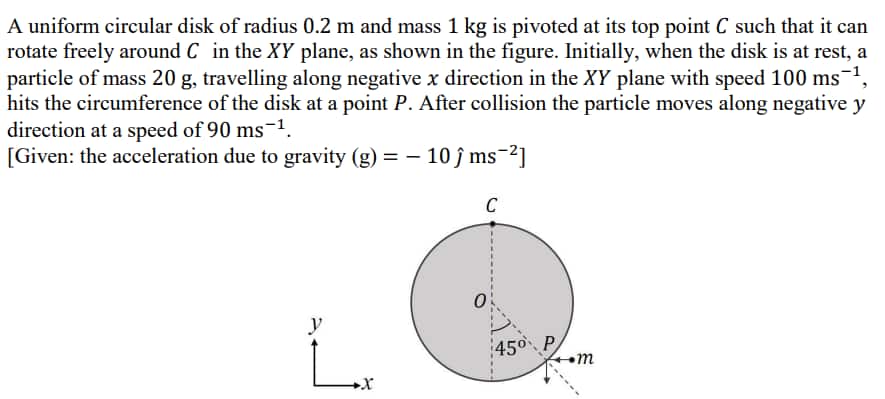
Amount of energy loss (in J) in the collision is:
This question involves the concepts of collisions, rotational motion, and energy concepts; hence, the students have to relate more than one concept to the question rather than simply use one formula.
This particle will change its direction after colliding with the disc; therefore, the students will have to know the change in velocity of the particle.
The disc is hinged at point C; therefore, the students will not apply conservation of momentum in the system but will take into account angular momentum about the hinge point.
The position of the point of collision P is at 45°; thus, the students will have to calculate the effect of the particle’s motion in this case.
Energy conservation or energy dissipation during collisions will further make the calculation difficult for the students.
However, it was possible to note the questions that were quite easy for the candidates. This is because the difficulty index of such questions was relatively lower.
|
Question |
Difficulty Index |
% Not Attempted |
% Full Marks |
% Wrong |
Chapter |
|
14 |
34.8 |
5.7% |
56.7% |
37.6% | |
|
15 |
39.9 |
32.4% |
49.3% |
18.3% |
Electromagnetic Induction |
|
4 |
43.1 |
32.2% |
46.0% |
21.8% | |
|
16 |
48.7 |
26.1% |
40.3% |
33.6% | |
|
6 |
49.5 |
31.3% |
24.7% |
24.2% |
Motion in a Plane |
Question 14 turned out to be the easiest question on Paper 1, with a difficulty index of 34.8. Moreover, the question featured the highest full-mark percentage among the easy questions, with 56.7% of candidates answering the question correctly.
Another relatively easy question was question 15, where 49.3% of candidates achieved full marks.
|
Question |
Difficulty Index |
% Not Attempted |
% Full Marks |
% Wrong |
Chapter |
|
2 |
48.4 |
46.8% |
38.6% |
14.7% | |
|
7 |
50.6 |
46.1% |
12.8% |
10.0% |
Electric Charges and Fields |
|
12 |
55.1 |
22.2% |
33.1% |
44.7% |
Ray Optics and Optical Instruments |
|
3 |
60.1 |
52.3% |
26.9% |
20.8% |
Ray Optics and Optical Instruments |
|
9 |
61.6 |
51.2% |
3.2% |
16.6% |
Thermodynamics |
The second-easiest physics question in Paper 2 is Question 2, with a difficulty index of 48.4, with 38.6% perfect marks and 14.7% wrong responses.
On the other hand, the question that had the lowest percentage of wrong responses is Question 7, with 10% wrong responses.
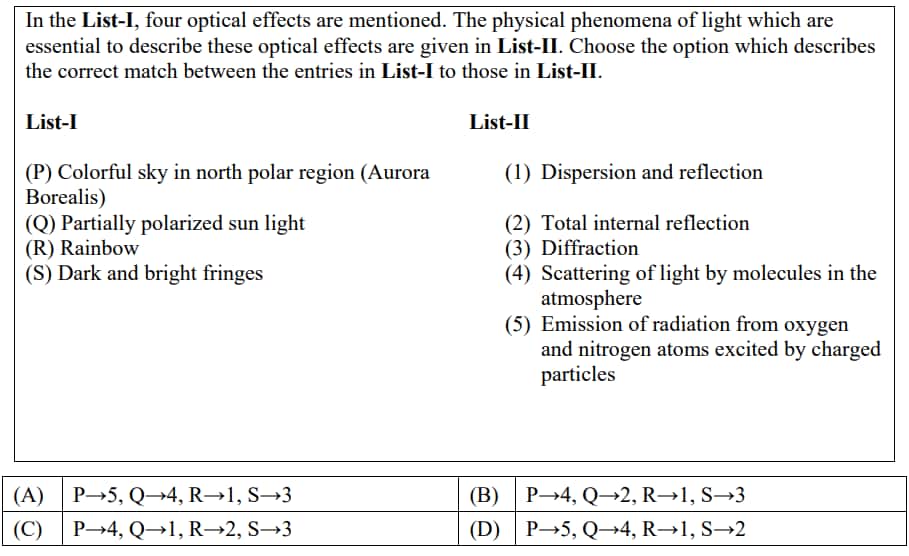
It is based on optical phenomena which are well-known; therefore, the students can remember the basic idea of each phenomenon.
Each optical phenomenon has a concept that is quite clear and familiar, like scattering in the case of a polarised sky and diffraction in the case of bright and dark fringes.
The options have been set in such a way that students can easily rule out wrong answers.
No complex calculations or solving of numericals are involved, thus making this question easy to attempt.
Students who have command over wave optics and common optical phenomena can easily solve it.
Application Free of Cost for Limited Time || NAAC A++ Accredited | Highest CTC 52 LPA | #11 in University Category by NIRF
Affiliated to Anna University | Highest CTC 44 LPA | Top Recruiters : JP Morgan Chase & Co, Nielson IQ, QUBE, META, GOOGLE, AMAZON & many more.
Some questions were difficult and also had a good chance of making candidates choose the wrong answer. This is where trap rate becomes useful.
|
Question |
Trap Rate |
% Not Attempted |
% Full Marks |
% Wrong |
Difficulty Index |
Chapter |
|
12 |
97.5% |
31.6% |
1.7% |
66.6% |
84.7 |
Moving charges and magnetism |
|
11 |
96.6% |
35.1% |
2.2% |
62.7% |
84.9 |
Thermal Properties of Matter |
|
9 |
94.0% |
26.6% |
4.4% |
69.0% |
81.3 |
Mechanical Properties of Fluids |
|
10 |
90.7% |
33.3% |
6.2% |
60.5% |
80.8 |
Thermodynamics |
|
8 |
57.3% |
26.9% |
15.7% |
41.9% |
60.8 |
Electromagnetic Induction |
The question with the highest trap rate in Paper 1 is Question 12 with 97.5%. This was followed by Questions 11 and 9 with trap rates of 96.6% and 94%, respectively.
Questions that needed the candidate to examine the problem well before answering it are these.
|
Question |
Trap Rate |
% Not Attempted |
% Full Marks |
% Wrong |
Difficulty Index |
Chapter |
|
18 |
98.1% |
39.2% |
1.2% |
59.6% |
86.7 |
System of Particles and Rotational Motion |
|
15 |
97.6% |
38.5% |
1.5% |
60.0% |
86.3 |
Mechanical Properties of Fluids |
|
17 |
97.2% |
38.1% |
1.7% |
60.2% |
85.9 |
System of Particles and Rotational Motion |
|
13 |
91.1% |
25.6% |
6.6% |
67.8% |
79.2 | |
|
11 |
88.5% |
31.9% |
7.8% |
60.3% |
79.0 |
Question 18 was the most difficult question in Paper 2, with a trap rate of 98.1%. The trap rates for Questions 15 and 17 were also extremely high at 97.6% and 97.2%, respectively.
The high percentage of wrong answers for these questions indicates that candidates had to be cautious while analysing the questions.
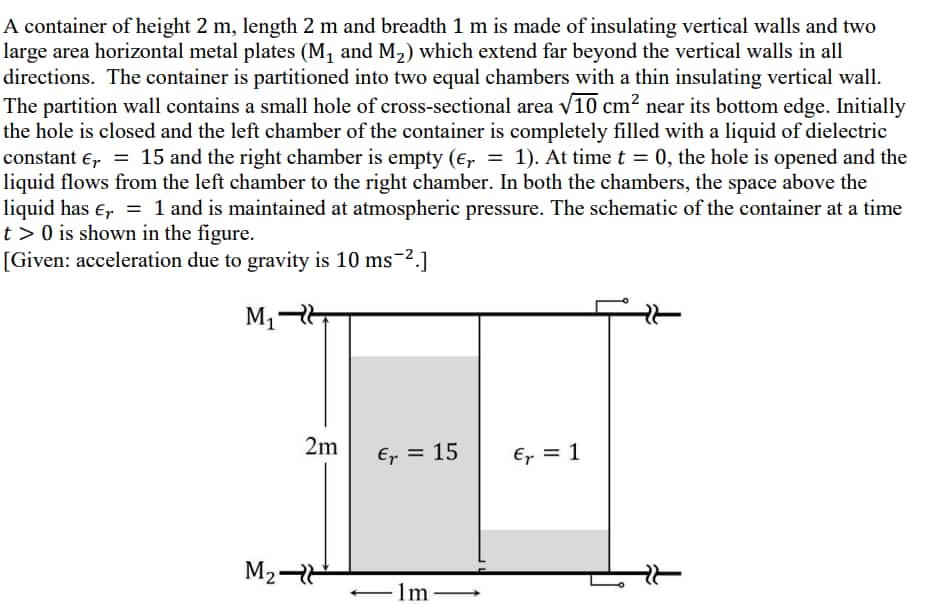
The height (in m) of the liquid in the left chamber at ? = 500 s is:
This problem might prove difficult for students because of the constantly fluctuating height of the liquid.
It utilises the idea of fluid dynamics and also that of capacitors, which students do not generally relate to each other.
It is very easy for students to confuse the arrangement of the liquid and air between the plates.
The tiny hole makes the flow dependent upon the fluctuating height of the liquid.
It is easy to overlook that the changing height of the liquid changes the capacitance of the system.
Below are the rankings of Paper 1 physics questions arranged in order of difficulty.
|
Question |
Chapter |
Difficulty Index |
% Not Attempted |
% Full Marks |
% Wrong |
|
11 |
Thermodynamics |
84.9 |
35.1% |
2.2% |
62.7% |
|
12 |
Magnetic Effects of Current |
84.7 |
31.6% |
1.7% |
66.6% |
|
9 |
Fluid Mechanics |
81.3 |
26.6% |
4.4% |
69.0% |
|
10 |
Thermodynamics |
80.8 |
33.3% |
6.2% |
60.5% |
|
3 |
Rotational Motion |
76.4 |
66.6% |
12.1% |
21.3% |
|
1 |
Rotational Motion |
74.9 |
68.0% |
13.0% |
19.0% |
|
5 |
Atoms & Nuclei |
73 |
53.9% |
5.3% |
27.8% |
|
2 |
EM Induction & AC |
71.6 |
71.5% |
14.6% |
13.9% |
|
13 |
Waves & Sound |
66.4 |
60.6% |
20.4% |
19.0% |
|
8 |
EM Waves |
60.8 |
26.9% |
15.7% |
41.9% |
|
7 |
Thermodynamics |
52.2 |
44.7% |
4.9% |
10.4% |
|
6 |
Kinematics |
49.5 |
31.3% |
24.7% |
24.2% |
|
16 |
Rotational Motion |
48.7 |
26.1% |
40.3% |
33.6% |
|
4 |
Ray Optics |
43.1 |
32.2% |
46.0% |
21.8% |
|
15 |
EM Induction & AC |
39.9 |
32.4% |
49.3% |
18.3% |
|
14 |
Wave Optics |
34.8 |
5.7% |
56.7% |
37.6% |
The most difficult question in Physics Paper 1 was Thermodynamics Question 11, which had a difficulty index of 84.9. The percentage of students who answered this question wrongly stood at about 62.7%.
Following closely was Question 12 from Magnetic Effects of Current, whose difficulty index stood at 84.7 and the percentage of wrong answers at 66.6%.
Thermodynamics, magnetic effects of current, fluid mechanics, and rotational motion questions were some of the difficult questions in this paper.
On the easier side, Question 14 from Wave Optics had the least difficulty index of 34.8. In addition, it had a very high full-marks percentage of 56.7%. Question 15 from EM Induction and AC was another relatively easy question with a difficulty index of 39.9.
From the analysis of the JEE Advanced 2026 Physics Paper 2, the difficulty of each problem can be determined by the performance of the students. This is done by arranging the problems from difficult to easy using the difficulty index.
|
Question |
Chapter |
Difficulty Index |
% Not Attempted |
% Full Marks |
% Wrong |
|
18 |
Rotational Motion |
86.7 |
39.2% |
1.2% |
59.6% |
|
15 |
Fluid Mechanics |
86.3 |
38.5% |
1.5% |
60.0% |
|
17 |
Rotational Motion |
85.9 |
38.1% |
1.7% |
60.2% |
|
13 |
Current Electricity |
79.2 |
25.6% |
6.6% |
67.8% |
|
11 |
Units & Experimental |
79.0 |
31.9% |
7.8% |
60.3% |
|
4 |
Gravitation |
78.1 |
62.4% |
11.1% |
26.5% |
|
16 |
Electrostatics |
77.2 |
40.1% |
10.8% |
49.1% |
|
10 |
Units & Experimental |
73.4 |
24.5% |
12.9% |
62.6% |
|
14 |
Units & Experimental |
69.9 |
10.6% |
14.6% |
74.8% |
|
6 |
Magnetic Effects of Current |
69.6 |
58.2% |
5.9% |
20.5% |
|
5 |
Ray Optics |
67.5 |
55.5% |
1.8% |
19.4% |
|
8 |
Electrostatics |
65.8 |
51.9% |
15.6% |
24.5% |
|
1 |
Current Electricity |
65.7 |
52.5% |
21.9% |
25.6% |
|
9 |
Thermodynamics |
61.6 |
51.2% |
3.2% |
16.6% |
|
3 |
Ray Optics |
60.1 |
52.3% |
26.9% |
20.8% |
|
12 |
Wave Optics |
55.1 |
22.2% |
33.1% |
44.7% |
|
7 |
Electrostatics |
50.6 |
46.1% |
12.8% |
10.0% |
|
2 |
Atoms & Nuclei |
48.4 |
46.8% |
38.6% |
14.7% |
In Physics Paper 2, the question from Rotational Motion, Q.18, was the hardest question with a difficulty index of 86.7%. Only 1.2% scored full marks, whereas 59.6% of candidates got this question wrong.
The other two difficult questions were Q.15 from Fluid Mechanics and Q.17 from Rotational Motion, with a difficulty index greater than 85%.
Some of the other difficult questions were from Current Electricity, Units and Experimental Physics, Gravitation, and Electrostatics.
In terms of easy questions, Q.2 from Atoms and Nuclei was the easiest, with a difficulty index of 48.4%, followed by Q.7 from Electrostatics (50.6%) and Q.12 from Wave Optics (55.1%).
From the question-wise analysis of the paper, we get the following highlights for JEE Advanced 2027 candidates:
Question 11 of Paper 1 is the toughest physics question of Paper 1 in terms of difficulty index.
Question 18 of Paper 2 is the toughest physics question overall, having a difficulty index as 86.7.
Question 14 in Paper 1 had the easiest difficulty index of 34.8.
Question 2 in Paper 2 had the easiest difficulty index of 48.4.
Questions 12, 11, and 9 in Paper 1 had very high trap indices, thus making them very difficult to answer.
Questions 18, 15, and 17 in Paper 2 had trap indices higher than 97%.
Question 14 in Paper 2 had the highest percentage of wrong responses at 74.84%.
Question 14 of Paper 1 was among those with the highest frequency of full marks at 56.70%.
Some of the difficult concepts included rotational motion, Thermodynamics, Fluids, and Electromagnetism.
The paper was completely based on the JEE Advanced syllabus.
From the above analysis, it is evident that the second paper contained more questions with a relatively high difficulty level, but the first paper also had many very difficult questions. Paper 2 contained the greatest difficulty level of 86.7 in Question 18, as compared to 84.9 in Question 11 of Paper 1. The first paper contained more questions with lower difficulty levels.
|
Parameter |
Physics Paper 1 |
Physics Paper 2 |
|
Total questions |
16 |
18 |
|
Hardest question |
Q11 |
Q18 |
|
Highest difficulty index |
84.9 |
86.7 |
|
Easiest question |
Q14 |
Q2 |
|
Lowest difficulty index |
34.8 |
48.4 |
|
Questions with a difficulty index above 80 |
4 |
3 |
|
Questions with difficulty index 70-80 |
3 |
5 |
|
Questions with a difficulty index below 50 |
5 |
1 |
|
Highest wrong-response rate |
Q9 - 69.0% |
Q14 - 74.8% |
|
Highest full-marks rate |
Q14 - 56.7% |
Q2 - 38.6% |
|
Highest trap rate |
Q12 - 97.5% |
Q18 - 98.1% |
Frequently Asked Questions (FAQs)
Both papers of the physics subject in JEE Advanced 2026 comprised questions of varying degrees of difficulty, such as easy, moderate, difficult, and tricky.
Question number 11 of Paper 1 had the highest difficulty index of 84.9 while question 18 of Paper 2 had the maximum difficulty index of 86.7.
Physics Paper 1 question 14 was the simplest in terms of difficulty index, scoring 34.8. In Physics Paper 2, question 2 was the simplest, scoring 48.4 in the difficulty index.
In Physics Paper 1, question 12 had the highest trap rate of 97.5 per cent. In Physics Paper 2, question 18 had the highest trap rate of 98.1 percent.

On Question asked by student community
Check the list of the most important chapters for JEE advance from here:
https://engineering.careers360.com/articles/jee-advanced-syllabus-weightage
JEE Main and JEE Advanced are both national-level engineering entrance examinations, but they serve different purposes.
JEE Main is conducted for admission to NITs, IIITs and other participating engineering institutes. It is also the qualifying examination for appearing in JEE Advanced.
JEE Advanced is conducted for admission to the IITs
Start your JEE preparation from Class 11 itself by building strong concepts in Physics, Chemistry and Mathematics. Follow your Class 11 syllabus systematically and avoid studying only for board examinations.
A good approach is:
Complete each chapter conceptually and solve basic questions first.
Gradually move to JEE-level problems.
Practise previous-year
After qualifying JEE Advanced and getting an IIT, there is no single course that is best for everyone. Your choice should depend on interest, rank, career goals and the branch available to you.
Generally:
CSE/AI/Data Science – good for software, AI, data and technology careers.
Electrical Engineering – useful for
Hello Student, I can definitely help you create a balanced plan, but I would not recommend preparing JEE , NEET , KCET , MHT-CET and school exams as five completely separate syllabi. Your Class 11 NCERT/board concepts should become the common base, with JEE-level Maths/Physics and NEET-level Biology/Chemistry added according

Ranked #43 among Engineering colleges in India by NIRF | Get Upto 100% Scholarships
Scholars’ Round Deadline: 14th Nov’26 | Earn upto 50% merit Scholarship + 10% for top performers | EFMD Accredited | AACSB (USA) & AMDISA Member | Highest CTC 28 LPA
Application Free of Cost for Limited Time || NAAC A++ Accredited | Highest CTC 52 LPA | #11 in University Category by NIRF
Affiliated to Anna University | Highest CTC 44 LPA | Top Recruiters : JP Morgan Chase & Co, Nielson IQ, QUBE, META, GOOGLE, AMAZON & many more.
Highest CTC 30 LPA | #9 in Management Category by Times B-School | Merit-Based Scholarship Upto - 50 Crores
Courses designed with CTOs, Data Scientists, and Cybersecurity experts | 50+ elective options