School of Computer Science, UPES, Dehradun
Ranked #43 among Engineering colleges in India by NIRF | Get Upto 100% Scholarships


Analysis of JEE Advanced 2026 Math Questions provides insight into the performance of the students on each particular question in Paper 1 and Paper 2 of the maths subject. The analysis includes the percentage of students who attempted the questions, the percentage of correct answers, the marks obtained, and the percentage of wrong answers. It further includes the questions that are easy, difficult, and tricky for JEE Advanced 2026 Maths. Students can easily analyse their performance in the JEE Advanced exam using this analysis.
This Story also Contains
In this article, we have discussed JEE Advanced 2026 Maths Question-Wise Analysis, with a focus on the JEE Advanced 2026 Maths tough questions, easiest questions, and highly tricky questions.
JEE Advanced 2026 Maths question analysis will help students to get an understanding of the level of difficulty, concepts, and topics involved in each question. It will also give students an insight into the JEE Advanced Exam pattern.
Get expert advice on college selection, admission chances, and career path in a personalized counselling session.
From the results of Paper 1, there is a great variation in the students’ performance. Some questions had high percentages of full marks, but others had very low percentages of full marks and very high percentages of wrong responses, according to the JEE Advanced 2026 Maths paper analysis.
Question No | % Not Attempted | % Full Marks | % Partial Marks | % Wrong Response |
1 | 47.57 | 15.89 | 36.54 | |
2 | 57.3 | 26.98 | 15.72 | |
3 | 46.43 | 18.85 | 34.72 | |
4 | 42.81 | 22.24 | 34.96 | |
5 | 42.13 | 10.44 | 12.84 | 34.59 |
6 | 46.71 | 23.41 | 10.67 | 19.21 |
7 | 37.99 | 6.55 | 9.13 | 46.33 |
8 | 46.81 | 4.12 | 40.66 | 8.41 |
9 | 34.22 | 0.12 | 65.67 | |
10 | 28.55 | 16.4 | 55.05 | |
11 | 38.2 | 0.72 | 61.08 | |
12 | 31.88 | 12.03 | 56.09 | |
13 | 37.32 | 43.09 | 19.59 | |
14 | 35.49 | 50.11 | 14.4 | |
15 | 48.22 | 29.21 | 22.57 | |
16 | 33.35 | 51.5 | 15.15 |
From the above data, it can be seen that Questions 16 and 14 had the highest rates of full marks in Paper 1, at 51.50% and 50.11%, respectively. However, Question 9 had the lowest rate of full marks of 0.12%, whereas 65.67% got it wrong.
Also, Question 8 stands out in the sense that 40.66% got partial marks for it. This means that students were able to answer some part of the question but failed to satisfy all the requirements to get full marks.
Read the freely downloadable ebook for proper analysis: JEE Advanced 2026 Question Analysis: Hardest, Easiest & Tricky Questions Explained
According to the JEE Advanced 2026 Question Paper, the maths paper reflected a marked disparity among students’ performance for each question posed to them. The initial questions were relatively well answered by most, while some of the later questions had very high wrong-answer percentages.
Question No | % Not Attempted | % Full Marks | % Partial Marks | % Wrong Response |
1 | 40.19 | 41.05 | 18.76 | |
2 | 36.7 | 47.14 | 16.15 | |
3 | 41.38 | 41.87 | 16.75 | |
4 | 30.45 | 37.61 | 31.94 | |
5 | 56.96 | 1.07 | 31.6 | 10.38 |
6 | 43.67 | 8.5 | 30.02 | 17.81 |
7 | 56.35 | 10.93 | 15 | 17.72 |
8 | 29.57 | 22.87 | 19.18 | 28.37 |
9 | 31.37 | 16.21 | 16.46 | 35.95 |
10 | 33.18 | 0.65 | 66.17 | |
11 | 26.55 | 6.2 | 67.24 | |
12 | 19.88 | 37.3 | 42.81 | |
13 | 25.43 | 9.81 | 64.76 | |
14 | 32.5 | 1 | 66.49 | |
15 | 22.72 | 14 | 63.28 | |
16 | 38.64 | 1.09 | 60.27 | |
17 | 20.01 | 27.31 | 52.68 | |
18 | 32.78 | 1.2 | 66.01 |
Question 2 performed very well on Paper 2, with 47.14% of students obtaining full marks for it. Questions 1 and 3 had more than 40% of students obtaining full marks.
It is evident that the difficult aspects of the paper are shown by Questions 10, 11, 14, and 18. Over 60% of students provided wrong answers for each of these questions. The question that obtained the highest percentage of wrong answers is Question 11 at 67.24%.
Based on the difficulty index and the responses of students in the JEE Advanced 2026 Exam, there were some questions that were really hard for the students.
Question | Difficulty Index | % Not Attempted | %Full Marks | %Wrong | Chapter |
11 | 86.9 | 38.2% | 0.7% | 61.1% | |
9 | 86.7 | 34.2% | 0.1% | 65.7% | |
12 | 75.1 | 31.9% | 12.0% | 56.1% | Trigonometry |
7 | 74.5 | 38.0% | 6.6% | 46.3% | |
1 | 72.5 | 47.6% | 15.9% | 36.5% | Limits, Continuity and Differentiability |
NOTE: Difficulty index is calculated by the experts using the student answers and the level of difficulty of the question. The questions which have a high difficulty index usually have low attempt rate, low percentage of full marks obtained by the students, and high percentage of wrong answers. The difficulty index helps to find out the questions which are the most difficult for the students in the JEE Advanced 2026 examination.
The difficulty level for Paper 2 was quite high, as there were many questions in Paper 2 with a difficulty index of more than 85.
Question | Difficulty Index | % Not Attempted | % Full Marks | % Wrong | Chapter |
16 | 86.6 | 38.6% | 1.1% | 60.3% | |
10 | 86.0 | 33.2% | 0.7% | 66.2% | Sets, Relations and Functions |
14 | 85.6 | 32.5% | 1.0% | 66.5% | Limits, Continuity and Differentiability |
18 | 85.4 | 32.8% | 1.2% | 66.0% | Integral calculus |
11 | 79.7 | 26.6% | 6.2% | 67.2% |

Solution:
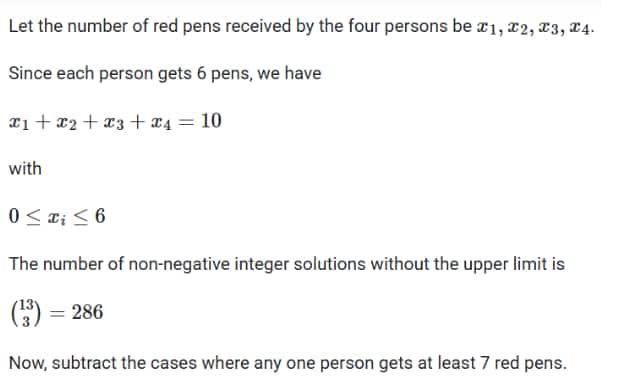
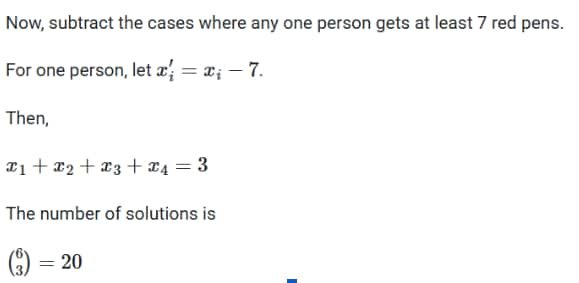
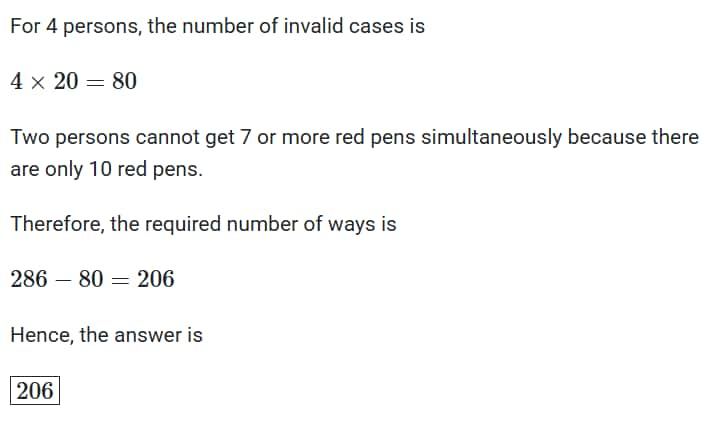
The problem requires identical objects, meaning that students have to know how to distribute them and not just use permutations for counting.
The constraint that each person should get exactly 6 pens provides a significant constraint on distribution.
Students have to consider the upper limit on the number of red pens that each person receives.
A direct application of stars and bars results in some cases being invalid.
The problem tests more of the conceptual understanding and formulation part and hence is a moderate-to-difficult-level JEE Advanced problem.
Not all questions in the test were equally hard. Below are JEE Advanced 2026 Maths easy questions; they have relatively lower difficulty and a higher percentage of full marks.
Question | Difficulty Index | %Not Attempted | % Full Marks | % Wrong | Chapter |
16 | 37.7 | 33.4% | 51.5% | 15.1% | Matrices and determinants |
14 | 38.7 | 35.5% | 50.1% | 14.4% | Trigonometry |
13 | 45.3 | 37.3% | 43.1% | 19.6% | |
8 | 51.9 | 46.8% | 4.1% | 8.4% | Matrices and determinants |
6 | 55.8 | 46.7% | 23.4% | 19.2% |
These are some of the easy JEE Advanced 2026 Maths questions asked in Paper 2.
Question | Difficulty Index | % Not Attempted | % Full Marks | % Wrong | Chapter |
2 | 41.4 | 36.7% | 47.1% | 16.2% | Coordinate geometry |
3 | 45.9 | 41.4% | 41.9% | 16.7% | |
1 | 46.9 | 40.2% | 41.1% | 18.8% | |
4 | 51.1 | 30.5% | 37.6% | 31.9% | Integral calculus |
12 | 51.4 | 19.9% | 37.3% | 42.8% | Probability and Statistics |
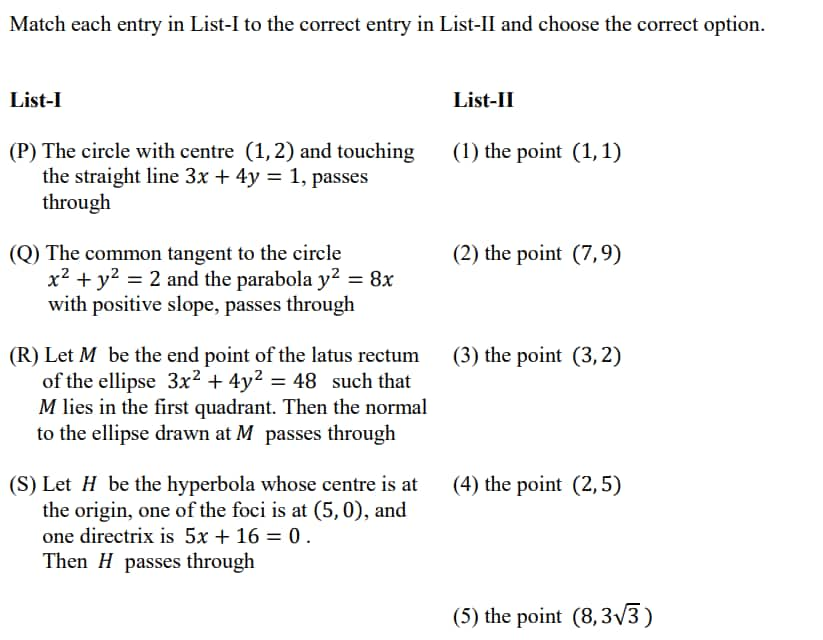
(a) (P) → (3), (Q) → (4), (R) → (1), (S) → (2)
(b) (P) → (3), (Q) → (2), (R) → (1), (S) → (5)
(c) (P) → (3), (Q) → (2), (R) → (4), (S) → (5)
(4) (P) → (4), (Q) → (1), (R) → (2), (S) → (3)
The question involves the basics of coordinate geometry, including circles, parabolas, ellipses, and hyperbolas.
The problem can be solved through formulas and equations directly and without any calculations.
The format of the question makes it easy for students to match the given condition with the right points.
The concepts involved in the problem are formula-orientated; hence, the problem can be easily solved by students having a good grasp of conic sections.
This question checks concept application ability rather than problem-solving, hence an easy JEE Advanced question.
Ranked #43 among Engineering colleges in India by NIRF | Get Upto 100% Scholarships
Scholars’ Round Deadline: 14th Nov’26 | Earn upto 50% merit Scholarship + 10% for top performers | EFMD Accredited | AACSB (USA) & AMDISA Member | Highest CTC 28 LPA
A hard question is different from a trick question. The question can be considered tricky if it is designed to make students commit a conceptual error, select a wrong answer choice, or make mistakes in computations.
The questions below had high rates of being traps.
Question | Trap Rate | % Not Attempted | % Full Marks | % Wrong | Difficulty Index | Chapter |
9 | 99.8% | 34.2% | 0.1% | 65.7% | 86.7 | Sets, Relations and Functions |
11 | 98.8% | 38.2% | 0.7% | 61.1% | 86.9 | Permutations and combinations |
12 | 82.3% | 31.9% | 12.0% | 56.1% | 75.1 | Trigonometry |
10 | 77.0% | 28.6% | 16.4% | 55.0% | 70.6 | Limits, Continuity and Differentiability |
7 | 74.7% | 38.0% | 6.6% | 46.3% | 74.5 | Limits, Continuity and Differentiability |
There were also a number of highly tricky questions in Paper 2.
Question | Trap Rate | % Not Attempted | % Full Marks | % Wrong | Difficulty Index | Chapter |
10 | 99.0% | 33.2% | 0.7% | 66.2% | 86.0 | Sets, Relations and Functions |
14 | 98.5% | 32.5% | 1.0% | 66.5% | 85.6 | Limits, Continuity and Differentiability |
16 | 98.2% | 38.6% | 1.1% | 60.3% | 86.6 | Integral calculus |
18 | 98.2% | 32.8% | 1.2% | 66.0% | 85.4 | Integral calculus |
11 | 91.6% | 26.6% | 6.2% | 67.2% | 79.7 | Probability and Statistics |
Paper 2 Question 10:
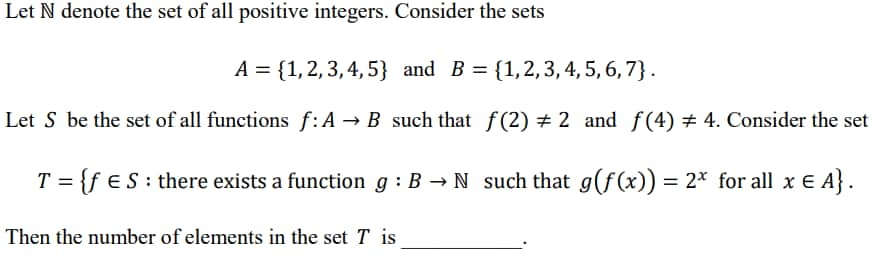
The problem seems easy on the surface, but the conditions that have been provided require careful study.
The number of conditions may easily distract the students, and they might end up with an incorrect count.
It is important for the students to take into account all the cases that have been provided in the conditions.
Any error made while analysing the conditions will make a difference in the final result.
From the analysis of JEE Advanced 2026 Mathematics paper, it is evident that the questions posed were well distributed in terms of difficulty levels. In Paper 1, Questions 9 and 11 are considered to be the toughest questions, while Questions 16 and 14 were relatively easy. On the other hand, in Paper 2, the questions with the greatest difficulty indices are 16, 10, 14, and 18, while 1, 2, and 3 had relatively higher chances of scoring well.
The above analysis makes it evident that great difficulty does not necessarily imply that a particular question has to be avoided. The students must analyze the question and judge the method before making any decision about solving it. It is important for students who will be appearing for the JEE Advanced 2027 exam to ensure conceptual clarity, practice more problems according to the JEE Advanced syllabus, and learn to judge between good questions and traps.
Frequently Asked Questions (FAQs)
JEE Advanced 2026 Maths Exam contained questions from easy to tough level. The exam tested the understanding and analytical ability of the candidate.
There is no defined number of questions which are expected to appear in the JEE Advanced Maths Exam. It is advised to the candidates that they should read the question paper and the information brochure carefully.
Some of the most important topics for JEE Advanced Maths Preparation include Calculus, Algebra, Coordinate Geometry, Vector Algebra, 3D Geometry, Probability, and Trigonometry.
JEE Advanced Maths is considered tougher than JEE Main Math because of concepts and problem-solving skills.

On Question asked by student community
Hello Student,
Check the useful resources given below:
Hope it helps!
Check the list of the most important chapters for JEE advance from here:
https://engineering.careers360.com/articles/jee-advanced-syllabus-weightage
JEE Main and JEE Advanced are both national-level engineering entrance examinations, but they serve different purposes.
JEE Main is conducted for admission to NITs, IIITs and other participating engineering institutes. It is also the qualifying examination for appearing in JEE Advanced.
JEE Advanced is conducted for admission to the IITs
Start your JEE preparation from Class 11 itself by building strong concepts in Physics, Chemistry and Mathematics. Follow your Class 11 syllabus systematically and avoid studying only for board examinations.
A good approach is:
Complete each chapter conceptually and solve basic questions first.
Gradually move to JEE-level problems.
Practise previous-year
After qualifying JEE Advanced and getting an IIT, there is no single course that is best for everyone. Your choice should depend on interest, rank, career goals and the branch available to you.
Generally:
CSE/AI/Data Science – good for software, AI, data and technology careers.
Electrical Engineering – useful for

Ranked #43 among Engineering colleges in India by NIRF | Get Upto 100% Scholarships
Scholars’ Round Deadline: 14th Nov’26 | Earn upto 50% merit Scholarship + 10% for top performers | EFMD Accredited | AACSB (USA) & AMDISA Member | Highest CTC 28 LPA
Diploma (17 Specializations), B.Tech / B.Tech (Hons.) / IE-B.Tech - 4 years - 25+ specializations | M. Tech - 14+ specializations | Highest CTC – 60 LPA
Special Scholarship for Students from Goa (Get an exclusive scholarship of ₹20,000 if you're a Goa-based student) | Bringing Parul Education Trust's 30-year Education Legacy to Goa
Application Free of Cost for Limited Time || NAAC A++ Accredited | Highest CTC 52 LPA | #11 in University Category by NIRF
Affiliated to Anna University | Highest CTC 44 LPA | Top Recruiters : JP Morgan Chase & Co, Nielson IQ, QUBE, META, GOOGLE, AMAZON & many more.