School of Computer Science, UPES, Dehradun
Ranked #43 among Engineering colleges in India by NIRF | Get Upto 100% Scholarships


GUJCET Exam Analysis 2026: The analysis of GUJCET 2026 will be useful for the candidates appearing for GUJCET 2027․ The paper was of moderate level of difficulty․ Questions in GUJCET exam were based on concepts and were almost entirely from the syllabus of Class 11 and Class 12 according to student reviews and memory-based papers․ In the article below‚ we have provided a subject-wise analysis of the GUJCET 2026 exam along with the previous year analysis and memory-based questions.
.jpg)
The analysis for Physics, Chemistry and Mathematics is provided in the table below. You can check the analysis here.
|
subject |
Difficulty level |
Key observations |
|
Physics |
Moderate | Questions based on concepts were asked from magnetic effects, galvanometer, and current electricity. Numerical questions were moderate. |
|
Chemistry |
Easy to Moderate | NCERT-based questions were asked. Questions from organic and inorganic chemistry were straightforward, while some physical chemistry questions required calculations. |
|
Mathematics |
Moderate |
Questions were formula-based and direct. Questions from Coordinate Geometry, Trigonometry, Probability, Calculus, etc were asked. |
|
Biology |
Easy to Moderate |
Questions directly from NCERT are asked from topics like human physiology, genetics, ecology, and plant physiology. |
Ranked #43 among Engineering colleges in India by NIRF | Get Upto 100% Scholarships
Scholars’ Round Deadline: 14th Nov’26 | Earn upto 50% merit Scholarship + 10% for top performers | EFMD Accredited | AACSB (USA) & AMDISA Member | Highest CTC 28 LPA
Also Read
Get expert advice on college selection, admission chances, and career path in a personalized counselling session.
We are sharing the detailed analysis of the GUJCET 2025 question paper in the table given below:
The overall difficulty level of the GUJCET 2026 exam based on Physics, Chemistry and Biology shift was moderate. Questions from Physics, Chemistry and Biology are concept-based and aligned with the GUJCET syllabus and NCERT concepts
| Subject | Difficulty Level | Important Topics Asked |
|---|---|---|
| Physics | Moderate | Magnetic Effect, Galvanometer, Current Electricity |
| Chemistry | Easy to Moderate | Mole Concept and Stoichiometry, Atomic Structure, Chemical Bonding, Thermodynamics |
| Biology | Easy to Moderate | Human Physiology, Genetics, Ecology, Plant Physiology |
| Mathematics | Moderate | Coordinate Geometry, Trigonometry, Probability, Calculus |
Application Free of Cost for Limited Time || NAAC A++ Accredited | Highest CTC 52 LPA | #11 in University Category by NIRF
Affiliated to Anna University | Highest CTC 44 LPA | Top Recruiters : JP Morgan Chase & Co, Nielson IQ, QUBE, META, GOOGLE, AMAZON & many more.
1) In a moving coil galvanometer, if the number of turns of the coil is doubled, the current sensitivity ______ and the voltage sensitivity ______.
(A) becomes half, does not change
(B) becomes double, does not change
(C) becomes half, becomes double
(D) does not change, becomes double
2) A current of 90 A flows from east to west through a wire passing above the head. At a point 1.5 m above this wire, the magnitude of the magnetic field is $\_\_\_\_$ and its direction is $\_\_\_\_$ .
(A) $1.2 \pi \times 10^{-5} \mathrm{~T}$, towards the south
(B) $1.2 \times 10^{-5} \mathrm{~T}$, towards the south
(C) $1.2 \pi \times 10^{-5} \mathrm{~T}$, towards the north
(D) $1.2 \times 10^{-5} \mathrm{~T}$, towards the north
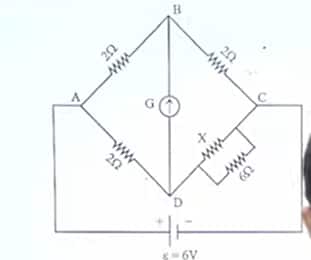
3) In the given figure, the Wheatstone bridge is in a balanced condition.
(A) 3 ohm
(B) 6 ohm
(C) 4 ohm
(D) 12 ohm
4) A particle having charge qqq moves with a velocity v perpendicular to a uniform magnetic field and follows a circular path of radius R. The time period of revolution of this particle is ______.
(A) depends on both v and R
(B) depends on R but not on v
(C) depends on neither v nor R
(D) depends on v but not on R
5) For superconductors, the magnetic susceptibility $\chi=$ $\_\_\_\_$ .
(A) -1
(B) 0.1
(C) 1
(D) zero
1) Which gas is evolved when zinc reacts with dilute HCl?
(a) Oxygen
(b) Hydrogen
(c) Chlorine
(d) Nitrogen
2) The $\mathbf{p H}$ of a neutral solution at $25^{\circ} \mathrm{C}$ is:
(a) 0
(b) 14
(c) 7
(d) 1
3) The hybridization of carbon in methane $\left(\mathrm{CH}_4\right)$ is:
(a) sp
(b) $\mathrm{sp}^2$
(c) $\mathrm{sp}^3$
(d) $\mathrm{dsp}^2$
4) The IUPAC name of $\mathrm{CH}_3 \mathrm{COOH}$ is:
(a) Methanoic acid
(b) Ethanoic acid
(c) Propanoic acid
(d) Butanoic acid
5) Which of the following is an example of a strong electrolyte?
(a) Acetic acid
(b) NaCl
(c) $\mathrm{NH}_4 \mathrm{OH}$
(d) Glucose
1) Photosynthesis occurs in:
(a) Mitochondria
(b) Ribosome
(c) Chloroplast
(d) Nucleus
2) Hemoglobin is responsible for:
(a) Digestion
(b) Oxygen transport
(c) Immunity
(d) Hormone secretion
3) Insulin hormone is secreted by:
(a) Liver
(b) Pancreas
(c) Kidney
(d) Thyroid
4) The basic unit of heredity is:
(a) Cell
(b) Chromosome
(c) Gene
(d) Tissue
5) Mendel is known as the father of:
(a) Evolution
(b) Genetics
(c) Ecology
(d) Taxonomy
1) Direction ratios of x -axis are:
(a) $(0,1,0)$
(b) $(1,0,0)$
(c) $(0,0,1)$
(d) $(1,1,1)$
2) Value of $\sin ^2 \theta+\cos ^2 \theta$:
(a) 0
(b) 1
(c) 2
(d) -1
3) Probability of getting a head in a fair coin toss:
(a) 0
(b) 1
(c) $1 / 2$
(d) 2
4) The derivative of $\sin x$ is:
(a) $\cos x$
(b) $-\cos x$
(c) $-\sin x$
(d) $\tan x$
5) If $f(x)=x^2+3 x$, then $f^{\prime}(x)$ is:
(a) $2 x+3$
(b) $x+3$
(c) $2 x$
(d) $x^2$
Students who are going to appear for the GUJCET 2027 exam should check the GUJCET exam pattern.
| Particulars | Details |
| Mode of Exam | Offline (Pen and Paper Based Test) |
| Duration | 3 hours
Physics & Chemistry - 120 minutes Mathematics - 60 minutes |
| Medium | English/Hindi/Gujarati |
| Sections |
|
| Type of Questions | Objective. Multiple Choice Questions |
| Number of Questions | 120 questions |
| Marking Scheme | 1 mark for every correct answer |
| Negative Marking | 0.25 marks will be deducted for every wrong answer |
Candidates can refer to the GUJCET paper analysis for the previous year for better preparation. With the help of the GUJCET previous year's analysis, candidates can understand the difficulty level and the most asked topics in the Gujarat CET exam.
| Subject | GUJCET difficulty level |
| Mathematics | Difficult level of Maths |
| Physics & Chemistry | Physics: Difficult level of physics Chemistry: Difficult level of Chemistry |
| Subject | GUJCET difficulty level |
| Mathematics | Difficult and lengthy |
| Physics & Chemistry | Physics: Moderate to difficult Chemistry: Easy to moderate |
| Subject | GUJCET difficulty level |
| Mathematics | Difficult |
| Physics & Chemistry | Moderate |
| Subject | Topics |
| Mathematics |
|
| Physics & Chemistry |
|
Frequently Asked Questions (FAQs)
The GUJCET 2027 syllabus is based on the standard NCERT and Gujarat Secondary and Higher Secondary Education Board (GSEB) curriculum for Classes 11 and 12. The authority will release the GUJCET 2027 syllabus on the official website.
As per the previous year's analysis, the GUJCET 2026 exam is of moderate to difficult level.
The GUJCET exam is conducted for a total of 120 marks.

On Question asked by student community
Hello, since you are appearing for Class 12 from the Telangana Board but were born in Gujarat and your parents have been residents of Gujarat since 2008, you should keep your Class 10 and 12 documents, identity proof, and Gujarat domicile/residence-related documents ready. Candidates from boards other than the Gujarat
Hello Dear Student,
If you have passed Class 12 through an Open School/Open Board , you can get a GUJCET marksheet only if you actually appeared for the GUJCET exam .
You can obtain your marksheet by:
Hello student,
With a JEE Mains CRL Rank of 60,729, SC category, and Gujarat home State quota, you have chance of getting a seat through JOSSA counselling, particularly in NITs, IIITs, and GFTIs where category-wise reservation are applicable. However, the exact allotment depend on factors such as your SC category
Hello dear student,
Yes, you have a very strong chance of getting admission to the ICT branch at DA-IICT Gandhinagar under the SEBC category with your score
Hope it helps!
Hi,
With 92.8 GUJCET percentile and 95.4 PCM percentile , you have a good chance of getting a TFWS seat and a decent chance in GIA colleges as well.
You can realistically target branches like:
Computer Engineering (CE)
Information Technology (IT)
AI & ML
Data Science
Colleges such as LJ

Ranked #43 among Engineering colleges in India by NIRF | Get Upto 100% Scholarships
Scholars’ Round Deadline: 14th Nov’26 | Earn upto 50% merit Scholarship + 10% for top performers | EFMD Accredited | AACSB (USA) & AMDISA Member | Highest CTC 28 LPA
Application Free of Cost for Limited Time || NAAC A++ Accredited | Highest CTC 52 LPA | #11 in University Category by NIRF
Affiliated to Anna University | Highest CTC 44 LPA | Top Recruiters : JP Morgan Chase & Co, Nielson IQ, QUBE, META, GOOGLE, AMAZON & many more.
Highest CTC 30 LPA | #9 in Management Category by Times B-School | Merit-Based Scholarship Upto - 50 Crores
Courses designed with CTOs, Data Scientists, and Cybersecurity experts | 50+ elective options