School of Computer Science, UPES, Dehradun
Ranked #43 among Engineering colleges in India by NIRF | Get Upto 100% Scholarships


JEE Advanced Analysis - The JEE Advanced Analysis helps the candidates get an insight into the difficulty level of the test and the complete test pattern. This includes the difficulty of Physics, Chemistry, and Mathematics, the types of questions asked in the JEE Advanced, important topics, and the complete test pattern. The JEE Advanced Analysis can give the candidates a fair idea about which part of the exam was easy, difficult, or moderate. Candidates can also use the JEE Advanced Analysis to know how well they have performed in the examination. This will be helpful for the candidates who are appearing in the coming examination to plan their preparation accordingly.
This Story also Contains
.jpg)
Analysis of JEE Advanced 2026 will provide information about the difficulty level of the test as well as the performance of the students in each subject. The analysis will cover the difficulty level of Physics, Chemistry, and Mathematics along with the kind of questions asked in the exam. The analysis will help students gauge the trend in the questions and also analyze their preparation for the exam.
| Subject | Difficulty Level | Analysis |
|---|---|---|
| Physics | Moderate to Difficult | Concepts and Numerical based questions were highlighted, particularly Mechanics, Electrodynamics, and Modern Physics. Several of the questions included more than one concept. |
| Chemistry | Moderate | Combination of Physical, Organic, and Inorganic Chemistry. Concepts of NCERT books had an important role, particularly Inorganic Chemistry, whereas organic Chemistry had reaction mechanism type of questions. |
| Mathematics | Difficult | Long and calculation-heavy questions filled up the paper. Calculus, Algebra, and Coordinate Geometry had more weight and required good analytical skills. |
Ranked #43 among Engineering colleges in India by NIRF | Get Upto 100% Scholarships
Scholars’ Round Deadline: 14th Nov’26 | Earn upto 50% merit Scholarship + 10% for top performers | EFMD Accredited | AACSB (USA) & AMDISA Member | Highest CTC 28 LPA
| Subject | Difficulty Level | Analysis |
|---|---|---|
| Physics | Difficult | Questions from Magnetism, Optics, and Thermodynamics are based on mix of multiple concepts. |
| Chemistry | Moderate to Difficult | Questions from Organic Chemistry, Coordination Compounds, Electrochemistry, and Chemical Equilibrium were included in the application category. Few questions were in statement form and based on concepts. |
| Mathematics | Difficult | This part is considered to be the hardest by many students because of the lengthy calculations and tough questions on topics such as Calculus, Probability, Vectors & 3D Geometry, and Matrices. |
Get expert advice on college selection, admission chances, and career path in a personalized counselling session.
JEE Advanced 2025 was consistent with previous years, where the conceptuality, analytical approach and overall time management were tested in both Paper 1 and Paper 2. Paper 1 had a very standard pattern of question paper with varied types of questions in the paper along with a clear marking scheme. In contrast to this, Paper 2 offered a slightly increased level of difficulty, more so for Physics and Mathematics.
Diploma (17 Specializations), B.Tech / B.Tech (Hons.) / IE-B.Tech - 4 years - 25+ specializations | M. Tech - 14+ specializations | Highest CTC – 60 LPA
Application Free of Cost for Limited Time || NAAC A++ Accredited | Highest CTC 52 LPA | #11 in University Category by NIRF
| Aspect | Paper 1 | Paper 2 |
|---|---|---|
| Total Questions | 16 (as per detailed section breakdown) | 48 (16 each from Physics, Chemistry, and Mathematics) |
| Question Types | Single correct, Multiple correct, Numerical, Matching | Single correct, Multiple select, Numerical |
| Difficulty Level | Moderate | Slightly tougher than Paper 1 |
| Most Difficult Subject | Physics | Physics |
| Lengthy Sections | Mathematics, Physics | Mathematics, Physics |
| Easiest Section | Chemistry | Chemistry |
| Out-of-Syllabus Questions | None | None |
| Paragraph-Type Questions | Included (Matching column) | Not included |
Candidates may refer to last year's IIT JEE Advanced analysis below. Being aware of the JEE Advanced previous year paper analysis for both paper 1 and 2 will help candidates prepare better for the exam.
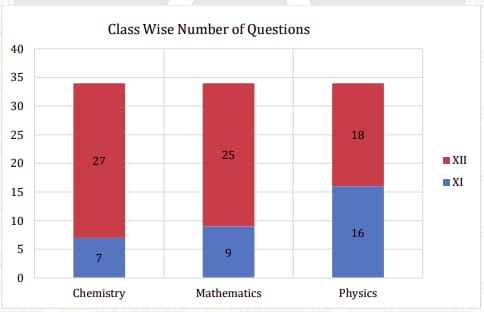
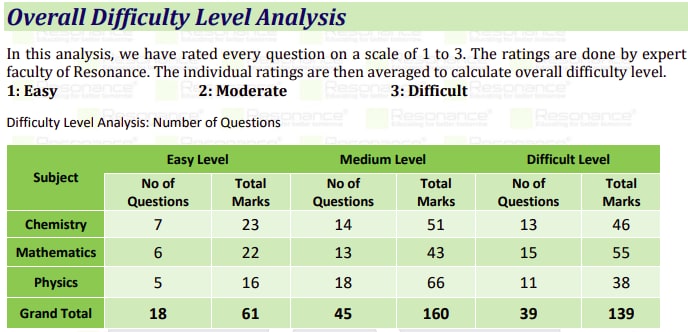
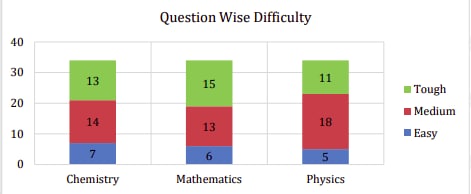
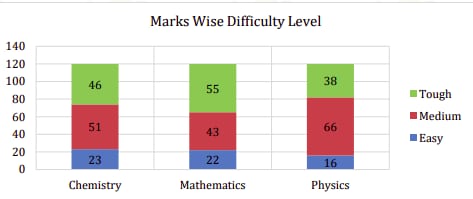
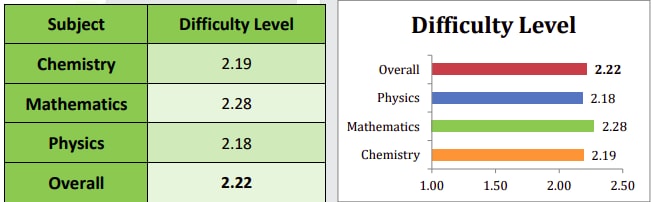
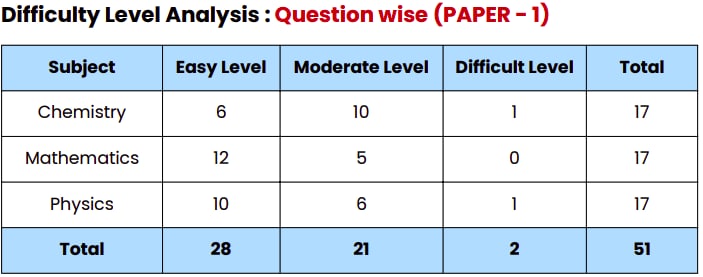
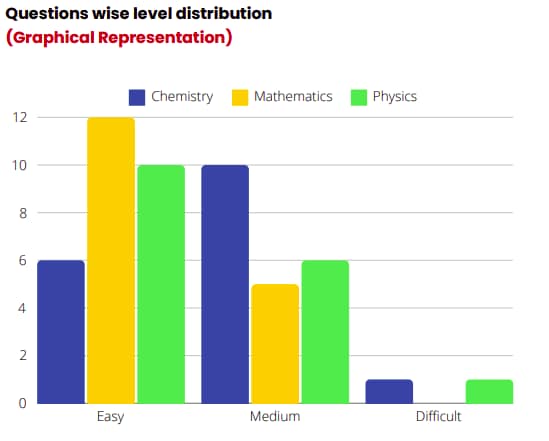
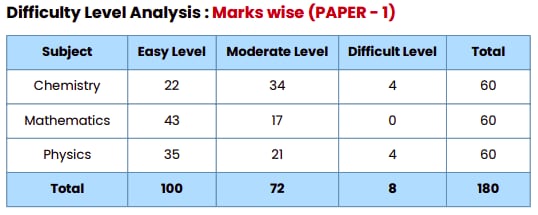
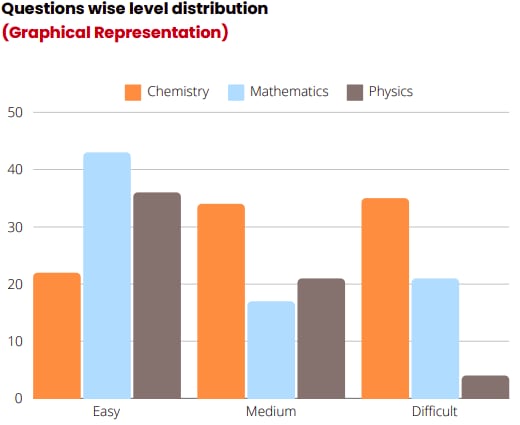
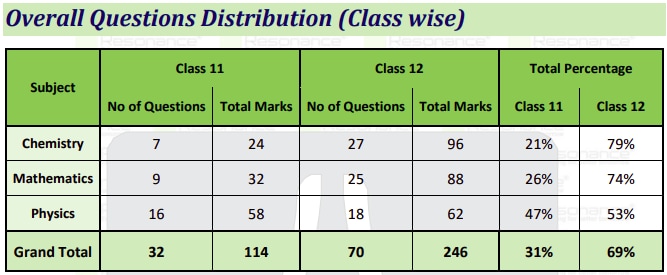
Analysis of JEE Advanced 2024 Paper 1 gives students an idea about the overall level of difficulty of the paper. The level of difficulty of Physics, Chemistry, and Mathematics is analyzed. Students will get to know about the type of questions asked in the paper.
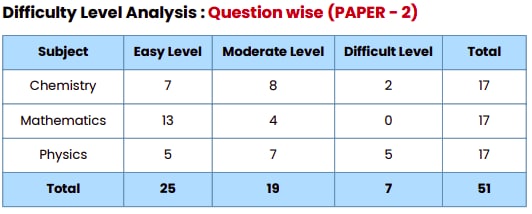
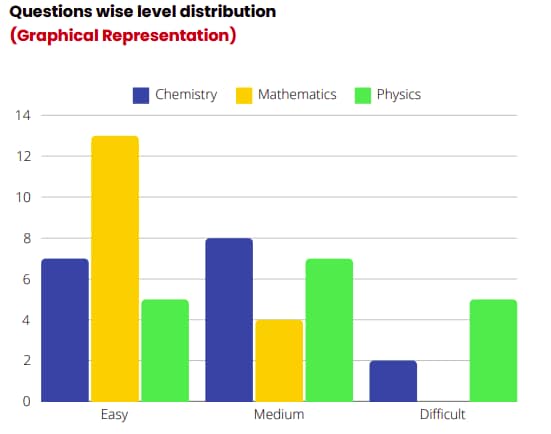
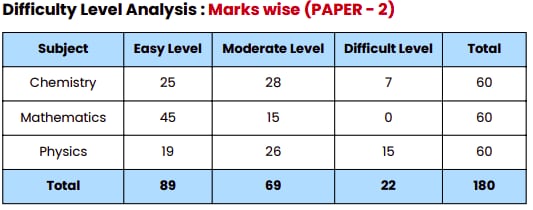
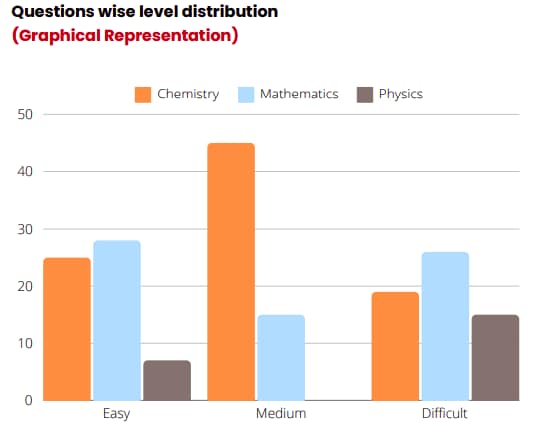
Analysis of JEE Advanced 2024 Paper 2 enables the candidates to analyze the difficulty level of the paper and type of questions asked in the paper. The analysis of the JEE Advanced Paper 2 will include the difficulty level of Physics, Chemistry, and Mathematics, along with the type of questions.
Candidates can check the JEE Advanced Shift 1 and 2 analysis here. Below is the JEE Main analysis based on the examinees' viewpoint.
The mathematics paper was tough compared to Chemistry and mathematics papers.
JEE Advanced Paper 1 was easy compared to Paper 2.
Questions were based on Matrices in mathematics. Moreover, questions from thermodynamics were asked in physics.
Questions in Physics were based on thermodynamics, modern physics, and optics.
Students found the overall level of the paper to be moderate to difficult but not easy. Some students have reported that Physics and Chemistry were Moderate, but Maths was relatively difficult. No mistakes reported till now as the complete paper is yet to be analyzed. The total mark of Paper-2 was 180 which is the same as last year.
|
Subject |
Important topics |
Difficulty level |
|
Chemistry |
Organic & Physical Chemistry, Chemical Kinetics, Ionic & Chemical Equilibrium, Electrochemistry, Thermodynamics, Aryl & Alkyl halides, Amines, Polymers, Biomolecules, Oxygen containing Compounds |
Moderate |
|
Physics |
Wave & Sound, Wave Optics, Fluids, EM Waves, Thermodynamics, Modern Physics, Current Electricity, Kinematics, Gravitation, Electrostatics |
Moderate |
|
Mathematics |
Functions, Differential Equations, Inverse Trigonometric functions, Differentiability, Vectors, 3D Geometry, Application of Derivatives, Complex Numbers, Matrices, Circle Permutation & Combination and Probability |
Tough |
Weightage of questions:
|
Subject |
Topics |
Weightage of question |
|
Physics |
Heat and Thermodynamics |
4 |
|
Optics |
3 | |
|
Mechanics |
| |
|
Chemistry |
Organic |
7 |
|
Reaction based |
6 | |
|
Physics Chemistry |
5 | |
|
Inorganic |
5 | |
|
Mathematics |
Vector & 3D |
1 |
|
Sequence and Series |
1 | |
|
Trigonometry |
1 | |
|
Calculus |
5 | |
|
Probability |
2 | |
|
Binomial |
2 |
Frequently Asked Questions (FAQs)
IIT Delhi will set the JEE Advanced paper in 2027.
The overall difficulty level of JEE Advanced 2026 was Moderate to Difficult. Students with strong conceptual understanding, regular mock test practice, and effective time management were better equipped to perform well.

On Question asked by student community
Hello Student,
Check the useful resources given below:
Hope it helps!
Check the list of the most important chapters for JEE advance from here:
https://engineering.careers360.com/articles/jee-advanced-syllabus-weightage
JEE Main and JEE Advanced are both national-level engineering entrance examinations, but they serve different purposes.
JEE Main is conducted for admission to NITs, IIITs and other participating engineering institutes. It is also the qualifying examination for appearing in JEE Advanced.
JEE Advanced is conducted for admission to the IITs
Start your JEE preparation from Class 11 itself by building strong concepts in Physics, Chemistry and Mathematics. Follow your Class 11 syllabus systematically and avoid studying only for board examinations.
A good approach is:
Complete each chapter conceptually and solve basic questions first.
Gradually move to JEE-level problems.
Practise previous-year
After qualifying JEE Advanced and getting an IIT, there is no single course that is best for everyone. Your choice should depend on interest, rank, career goals and the branch available to you.
Generally:
CSE/AI/Data Science – good for software, AI, data and technology careers.
Electrical Engineering – useful for

Ranked #43 among Engineering colleges in India by NIRF | Get Upto 100% Scholarships
Scholars’ Round Deadline: 14th Nov’26 | Earn upto 50% merit Scholarship + 10% for top performers | EFMD Accredited | AACSB (USA) & AMDISA Member | Highest CTC 28 LPA
Diploma (17 Specializations), B.Tech / B.Tech (Hons.) / IE-B.Tech - 4 years - 25+ specializations | M. Tech - 14+ specializations | Highest CTC – 60 LPA
Application Free of Cost for Limited Time || NAAC A++ Accredited | Highest CTC 52 LPA | #11 in University Category by NIRF
Affiliated to Anna University | Highest CTC 44 LPA | Top Recruiters : JP Morgan Chase & Co, Nielson IQ, QUBE, META, GOOGLE, AMAZON & many more.
Highest CTC 30 LPA | #9 in Management Category by Times B-School | Merit-Based Scholarship Upto - 50 Crores