Woxsen University BBA (Hons.) Admissions 2027
Application Closing Soon! BBA | BBA (Hons.) | BBA+ MBA (Integrated) | AACSB, Business Graduates Association, AMDISA Member | Merit-Based Scholarships


Mining Engineering is not a branch that has many takers. It is a specialised branch that is offered by only a handful of IITs and NITs. An RTI-based analysis of the four institutions that offer mining engineering gives information about registration patterns, placement conversion, and salary outcomes. Before we move further, students should know that these numbers are indicative and not universal.
This Story also Contains
Across the four institutes:
The participation strength in the placement is quite high, if we take it against the registered number (76.88%). However, if we calculate it against the intake, the percentage is around 60 per cent. And this can be cause for concern.
Among those who registered, over three-fourths secured offers. Intake-based placement percentage stands at 59.30 per cent, which is substantial for a specialised core branch.
Get expert advice on college selection, admission chances, and career path in a personalized counselling session.
IITs considered: 1
NITs considered: 3
Total institutes analysed: 4
Application Closing Soon! BBA | BBA (Hons.) | BBA+ MBA (Integrated) | AACSB, Business Graduates Association, AMDISA Member | Merit-Based Scholarships
400+ Recruiters | Highest CTC 17.2 LPA | Average CTC 8 LPA | 92% Avg. Placements | Ranked as Platinum Institute | Awarded Best Business School of the Year
The table focuses on mining engineering placements across specific IITs and NITs. It takes into account intake, registered students, offers accepted, placement percentages and the salaries to portray the actual outcome.
Institute Name | Approved Intake 2021-22 | Students Registered for Placements 2024-25 | Placement Offer Accepted by Students 2024-25 | Placement % (Intake) | Placement % (Registered) | MAX CTC | Average CTC |
47 | 44 | 34 | 72.34% | 77.27% | 31.00 | 11.59 | |
103 | 87 | 67 | 65.05% | 77.01% | 51.03 | 11.52 | |
58 | 39 | 28 | 48.28% | 71.79% | 27.67 | 11.21 | |
50 | 29 | 24 | 48.00% | 82.76% | 13.50 | 8.58 | |
Total | 258 | 199 | 153 | 59.30% | 76.88% | 10.73 |
Observations: High Registration Rate: 199 out of 258 students registered (77 per cent). Strong Conversion: 76.88 per cent of registered students secured placements. Intake-Based Placement: 59.30 per cent. Although this number is significantly higher than many niche branches it is advised that students be cautious. Highest Salary: Rs. 51.03 LPA (IIT Dhanbad). Average CTC Across Institutes: Rs. 10.73 LPA.
Salary Stability: Three institutes report average CTC in the Rs. 11 LPA range; VNIT Nagpur is lower at Rs. 8.58 LPA.
Important clarification: While the cover page mentions highest, average, and lowest salaries, this compiled table primarily reflects maximum and average CTC. The dataset does not systematically reflect the lowest CTC offered across all institutes.
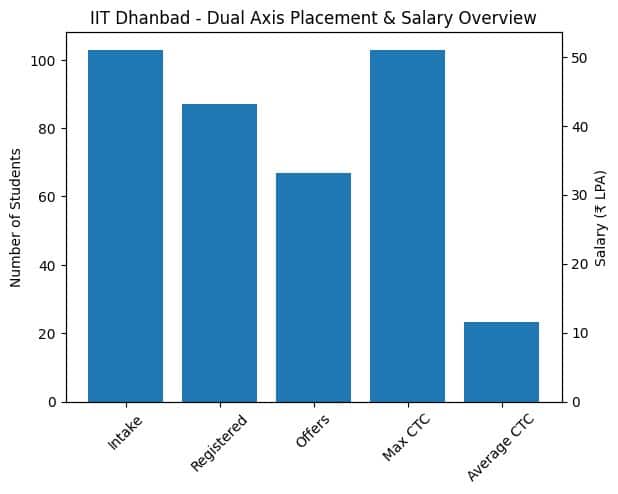
IIT Dhanbad reports the highest salary ceiling in the dataset and strong placement intensity.
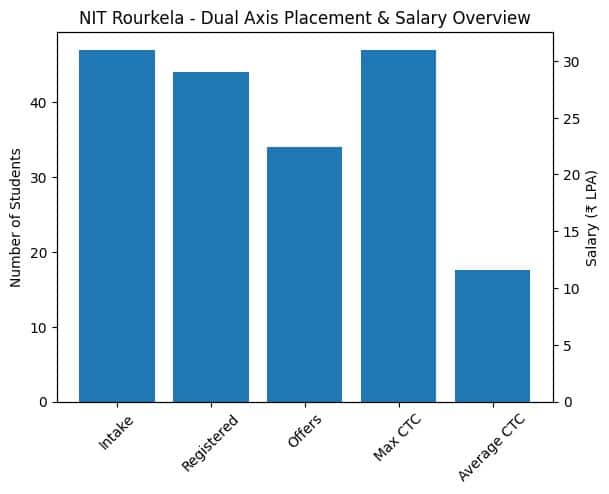
Rourkela shows the highest intake-based placement percentage (72.34 per cent), reflecting strong alignment between cohort and recruiter demand.
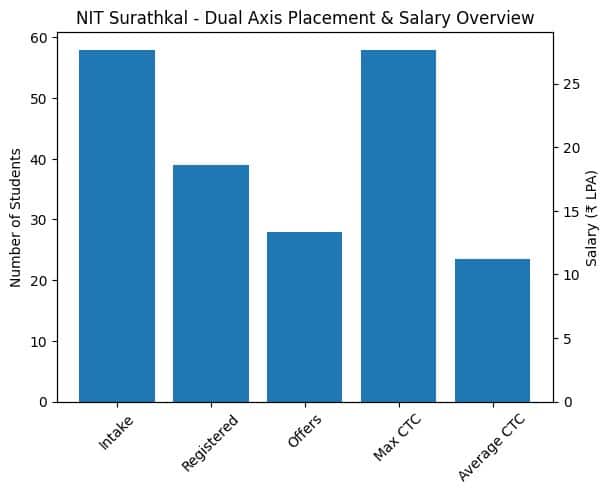
Performance is stable, with average salaries clustered around Rs. 11 LPA.
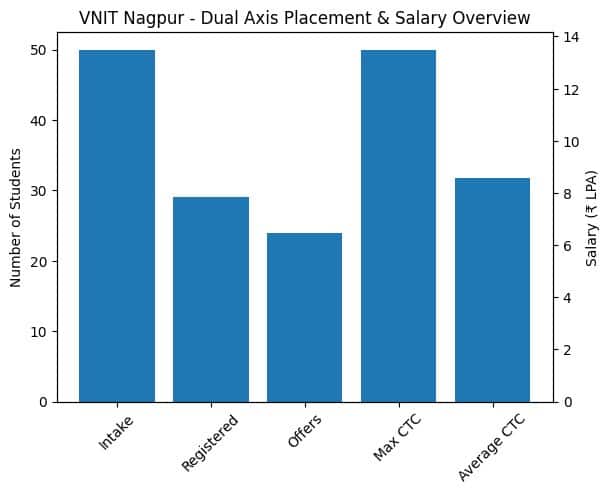
Nagpur has the highest registered conversion rate (82.76 per cent), but average salaries are lower.
Across institutes, average CTC values remain in a narrow band between Rs. 8.5 LPA and Rs. 11.6 LPA, except for the higher maximum packages at IIT Dhanbad.
The table that has been provided below showcases the differences in the placement outcomes for CSE and Mining Engineering. The table focuses on the differences in intake size, registrations, placement conversion, and also the average salaries across the participating institutes.
| Parameter | CSE (Top Branch) | Mining Engineering |
|---|---|---|
No. of Institutes | 23 | 4 |
Approved Intake (2021–22) | 2332 | 258 |
Students Registered for Placements (2024–25) | 2188 (93%) | 199 (77%) |
Placement Offers Accepted (2024–25) | 1892 | 153 |
Placement % (Registered) | 86.47% | 76.88% |
Placement % (Intake) | 81.13% | 59.30% |
Average CTC | 20.35 L | 10.73 L |
Average CTC | 20.35 L | 10.73 L |
Observations: Registration Gap Exists, But Smaller: 93 per cent in CSE vs 77 per cent in Mining.
Conversion Strength: Mining’s 76.88 per cent placement (registered) is lower than CSE but not drastically so.
Salary Gap: Average CTC in Mining (Rs. 10.73 LPA) is nearly half of CSE (Rs. 20.35 LPA).
Scale Difference: CSE intake is nearly nine times larger.
Unlike branches where registration is extremely low, Mining shows reasonably strong placement participation.
To remove scale bias, both branches are compared within the same four institutes.
Parameter | CSE (Top Branch) | Mining Engineering |
|---|---|---|
No. of Institutes | 4 | 4 |
Approved Intake (2021–22) | 505 | 258 |
Students Registered for Placements (2024–25) | 501 | 199 (77%) |
Placement Offers Accepted (2024–25) | 452 | 153 |
Placement % (Registered) | 88% | 76.88% |
Placement % (Intake) | 89% | 59.30% |
Average CTC | 22.81 L | 10.73 L |
Observations: Even within the same institutes, CSE significantly outperforms Mining in salary. Placement conversion gap is limited (88 per cent vs 76.88 per cent). Intake-based placement difference remains considerable (89 per cent vs 59.30 per cent). Salary difference widens in this category: Rs. 22.81 L vs Rs. 10.73 L. This shows that Mining is placement-intensive, but the salary ceilings are lower if we compare it with CSE.
Mining Engineering is industry-specific. Recruiters largely belong to core industries, mining, metals, energy, and allied sectors. CSE, by nature, benefits a lot from cross-sector demand, technology, finance, consulting, analytics, and product firms.
That structural demand difference is reflected in salary as well. However, Mining does not show weak participation. With 77 per cent of students registering and 76.88 per cent conversion among them, the branch demonstrates functional placement viability.
Mining Engineering is offered only in a select set of institutes. Unlike CSE, it is not available everywhere. So when you receive your rank, the decision is more profound:
A top IIT/NIT in a branch you may not prefer OR Mining Engineering in an institute known for that domain.
When it comes to placements, it is often the branch that aligns with recruiters and not just the institute name. Core-sector companies recruit for specific skill sets. Mining is not a fallback branch. It is a branch with huge potential.
Mining Engineering placements reveal healthy participation and an average conversion rate.
show solid participation and respectable conversion rates. The salary gap compared to CSE is clear, but the branch is not placement-deficient. The decision, therefore, is not about “better” or “worse.”
It is about alignment. You have a rank. With that rank, you can secure a brand in one branch or a branch in a specific domain. Mining Engineering requires clarity of intent.
If you choose the branch, choose it because you understand the sector, not because of cut-offs. A student should keep in mind that placements are not automatic; they are the result of branch demand, the recruiter profile, and the expectations of students. The choice of which branch to opt for, begins much before the placement season.

On Question asked by student community
Hello, admission to MBM Jodhpur for Mining Engineering depends on your JEE Main rank, EWS category, home state quota and the counselling process. You can check more details about MBM Jodhpur admission here: MBM Jodhpur Admission
Dear Student,
Agar aap 10th ke baad mining engineering course karna chahte hain, aap Diploma in Mining Engineering course kar sakte hain. Aapne JCECE nahi diya hai, isliye admission eligibility/alternative round college se confirm karein.
Hello, Mining Engineering courses are available at diploma, undergraduate and postgraduate levels. The fees vary depending on the course and college. You can check Mining Engineering colleges, courses and fees here: Top Mining Engineering Colleges in India
Please rewrite the question in clear words, because giving an answer based on an unclear question could be misleading.
Hello Student,
Yes, B.tech/BA Mining Engineering through lateral entry (direct admission to 2nd year/3rd semester) is available in some state and Institute. Generally candidates need 3 year diploma in Engineering/Technology, with the required minimum marks the exact criteria and entrance exam depend on the state.
If you tell us your

Globally Recognized by AACSB (US) & AMBA (UK) | 18 LPA Avg. CTC for PGPM 2026
Gateway to IBS Hyderabad & 8 other IBS campuses | Scholarships worth 10 CR
BBA 2027 Early Bird Applications Deadline 30th Sept'26. Apply now using coupon code CAREER250 and get ₹250 off the application fee | 100% Placements with 260+ Recruiters
Last Date to Apply: 17th August | QS I-Gauge Diamond Rated | NAAC A+ Accredited | 621 Recruitment Partners | INR 40 LPA Highest CTC | 4482 Job offers
Among top 6% B-Schools globally to be accredited by AACSB | Highest Package-35 LPA
10000+ Alumni across the globe | Scholarships available