Integral University M.Tech Admissions 2026
NAAC A+ Accredited | Highest CTC 45 LPA | Scholarships Available


GATE 2027 Electronics and Communication Engineering (ECE)- GATE 2027 ECE Preperation requires a clear idea of the syllabus, consistent practice, and keeping a study plan that actually makes sense. In this article, there are some of the best preparation tips for GATE ECE 2027, including subject-wise approaches, which important topics to study first, useful book suggestions and revision methods that can help aspirants score well in the GATE 2027 exam. Also, it shares the latest GATE 2027 ECE syllabus updates, so you can align your preparation with the revised syllabus and then focus on what’s most important for the paper.
This Story also Contains
.jpg)
Refer to the table given below for GATE 2027 Exam Schedule
| Updates | Dates |
| GATE Online Application Process Begins | 14 August 2026 |
| GATE 2027 Regular Registration Closes | 21 September 2026 |
| GATE 2027 Extended Registration Closes | 30 September 2026 |
| GATE 2027 City allotment notice | 4 January 2027 |
| GATE 2027 Exam Dates |
Week 1: 6 and 7 Feb 2027 Week 2: 13 and 14 Feb 2027 Week 3: 20 and 21 Feb 2027 |
Aspirants might be leaving no stone unturned in their preparation, and to help them polish their preparation, we have come up with the preparation tips for the GATE Exam. From mentioning the syllabus to tips to release stress, we have got the students covered. Mentioned below are the tips to prepare for GATE 2027 for the ECE branch.
Plan the strategy - The first and foremost step is to prepare a well-planned strategy and schedule. Aspirants must ensure that they have allotted time accordingly. They must also make sure that there is time for relaxation in their busy study schedule.
Know the syllabus well - Studying anything and everything will go in vain if the student is not familiar with the syllabus of the exam for the particular course. Going through the GATE syllabus of Electronics and Communication Engineering (ECE) before starting the preparation is a necessary step for better preparation for GATE 2027.
Books are best friends - Refer to the good books related to the syllabus. Always remember that one good book is equal to ten friends.
Cover all the topics - Aspirants must make sure that they have covered all the topics while preparing for the exam. Skipping any topic while preparing with the thought that it could be covered at the last moment will not be of any help.
Practise is the key to success - Once all the topics are covered, practice by giving the mock test of GATE. Candidates can also practice from previous years’ exam papers and sample papers. It must be kept in mind that practice makes a man perfect, and thus practice will help in achieving the desired results.
Revision - After covering everything, revise it again and keep revising till the topics and basic concepts are at your fingertips.
Don’t stress yourself - Apart from studying and practising everything, it is equally important to keep your mind calm. Relax and don’t put too much exertion and stress on yourself.
The GATE Electronics and Communication Syllabus 2027 includes all the important topics that students need to prepare for the exam. Refer to the latest GATE 2026 syllabus given below in the PDF foemat carefully to understand the subjects.
GATE 2027 Electronics and Communication Engineering Syllabus PDF
|
S.No. |
Sections |
Topics to be Covered |
|
1 |
Engineering Mathematics |
|
|
2 |
Electronic Devices |
Energy bands in intrinsic and extrinsic silicon; Carrier transport current, drift current, mobility and resistivity; Generation and recombination of carriers; Poisson and continuity equations; P-N junction, Zener diode, BJT, MOS capacitor, MOSFET, LED, etc. |
|
3 |
Networks, Signals, and Systems |
Network solution methods Continuous-time signals |
|
4 |
Analog Circuits |
Small signal equivalent circuits of diodes, BJTs, and MOSFETs; Simple diode circuits: clipping, clamping, and rectifiers; Single-stage BJT and MOSFET amplifiers: biasing, bias stability, mid-frequency small signal analysis, etc. |
|
5 |
Digital Circuits |
Number systems; Combinatorial circuits: Boolean algebra, minimisation of functions using Boolean identities and Karnaugh map, logic gates and their static CMOS implementations, arithmetic circuits, code converters, multiplexers, decoders, and PLAs; Sequential circuits: latches and flip-flops, etc. |
|
6 |
Control Systems |
Basic control system components; Feedback principle; Transfer function; Block diagram representation; Signal flow graph; Transient and steady-state analysis of LTI systems; Frequency response; Routh-Hurwitz and Nyquist stability criteria; Bode and root-locus plots; Lag, lead, and lag-lead, etc. |
|
7 |
Communications |
Random processes: auto-correlation and power spectral density, properties of white noise, filtering of random signals through LTI systems; Analog communications: amplitude modulation and demodulation, angle modulation and demodulation, spectra of AM and FM, superheterodyne receivers, circuits for analog communication, etc. |
|
8 |
Electromagnetics |
Electrostatics; Maxwell’s equations: differential and integral forms and their interpretation, boundary conditions, wave equation, Poynting vector; Plane waves and properties: reflection and refraction, polarisation, phase and group velocity, propagation through various media, skin depth; Transmission lines: equations, characteristic impedance, impedance matching, impedance transformation, etc. |
Quick Links:-
What is a Good GATE Score?
GATE Preparation Timetable
|
S.No. |
Reference Books for ECE |
Authors |
|
1 |
General Aptitude |
Quantitative Aptitude by R.S Aggarwal Quantitative Aptitude by CAT by Arun Sharma |
|
2 |
Network |
|
|
3 |
Control System |
|
|
4 |
Electronic Devices |
|
|
5 |
Signal Systems |
Digital Signal Processing by S.K Mitra, Modern Digital and Analog Communications Systems by BP Lathi, Signals & Systems By Alan V. Oppenheim |
|
6 |
Analog Circuits |
Analog Electronics, Electronics devices, and circuits – Donald A Neaman, Microelectronics Circuits by Sedra & Smith, Electronic Devices and Circuit Theory by Robert L Boylestad & Nashelsky, Pulse and Digital Electronics by Millman and Taub |
|
7 |
Digital System |
Digital Logic and Computer Design by M.Morris Mano, Digital circuits and design by Salivahanan, or Fundamentals of digital systems by Anand kumar, Digital Electronic Principles and applications by Ronald J. Toccii, Pearson Publications |
|
8 |
Electromagnetics |
Elements of Electromagnetics by Matthew N.O. Sadiku Network lines and fields by J.D ryder (Transmission lines part) Electromagnetic waves and Radiating Systems by Jordon and ballmain Antenna Theory by Balanis NPTEL Lectures by Prof. R. Shevgaonkar |
|
9 |
Communication System |
Analog and Digital Communication Systems by Simon Haykin, Principle of Communication System by Taub& Schillings, Modern Digital and Analog Communications Systems by BP Lathi, Electronic Communication Systems by Kennedy and Davis (just the Noise chapter) |
|
10 |
MCQ book |
Gate ECE by R.K Kanodia |
|
11 |
Maths |
Advanced Engineering Mathematics by R. K. Jain, S. R. K. Iyengar – Narosa Publications Higher Engineering Mathematics by Dr B.S. Grewal |
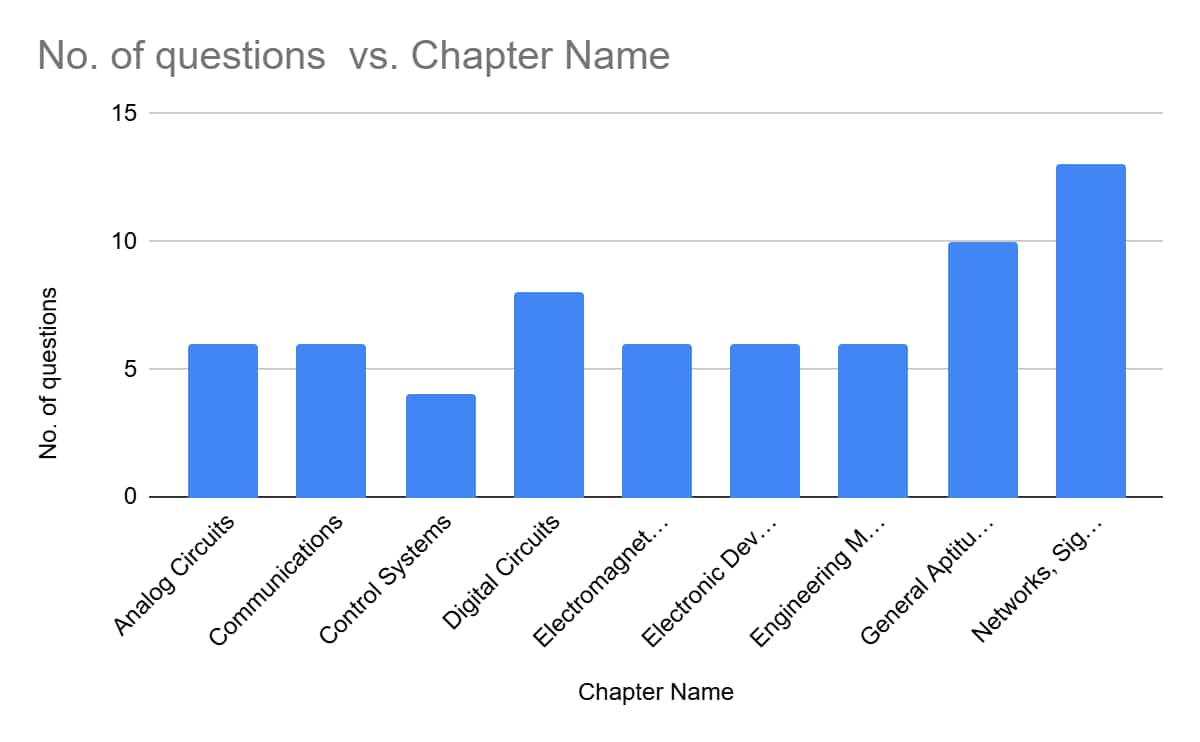
Refer to the table below for the chapter-wise weightage of the Electronics and Communication Engineering exam. This table helps in GATE 2027 Preparation:
|
Chapter Name |
No. of questions |
Weightage |
|
Analog Circuits |
6 |
9.23% |
|
Communications |
6 |
9.23% |
|
Control Systems |
4 |
6.15% |
|
Digital Circuits |
8 |
12.31% |
|
Electromagnetics |
6 |
9.23% |
|
Electronic Devices |
6 |
9.23% |
|
Engineering Mathematics |
6 |
9.23% |
|
General Aptitude |
10 |
15.38% |
|
Networks, Signals and Systems |
13 |
20.00% |
|
Grand Total |
65 |
100.00% |
Engineering Mathematics
Don't treat this as a side subject. Linear Algebra, Calculus, Probability, and Differential Equations show up consistently across GATE ECE papers. Solve numericals regularly, keep a formula sheet handy, and revisit PYQs from this section specifically — the question types repeat more than people realise.
Networks
Network theorems and circuit analysis form the backbone of this subject. Transient and steady-state analyses need more attention than most students give them. The numericals here can be time-consuming, so practice enough to build speed without sacrificing accuracy.
Electronic Devices
Diodes, BJTs, MOSFETs, semiconductor physics — get the concepts right before jumping to problems. Characteristics and applications are frequently tested. PYQs will quickly show you which device types GATE focuses on most.
Analog Circuits
Amplifiers, feedback circuits, oscillators, and op-amps — this section rewards students who actually understand what's happening in a circuit rather than memorising formulas. Practice circuit analysis problems, not just theory.
Digital Circuits
Boolean algebra and logic gates first, then Karnaugh maps and sequential circuits. Objective questions are the best practice format here — they build both speed and accuracy, which matters given how GATE structures this section.
Signals and Systems
Fourier Series, Laplace Transform, Z-Transform — these need proper time, not a rushed one-week treatment. Understand signal properties and system responses conceptually before solving problems. Numerical practice is non-negotiable here.
Control Systems
Transfer functions, stability criteria, root locus, and Bode plots — each of these needs individual attention. Don't club them together and skim through. Standard formulas need to be on your formula sheet and revised regularly.
Communication Systems
Analog and digital communication both matter. Modulation and demodulation techniques are heavily tested. Bandwidth and noise-based numericals trip up a lot of students who only studied theory — practice those problems specifically.
Electromagnetics
Maxwell's equations and transmission lines are the core of this section. Wave propagation and EM fields concepts take time to settle. Go through PYQs to see which areas GATE actually tests — the syllabus looks broader than what typically appears in papers.
General Aptitude
Twenty to thirty minutes daily is enough if it's consistent. Quantitative aptitude and verbal ability both need attention. Topic-wise mocks help identify exactly where you're losing marks.
Read the syllabus before opening any book. Know what's high-weightage, understand the exam pattern, then build your plan. Students who skip this step spend months studying in the wrong direction.
Write short notes and formula sheets as you study each topic. Don't plan to do this later; it won't happen. Solve topic-wise questions immediately after finishing each chapter, not at the end of the subject.
PYQs are not optional. They show you how GATE frames questions, what difficulty level to expect, and which topics keep appearing. Start sectional mocks once subjects are done, then move to full-length mocks under proper exam conditions.
Revise weekly. Don't let a finished subject sit untouched for two months. Keep an error notebook; every repeated mistake needs to be written down and revisited. In the final months, no new topics. Everything goes into revision, formula sheets, and mocks.
DON'T WAIT till the syllabus is completed to start revising. Revisit topics regularly while studying new ones — that's the only way things actually stay in memory.
Revise a topic one day after studying it, again after seven days, and once more after thirty days. It sounds mechanical, but it genuinely works for retention.
Spend fifteen to twenty minutes every day on formulas alone — Engineering Mathematics and core ECE subjects especially. Keep your short notes tight and actually use them rather than rewriting them endlessly.
Redo PYQs during revision. First-attempt PYQs show you the concepts; second-attempt PYQs show you whether you actually understood them. Your error notebook should come out before every mock test.
Sectional mocks first, full-length mocks once you're in the revision phase. Analyse every test — not just the score, but where specifically the marks went. Weak topics need immediate attention, not a mental note to fix later.
Networks, Signals and Systems, Analog Circuits, Digital Circuits, Communication Systems, and Control Systems get more revision time than others; that's where the marks are. Numerical problems should be part of revision, not just note-reading.
General Aptitude and Engineering Mathematics daily, even in small doses. The last twenty to thirty days are only for revision and mocks; nothing new enters the picture at that stage
Frequently Asked Questions (FAQs)
Read the syllabus first — not after buying books, not after joining a test series, before any of that. Once you know what's being tested and how much each section weighs, build a monthly plan around that. Cover concepts from standard books, solve PYQs topic by topic, and start mocks once the major subjects are done. Revise as you go, not just at the end.
Five to six focused hours are enough for most students. The problem isn't usually total hours — it's consistency. Studying seriously five days a week beats cramming twelve hours on a Sunday and doing nothing the rest of the week.
PYQs are non-negotiable, but they're not the whole picture. They tell you what GATE asks and how it asks it. Mocks tell you whether you can actually solve those questions in three hours under pressure. You need both.
Work from short notes, not textbooks again. Revise formulas daily, even if it's just fifteen minutes. Redo PYQs during revision — your second attempt will catch mistakes your first attempt didn't. One full-length mock per week, analysed properly, is more useful
No. Plenty of students clear the GATE ECE with good scores through self-study. What coaching gives some people is structure and deadlines — if you can build that yourself, you don't need it.
Very important, and not just for the score. Mocks show you where your time is going, which topics cost you marks under pressure, and whether your accuracy holds up in a three-hour sitting. Taking mocks without analysing them properly is a waste of time, though.
Yes, comfortably — if the first few months aren't wasted. The syllabus is wide but not unmanageable in twelve months. Students who struggle usually lose three or four months to poor planning at the start
Work from short notes, not textbooks again. Revise formulas daily, even if it's just fifteen minutes. Redo PYQs during revision — your second attempt will catch mistakes your first attempt didn't. One full-length mock per week, analysed properly, is more useful than three mocks taken back to back without review.

On Question asked by student community
Dear Student,
Admission rules for OCI candidates may vary depending on the institution and programme. As an Overseas Citizen of India (OCI) cardholder, you can apply for GATE 2027 under the international/foreign candidate section if you reside or have completed your degree outside India, though you can select your appropriate
Hello Student, your CSE background and 4 years of automotive experience can be useful for an Embedded Systems specialization. However, for an M.Tech , I would be cautious about choosing a fully online/distance programme, as recognition and mode of delivery depend on the university and applicable regulatory rules. I can
Hello Student, Please share your B.Tech branch, percentage/CGPA, GATE status and budget, and I can suggest the most suitable colleges for you.
Hello Student,
You can check the GATE Food Technology previous year question papers on Careers360. Food Technology is covered under XE-G (Engineering Sciences) and XL-U (Life Sciences).
https://engineering.careers360.com/articles/gate-question-papers
Hello Student, if you are planning to appear for GATE 2027, the registration is scheduled to start on 27 August 2026. The regular last date is 27 September 2026, and you can submit the form with a late fee up to 5 October 2026. The exam will be held on

Recognized as Category-1 Deemed to be University by UGC | 41,000 + Alumni Imprints Globally | Students from over 20+ countries
NAAC A+ Accredited | Highest CTC 45 LPA | Scholarships Available
Campuses in Ropar, Agartala, Aizawl, Ajmer, Aurangabad, Calicut, Imphal, Itanagar, Kohima, Gorakhpur, Patna & Srinagar
100+ Recruiters | 100+ Placements of 2026 Batch | NBA & NAAC Accredited | Highest CTC 37 LPA
Last Date to Apply: 25th Sep'26 | NBA Accredited | AICTE Approved | Affiliated to AKTU | Highest CTC 14.2 LPA | Accepts CUET Score
NAAC A+ Accredited | 100% Placement Assistance | Scholarships to Meritorious Students