Integral University M.Tech Admissions 2026
NAAC A+ Accredited | Highest CTC 45 LPA | Scholarships Available


GATE 2026 Paper Analysis for CE by APSEd - Candidates can check the GATE 2026 Paper analysis for CE by APSEd on this page. This analysis covers a review of the CE Exam conducted in February 2026. The Paper analysis for CE by APSEd includes the details on the GATE exam difficulty level, important topics, comparison between CE-1 and CE-2 papers, expected cutoff, etc. The GATE 2026 exam for CE was conducted by IIT Guwahati in both morning and afternoon sessions. Along with the GATE Paper Analysis, previous year analyses of the CE exams are also available on this page.
This Story also Contains
Read the full article to know more about GATE 2026 Paper Analysis for CE by APSEd. Along with the paper analysis, students can also refer to can refer to the official GATE result, answer key, and cutoff.
The GATE 2026 Civil Engineering (CE) exam was conducted in two sessions. The GATE 2026 Civil Engineering (CE) paper analysis by APSEd is provided below. This analysis is prepared by experts.
1. . The GATE 2026 Civil Engineering Exam was moderate.
2. The GATE 2026 CE 1 paper was a mix of conceptual and numerical questions.
3. Questions were asked from core Civil Engineering subjects, Engineering Mathematics, and General Aptitude.
4. GATE General Aptitude section for CE was easy to moderate.
5. Engineering mathematics was moderate.
1. The difficulty level of GATE CE Paper 2 was moderate and similar to Shift 1.
2. Questions were asked from topics like Geotechnical Engineering, Soil Mechanics, Transportation Engineering, and Environmental Engineering received good weightage.
3. Questions from General Aptitude and Engineering Mathematics were simple and scoring.
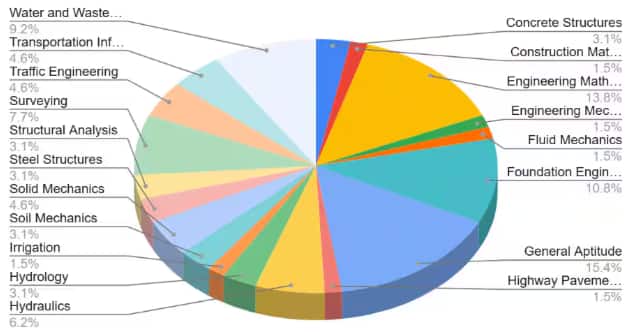
Refer to the table given below for GATE CE 2026 topic-wise weightage. This table helps students to identify the most asked topics:
| Chapter | Question Count (Paper 1) | Question Count (Paper 2) | Total (Paper 1 and Paper 2) | Weightage |
| Concrete Structures | 2 | 3 | 5 | 3.85% |
| Construction Materials and Management | 1 | - | 1 | 0.77% |
| Engineering Mathematics | 9 | 9 | 18 | 13.85% |
| Engineering Mechanics | 1 | - | 1 | 0.77% |
| Fluid Mechanics | 1 | 2 | 3 | 2.31% |
| Foundation Engineering | 7 | 4 | 11 | 8.46% |
| General Aptitude | 10 | 10 | 20 | 15.38% |
| Highway Pavements | 1 | 2 | 3 | 2.31% |
| Hydraulics | 4 | 2 | 6 | 4.62% |
| Hydrology | 2 | 3 | 5 | 3.85% |
| Irrigation | 1 | 1 | 2 | 1.54% |
| Soil Mechanics | 2 | 4 | 6 | 4.62% |
| Solid Mechanics | 3 | 3 | 6 | 4.62% |
| Steel Structures | 2 | 2 | 4 | 3.08% |
| Structural Analysis | 2 | 3 | 5 | 3.85% |
| Surveying | 5 | 4 | 9 | 6.92% |
| Traffic Engineering | 3 | 2 | 5 | 3.85% |
| Transportation Infrastructure | 3 | 4 | 7 | 5.38% |
| Water and Waste Water Quality and Treatment | 6 | 5 | 11 | 8.46% |
| Air Pollution | - | 2 | 2 | 1.54% |
| Grand Total | 65 | 65 | 130 | 100% |
Candidates can check the previous year civil engineering for GATE CE Analysis by APSEd below.
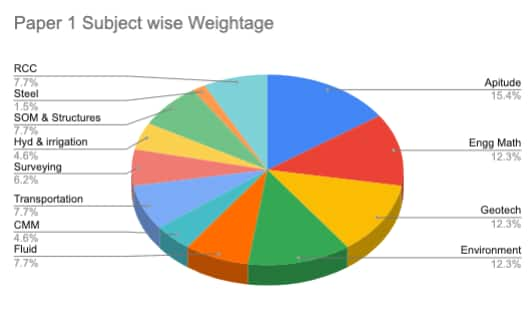
In the forenoon session of the GATE 2022 exam, after general aptitude and engineering mathematics, environmental engineering held the most significant weightage. Approximately 12% of the total questions were focused on environmental engineering and geotechnical topics.
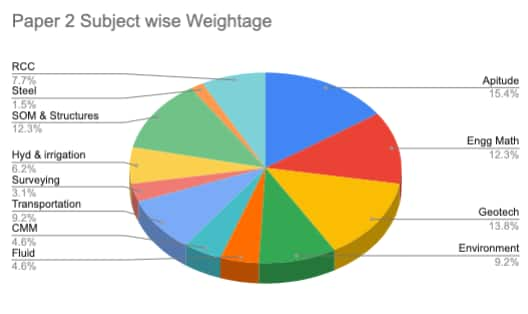
In the afternoon session of the GATE exam, geotechnical engineering had the highest weightage after general aptitude and engineering mathematics. About 14% of the total questions were from geotechnical engineering.
APSEd has analysed the GATE 2021 paper. The key highlights of the CE papers are-
Both the forenoon and afternoon papers were more of concepts. The numerical part was more but those were completely conceptual.
Multiple select questions(MSQ) was a newly added question type in GATE 2021. But. in both the papers, they asked 2 to 3 multiple select questions. MSQs were of ESE standards and not at all lengthy. These questions were of 'are Correct' and 'are Not Correct' types.
There were more NATs as compared to the previous year. On average 16 NATs were asked in the exam.
Structural analysis, SOM, MOM and Steel Structures questions were a bit lengthy and tricky in both papers. The students who solved these questions will have a high chance to score higher, as other subjects' questions can be solved by anyone.
GATE 2021 taught us one important thing we can not ignore any subject. This time they asked 4 to 5 questions from construction technology. This was not at all expected, keeping an eye on the previous years' papers.
The difficulty level of both papers was more or less the same as last year's paper. But, unlike the previous year papers, the one and two-mark questions were mixed and jumbled. This is a new trend observed in GATE 2021.
Overall, both the GATE 2021 CE papers were moderate. And taking the students' opinions on paper 2 was relatively lengthy, so time time-consuming as compared to paper 1.
In both the papers, 4-5 construction materials and management(building materials inclusive) questions were asked. Every year they used to ask a maximum of 2 questions from this subject. So, this time the trend was lost. We can never ignore a subject in GATE, they change the trend every year. The question on 'network system', asked in paper 1 was not easy.
Transportation engineering questions were easy, these were even easier than the previous year papers.
RCC questions were balanced in both papers. In both the papers, there was no one-mark question. There were 2, two marks questions in both papers. Out of these two, one was damn easy, and the other was a standard one.
In paper 1 there were no questions from hydrology and there were 1-2 questions from irrigation. Whereas in paper 2, there were questions from infiltration, phi-index, hydrographs, duty and delta.
Structural analysis and steel were lengthy in paper 2 as compared to paper 1.
The GATE 2026 CE Cutoff is provided in the table given below. Using this table students will be able to check the qualifying marks that need to be scored for higher chances of admission or PSU recruitment through the GATE cut-off. The previous years’ GATE cutoff for Civil Engineering can be checked by the candidates below:
|
Year |
General |
OBC NCL |
SC/ST/PWD |
| 2026 | 28.7 | 25.8 | 19.1 |
| 2025 | 29.2 | 26.2 | 19.4 |
| 2024 | 28.3 | 25.4 | 18.8 |
| 2023 | 26.6 | 23.9 | 17.7 |
| 2022 | 23.5 | 22.7 | 16.8 |
|
2021 |
29.2 |
- |
- |
|
2020 |
32.9 |
29.6 |
21.9 |
|
2019 |
28.2 |
25.4 |
18.8 |
|
2018 |
26.9 |
24.2 |
17.9 |
|
2017 |
28.7 |
25.8 |
19.1 |
|
2016 |
22.5 |
22.5 |
16.6 |
|
2015 |
25 |
22.5 |
16.67 |
|
2014 |
26.57 |
23.91 |
17.71 |
|
2013 |
27.13 |
24.42 |
18.09 |
Asia’s only university to be awarded the highest accreditation by WASC, USA and by the Quality Assurance Agency for Higher Education (QAA), UK
NAAC A++ Grade | 42 LPA-Highest Salary | 1500+ annual placements
Frequently Asked Questions (FAQs)
According to APSEd's analysis, the GATE 2026 CE paper was moderate in overall difficulty. The exam featured a balanced mix of conceptual, numerical, and application-based questions across all major Civil Engineering subjects.
Yes, the GATE 2026 Civil Engineering (CE) examination was conducted in two shifts. Both shifts followed the same syllabus and exam pattern, with only minor variations in the distribution of questions.
General Aptitude and Engineering Mathematics were considered the most scoring sections. Candidates who prepared these topics well were able to secure marks with relatively less effort.
According to APSEd analysis of GATE 2026 CE, subjects such as Structural Engineering, Geotechnical Engineering, Transportation Engineering, Environmental Engineering, Fluid Mechanics, Strength of Materials, and Engineering Hydrology carried significant weightage in the examination.

On Question asked by student community
Dear Student,
Admission rules for OCI candidates may vary depending on the institution and programme. As an Overseas Citizen of India (OCI) cardholder, you can apply for GATE 2027 under the international/foreign candidate section if you reside or have completed your degree outside India, though you can select your appropriate
Hello Student, your CSE background and 4 years of automotive experience can be useful for an Embedded Systems specialization. However, for an M.Tech , I would be cautious about choosing a fully online/distance programme, as recognition and mode of delivery depend on the university and applicable regulatory rules. I can
Hello Student, Please share your B.Tech branch, percentage/CGPA, GATE status and budget, and I can suggest the most suitable colleges for you.
Hello Student,
You can check the GATE Food Technology previous year question papers on Careers360. Food Technology is covered under XE-G (Engineering Sciences) and XL-U (Life Sciences).
https://engineering.careers360.com/articles/gate-question-papers
Hello Student, if you are planning to appear for GATE 2027, the registration is scheduled to start on 27 August 2026. The regular last date is 27 September 2026, and you can submit the form with a late fee up to 5 October 2026. The exam will be held on

Among top 100 Universities Globally in the Times Higher Education (THE) Interdisciplinary Science Rankings 2026
Recognized as Category-1 Deemed to be University by UGC | 41,000 + Alumni Imprints Globally | Students from over 20+ countries
NAAC A+ Accredited | Highest CTC 45 LPA | Scholarships Available
Campuses in Ropar, Agartala, Aizawl, Ajmer, Aurangabad, Calicut, Imphal, Itanagar, Kohima, Gorakhpur, Patna & Srinagar
100+ Recruiters | 100+ Placements of 2026 Batch | NBA & NAAC Accredited | Highest CTC 37 LPA
Applications Closing Soon | NBA Accredited | AICTE Approved | Affiliated to AKTU | Highest CTC 14.2 LPA | Accepts CUET Score